

Weigh weekly, re-dose weekly: the growing-kitten trap
Alastair Greenway
BVM&S MRCVS
There is one habit that quietly decides more FIP outcomes than almost anything else you will do across the eighty-four days, and hardly anyone warns owners about it. It is not dramatic. It is a set of kitchen scales and a Sunday-morning weigh-in. But get it right and you protect everything else you are doing. Get it wrong, through no fault of your own, and a treatment that was working can slowly stop working while your kitten looks like it is thriving.
So this is the article to read twice. It is short on purpose, because the message is simple: weigh your kitten every week, and let the dose grow with the kitten.
Why a dose that was perfect can quietly become too small
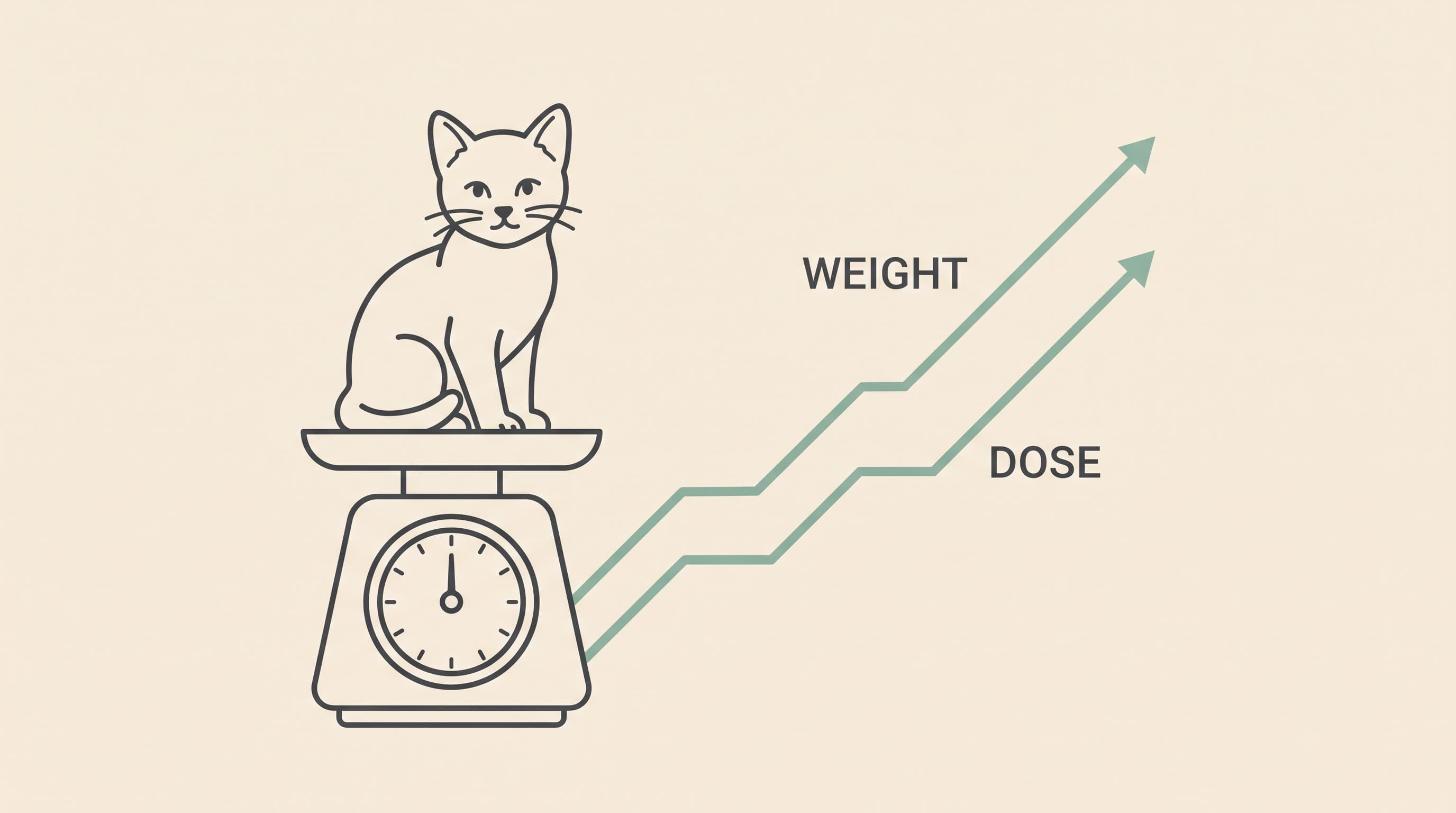
FIP most often strikes young, growing kittens. And when treatment is working, one of the first things that happens is the very thing you have been longing to see: your kitten starts eating properly, feeling better, and putting on weight. A poorly kitten can gain a genuinely large fraction of its body weight over an 84-day course. That is the good news made visible.
Here is the catch. The dose of antiviral is worked out per kilogram of body weight. So a dose that was exactly right for a 1.5 kg kitten in week one is, by the maths, too small for the same kitten once it reaches 2.5 or 3 kg a few weeks later. Nothing went wrong. The medicine did not fail. The kitten simply outgrew its dose, and if nobody notices, the drug level slips below what is needed to keep the virus suppressed.
The cruel part is how invisible it is. The kitten looks better, so it feels like the last thing you should be worrying about. But an under-dose does not announce itself. It just quietly lets the virus regain ground.
This is a leading, avoidable cause of treatment failure
This is not a theoretical risk that vets mention to be thorough. It is one of the recognised reasons FIP treatment stalls or relapses. The current UK guidance puts it plainly: it is very important to weigh cats weekly during treatment, because weight gain and growth in kittens will occur with successful treatment and requires the dose to be increased, and failing to increase the dose as the kitten grows appears to be a common cause of poor response to treatment (ISFM/Taylor et al., 2024).
Read that again, because it is the whole reason this article exists. The under-dose is not caused by the disease being untreatable. It is caused by the dose lagging behind the kitten. And that means it is almost entirely preventable with a weekly habit and an open line to your vet.
We say this without a flicker of blame, because no one hands new FIP owners this information clearly, and it runs against every instinct. When your kitten is finally gaining weight, "the dose might now be too low" is the last thought you would have. That is exactly why we are putting it front and centre.
The habit: weigh, log, check with your vet
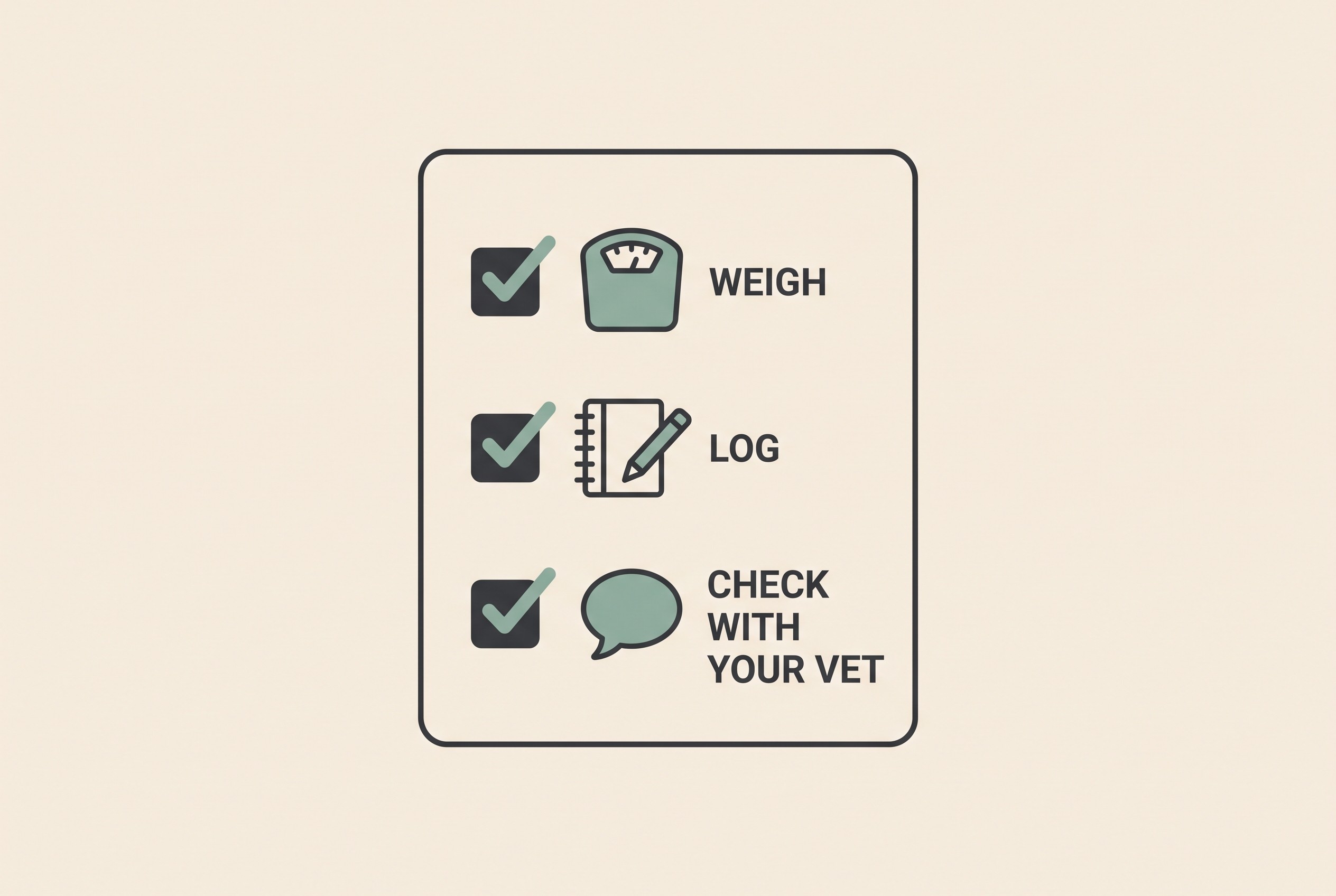
The routine that protects your kitten is three steps, once a week, and it never involves you changing a dose yourself.
Weigh. Same scales, same day of the week, ideally the same time of day for consistency. Kitchen scales that read in grams are perfect, and far more useful here than bathroom scales, because you are trying to catch changes of a few hundred grams that matter.
Log. Write the weight down, or better, put it into the FIP Treatment Companion, which is built for exactly this. It holds the weekly reweigh prompt so you do not forget, keeps the running record, and flags when the weight has climbed enough that the dose likely needs revisiting.
Check with your vet. When the weight goes up, the dose needs recalculating to the new weight, and that recalculation is your vet's job, not yours. You are the one who spots the trigger and raises it. Your vet is the one who confirms the new amount and issues it. This division of labour is the safe one, and it is not negotiable: the owner measures and flags, the vet sets the dose.
What this looks like across a real course
Picture a kitten who starts treatment at a poorly, underweight 1.4 kg. In the first fortnight the appetite comes back, and week by week the scales creep up: 1.7 kg, then 2.0, then 2.4, still climbing as a young cat should. That gain is exactly what you have been praying for, and it is also a moving target for the dose. The amount that was right at 1.4 kg is meaningfully short of what the same kitten needs at 2.4 kg. Nothing has gone wrong. The kitten has simply grown into a bigger dose, and the weekly weigh-in is what tells your vet it is time to catch the prescription up.
This is why "set and forget" is the one approach that does not work with FIP. A dose is a snapshot of a kitten on a particular day, not a fixed quantity for the whole twelve weeks. Expecting it to change, and being a little pleased when it does because it means your kitten is thriving, is exactly the right frame of mind.
Keeping the dose on track between vet visits
You will not be at the vet every week, so the weekly rhythm mostly happens at home, and that is fine as long as the loop stays closed. The pattern that works: weigh at home each week, log it, and when the weight has climbed by a meaningful amount, get in touch rather than waiting for the next scheduled appointment. Many vets are happy to adjust a prescription off a reported weight between visits precisely because this comes up so often. The Treatment Companion is designed to nudge you here, flagging when the gain since the last dose change is enough to be worth a message.
What you are guarding against is drift: three or four weeks slipping by, the kitten quietly gaining the whole time, and the dose sitting where it was set a month ago. A single week's small gain rarely matters. A month of unnoticed gain can matter a great deal. The weigh-in is cheap insurance against that slow, invisible slide.
How to weigh a wriggly kitten accurately
A squirming kitten and a set of scales is a comedy sketch waiting to happen, so here is the reliable trick. Put a small box, a bowl or a carrier on the scales first and zero them (the "tare" button), then pop the kitten inside. A sleepy kitten weighs more accurately than a playing one, so just after a nap is ideal. If your kitten simply will not settle, weigh yourself holding the kitten, then weigh yourself alone, and take the difference; it is less precise, but a consistent method beats a perfect method you can't actually do.
The point is not laboratory precision. It is catching the trend. If your log shows a steady climb week on week, that is your cue to make sure the dose is keeping pace, and your cue to check with your vet before the gap gets wide.
What "recalculate the dose" really means (and why we won't do the sum for you)
When the weight rises, the dose is recalculated so the milligrams keep matching the new kilograms. That is why the dose climbs through the course, and it is also why the cost climbs as the course goes on, which can come as an unwelcome surprise if no one mentioned it. A bigger kitten needs more drug, and more drug costs more. Knowing that in advance takes some of the sting out of it.
You will notice we are not printing the calculation. That is deliberate and it is for your cat's safety. A dose worked out from an out-of-date weight, or from a number copied off a website, or from a form of the drug your cat is not even on, is exactly how kittens get under-dosed or over-dosed. The maths belongs with the person who knows your cat's exact drug, form, disease type and latest weight, and that is your vet. Your job is the weekly weigh-in and the flag. It is genuinely the most powerful thing you can do, and it does not require you to do any pharmacology.
The deeper reason weight matters so much
If you want the "why" underneath the rule, it comes down to how differently the drug behaves from cat to cat. Research measuring GS-441524 levels in the blood of treated cats has found that drug levels vary considerably between individuals, and that this variation is part of why some cats need more than a textbook dose to do well (Coggins et al., 2025; therapeutic drug monitoring research, 2026). Weight is the single biggest, most measurable lever you and your vet have to keep a cat in the effective range as it changes over twelve weeks. It is not the only factor, but it is the one you can track at home with a set of scales, which is precisely why it carries so much of the load.
This is also the thinking behind the "if in doubt, use the higher dose" caution you may hear your vet mention: because under-dosing is the bigger danger, an experienced vet faced with uncertainty will tend to err upward rather than risk leaving a cat short (ISFM/Taylor et al., 2024). That is a clinical judgement for your vet to make, never a licence to nudge the dose up yourself. If you feel your cat is not progressing as hoped, the move is to raise it with your vet, and there is more on that in when treatment stalls.
The single thing to take away
Weigh weekly. Log it. When the weight climbs, check with your vet so the dose climbs too. Never let the dose lag behind the kitten, and never change it yourself. That one habit, kept up for twelve weeks, closes off one of the most common and most avoidable ways FIP treatment goes wrong, and it costs you nothing but a few minutes and a set of kitchen scales.
If you do only one extra thing beyond giving the daily dose, make it the weekly weigh-in. Set the reminder in the Treatment Companion now, before the week runs away with you.
References
- Taylor S, Tasker S, Barker EN, Gunn-Moore D, et al. An update on treatment of FIP using antiviral drugs (ISFM/UK living document, 2024 edition).
- Coggins SJ, et al. Pharmacokinetics of GS-441524 following intravenous remdesivir in six cats and results of therapeutic drug monitoring during treatment of feline infectious peritonitis: 22 cases (2021-2024). Journal of Small Animal Practice 2025.
- Therapeutic drug monitoring of GS-441524, pharmacokinetic variability and dose optimisation, 2026.
Free downloads
Companion worksheets to put what you've read into practice. Free PDFs, print at home.
Keep track of how your pet is doing
The owners who cope best are the ones who notice changes early. A simple health log shows you what is working, and what is not, before the next vet visit.
Start tracking, freeYou're not doing this alone
Compare treatment journeys and talk to owners managing feline infectious peritonitis (fip). Free to join.
Join PetsLikeMine