

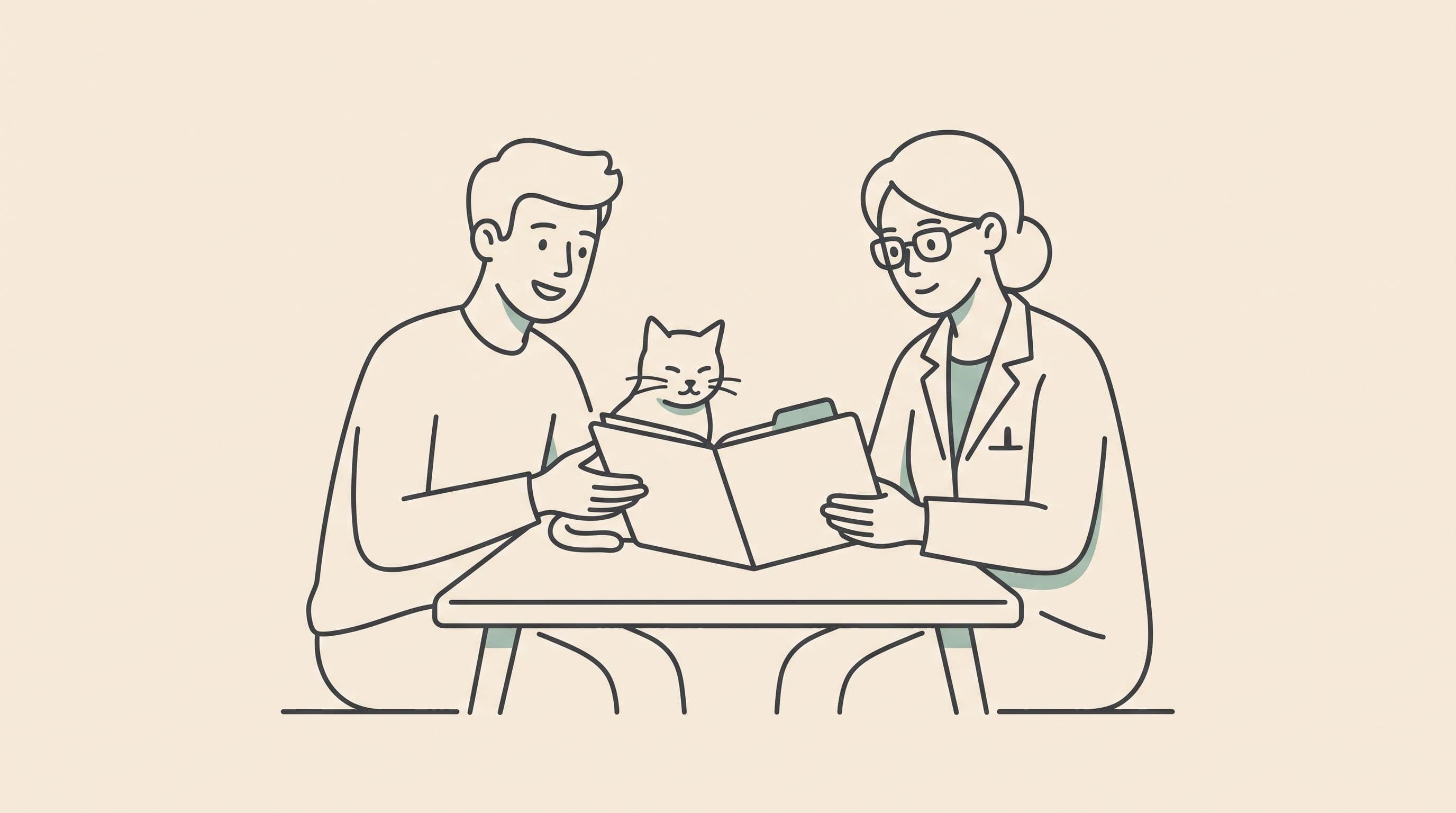
How to talk to your vet about FIP treatment
Alastair Greenway
BVM&S MRCVS
You have read that FIP is treatable in the UK, and you believe it. Now you are sitting with a different worry, one that a lot of owners feel and very few say out loud: what if my own vet doesn't know? What if I walk in, ask about treatment, and get a blank look or a gentle "there's nothing we can do"?
It is a fair thing to be anxious about, and it is worth naming plainly so you can go in prepared rather than frightened. FIP treatment is new enough that not every vet in the country has prescribed it, and a handful may still be working from the old picture in which FIP meant goodbye. That does not make them a bad vet. It means this is one of those fast-moving corners of medicine where an owner sometimes arrives with information the practice has not needed until now. The good news is that this conversation almost always goes well, and this article is about how to make it go well.
Start from partnership, not battle
The single most useful mindset before this appointment is that you and your vet are on the same side of the table. You both want your cat well. If you walk in braced for a fight, quoting the internet at someone who has spent years training to help animals, the conversation gets harder for no reason. If you walk in as a partner who has done some reading and wants to work through it together, you will get much further.
Most vets welcome an owner who has clearly thought about their cat. What they do not love, understandably, is being told they are wrong by someone waving a forum post. So the framing that works is not "I read that you have to treat this," it is "I have read that FIP is now treatable in the UK, and I would really like to understand whether that is an option for my cat." That opens a door rather than putting up a wall.
What to say, in plain words
You do not need a script, but it helps to have your key questions ready so the fear does not scramble them in the moment. Here is the shape of the conversation.
Name what you have understood. "I understand FIP used to be untreatable, but that antiviral treatment with GS-441524 and remdesivir is now legal in the UK and can be prescribed by any vet under the cascade, through Bova UK." Saying it calmly signals you have done real reading, not panic-scrolling.
Ask the open question. "Is antiviral treatment something we can consider for my cat?" Let them answer. Many vets will say yes straight away.
Ask about their experience, kindly. "Have you treated FIP with these antivirals before, or would you like to?" This is not a test. It genuinely helps you both decide whether they lead, or whether they would rather bring in support.
Ask about the plan. If treatment is on the table, ask what form your vet would start with, oral or injectable, roughly how long the course runs, and what monitoring looks like along the way.
If your vet is confident and experienced, this whole exchange might take five minutes and end with a prescription plan. If they are more cautious, the next part matters.
If your vet is unsure or hesitant
A hesitant vet is not a closed door. There is a legal, well-trodden route to confidence, and you can offer it without stepping on any toes.
The current UK guidance vets use is the ISFM update on treating FIP with antiviral drugs, a living document revised each year by a group of UK feline specialists (Taylor et al., 2025). Bova UK, the authorised specials manufacturer that supplies the medicine, also provides veterinary support and protocols (Bova, 2023). You can say, gently, "I understand there's current ISFM guidance and that Bova offers support to prescribing vets. Would it help to look at that?" Many a cautious vet becomes a confident one after a single read of the up-to-date protocol, because the framework is clear and the drugs are legally available to them.
If your vet would still rather someone with more FIP experience took the lead, that is a perfectly good outcome too. Ask about referral to a practice or a feline specialist who treats FIP regularly. Being referred is not a failure or a delay tactic. It is your vet doing the responsible thing, and the treatment is exactly the same legal route wherever it is prescribed.
The one response worth gently pushing back on is a flat "there is nothing we can do", if it is offered without discussion. That was true a few years ago and is no longer the general picture. If you hear it, it is reasonable to ask, warmly, "I had read that treatment is now possible in the UK. Could we talk about whether it might suit my cat, or whether a referral would help?"

Come prepared, so fear does not do the talking
FIP appointments are emotional, and emotion is terrible for memory. A few small preparations make a real difference.
Write your questions down and take them in on your phone or a scrap of paper. You will forget at least one otherwise, and it is always the one that kept you up the night before.
Bring your cat's story. Age, when the signs started, what you have noticed, any recent stress like a house move, new arrivals or recent neutering. FIP has no single test, so your cat's history is part of the diagnostic picture (Thayer et al., 2022), and the clearer you are, the more your vet has to work with.
Bring someone if you can. A second person hears things you miss and remembers the plan when you are too frightened to take it in. If nobody can come, ask if you can record the key part of the conversation, or ask your vet to write down the plan.
Ask about cost early and directly. Money is part of this decision and there is no shame in raising it. Ask what the medicine and monitoring are likely to cost so you can plan, and mention if you have insurance. We cover the money in detail in what FIP treatment costs in the UK and whether insurance covers it, and having read those before you go means you can have a grounded conversation rather than a panicked one.
Questions that tend to help
If you want a compact list to take with you, these are the ones owners most often find useful:
- Is antiviral treatment something we can consider for my cat, and why or why not?
- Would you start with oral tablets or injections, and why?
- Roughly how long is the course, and what does monitoring involve?
- What will the medicine and the rechecks cost, roughly, so I can plan?
- If you would prefer, is there a colleague or a referral practice who treats FIP regularly?
- What should I watch for at home, and when should I call you?
None of these are confrontational. Every one of them is the sort of thing a good vet is glad to be asked, because it shows you are ready to be a real partner in your cat's care.
Handling the harder emotions in the room
It helps to know, before you go, that this appointment can stir up feelings that catch you off guard, and that none of them mean you are handling it badly.
You may feel a flash of anger, at the situation, at the cost, sometimes at the vet in front of you who did not cause any of it. That is grief looking for somewhere to land, and it is human. If you feel it rising, it is fine to say so plainly: "I'm sorry, I'm frightened and I'm finding this hard." A good vet will meet that with kindness, not defensiveness, and naming it usually takes the heat out of the room.
You may also feel guilt, a conviction that you missed something or caused this. FIP develops from a common feline coronavirus that most cats carry, through a mutation inside your cat's own body (Thayer et al., 2022). It is not something you did, and it is not something you could reasonably have prevented. If that guilt is loud, it is worth saying to your vet too, because they can tell you honestly that this is nobody's fault, and hearing it from the person treating your cat lands differently than reading it here.
And you may simply freeze, unable to take in what is being said. That is why bringing someone, writing things down, and asking for the plan in writing all matter so much. There is no prize for holding it together. There is only getting your cat the care they need, and you are allowed to be a mess while you do it.
When you leave the room
Whatever the outcome, try to leave with the plan written down: what is being prescribed or what happens next, when the next contact is, and who to call if you are worried. If a decision is being made over a day or two, ask when you will hear and from whom, so you are not left refreshing your phone.
And if the appointment did not go the way you hoped, you have options rather than a dead end. A second opinion is always your right, and asking for one is normal and not an insult to anyone. The legal treatment route exists no matter which practice you are standing in, so the goal is simply to find the vet who is ready to walk it with you.
The conversation you are dreading is, for most owners, the moment the ground steadies. You go in frightened that the answer is no, and you usually come out with a plan. Once you have that plan, the daily dosing routine is there to help you carry it out.
References
- Taylor S, Tasker S, Barker E, Gunn-Moore D, Sorrell S, Cerna P, Coggins S. An update on treatment of FIP using antiviral drugs in 2025: growing experience but more to learn. ISFM/UK, 2025.
- Bova UK. FAQs about treating FIP, and veterinary support for prescribing vets. 2023.
- Thayer V, Gogolski S, Felten S, Hartmann K, Kennedy M, Olah GA. 2022 AAFP/EveryCat Feline Infectious Peritonitis Diagnosis Guidelines. Journal of Feline Medicine and Surgery, 2022. The legal-route line (any vet may prescribe under the cascade via Bova UK) is -flagged and gated on Claire Greenway's sign-off before publish.
Free downloads
Companion worksheets to put what you've read into practice. Free PDFs, print at home.
Keep track of how your pet is doing
The owners who cope best are the ones who notice changes early. A simple health log shows you what is working, and what is not, before the next vet visit.
Start tracking, freeYou're not doing this alone
Compare treatment journeys and talk to owners managing feline infectious peritonitis (fip). Free to join.
Join PetsLikeMine