


The black market, answered honestly
Alastair Greenway
BVM&S MRCVS
If you have been researching FIP for more than an hour, you have almost certainly found them: the Facebook groups, the unofficial suppliers, the owners sharing photos of vials and spreadsheets of doses, all promising to save your cat for less than the vet quoted. And if you are honest with yourself, part of you has wondered whether that is the answer. I want to talk about that openly, without wagging a finger at you, because you are not a bad owner for having looked. You are a frightened one, doing everything you can think of for a cat you love.
So this article is not a telling-off. It is the straight story of why that world exists, what it can and cannot offer, and why, in the UK today, the legal route through your vet is the safer road. I am not going to name suppliers, link to groups, or tell anyone how any of it works, because that would help no one and could put cats at risk. What I will do is give you the honest reasoning, so you can make this decision with clear eyes rather than fear.
Why the black market existed at all
To understand this fairly, you have to understand where it came from, because it did not appear out of greed or recklessness. It appeared out of desperation, and for a long time it was the only thing standing between a lot of cats and certain death.
For most of veterinary history, FIP killed. Then, around 2018 and 2019, research showed that antiviral drugs could actually cure it (Pedersen et al., 2019). That was extraordinary news, and it created an unbearable gap: the cure existed, but there was no legal way for most owners to get it for their cat. No licensed product, no pharmacy that could dispense it, nothing a vet could legally prescribe. Into that gap stepped a global, informal network of suppliers and volunteer owner-groups who imported and distributed unlicensed product and helped each other dose it. For several years, that network saved cats who would otherwise have died. That is the honest history, and it is why so many owners speak of these groups with real gratitude.
None of that is a moral failing on anyone's part. When the only bridge across a river is an unofficial one, people cross it. But the reason the bridge existed was that there was no official one. In the UK, that is no longer the case.
What changed in the UK
Since August 2021, FIP treatment has been legally available in the UK. A UK-authorised specials pharmacy, Bova UK, manufactures compounded remdesivir and oral GS-441524, and any vet can prescribe it for your cat under the veterinary prescribing cascade, the legal framework for using an unlicensed medicine when there is no licensed one (Bova, 2023; Veterinary Prescriber, 2022). We explain that route in full in FIP is treatable now: the legal UK route.
That single change is what makes this whole question different in Britain than it was five years ago, and different than it may still be in some other countries. The gap that the black market grew to fill has, here, been closed. There is now an official bridge. The reason to cross the unofficial one has largely gone.
It is worth noting, gently, that the picture is not identical everywhere. In the United States, for example, the position is more of a halfway house: the medicine compounded from bulk drug is still technically an unapproved animal drug, but since May 2024 the FDA has said it does not intend to take enforcement action when a vet prescribes it for a specific cat under set conditions (FDA, 2024). That is a different legal footing from the UK's, and it is why American advice can read differently from ours. If you are in the UK, the clear route is the one through your own vet.
What the legal route gives you that the other cannot
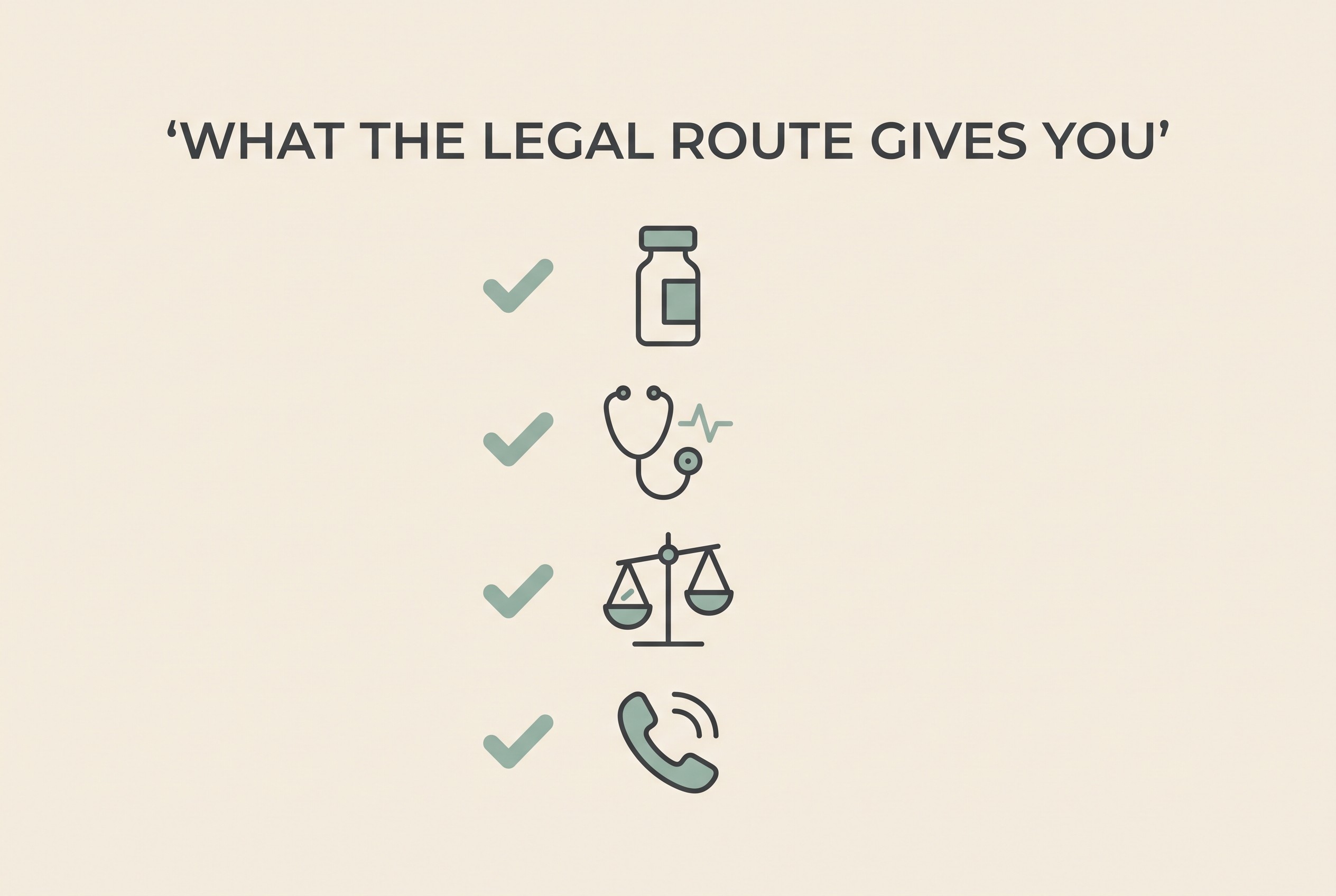
This is the heart of it, and it is not really about legality for its own sake. It is about safety, and about not being alone. Here is what the vet route offers that an online purchase, however well-intentioned the seller, structurally cannot.
You know what is in the vial. When your vet prescribes, the medicine comes from an authorised manufacturer, so its purity and strength are known and controlled. With unlicensed product bought online, the purity and safety are unknown, and contamination has been reported (Taylor et al., 2025). You cannot see what is in an unregulated vial, and neither can the person who sold it to you. For a drug you are injecting or giving daily to a small, sick cat, that uncertainty is not a small thing.
Someone is watching your cat, not just the calendar. This may be the biggest difference of all. FIP treatment is not "give the drug and wait". It needs monitoring: recheck bloodwork, dose adjustments as a growing kitten gains weight, decisions when things do not go to plan. On the legal route your vet does all of that with you. On the unofficial route, most owners were largely on their own. In one analysis, only a small fraction of owners using illegal antivirals, under one in ten, reported getting meaningful help from a vet on how to give the drugs safely or monitor the response (Taylor et al., 2025). That is not a criticism of those owners. It is a description of how alone the old route left people, at exactly the moments a professional eye matters most.
You get the right dose, adjusted over time. FIP dosing depends on your cat's weight and the form of the disease, and it changes as a kitten grows, which is one of the trickiest and most consequential parts of treatment (here is why). Getting that right, and adjusting it, is a clinical job. A prescribing vet does it. A spreadsheet from a stranger cannot.
If something goes wrong, you have help. Side effects, a cat that stalls, a relapse: all of these are far less frightening when there is a vet on the other end of the phone who prescribed the medicine and knows the case. That safety net is precisely what the unofficial route could never provide.
The honest risks, said plainly
I am not going to catastrophise, because that is not fair to owners who used these routes and saved their cats. But you deserve the real risks named. Unregulated product may be weaker, stronger or contaminated than the label claims, and you have no way to check (Taylor et al., 2025). Dosing without professional oversight can go wrong, particularly for a growing kitten whose needs change weekly. Buying online means no recourse if the product is wrong, no monitoring to catch problems early, and, in the worst cases, money spent on something that does not help while the cat gets sicker. And spending on the unofficial route can leave you with less to fall back on if you then need your vet anyway.
The people who ran and used those networks were, overwhelmingly, trying to do right by their cats in a system that had failed them. The point is not that they were wrong. It is that in the UK today, you no longer have to take those risks to get the same active medicine.
What to do with all this
If cost is what is pushing you towards the unofficial route, please read what FIP treatment costs in the UK first, because the legal price has come down, insurance may help (our insurance guide walks you through it), and a frank conversation with your vet about affordability often opens doors that the internet told you were shut. The black market is not the affordable answer it can appear to be, once you account for the risks and the lack of a safety net.
If it is fear that your vet will not know or will not help, read how to talk to your vet about FIP. That conversation is usually the turning point.
You went looking for a way to save your cat, and you found a world that once was the only way. In the UK, it no longer is. The same medicine is available legally, through someone who will know your cat and stay with you through the whole course. That is the road I would want for my own cat, and it is the one I would want for yours.
References
- Taylor S, Tasker S, Barker E, Gunn-Moore D, Sorrell S, Cerna P, Coggins S. An update on treatment of FIP using antiviral drugs in 2025: growing experience but more to learn. ISFM/UK, 2025.
- Bova UK. The treatment of feline infectious peritonitis (FIP) in the UK: an update. 2023.
- Veterinary Prescriber. Remdesivir, cats and the cascade. 2022.
- Pedersen NC, et al. Efficacy and safety of GS-441524 for treatment of cats with naturally occurring FIP. Journal of Feline Medicine and Surgery, 2019.
- U.S. Food and Drug Administration. GFI #256 and CVM position on compounded GS-441524 for FIP (enforcement discretion, May 2024). 2024. US context only; not the UK legal position. This article names no supplier, no group, no brand, no marketplace and gives no sourcing, importing or dosing instructions, by design. The UK legal-route statements, the safety/contamination claim and the owner-support figure are -flagged and gated on Claire Greenway's sign-off before publish. The US GFI #256 line is included only as context and must never be presented as the UK position.
Keep track of how your pet is doing
The owners who cope best are the ones who notice changes early. A simple health log shows you what is working, and what is not, before the next vet visit.
Start tracking, freeYou're not doing this alone
Compare treatment journeys and talk to owners managing feline infectious peritonitis (fip). Free to join.
Join PetsLikeMine