

Is it FIP? Why there's no single test
Alastair Greenway
BVM&S MRCVS
If you are here because a test came back saying "consistent with FIP" rather than a clean yes or no, I understand exactly how maddening that is. You wanted an answer and you were handed a probability. You may be frightened of treating your cat for something that turns out to be nothing, or frustrated that after all the poking and bloods and money, nobody will just say the word. Some owners quietly wonder whether their vet is out of their depth.
So let me take that worry off the table straight away. There is no single blood test that says "yes, this is FIP", and there never has been. A vet who talks in terms of "consistent with FIP" or "a strong picture of FIP" is not hedging or fumbling. They are describing the disease accurately. Diagnosing FIP is a matter of building a case from several pieces of evidence and weighing them together, and the international diagnosis guidelines say so in as many words (Thayer et al., 2022). Understanding why is the thing that will let you stop feeling gaslit by the uncertainty and start reading the picture the way your vet does.
Why one test can never settle it
The trouble sits in the biology. FIP is caused by a mutated form of a very common feline coronavirus that most cats carry harmlessly in the gut (Thayer et al., 2022). That creates two overlapping problems for any test.
First, a test that finds the coronavirus does not, by itself, tell you whether it is the harmless gut version or the dangerous mutated one, because the ordinary virus can turn up in the blood and tissues of perfectly well cats too. Second, the changes FIP causes in the blood, a raised globulin, a low-grade fever, anaemia, are all things that other diseases cause as well. No single finding is unique to FIP. The guidelines put it bluntly: FIP lacks pathognomonic (that is, uniquely diagnostic) clinical signs or laboratory changes, which is exactly why it is challenging to diagnose (Thayer et al., 2022).
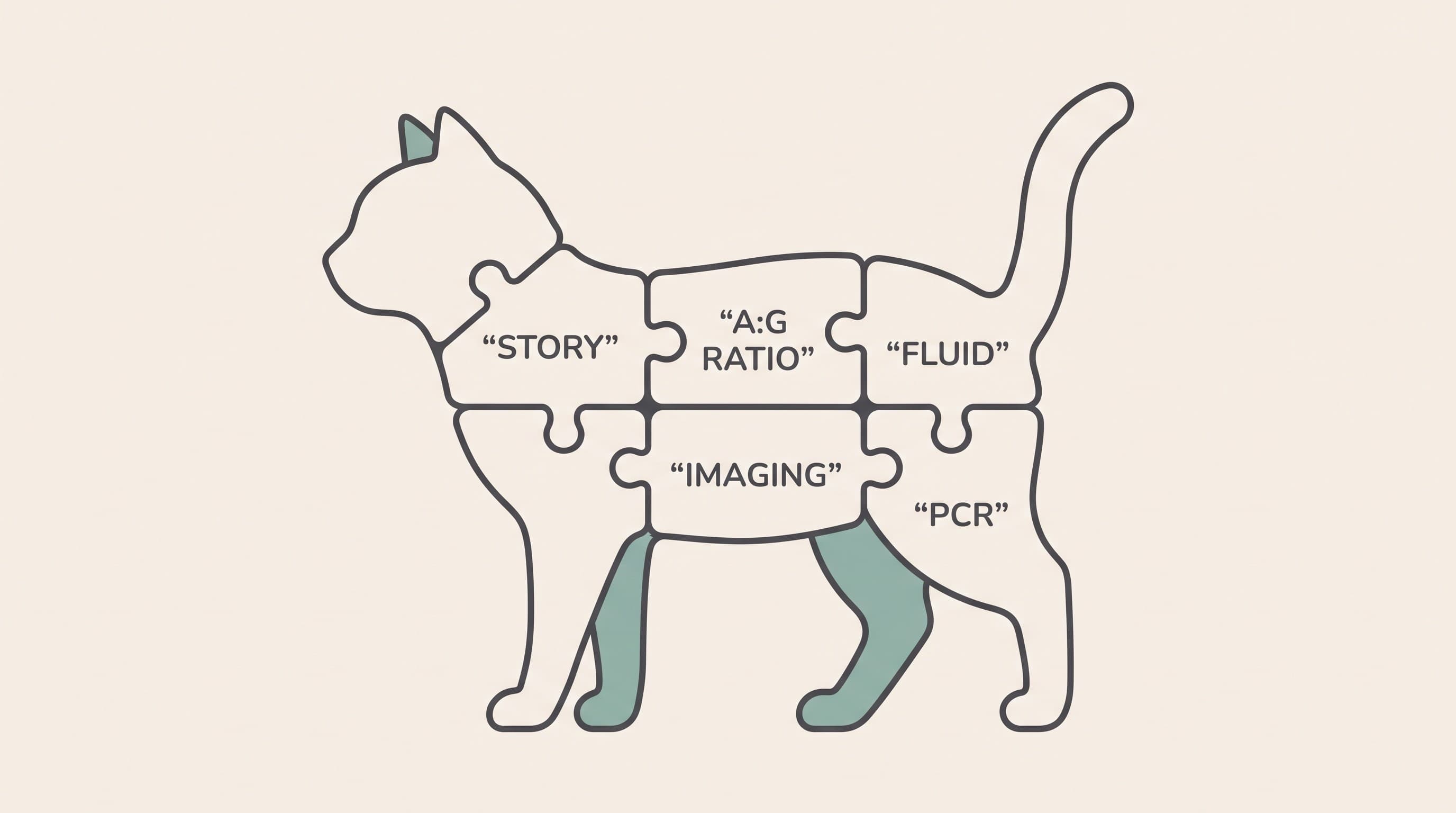
So instead of one test, a good work-up assembles the picture brick by brick: the story and the signalment, the routine bloods, the fluid if there is any to sample, imaging, and targeted tests like PCR or immunostaining (Thayer et al., 2022). Each brick adds weight. None of them, alone, is the wall.
The pieces of the puzzle
The story and the signalment. This sounds soft, but it is genuinely one of the strongest bricks. A young cat, often under two, sometimes recently rehomed or from a multi-cat background, showing the classic combination of a fluctuating fever that does not respond to antibiotics, weight loss or poor growth, and low energy, is a story that fits FIP well. Your vet is not making small talk when they ask how old your cat is and where it came from. They are laying the first brick.
The routine bloods. Certain patterns raise suspicion. The one you will hear about most is the albumin-to-globulin ratio, usually written A:G, which is covered in detail in reading the bloodwork. In short, FIP tends to push globulins (a family of proteins linked to inflammation) up and albumin down, so the ratio drops. A low A:G ratio makes FIP more likely, but plenty of cats with a low ratio do not have FIP, and some cats with FIP have a near-normal one (Thayer et al., 2022). It is a strong brick, not a verdict.
The fluid, when there is any. This is often the single most useful step, and it is worth understanding why your vet may want to do it. If your cat has the wet form of FIP, with fluid in the belly or chest, that fluid can be sampled with a fine needle, usually quickly and with little distress, and it carries a lot of information. FIP fluid has a characteristic look and chemistry: it is typically high in protein (over 35 g/l), has a low cell count, and shows the same low A:G pattern within the fluid itself (Thayer et al., 2022). A simple, inexpensive in-clinic check called the Rivalta test can be run on it, and while a positive result only raises suspicion, a negative result makes FIP quite unlikely, which is genuinely useful information (Thayer et al., 2022). Sampling fluid also lets the lab look directly for the virus in the cells that FIP infects, which is about as close to confirmation as this disease offers.
Imaging. Ultrasound or x-rays help find fluid you cannot see from the outside, show up enlarged organs or lymph nodes, and rule other diseases in or out. Imaging rarely proves FIP on its own, but it adds bricks and, importantly, helps exclude the things FIP can mimic.
PCR and immunostaining. These are the tests that look for the virus directly. A PCR test detects coronavirus genetic material, and a high viral load in the right sample, alongside a consistent clinical picture, is very suggestive of FIP (Thayer et al., 2022). Immunostaining (looking for the virus inside the specific immune cells it infects) is more specific still, and a clearly positive result on the right sample is one of the most confirmatory findings available. But even here there are limits: a negative PCR does not rule FIP out, and sample quality matters (Thayer et al., 2022).
The test that sounds like an answer but isn't
One result causes more confusion than any other, so it is worth heading off. You may have had, or read about, a coronavirus antibody titre, a blood test that measures how strongly your cat's immune system has responded to feline coronavirus. It feels like it should be the answer: surely a high titre means FIP? It does not. Because nearly all cats have met the ordinary gut coronavirus, a great many perfectly healthy cats have high antibody titres, and some cats with genuine FIP have low or even negative ones (Thayer et al., 2022). A titre tells you a cat has encountered coronavirus at some point. It cannot, on its own, tell the harmless gut virus apart from the FIP-causing mutation, and the guidelines are clear that it should never be used alone to diagnose or rule out FIP (Thayer et al., 2022). If your vet has been cautious about a titre result, or declined to hang much on one, that is them getting it right. It is a piece that is easy to over-read, which is precisely why it can mislead an anxious owner scanning results at midnight.
Why the dry form is the hardest of all
If your cat has the dry, non-effusive form, with no free fluid to tap, you may have noticed the work-up dragging on longer and feeling less conclusive. That is not a failing on anyone's part. It is the single hardest version of FIP to confirm, precisely because the most information-rich test, sampling the fluid, is off the table when there is no fluid (Thayer et al., 2022). These cases lean harder on the whole picture: the story, the bloods, imaging, sometimes sampling an affected organ or lymph node directly, and occasionally a period of watching how the cat responds. If your diagnosis has felt slower and more uncertain than you expected, the dry form is very often why, and it does not mean your cat's case is any less real or less treatable.
"Enough to treat" is a real and proper standard
Here is the point that I most want you to take away, because it is where the fear tends to concentrate. Vets do not wait for a mythical perfect test before treating FIP, because that test does not exist and waiting for it would cost cats their lives. Instead they build to what the guidelines call diagnostic confidence: a picture strong enough, across enough of those bricks, that FIP is comfortably the best explanation and treatment is justified (Thayer et al., 2022).
Starting treatment on a strong clinical picture is standard, appropriate practice. You are not gambling, and you are not letting your vet experiment on your cat. In many cases, a clear and rapid response to antiviral treatment becomes part of the evidence itself, because cats with FIP tend to improve strikingly, and quickly, once the right drug reaches the right place. If your vet has recommended treating on a "consistent with FIP" picture, that is them doing the job well, not cutting a corner.

Getting through the limbo
While the picture is being built, the waiting is its own ordeal, so a few practical things.
Ask your vet where they are in the process and what would move the needle either way. A fair question is simply, "What are you weighing, and is there one more test that would change your mind?" It turns a frightening fog into a plan you can see the edges of.
A second opinion or a referral is not a betrayal of your vet, and for a tricky case, especially a dry-form one, it can add exactly the piece the picture is missing. FIP is a fast-moving field and it is entirely reasonable to want another set of eyes.
Keep your own record. Note the dates, the temperatures if you are taking them, what your cat is eating, how bright it seems day to day. When the diagnosis is composite, this kind of running picture genuinely helps your vet, and it is the same habit that will serve you if treatment begins. The FIP Treatment Companion is built to hold exactly this, including the bloodwork numbers as they change through the journey ahead.
None of this replaces the one thing worth understanding next, which is what happens once the picture is strong enough to act on. If you are moving toward that decision, the calm explanation of the treatment itself, and the fact that it is legal and vet-prescribed here in the UK, is in FIP is treatable now: the legal UK route. And if the numbers on your cat's results are what is keeping you up, reading the bloodwork walks through them one at a time.
References
- Thayer V, Gogolski S, Felten S, Hartmann K, Kennedy M, Olah GA. 2022 AAFP/EveryCat Feline Infectious Peritonitis Diagnosis Guidelines. Journal of Feline Medicine and Surgery. 2022;24(9):905-933.
- 2022 AAFP/EveryCat Feline Infectious Peritonitis Diagnosis Guidelines (full text, PMC).
- Taylor SS, Coggins S, Barker EN, et al. Retrospective study and outcome of 307 cats with feline infectious peritonitis treated with legally sourced veterinary compounded preparations of remdesivir and GS-441524 (2020-2022). Journal of Feline Medicine and Surgery. 2023;25(9).
Keep track of how your pet is doing
The owners who cope best are the ones who notice changes early. A simple health log shows you what is working, and what is not, before the next vet visit.
Start tracking, freeYou're not doing this alone
Compare treatment journeys and talk to owners managing feline infectious peritonitis (fip). Free to join.
Join PetsLikeMine