

Reading the bloodwork: A:G ratio, globulins, PCV
Alastair Greenway
BVM&S MRCVS
If you have a printout of your cat's results in front of you, a column of numbers with a few of them flagged in bold or marked with an H or an L, and your vet mentioned "the globulins" or "the A:G ratio" and moved on faster than you could take it in, this article is for you. My aim is simple: to sit with you and the printout, and explain the handful of numbers that matter in FIP, in plain language, so the page stops feeling like a coded verdict you are not allowed to read.
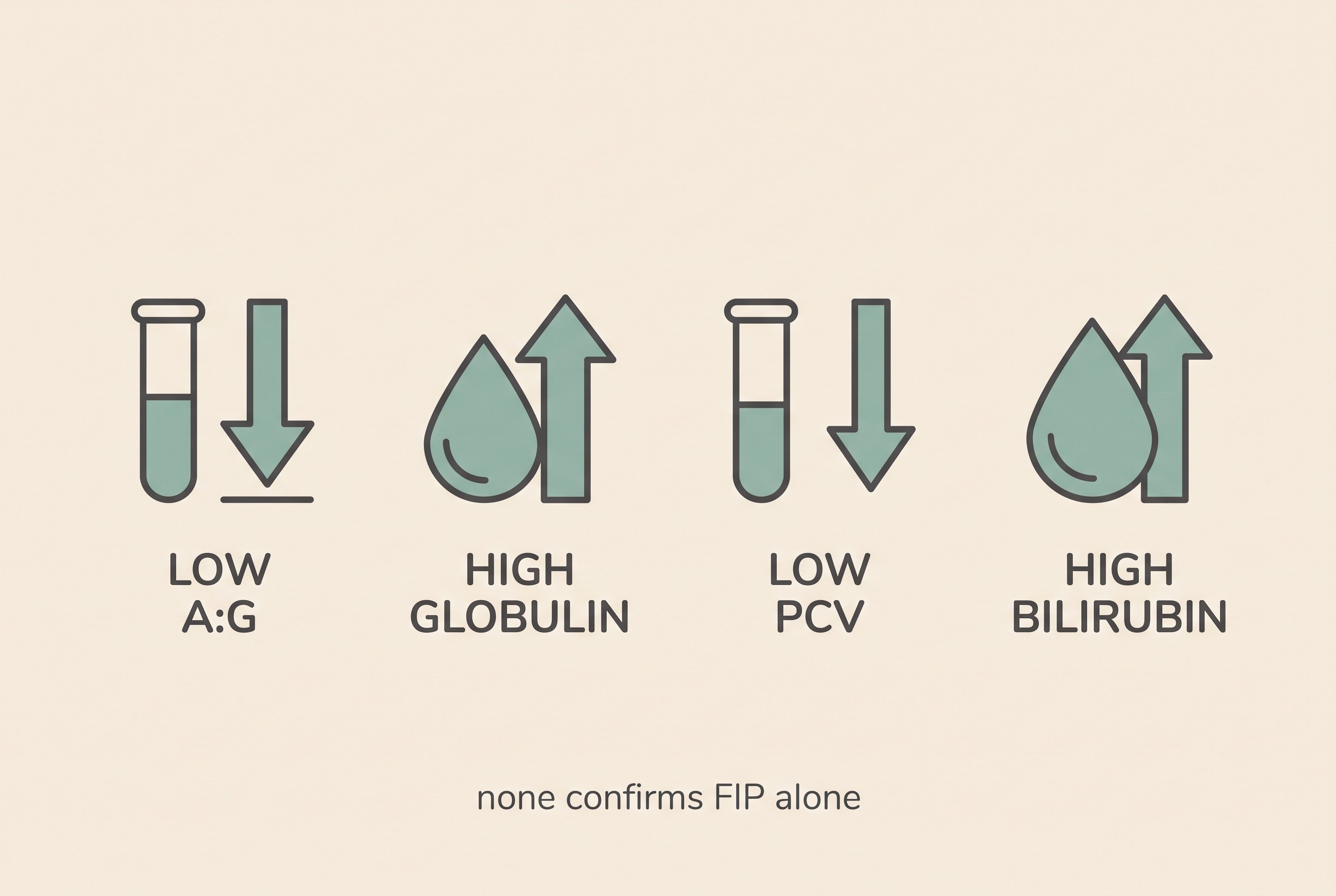
Two things to hold before we start. First, no single number on that page proves or disproves FIP. Every finding I am about to explain is supportive, part of a bigger picture, never the whole answer, and that is not a weakness in the testing, it is simply how this disease works (Thayer et al., 2022). If you want the fuller explanation of why FIP has no one confirmatory test, it is in is it FIP? Why there's no single test. Second, these are ranges and patterns, not pass-or-fail lines. A result just inside or just outside "normal" is a nudge, not a sentence, and your vet reads it alongside everything else they know about your cat.
The proteins: globulins, albumin, and the A:G ratio
This is the group your vet most likely pointed at, so we will start here.
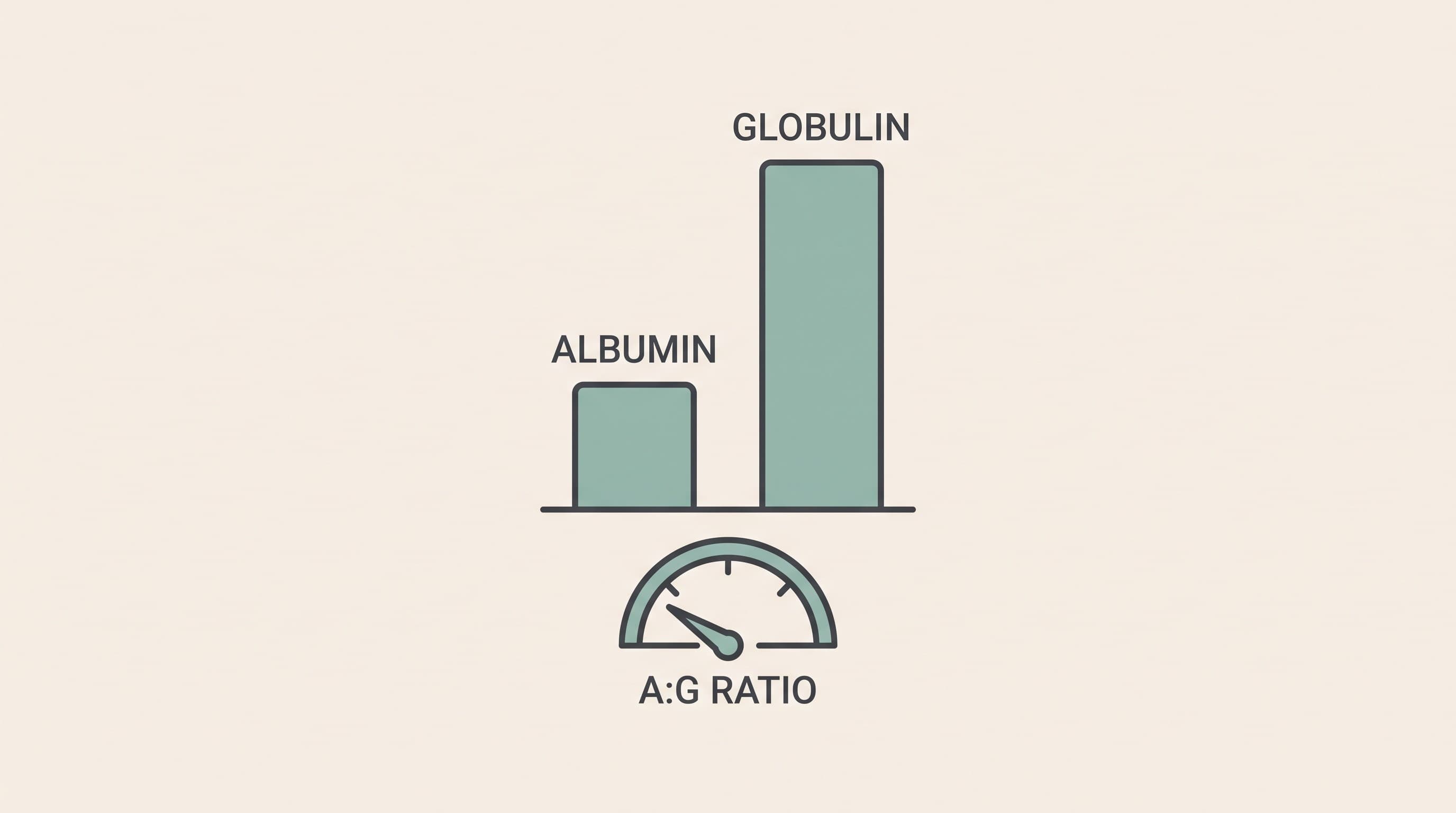
Your cat's blood carries two big families of protein: albumin and globulins. Albumin is the general-purpose protein made by the liver that, among other jobs, holds fluid inside the blood vessels. Globulins are a broad family that includes the antibodies and inflammation-related proteins the immune system throws into a fight. In a healthy cat there is comfortably more albumin than globulin.
FIP tends to push these two in opposite directions. The relentless inflammation drives globulins up (a state called hyperglobulinaemia), while albumin drifts down (hypoalbuminaemia), partly because inflammation suppresses its production and partly because the leaky, inflamed vessels lose it (Thayer et al., 2022). So on the printout you are often looking for a high globulin and a low-ish albumin sitting together.
The A:G ratio is just those two numbers divided: albumin divided by globulin. It is a tidy way of capturing the seesaw in one figure. Because FIP lifts globulin and lowers albumin, it drops the ratio. The diagnosis guidelines put rough guides on it: an A:G ratio below 0.4 makes FIP somewhat more likely, while a ratio above about 0.6 makes it somewhat less likely (Thayer et al., 2022). Notice the language, "more likely" and "less likely", not "yes" and "no". Plenty of cats with a low A:G ratio have something other than FIP, such as another chronic inflammatory or infectious disease, and some cats with genuine FIP have a ratio that looks almost normal (Thayer et al., 2022). It is a strong signpost, not the destination.
There is even a counter-intuitive exception worth knowing, so a confusing result does not throw you: if FIP involves the gut heavily and the cat is losing protein through the bowel, the globulin can actually be low rather than high, the opposite of the usual pattern (Thayer et al., 2022). Your vet will interpret the numbers in the context of the rest of the picture, which is exactly why the printout alone can mislead.
AGP: the inflammation marker your vet may add
You may see, or your vet may send off for, a test called alpha-1 acid glycoprotein, usually written AGP. It is an inflammatory protein that tends to climb in FIP, and it can be useful precisely because it sometimes rises when the ordinary globulin picture is ambiguous. The guidelines offer rough guides here too: an AGP above 1.5 g/l makes FIP moderately more likely, and above 3.0 g/l it becomes considerably more supportive, while a value under 1.5 g/l nudges the other way (Thayer et al., 2022). Like everything else on the page, it is a weighted piece of evidence, not a standalone answer, and it can be raised by other inflammatory diseases too.
The red cells: PCV and anaemia
PCV stands for packed cell volume, sometimes reported as haematocrit or HCT. It is a straightforward measure of what proportion of the blood is red cells, in other words a direct read on whether your cat is anaemic. A low PCV means fewer red cells than there should be.
Many cats with FIP are mildly to moderately anaemic, and the characteristic kind is a non-regenerative anaemia: the bone marrow is not ramping up new red cell production to compensate, which is typical of the "anaemia of chronic disease" that long-running inflammation causes (Thayer et al., 2022). You might also see microcytosis, a note that the red cells are smaller than normal. On its own, anaemia points nowhere in particular, since a great many illnesses cause it. In the FIP picture, it is another brick: consistent with the disease, far from unique to it.
The white cells and platelets
Two more lines from the full blood count come up often, so they are worth naming.
Lymphopenia means a low count of lymphocytes, one type of white blood cell. It is a common finding in FIP, thought to reflect the way the disease and its inflammation affect these immune cells (Thayer et al., 2022). You may also see a raised neutrophil count, sometimes with young "band" forms, which is simply the body's general response to inflammation, and thrombocytopenia, a lower-than-normal platelet count. None of these is specific to FIP. Together, and alongside the protein changes, they thicken the picture.
Bilirubin and jaundice
If your cat looks yellow, in the gums, the skin, or the whites of the eyes, or if the printout flags a high bilirubin, this is worth understanding. Bilirubin is a yellow pigment that rises when red cells are being broken down faster than usual or when the liver is inflamed, both of which FIP can cause (Thayer et al., 2022). Raised bilirubin, and the visible jaundice that can come with it, is a recognised FIP-associated finding, and it tends to be one your vet takes seriously. As ever, it is not proof by itself, since liver disease and other conditions raise bilirubin too, but combined with the protein and blood-count changes it adds real weight.
When the bloods look almost normal
This one catches owners off guard, so I will say it plainly: a fairly normal-looking blood panel does not rule FIP out. Some cats, particularly early in the illness or with the dry form, have bloods that are only mildly off, or that miss the classic protein pattern altogether (Thayer et al., 2022). If your vet is still concerned about FIP despite bloods that look "not that bad" to you, they are not overreacting. They are weighing the whole picture, the story, the physical examination, the imaging, any fluid, against results that are only one part of it. The reverse is also true: strikingly abnormal bloods do not, by themselves, confirm FIP either, because other serious illnesses can produce a similar page.
A related point that spares a lot of needless worry. Laboratory reference ranges vary between labs and between machines, so the exact numbers that count as "high" or "low" shift a little depending on where the sample was run. A result flagged at one practice might sit inside range at another. This is why chasing a single decimal place is rarely worthwhile, and why your vet interprets the figure against that lab's own range and against your cat, rather than against a fixed universal cut-off. If a number is close to the edge, it is telling you "borderline", not "doomed".
The finding that is not on the routine bloods: the effusion
One of the most useful "blood-like" tests in FIP is not run on blood at all, but on fluid, if your cat has the wet form and there is fluid to sample. That fluid is often analysed for exactly the same proteins, and FIP fluid characteristically has a high total protein (over 35 g/l), a low A:G ratio within the fluid itself, and a relatively low cell count (Thayer et al., 2022). If your paperwork includes a fluid analysis as well as blood results, this is why: the fluid frequently carries more diagnostic weight than the blood, which is explained in is it FIP?.
Why the numbers matter beyond diagnosis
There is a reason to get comfortable with these figures even after a diagnosis is made, and it is a hopeful one. The same numbers, especially the globulins, the A:G ratio and the PCV, are what your vet will track through treatment to see whether it is working. As a cat responds to antiviral treatment, you typically see the inflammation settle: globulins fall, albumin recovers, the A:G ratio climbs back up, the anaemia improves. Watching those trends move in the right direction over the weeks is one of the genuine reassurances of the treatment journey, and the recheck points are covered in bloodwork checkpoints: day 30, 60 and 84.
That is exactly why keeping your own copy of each result is worth doing. A single printout is a snapshot; the trend is the story. The FIP Treatment Companion has a bloodwork tracker built to hold these numbers over time so you, and your vet, can see the line moving rather than guessing from memory.
For now, if you take one thing from the page in front of you, let it be this: no single number there is a verdict, the pattern matters more than any one line, and the very numbers that helped diagnose your cat are the ones that will, with treatment, show you it is getting better. If you want the wider context of how the whole diagnosis is built, is it FIP? Why there's no single test is the piece to read next.
References
- Thayer V, Gogolski S, Felten S, Hartmann K, Kennedy M, Olah GA. 2022 AAFP/EveryCat Feline Infectious Peritonitis Diagnosis Guidelines. Journal of Feline Medicine and Surgery. 2022;24(9):905-933.
- 2022 AAFP/EveryCat Feline Infectious Peritonitis Diagnosis Guidelines (full text, PMC).
- Taylor SS, Coggins S, Barker EN, et al. Retrospective study and outcome of 307 cats with feline infectious peritonitis treated with legally sourced veterinary compounded preparations of remdesivir and GS-441524 (2020-2022). Journal of Feline Medicine and Surgery. 2023;25(9).
Keep track of how your pet is doing
The owners who cope best are the ones who notice changes early. A simple health log shows you what is working, and what is not, before the next vet visit.
Start tracking, freeYou're not doing this alone
Compare treatment journeys and talk to owners managing feline infectious peritonitis (fip). Free to join.
Join PetsLikeMine