


Bloodwork checkpoints: day 30, 60 and 84
Alastair Greenway
BVM&S MRCVS
A recheck appointment is coming up, blood is going to be taken, and you would rather not walk in blind. You want to know what your vet is actually looking for, what counts as good news, and what the numbers on the printout mean, so that when the results come back you can read them with understanding instead of dread. That is a completely reasonable thing to want, and it is exactly what this article is for.
The short version is heartening: over the course of treatment, the blood tests should gradually move from "clearly abnormal" towards "reassuringly normal", and that journey is one of the main ways your vet confirms the treatment is genuinely working, not just making your cat feel better on the surface. Let's walk through what gets checked, when, and how to read the direction of travel.
Why bloodwork, when my cat already looks better?
Because looking better and being better are not always the same distance along the road, and the bloods measure the second one.
Cats often perk up in the first week or two of treatment, well before the underlying disease has actually resolved. That early bounce is real and worth celebrating, but it is not proof the job is done. The blood markers change more slowly and more honestly, so they are how your vet checks that the inflammation and the disease process are genuinely settling, that the treatment is holding, and eventually that it is safe to think about stopping. Rechecking bloods is not box-ticking. It is the difference between hoping your cat is better and being able to show it.
Roughly when the checkpoints fall
Most treatment plans build in blood rechecks at intervals across the 84-day course, commonly around the two-week mark, again near the middle, and again towards the end before stopping (ISFM/Taylor et al., 2024). Many owners and clinics think of these as roughly the day 30, day 60 and day 84 checkpoints, plus an early baseline near the start. Your vet may check more often early on, or if your cat is not progressing as hoped, and the exact timing is theirs to set for your cat. The pattern to hold in your head is: a starting picture, staged rechecks along the way, and a final check before the treatment stops.
Alongside the blood, your vet may reassess any fluid (effusion) in the belly or chest, because its shrinking and clearing is one of the clearest early signs of response in the wet form (ISFM/Taylor et al., 2024).
It is worth knowing why the checks are spaced the way they are. The early one confirms the treatment is doing something and catches any cat who is not responding, so the plan can be changed sooner rather than later. The middle one confirms the response is holding and established, not just an early flicker. The final one is the evidence base for the biggest decision of the course, whether it is safe to stop the drug. Each checkpoint answers a different question, which is why your vet wants all of them rather than one at the end.
The numbers your vet is watching, in plain terms
You do not need to memorise reference ranges. You need to understand what each marker is telling the story about, and which direction is the good one.
Total protein, globulins and albumin (and the A:G ratio). This cluster is the heart of FIP bloodwork. FIP typically drives the globulins up (a marker of inflammation) and the albumin down, which pushes the albumin-to-globulin ratio, the A:G ratio, low. A low A:G ratio is one of the most useful supportive findings in diagnosis, and in the large UK study a low A:G ratio of 0.4 or below was seen in around three-quarters of cats (Taylor et al., 2023). As treatment works, you want to see the globulins fall, the albumin rise, and the A:G ratio climb back towards normal. This is the single most followed trend across the course.
Two honest heads-ups so the numbers do not frighten you. The globulins are often the slowest marker to come good, lagging well behind how well your cat looks and feels, so do not be dismayed if they are still a bit high while everything else is heading the right way (Taylor et al., 2023). And in that same study, over a quarter of cats actually showed a temporary worsening of the globulins when rechecked early, before they then improved (Taylor et al., 2023). An early dip in the wrong direction is a known part of the pattern, not a sign of failure.
Haematocrit, or PCV (packed cell volume). This measures the proportion of red blood cells and tells you whether your cat is anaemic, which FIP commonly causes. As treatment works, a low PCV should climb back towards normal, and a rising PCV is one of the more satisfying trends to watch because it tracks your cat getting stronger.
Bilirubin. Raised bilirubin (which can show as a yellow tinge, or jaundice, in more severe cases) reflects the disease process, and a falling bilirubin is a good early sign of response (Taylor et al., 2023).
General health markers. Your vet will also look at the wider haematology and biochemistry, partly to track the FIP and partly to keep an eye on how your cat is tolerating treatment overall. A rounded picture is more useful than any single number, which is why the whole panel is run rather than one test.
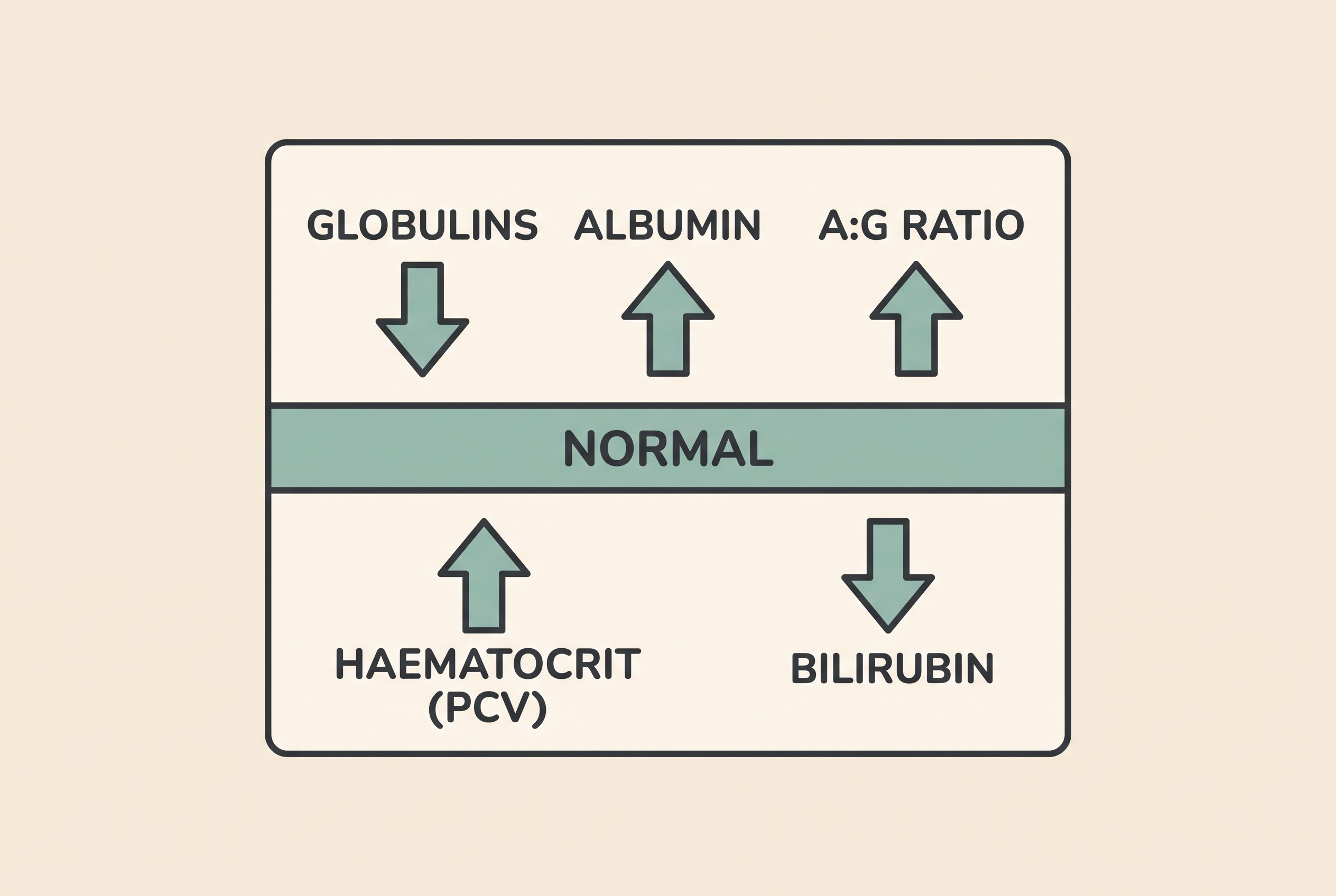
Reading progress across the three checkpoints
Here is the mental model that makes results easy to read: you are not chasing a perfect printout at any single visit, you are watching the trend from one checkpoint to the next.
At the early check (around day 30), you are hoping to see movement in the right direction: the A:G ratio starting to climb, a low PCV beginning to recover, bilirubin easing. Things do not have to be normal yet. They have to be heading there. Remember that some cats show that temporary globulin wobble around this early stage, so your vet reads the whole panel together rather than reacting to one marker.
By the middle check (around day 60), the trend should be clearer and more established. More markers moving towards normal, the effusion (if there was one) much reduced or gone, your cat visibly stronger. This is the checkpoint that often lets everyone breathe a little easier.
At the final check (around day 84), the aim is for the bloodwork to be normal, or very close to it, before treatment stops (ISFM/Taylor et al., 2024). Ideally the globulins have finally settled, the A:G ratio is back in range, the PCV is normal. This is a key part of the decision that the treatment phase has done its work. It is worth saying clearly, though, that reaching day 84 with good bloods is not the finish line. It is the gateway to the observation window, the 84 days off treatment during which your cat is watched to confirm the disease stays away. That distinction matters, and it is explained fully in the 84-day observation window.
A note on duration, because the goalposts are moving
You may read that some cats are now being treated for shorter courses, around 42 days rather than 84, particularly for the wet form, and wonder how that squares with a "day 84" checkpoint. This is an active and genuine area of research: recent UK work has been studying shorter courses, with some findings suggesting shorter treatment can be effective and may even reduce certain side effects (42-vs-84-day duration studies, 2024-25). It is not yet a settled, universal standard, so the 84-day course remains the common reference point, and your vet's plan, and the checkpoints within it, is the one to follow. If your cat is on a shorter course, the same logic applies on a compressed timeline: baseline, staged rechecks, and normal bloods before stopping.
What to do with all this at the appointment
You do not need to become an analyst. A few simple things make the recheck far more useful and far less frightening.
Bring your home notes, especially the weekly weights and anything you have logged about appetite, energy and any wobbles. Your tracking record gives the bloods context, and the two together tell a fuller story than either alone. Ask your vet to show you the trend, not just today's numbers, because "the A:G ratio has gone from low up to nearly normal since we started" is far more reassuring and meaningful than a single figure in isolation. And if a marker is stubborn or has wobbled, ask what it means for the plan rather than assuming the worst, because as you now know, a lagging globulin or an early dip is often part of the normal picture.
If a result is disappointing
Not every checkpoint brings unbroken good news, and it helps to know that in advance so a stubborn number does not knock you flat. A marker that is slow to move, an early globulin wobble, or a result that is better but not yet normal is not the same as treatment failing. Often it just means recovery is taking its usual unhurried course, and the answer is to keep going and recheck as planned.
Sometimes, though, a result is genuinely a prompt to act, and that is exactly what the checkpoints are for. If the numbers are not heading the right way, your vet has options: reviewing whether the dose has kept pace with your cat's weight, considering whether the dose should go up, or looking at whether a different form of the drug is needed. Under-dosing, especially in a growing kitten whose dose has lagged behind its weight, is one of the first things a good vet will check, which is another reason the weekly weigh-in and your home records are so valuable at these appointments. A disappointing checkpoint is information that lets your vet adjust the plan, not a verdict, and treatment that is stalling can very often be got moving again. There is more on that in when treatment stalls.
Keep your results in one place, in the FIP Treatment Companion or your own record, so you can see the whole arc from baseline to day 84. When you can lay the checkpoints side by side and watch the numbers walk back towards normal, the bloodwork stops being a source of dread and becomes what it is meant to be: the clearest evidence you have that what you are doing, every single day, is working.
References
- Taylor S, Coggins S, Barker EN, et al. Retrospective study and outcome of 307 cats with feline infectious peritonitis treated with legally sourced veterinary compounded preparations of remdesivir and GS-441524 (2020-2022). Journal of Feline Medicine and Surgery 2023;25(9).
- Taylor S, Tasker S, Barker EN, Gunn-Moore D, et al. An update on treatment of FIP using antiviral drugs (ISFM/UK living document, 2024 edition).
- Thayer V, Gogolski S, Felten S, et al. 2022 AAFP/EveryCat Feline Infectious Peritonitis Diagnosis Guidelines. Journal of Feline Medicine and Surgery 2022;24(9):905-933.
- 42-vs-84-day GS-441524 duration studies for effusive FIP, 2024-25.
Free downloads
Companion worksheets to put what you've read into practice. Free PDFs, print at home.
Keep track of how your pet is doing
The owners who cope best are the ones who notice changes early. A simple health log shows you what is working, and what is not, before the next vet visit.
Start tracking, freeYou're not doing this alone
Compare treatment journeys and talk to owners managing feline infectious peritonitis (fip). Free to join.
Join PetsLikeMine