

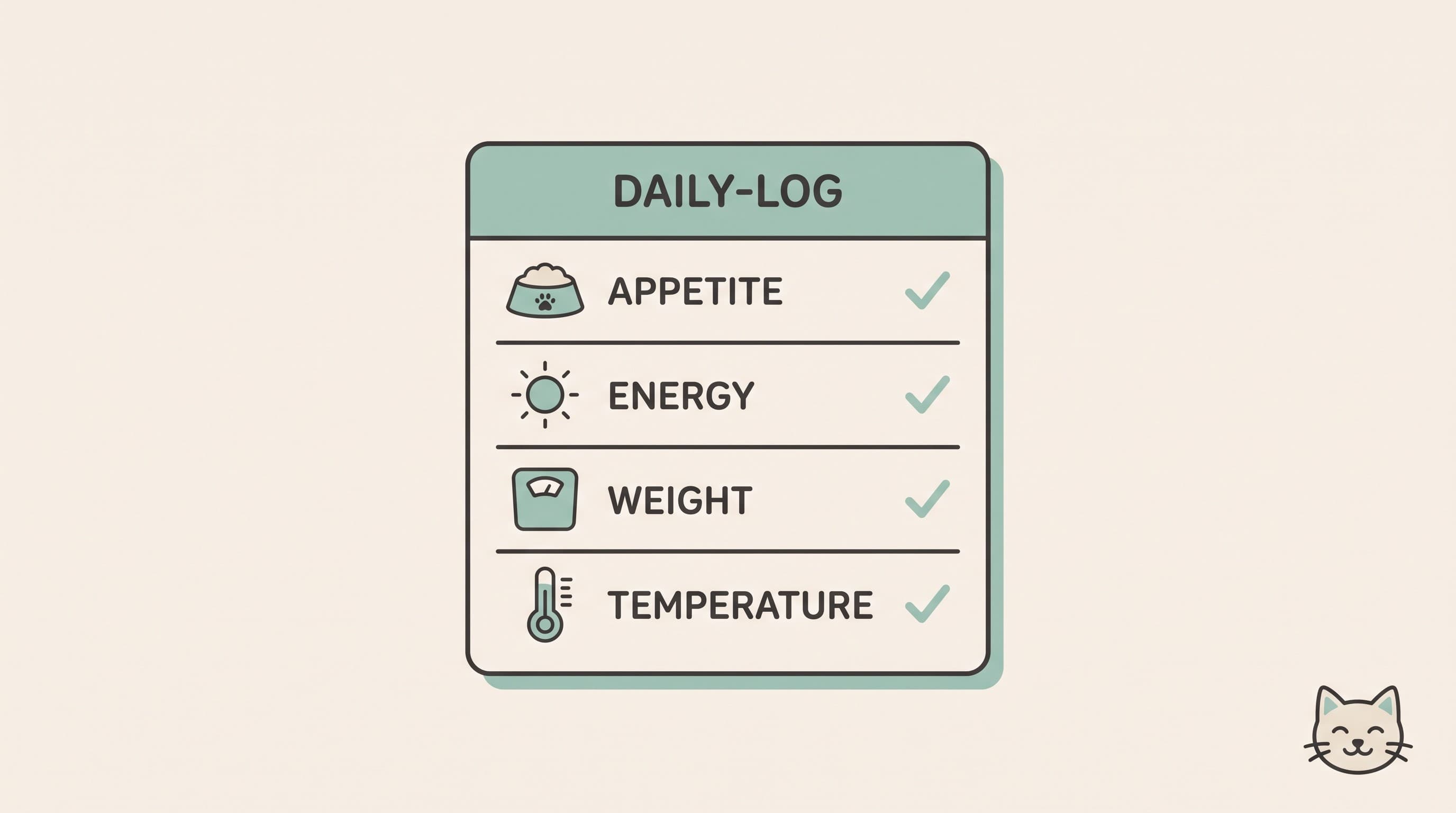
What to track during treatment (and why)
Alastair Greenway
BVM&S MRCVS
Once the daily dose is under way, most owners hit the same quiet question: what am I actually supposed to be watching for? You want to know what "getting better" looks like, day by day, so you can tell the difference between a normal quiet afternoon and something you should ring the vet about. And you want to know what to write down, because your memory at week five will not be trustworthy, no matter how sure you feel now.
Good news on both counts. The signs that treatment is working are, for the most part, the ordinary things you already look at every day. You do not need to become a clinician. You need to become a good, steady note-taker, and this article is your list of what to note.
Why tracking matters more than it sounds
Two reasons, and both are practical.
First, recovery from FIP is a trend, not a moment. Cats do not flip from ill to well overnight. They inch back over days and weeks, and the improvement is often too gradual to feel from inside the daily routine. A written record lets you see the slope you cannot feel. When week four's notes sit next to week one's, the progress that felt invisible becomes obvious, and on the hard days that evidence is a genuine comfort.
Second, your notes are what make your vet's job possible between visits. "She seems a bit off" is hard to act on. "She's eaten roughly half her usual amount for three days, and her weight has dipped 80 grams" is something a vet can actually work with. The record turns your worry into information, and information is what gets problems caught early.
The FIP Treatment Companion is built to hold all of this so you are not juggling a notebook and your phone and a tired brain. It timestamps the daily dose, prompts the weekly weigh-in, and keeps the running picture in one place. However you record it, the point is the same: capture it as it happens, because you will not reconstruct it accurately later.
The daily markers: the everyday things that tell the real story
These are the ones to glance at every day. None of them requires equipment beyond your own attention.
Appetite. This is the big one, and often the first thing to improve when treatment is working. Note roughly how much your cat is eating against its normal, and whether it is eating willingly or being coaxed. A returning appetite is one of the most reassuring early signs there is. A fading one, especially after a good run, is one of the first things to flag.
Energy and demeanour. Not "is she playing like a healthy cat", which is an unfair bar early on, but "is she a little brighter than yesterday". Interest in what is going on around her, coming to greet you, grooming, choosing to move about rather than staying tucked away. These small returns of personality are the recovery you are looking for.
Weight. Track this weekly rather than daily, on the same accurate scales, because it does double duty. A steady climb is a sign of recovery, and it is also the number your vet needs to keep the dose right as a growing kitten gains weight. That link is important enough to have its own article: weigh weekly, re-dose weekly. Do not skip the weigh-in even when everything seems fine, because "everything seems fine" is exactly when an outgrown dose hides.
Toileting. A quick daily glance. Is she using the tray normally, are stools reasonable, is she drinking and passing urine as usual. Soft stool for a day is rarely a crisis, but a change that persists is worth noting and mentioning.
Any belly or chest swelling, in the wet form. If your cat was diagnosed with the effusive form, where fluid builds up in the abdomen or chest, then a shrinking belly is one of the most visible signs treatment is working, and a returning swelling is one of the more important things to flag. You do not need to measure anything clever. Just notice the shape and the breathing: comfortable, easy breathing and a settling tummy are good news, while faster or more laboured breathing warrants prompt contact.
The injection site, if your cat is on injections. A small check for lumps, soreness or reluctance to be touched at the site. Injection-site discomfort is common on the subcutaneous route, reported in nearly half of cats given it in the large UK study (Taylor et al., 2023), so a tender spot is often expected rather than alarming, but note it, and flag anything that looks more than mild.
Temperature: useful, but only if it doesn't cause more stress than it saves
A raised temperature is one of the hallmarks of active FIP, and a settling temperature is a classic early sign that treatment is working. In the UK study, temperature was one of the markers that normalised relatively quickly once effective treatment began (Taylor et al., 2023). So a home thermometer can be genuinely informative.
The honest caveat is that taking a cat's temperature (rectally, which is the accurate way) is not a bit of fun for either of you, and a daily battle can do more harm to your relationship and your cat's stress levels than the reading is worth. Talk to your vet about whether home temperature checks are useful in your cat's case and how often. For some cats it is a helpful daily data point; for others, a fortnightly check at the vet, plus watching the softer signs at home, is plenty. There is no prize for a heroic daily reading that leaves your cat hiding under the bed. If you do take it, note the number and the time, and know that a single high reading on a stressful day is not the same as a sustained fever.
What "good" looks like, and roughly when
It helps to know the shape of a normal recovery so you are not measuring against an impossible timeline.
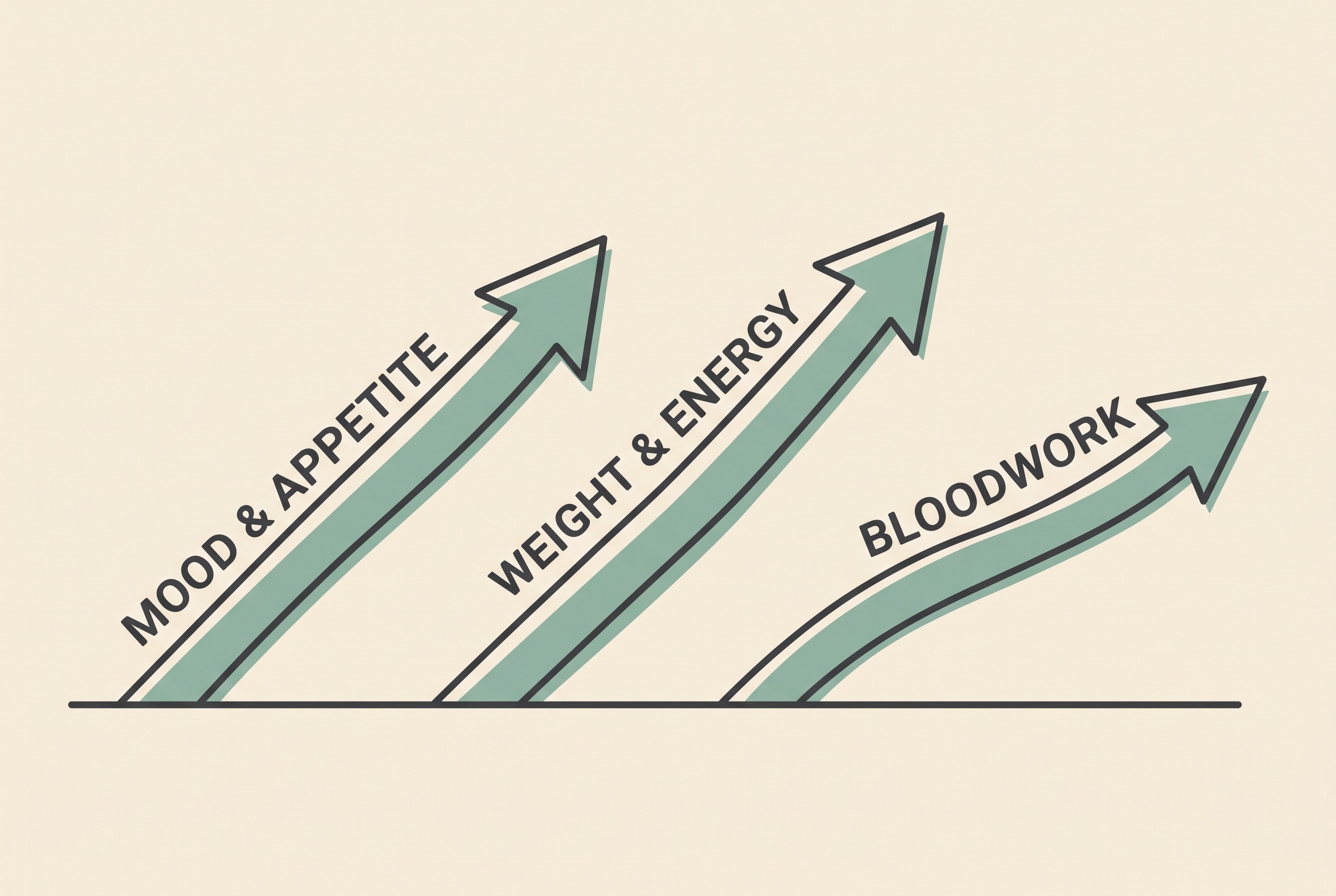
In the first week or two, the earliest wins tend to be a brighter mood, a returning appetite and a settling temperature. Over the following weeks, weight starts to climb and energy builds. The bloodwork tells its own slower story, with some markers taking many weeks to return to normal, which is entirely expected and is covered in bloodwork checkpoints: day 30, 60 and 84. Do not be unsettled if the numbers lag behind how well your cat looks; that is the usual pattern, not a warning sign.
One thing worth knowing so it does not frighten you: in the UK study, over a quarter of cats had an initial worsening of one blood marker (the globulins) before it improved, when it was rechecked early in treatment (Taylor et al., 2023). Recovery is not always a straight line, and an early wobble in the numbers is not the same as failure.
When a note becomes a phone call
Tracking is only useful if you know which entries mean "keep watching" and which mean "ring the vet". As a general steer, one off-meal, one quiet afternoon or a single soft stool is a note, not an emergency. A pattern over two or three days, or any sudden change, is a phone call.
Contact your vet promptly if you see appetite or energy falling away after a period of improvement, weight dropping rather than holding or climbing, a return of the belly or chest swelling, repeated vomiting or an inability to keep doses down, or any new sign involving the eyes or balance and coordination. Anything neurological or ocular, such as wobbliness, a seizure, a marked behaviour change or a changed-looking eye, warrants urgent contact rather than waiting to see, because the forms of FIP that affect the eyes and brain need prompt attention. The full picture of what a genuine setback looks like, versus an ordinary off-day, is set out in relapse: the signs, the timing, what to do, though that becomes most relevant later, in the observation window.
The rule that keeps you sane through all of this: watch the pattern, not the moment. Cats have off-days like anyone. What you are looking for is direction of travel, and that is precisely what your daily notes reveal that day-to-day worry cannot.
Keep it light enough that you actually do it
The best tracking system is the one you will still be using at week ten. If a detailed daily log feels sustainable, keep one. If not, a few taps in the Treatment Companion each day, plus the weekly weigh-in, captures the things that matter most: appetite, energy, weight, and anything that felt different. Consistency beats completeness. A simple record kept every day is worth far more than an elaborate one abandoned by week three.
If more than one person is caring for your cat, share the tracking rather than duplicating it. One shared log, whether that is the Treatment Companion or a note on the fridge, means everyone can see what has already been recorded and nothing falls through the gap between "I thought you'd logged it". It also spreads the emotional weight, which over twelve weeks matters more than people expect. Watching a poorly cat around the clock is tiring, and a shared record lets you take a genuine break knowing the picture is still being kept.
Keep tracking right through to the end of treatment, and then keep a lighter version going into the observation window that follows, because that is when you are watching for any sign the disease is trying to return. The habits you build now are the same ones that will carry you through those next twelve weeks, so it is worth getting comfortable with them early. There is more on that phase in the 84-day observation window.
You are not being asked to diagnose anything. You are being your cat's eyes and memory across a long treatment, so that when your vet needs the picture, you can hand it over clearly. That is a role you are already qualified for, because no one watches your cat as closely, or loves it as much, as you do.
References
- Taylor S, Coggins S, Barker EN, et al. Retrospective study and outcome of 307 cats with feline infectious peritonitis treated with legally sourced veterinary compounded preparations of remdesivir and GS-441524 (2020-2022). Journal of Feline Medicine and Surgery 2023;25(9).
- Taylor S, Tasker S, Barker EN, Gunn-Moore D, et al. An update on treatment of FIP using antiviral drugs (ISFM/UK living document, 2024 edition).
- Thayer V, Gogolski S, Felten S, et al. 2022 AAFP/EveryCat Feline Infectious Peritonitis Diagnosis Guidelines. Journal of Feline Medicine and Surgery 2022;24(9):905-933.
Free downloads
Companion worksheets to put what you've read into practice. Free PDFs, print at home.
Keep track of how your pet is doing
The owners who cope best are the ones who notice changes early. A simple health log shows you what is working, and what is not, before the next vet visit.
Start tracking, freeYou're not doing this alone
Compare treatment journeys and talk to owners managing feline infectious peritonitis (fip). Free to join.
Join PetsLikeMine