

Life after FIP: your cured cat's future
Alastair Greenway
BVM&S MRCVS
There is a particular quiet that arrives after FIP treatment ends well. The daily medicine is done, the observation window has passed, your vet has used the word remission, and after months of living on high alert you find yourself asking a question that would have felt greedy a while ago: what now? Is my cat actually normal? Can they just be a cat again? Do I ever get to stop treating them like a patient?
The short answer, and the one the evidence supports, is yes. A cat who comes through FIP treatment successfully can go on to live a full, ordinary, happy life. This article is about what that life looks like, the handful of practical things worth knowing, and the permission, which you have thoroughly earned, to relax.
Is my cat truly normal now?
For most cured cats, genuinely yes. In the study that followed treated cats most closely for a year after remission, the cats kept their normal weight and quality of life, their blood results stayed stable, and there were no confirmed relapses across that year (Zwicklbauer et al., 2023). These were cats eating, playing, sleeping in sunbeams and generally being unremarkable, which after FIP is the most wonderful word there is.
Their organs come through better than you might fear, too. FIP inflames blood vessels throughout the body, so it's reasonable to worry about lasting damage, but for the majority of cats the bloodwork that was deranged at diagnosis, the raised globulins, the low albumin, the anaemia, returns to normal ranges as they recover and stays there (Zwicklbauer et al., 2023). A cured cat is generally not a fragile cat, and there's no need to wrap them in cotton wool. They can play hard, climb, go outside if that was their life before, and do all the ordinary cat things their body is built for. Holding them back "just in case" tends to cost them more in quality of life than it ever buys in safety.
There is one honest exception, and it belongs to the cats who had neurological FIP. A minority of these can be left with a small residual sign, a slight wobble, a mild head tilt, an occasional unsteadiness, because the nervous system is slower to heal and sometimes doesn't fully reverse (Neurological re-emergence report, 2025). If your cat has a little of this, it usually settles into something they live with perfectly happily rather than something that holds them back. If you want to understand why the neurological form behaves this way, neuro and ocular relapse: the barrier problem explains it. For most cats, though, "normal" really does mean normal.
The practical things worth knowing
Once your cat is cured, life largely returns to the ordinary rhythm of any cat's care. A few specific questions come up often enough to answer directly.
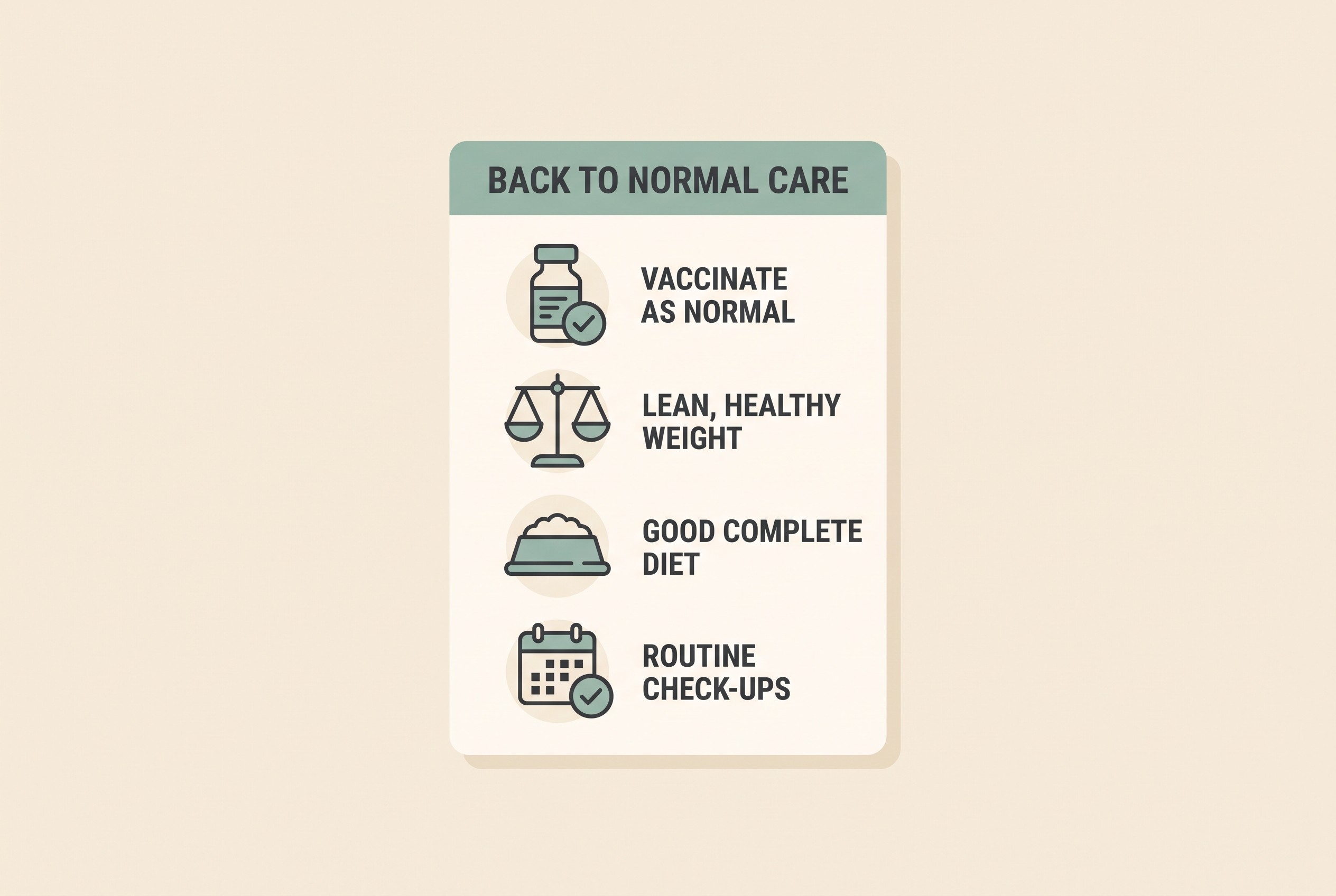
Vaccinations. Owners are sometimes nervous that a routine vaccine might somehow stir FIP back up. Reassuringly, the specialist guidance is that cats can be safely vaccinated after, or even during, successful treatment without causing a relapse (ISFM, 2024). Your cat still needs their normal preventive healthcare, and keeping them protected against the common feline diseases is part of giving them the long life you fought for. Talk to your vet about timing, but don't skip vaccination out of FIP fear.
Neutering. If your cat wasn't neutered before or during treatment, this is usually the time to arrange it once they're fully recovered and your vet is happy. Beyond the usual benefits, it removes the stress of hormones and roaming, and reducing stress is a small kindness to a cat who has been through a lot.
Diet and weight. No special "FIP recovery diet" is needed long-term. A good-quality complete diet appropriate to your cat's life stage is right. Many cats are underweight at diagnosis and gain healthily through treatment, so once they're cured the job flips to the ordinary one: keeping them at a lean, healthy weight rather than letting recovery tip into overweight. Your regular weigh-ins can quietly become a normal wellness habit instead of an anxious one.
Bloods and check-ups. After the intensive monitoring of treatment and observation, your cat returns to routine veterinary care like any other cat. Your vet may suggest a check a few months down the line for peace of mind, but you are moving from "patient" to "healthy cat with an interesting history".
Breeding. If your cat is a pedigree and you'd wondered about breeding from them one day, this is the one place I'd ask you to hold back. Susceptibility to FIP has a partly inherited component, so a cat who developed FIP, and their close relatives, are best kept out of a breeding programme, and responsible breeders take the same view (Pedersen, 2019). It's not a reflection on your cat, who can live a completely full life. It's simply about not passing on the vulnerability. There's more on this in breeders and FIP if it's relevant to you.
Insurance. It's worth a word with your insurer about how they'll treat FIP going forward, because once claimed for, it may be logged as a pre-existing condition, which can affect future cover for anything related. This varies between policies and providers, so ask specifically rather than assume, and it's covered in more depth in does insurance cover FIP?.
When do you actually get to relax?
Genuinely, once the observation window has passed clear and your vet has confirmed remission, you can start living normally. The relapse risk was always concentrated in the weeks right after treatment stopped, and the longer your cat stays well beyond that, the more that risk fades into the background (Taylor et al., 2023). Late relapses happen, but they're rare.
Most owners find the worry outlasts the danger by a while, and that's completely normal. You spent months learning to read your cat for the smallest sign, and that habit doesn't switch off overnight. The healthiest way through it is the one that also keeps your cat safest: know the genuine signs of relapse so a real one would be caught early, and then let yourself trust the wellness in front of you. Knowing the true red flags is exactly what earns you the right to stop watching for them constantly. One day, usually a few months in, you'll notice you haven't thought about FIP in weeks. That day comes.
Will they be more prone to other illnesses?
This is a fair worry, and the reassuring answer is that a cured FIP cat is not a generally weakened cat. FIP is not like a chronic disease that leaves the immune system permanently dented. Once the disease is beaten and the inflammation has settled, your cat's body works as it did before. There's no evidence that recovered cats are unusually prone to catching other infections or to unrelated illnesses later in life (Zwicklbauer et al., 2023). They should be given exactly the same preventive care as any other cat, no more and no less: their vaccinations, parasite control, dental care and routine check-ups, all of which quietly protect the long life ahead of them.
What is worth keeping is the good habit the whole ordeal gave you. You've become an owner who notices changes early and doesn't sit on a symptom, and that instinct serves any cat well across a lifetime, whatever the cause. Just point it at ordinary cat health now rather than at FIP specifically. If anything unrelated crops up in future, mention the FIP history to your vet so it's on the record, and then let them treat whatever it is on its own terms.
The bigger picture
It's worth stepping back to see what you actually did. A decade ago, a cat with FIP was a cat you were going to lose, almost without exception. The treatment that saved yours has only been legally available in the UK since 2021, which means your cat is one of the first generation of cats to survive this disease at all (ISFM, 2024). We don't yet have twenty years of data on that generation, simply because twenty years haven't passed, but the cats we've followed have done extremely well, and every year adds to how confident we can be (Zwicklbauer et al., 2023). Your cat isn't living on borrowed time. They're living on new medicine, and the results so far are genuinely good.
It's also worth saying, quietly, that you learned something in all this. You now know how to give medicine to a squirming cat, how to read a subtle change in demeanour, how to work in partnership with your vet through something frightening. Those aren't skills you'd have chosen to acquire, but they make you a formidable advocate for your cat for the rest of their life, and for any cat you care for in the future. The ordeal took a great deal from you. It also, in its way, left you more capable than it found you.
So let your cat be a cat. Let them nap in the sun, ambush your ankles, ignore the expensive toy in favour of the box it came in. That ordinariness is the whole point, and it's yours to enjoy now. If you ever want to revisit exactly what your vet meant by that final all-clear, what remission really means is there whenever you need it. For now, the most useful thing I can tell you is that there's nothing left to do except love the cat you kept.
References
- Zwicklbauer K, Krentz D, Bergmann M, et al. Long-term follow-up of cats in complete remission after treatment of feline infectious peritonitis with oral GS-441524. Journal of Feline Medicine and Surgery 2023; 25(8). doi:10.1177/1098612X231183250
- Taylor S, Tasker S, Barker E, et al. An update on treatment of FIP using antiviral drugs in 2024 (living ISFM document, editions 2023/2024/2025). International Society of Feline Medicine / International Cat Care.
- Taylor SS, Coggins S, Barker EN, et al. Retrospective study and outcome of 307 cats with feline infectious peritonitis treated with legally sourced veterinary compounded preparations of remdesivir and GS-441524 (2020–2022). Journal of Feline Medicine and Surgery 2023; 25(9). doi:10.1177/1098612X231194460
- Thayer V, Gogolski S, Felten S, et al. 2022 AAFP/EveryCat Feline Infectious Peritonitis Diagnosis Guidelines. Journal of Feline Medicine and Surgery 2022; 24(9): 905–933. doi:10.1177/1098612X221118761
Keep track of how your pet is doing
The owners who cope best are the ones who notice changes early. A simple health log shows you what is working, and what is not, before the next vet visit.
Start tracking, freeYou're not doing this alone
Compare treatment journeys and talk to owners managing feline infectious peritonitis (fip). Free to join.
Join PetsLikeMine