

Neuro and ocular relapse: the barrier problem
Alastair Greenway
BVM&S MRCVS
If your cat had neurological or ocular FIP, or you've been told the disease has reached the brain or the eyes, you're carrying a particular worry that owners of the "wet belly" cases don't always have. You may have heard that these forms are harder to treat, or that they can come back even when the rest of your cat looks completely well. That's true, and pretending otherwise would help no one. But "harder" is not the same as "hopeless", and the reason these forms behave differently is something you can actually understand, which makes it something you can watch for sensibly rather than dread blindly.
The whole thing comes down to two barriers your cat's body builds on purpose, and what they mean for the medicine.
Why the brain and eyes are different
Your cat's body treats the brain and the eyes as precious cargo. It walls them off from the general bloodstream with tightly sealed linings, the blood-brain barrier and the blood-eye barrier, that let in only what's meant to get in and keep out a great deal that circulates freely everywhere else. Most of the time this is a wonderful piece of engineering. When you're trying to get an antiviral drug into those exact places, it becomes the problem.
The medicine used for FIP, GS-441524, reaches the belly, the chest and the bloodstream well. It reaches the brain and the eyes less easily, because those barriers slow it down. The current specialist literature is direct about this: lower drug concentrations in the fluid around the brain are thought to result from limited blood-brain barrier penetration, which is exactly why higher doses are recommended for the neurological forms (Neurological re-emergence study, 2025). The same logic extends to the eye.
That single fact explains almost everything else about these forms. It's why they need a bigger dose. It's why they can be slower to settle. And it's why they carry a somewhat higher chance of coming back, because a virus sheltering behind a barrier the medicine struggles to cross is a virus that's harder to fully clear.
The higher dose, and why your vet may have prescribed it
Because the drug has to get across those barriers in useful amounts, ocular and neurological FIP are treated at higher doses than the straightforward abdominal cases. In the current ISFM treatment guidance, cats without ocular or neurological signs are typically started around 15 mg/kg once daily, while ocular disease is pushed higher, and neurological disease higher still, up to around 20 mg/kg a day, often split into two doses twelve hours apart to keep the level in the body steadier through the day (ISFM, 2024).
I'm giving you those numbers so the plan your vet set makes sense, not so you can check the maths or adjust anything. The dose is per kilogram of your cat's current weight, it is your vet's to set and change, and the point of sharing it is simply this: if your cat is on a higher dose, or a twice-daily schedule, or has been kept on treatment longer than a friend's cat with a belly effusion, that is not a mistake or a sign things are going badly. It is the correct, deliberate response to where the disease is. The splitting into twice-daily doses in particular is about smoothing out the level in the blood so more of it has a chance to cross the barrier, not about giving "more medicine" for its own sake.
The specialists are also honest that the ideal dose and duration for the neurological forms are still being worked out (Neurological re-emergence study, 2025). This is a young treatment, and the CNS cases are the frontier of it. If your vet adjusts the plan as they watch your cat's response, that's good medicine, not indecision.
When the barrier forms relapse
Here's the part that unsettles owners most, so let's meet it plainly. A cat can look well in body, be eating, be a good weight, have a flat belly and clear bloods, and still have FIP smouldering behind one of those barriers. That's why neurological or ocular relapse can appear seemingly out of nowhere in a cat who seemed to be sailing through the observation window.
It's uncommon. Across the wider FIP literature, relapse of any kind sits under 10% (ISFM, 2024), and most cats never relapse at all. But when a relapse does involve the brain or the eyes, it can happen even while the rest of the body reads as healthy, which is precisely why the signs to watch for are different from watching a belly for fluid.
The neurological and ocular red flags are:
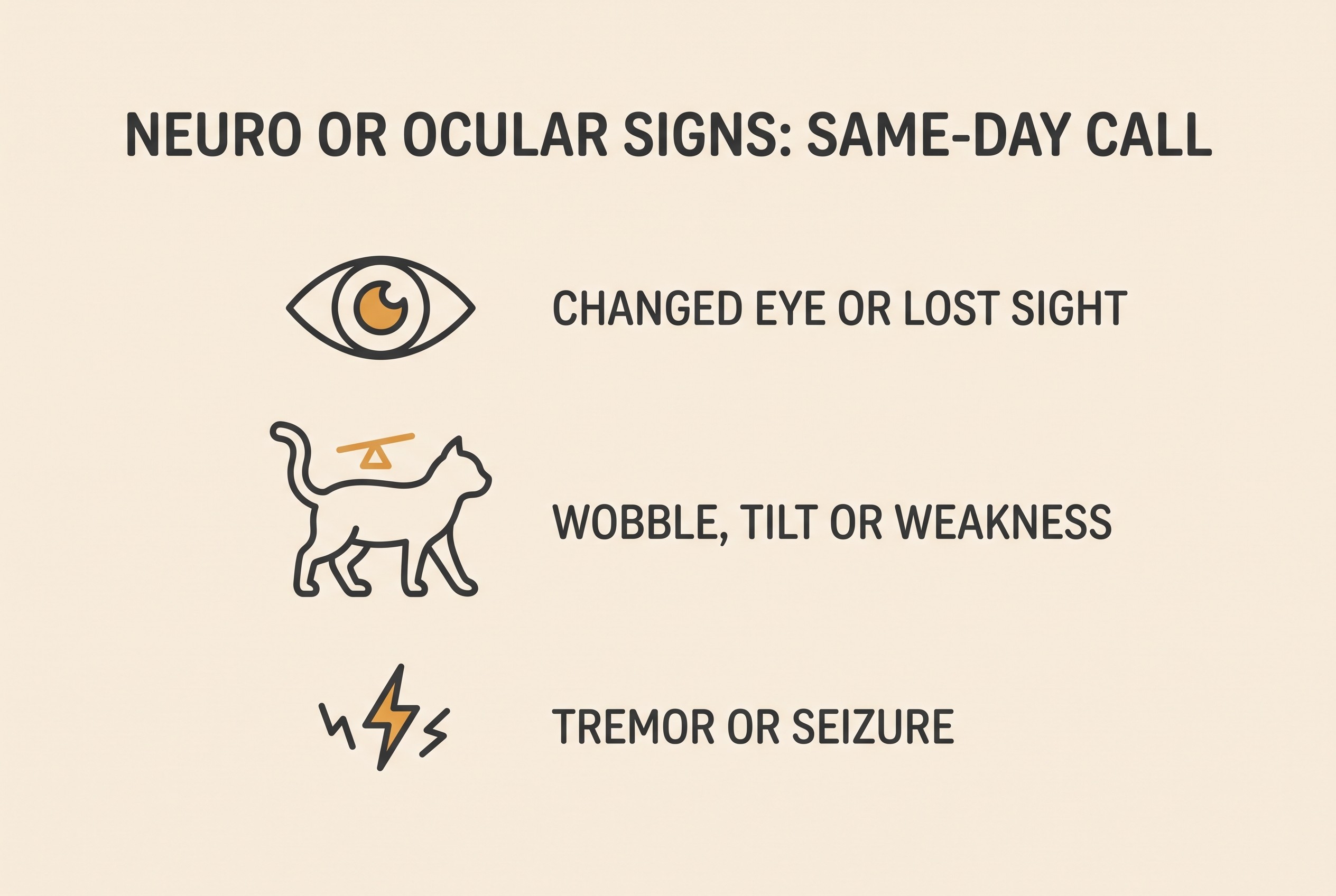
- A change in an eye. A shift in the colour or clarity of the iris, cloudiness, a visible change in the pupil, a cat bumping into things or seeming to have lost some sight. Owners sometimes describe it as the eye looking "different" before they can say how.
- Wobbliness or weakness. Stumbling, a drunken-looking walk, dragging a limb, a head tilt, or trouble judging jumps they used to make easily.
- Tremors or seizures. Any shaking, twitching, or a full seizure. A seizure is always a same-day emergency.
- A change in behaviour or personality. A cat who becomes withdrawn, disoriented, unusually clingy or unusually distant, circles, presses their head against walls, or simply "isn't themselves" in a way you can't put your finger on.
Timing tends to follow the same shape as other relapses, clustering in the weeks after treatment stops, though the neurological literature reports a wide spread of re-emergence timing across different studies, so there's no single safe day to relax completely (Neurological re-emergence study, 2025). In one documented case, lethargy and fever returned about 17 days after treatment ended, with neurological signs following a few days later (Neurological re-emergence study, 2025). The lesson isn't to panic at day 17. It's that a returning fever or a flat, off cat in the early weeks off treatment deserves attention even before any obvious neurological sign appears.
It also means the watching for a neurological or ocular cat is a little different in kind. For a cat who had a belly effusion, you're largely watching the body: appetite, weight, energy, a distended tummy. For a cat who had brain or eye involvement, you add a second layer, watching the eyes and the way your cat moves and behaves, because those are where a relapse can show first while everything else still looks fine. It's worth building this gently into your daily observation: does the eye look the same as yesterday, is the walk steady, is your cat behaving like themselves. Not an anxious inspection, just a familiar glance you learn to do without thinking. The FIP Treatment Companion's observation checklist can prompt these specific checks so you're not relying on memory alone.
What to do, and why early matters so much
If you see any eye change, any wobble, or any tremor or seizure, contact your vet the same day. Not next week's check, not "let's see how tomorrow goes". Same day. With the barrier forms, the medicine already has the hardest job in the body, and giving it a head start while the burden of virus is small is one of the few levers that genuinely helps.
Your vet will assess it properly, which may mean a neurological or eye examination, bloods, and sometimes imaging or sampling the fluid around the brain, to confirm it's a true relapse and not something unrelated. If it is a relapse, re-treatment is very often possible. The specialist approach is to restart or step up treatment at a higher dose, frequently at or towards the neurological dose, and often split twice daily, for a further full course (ISFM, 2024). In the large UK study, most re-treated cats responded (Taylor et al., 2023).
Two honest caveats belong here, because false comfort helps no one. First, the barrier forms can leave a mark. In one detailed case, extended high-dose treatment brought a cat with severe neurological relapse to partial recovery, but a degree of wobbliness remained at long-term follow-up (Neurological re-emergence study, 2025). Some neurological cats recover fully; some are left with a residual tilt or a slight unsteadiness that doesn't stop them living a good, happy life. Second, these are the harder cases, and outcomes are a little less certain than for the straightforward abdominal ones (Gokalsing et al., 2025). None of that means giving up early. It means treating promptly, at the right dose, and judging success by how your cat is doing over weeks, not by expecting a light switch.
What recovery looks like for these forms is worth setting your expectations around, because it's usually gradual and can be genuinely encouraging. Nervous tissue heals slowly, so a neurological cat may improve in steps rather than all at once, a little steadier each week, a little more themselves. Your vet will often track this with repeat neurological or eye examinations rather than a single test, watching the direction of travel. A cat who is slowly getting better, even from a frightening starting point, is a cat the treatment is helping. The residual signs that sometimes remain, a mild tilt or a slight unsteadiness on a jump, tend to be things cats adapt to remarkably well. They don't read them as a loss the way we might. They simply carry on.
The hard line on dosing
Everything above is here so you understand your cat's plan, never so you adjust it. Do not increase a dose, split a dose, or extend a course yourself, and never source medicine outside your vet. The right adjustment for a barrier-form relapse depends on the drug, the current dose and the exact nature of the signs, and it is genuinely a specialist judgement (ISFM, 2024). Your job is the watching and the early call. The dosing is your vet's, prescribed through the legal UK route and monitored by them.
If you're still in treatment, the habit that most protects a neurological or ocular cat from relapse is the same one that protects every FIP cat: weigh weekly and let the dose keep pace with the weight, because a barrier form fought with a dose that's slipped behind is a barrier form given room to come back. And if you want the fuller picture of relapse across all forms, the signs, the timing and what to do sets it out. To understand how these four presentations differ in the first place, the four forms of FIP is the place to start.
What I'd leave you holding is this: the barrier that makes these forms harder is the same barrier that normally protects your cat's brain and eyes every day of their life. It isn't working against you out of malice. It just means the watching has to be a little sharper and the calls a little quicker, and you now know exactly what you're watching for.
References
- Taylor S, Tasker S, Barker E, et al. An update on treatment of FIP using antiviral drugs in 2024 (living ISFM document, editions 2023/2024/2025). International Society of Feline Medicine / International Cat Care.
- Taylor SS, Coggins S, Barker EN, et al. Retrospective study and outcome of 307 cats with feline infectious peritonitis treated with legally sourced veterinary compounded preparations of remdesivir and GS-441524 (2020–2022). Journal of Feline Medicine and Surgery 2023; 25(9). doi:10.1177/1098612X231194460
- Gokalsing E, Ferrolho J, Gibson MS, Vilhena H, Anastácio S. Efficacy of GS-441524 for Feline Infectious Peritonitis: A Systematic Review (2018–2024). Pathogens 2025; 14(7): 717. doi:10.3390/pathogens14070717
- Pedersen NC, et al. UC Davis GS-441524 FIP treatment work, 2019 (legacy by-form dosing and pre-legal context).
Keep track of how your pet is doing
The owners who cope best are the ones who notice changes early. A simple health log shows you what is working, and what is not, before the next vet visit.
Start tracking, freeYou're not doing this alone
Compare treatment journeys and talk to owners managing feline infectious peritonitis (fip). Free to join.
Join PetsLikeMine