

Wet, dry, ocular, neuro: the four faces of FIP
Alastair Greenway
BVM&S MRCVS
You are probably here because you are watching one particular thing and trying to work out what it means. A belly that has swelled up over a few days. An eye that has gone cloudy or changed colour. A back leg that has started to give way, or a kitten that seems suddenly clumsy. Maybe a yellow tinge to the gums or the whites of the eyes. When you search each of these on its own you get a hundred possibilities, and somewhere in the pile is FIP, which is how you ended up here, frightened.
Let me give you the map. FIP does not look the same in every cat, and vets talk about four broad forms: wet, dry, ocular and neurological. They are not four different diseases. They are four faces of the same one, defined by where in the body the inflammation lands. Knowing which face you are looking at helps you understand what your vet is seeing and what treatment tends to involve. And I will say now, because you may be bracing for it, that the form your cat has does not decide whether it can be treated. All four are treatable. Some simply take a higher dose or a longer, more careful course than others.
Before the detail, one thing that trips people up: these forms overlap. A cat can have wet and dry features together, or the eye or the nervous system can be involved alongside fluid in the belly (Thayer et al., 2022). So do not get too fixed on sorting your cat into exactly one box. The point of the four forms is to understand the pieces, not to force a single label.
Wet (effusive) FIP
The wet form is the one most people picture, and it is the most common (Taylor et al., 2023). "Effusive" simply means fluid-producing. In wet FIP, inflammation makes blood vessels leaky, and a protein-rich fluid seeps out and pools in a body cavity.
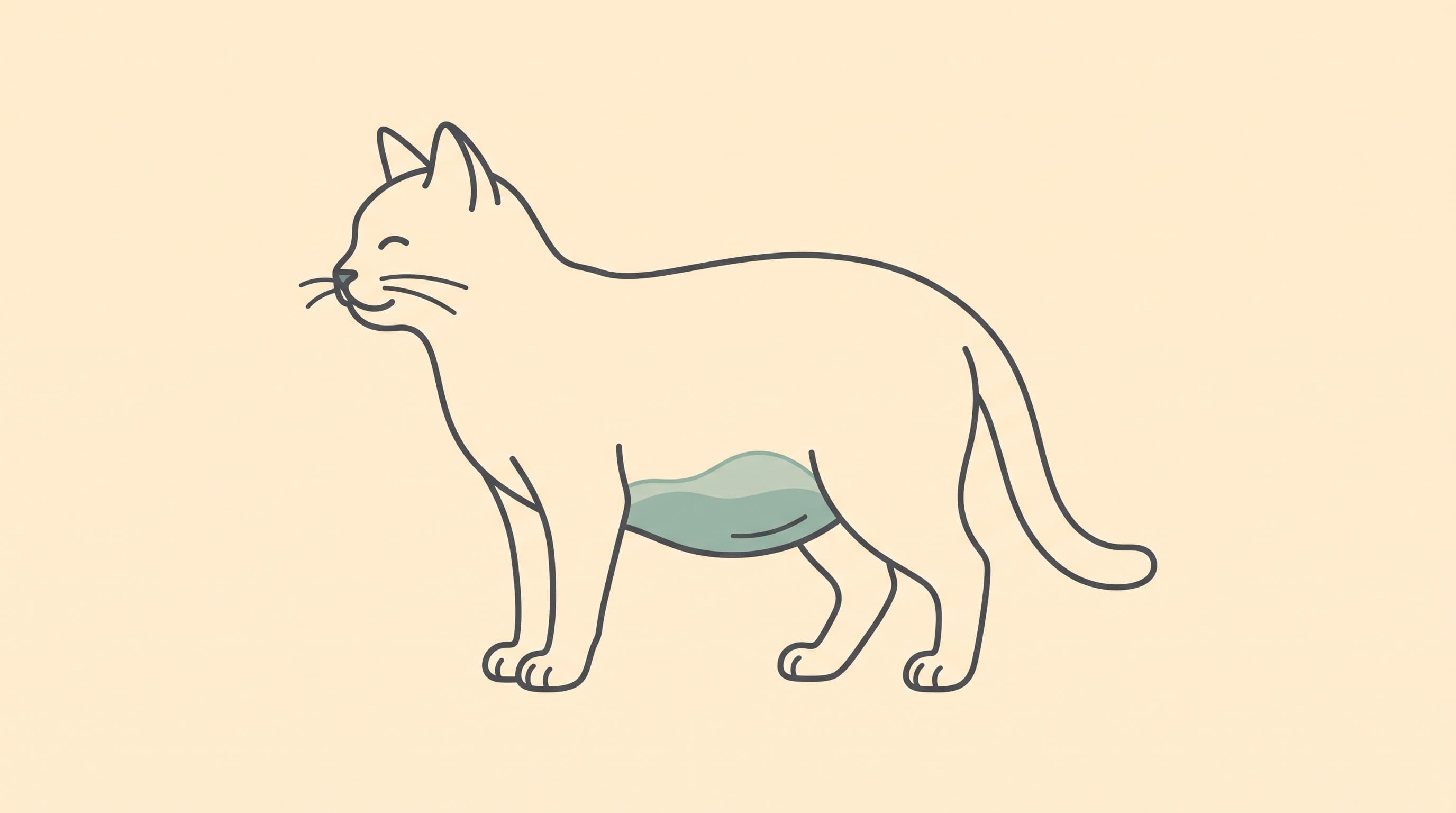
Most often that cavity is the abdomen, so the classic sign is a belly that swells and rounds out over days to a week or two, sometimes while the rest of the cat is growing thinner. It can look, heartbreakingly, like a kitten with a "pot belly". If the fluid collects in the chest instead, the first sign is often changed breathing: faster, shallower, more effortful, or a cat that seems reluctant to lie flat. Any cat that is struggling to breathe is an emergency and needs a vet straight away, whatever the cause.
The reason vets often seem almost relieved to find fluid is that, of all the forms, wet FIP is frequently the easiest to build a diagnosis around. That fluid can be sampled and tells the lab a great deal, which is explained in is it FIP? Why there's no single test. The fluid is doing you a diagnostic favour, even though it looks alarming.
Dry (non-effusive) FIP
The dry form produces no free fluid, which makes it quieter, vaguer and harder to spot. Instead of pooling fluid, dry FIP causes small pockets of inflammation, called granulomas, to form in the organs: the liver, kidneys, lymph nodes, intestines, wherever the mutated virus takes hold (Thayer et al., 2022).
Because it can settle almost anywhere, the signs are frustratingly non-specific. A fever that comes and goes and shrugs off antibiotics. Weight loss, or a kitten that simply stops growing as it should. Low energy, poor appetite, a cat that has gone quietly "off". Depending on which organs are involved you might see jaundice (a yellow tinge to the gums, skin or eyes, which points to the liver), or signs that look like a gut or kidney problem.
This vagueness is exactly why the dry form is the hardest to confirm and often takes the longest to diagnose, since there is no fluid to sample and the whole picture has to carry more weight (is it FIP? covers why). If your cat's diagnosis has felt slow and uncertain, the dry form is frequently the reason, and it is no less treatable for being harder to pin down.
Ocular FIP
Ocular FIP is FIP that shows up in the eyes, and for some cats it is the very first sign, appearing before anything else seems wrong. It happens because the eye, like the brain, sits behind a protective barrier that some FIP virus manages to slip past.
What you might see: an eye that looks cloudy or hazy, a change in the colour of the iris (a brown or muddy tinge creeping across a previously clear eye), blood or a strange "flare" inside the eye, a pupil that looks odd or does not respond normally to light, or simply an eye that looks inflamed and sore. Sometimes it affects one eye, sometimes both.
Any sudden change in a cat's eye deserves a prompt vet visit regardless of the cause, because eyes can deteriorate quickly. In the context of FIP, ocular involvement matters for a specific practical reason: getting antiviral drug into the eye in sufficient amounts usually needs a higher dose than the plain wet or dry forms, because of that protective barrier (Taylor et al., ISFM update 2024 to 2025). Your vet will factor that in, and it is discussed further in neuro and ocular relapse: the barrier problem.

Neurological FIP
The neurological form is FIP affecting the brain and spinal cord, and it is the one that frightens owners most, so let me be careful and clear. Like the eye, the nervous system sits behind a barrier (the blood-brain barrier) that shields it, which is both why neuro FIP is less common and why it needs particular attention in treatment.
The signs come from where in the nervous system the inflammation lands. You might see wobbliness or a drunken, uncoordinated walk; weakness or dragging in the back legs; a head tilt or unusual eye movements; a change in behaviour or personality; increased sensitivity to being touched; or, in more advanced cases, seizures. A kitten that was fine last week and is now stumbling, or a cat that has a seizure, needs to be seen urgently.
Here is the part that matters for hope. Neurological FIP was, not long ago, considered close to hopeless, because the older drugs could not reach the brain well. That has changed. The nervous system forms are now treatable too, but they typically need a higher dose of antiviral, often given as two smaller doses through the day, so the drug can cross the barrier and reach where it is needed (Taylor et al., ISFM update 2024 to 2025). This is a decision for your vet, not a dose to work out at home, and the principle behind it is covered in neuro and ocular relapse. If your cat has the neurological form, you have not been handed a hopeless case. You have been handed one that needs a carefully judged, usually higher-dose plan.
Mixed and shifting forms
Because these are four faces of one disease, they blur into each other, and it helps to expect that rather than be thrown by it. Plenty of cats show a mixture from the start, a swollen belly (wet) alongside a wavering fever and weight loss (dry), or fluid in the abdomen with a subtly changed eye (Thayer et al., 2022). A cat can also seem to shift from one presentation to another over time. None of this means the diagnosis was wrong or that things are spiralling in some special way. It reflects where the virus and the inflammation happen to be active, which can involve more than one place at once.
What this means practically is that you do not need to become an expert in classifying your cat, and you certainly should not lie awake trying to decide which single box it belongs in. Your job is to notice and report changes, especially any new eye or nervous-system sign, and let your vet weigh what they mean. The form matters most as a piece of information that shapes the dose and the monitoring, not as a label you have to get exactly right.
When any of this is an emergency
Most FIP signs develop over days and give you time to book a proper appointment. A few need a vet the same day, whatever the underlying cause. Call for urgent help if your cat is struggling to breathe or breathing fast and shallow (which can mean fluid in the chest), has a seizure, becomes suddenly very weak or collapses, stops eating and drinking entirely, or has a sudden, marked change in an eye. These are worth knowing not to frighten you but so you can tell the difference between "book a visit this week" and "ring now", which is exactly the kind of clarity that is hard to find at 2am on a phone.
What the form does and does not decide
So the four forms tell you where the disease has landed and shape the treatment plan, chiefly whether a standard or a higher dose is needed. What they do not do is sort cats into "treatable" and "untreatable". In the UK study of 307 treated cats, all forms were represented, including the neurological and ocular ones, and the great majority of cats survived (Taylor et al., 2023). The form is a piece of information for your vet to act on, not a sentence.
If you are still trying to work out whether your cat has FIP at all, the next step is understanding how that diagnosis gets built, since no single test settles it: is it FIP? Why there's no single test. If you already have a diagnosis and want the bigger picture of where the disease comes from, start with what FIP is: the coronavirus connection. And when you are ready to think about treatment, the legal UK route through your own vet is set out in FIP is treatable now.
References
- Thayer V, Gogolski S, Felten S, Hartmann K, Kennedy M, Olah GA. 2022 AAFP/EveryCat Feline Infectious Peritonitis Diagnosis Guidelines. Journal of Feline Medicine and Surgery. 2022;24(9):905-933.
- Taylor SS, Coggins S, Barker EN, et al. Retrospective study and outcome of 307 cats with feline infectious peritonitis treated with legally sourced veterinary compounded preparations of remdesivir and GS-441524 (2020-2022). Journal of Feline Medicine and Surgery. 2023;25(9).
- Taylor SS, Tasker S, Barker EN, Gunn-Moore D, et al. An update on treatment of feline infectious peritonitis using antiviral drugs (ISFM living document, editions 2023/2024/2025).
- Pedersen NC. An update on feline infectious peritonitis: diagnostics and therapeutics. UC Davis. 2019.
Keep track of how your pet is doing
The owners who cope best are the ones who notice changes early. A simple health log shows you what is working, and what is not, before the next vet visit.
Start tracking, freeYou're not doing this alone
Compare treatment journeys and talk to owners managing feline infectious peritonitis (fip). Free to join.
Join PetsLikeMine