

What FIP is: the coronavirus connection
Alastair Greenway
BVM&S MRCVS
If you have just heard the letters FIP, whether in the consult room, down the phone, or read off a lab report while you sat in the car park, I want to say the most important thing first, before anything else, because the internet will not say it to you kindly. For most of the time this disease has had a name, FIP was almost always fatal, and that is why nearly everything written about it online is so bleak. That is no longer the whole story. In the space of a few years FIP has gone from a near-certain death sentence to a condition that is usually treatable, and in the UK that treatment is legal and prescribed by vets. So if you have arrived here braced for the worst, please take one steadier breath. The ground is more solid than the old pages make it feel.
This article is the calm, unhurried version of what FIP actually is: where it comes from, why it happened to your cat, and what the four letters really mean. There is no dosing here and nothing you need to act on this minute. It is just the picture, laid out plainly, so the rest makes sense.
What FIP actually is
FIP stands for feline infectious peritonitis, and the name is genuinely misleading, so let's take it apart.
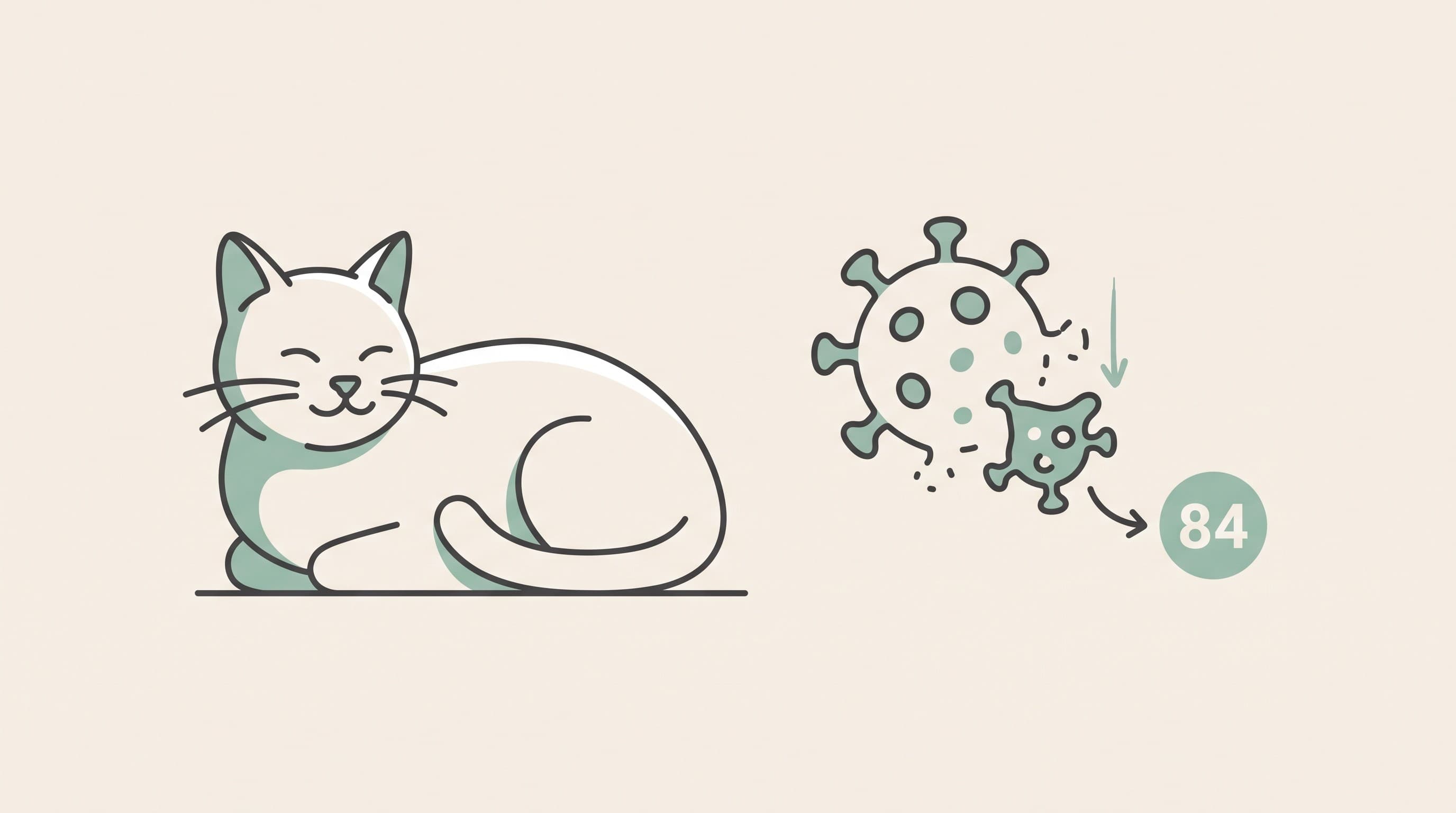
Nearly all cats, at some point, carry a very common virus called feline coronavirus, usually shortened to FCoV. This is not the human COVID virus and it does not pass between cats and people. In most cats FCoV lives quietly in the gut, causes nothing worse than a bout of mild diarrhoea, or often no signs at all, and the cat clears it or carries it without ever being ill. It is so common that in multi-cat homes and shelters the majority of cats have met it, with seroprevalence reaching up to around 90% in those crowded settings (ABCD guidelines, 2022). On its own, this gut virus is not FIP and is not something to fear.
FIP happens when, in a small number of cats, that harmless gut coronavirus mutates inside that individual cat's own body. The changed virus stops behaving like a gut bug and starts infecting the cat's immune cells, spreading through the body and triggering the intense inflammation that makes a cat with FIP so unwell (Thayer et al., 2022). Only a small fraction of cats that carry FCoV ever develop FIP, estimated at roughly 5% in higher-risk multi-cat environments (ABCD guidelines, 2022).
Here is the part that matters most for the fear you may be carrying about your other cats. FIP is not something your cat "caught" as FIP from another cat. It developed from the ordinary coronavirus your cat was already carrying, through a mutation that happened inside your cat. The common gut virus can pass between cats, mostly through shared litter trays. The FIP itself does not spread that way. That distinction drives a great deal of needless panic, and there is a whole article on what it means for the rest of your household (FIP and your other cats).
Why kittens and young cats, and why yours
If your cat is young, you are not imagining a pattern. FIP most often strikes kittens and young cats, typically those under two years old, and more than half of cats that develop FIP are under a year old (ABCD guidelines, 2022). The risk falls away steadily as cats get older, though it never quite reaches zero, which is why FIP in an adult or senior cat, while less common, does happen (there is a separate piece on FIP in kittens versus adult cats).
Nobody can tell you the single reason it was your cat, because there isn't one. What we understand is that a young, still-developing immune system is less able to keep coronavirus replication in check, which makes the crucial mutation more likely (Pedersen, 2019). Stress seems to play a part too, and the timing is cruel: the classic FIP story is a kitten that has recently been rehomed, neutered, vaccinated or moved into a busy household, all the ordinary milestones of early life. Purebred and pedigree kittens appear to be over-represented, and males slightly more than females (Pedersen, 2019).
I want to be plain about one thing, because owners torture themselves with it. This is not your fault. You did not cause this by rehoming a kitten, by having more than one cat, or by anything you did or failed to do. FIP is a piece of very bad luck sitting on top of a virus that is almost everywhere. If you find yourself circling the "what did I do wrong" question, the piece on multi-cat homes and FIP risk exists to answer it honestly and let you put it down.
The four forms, in a sentence each
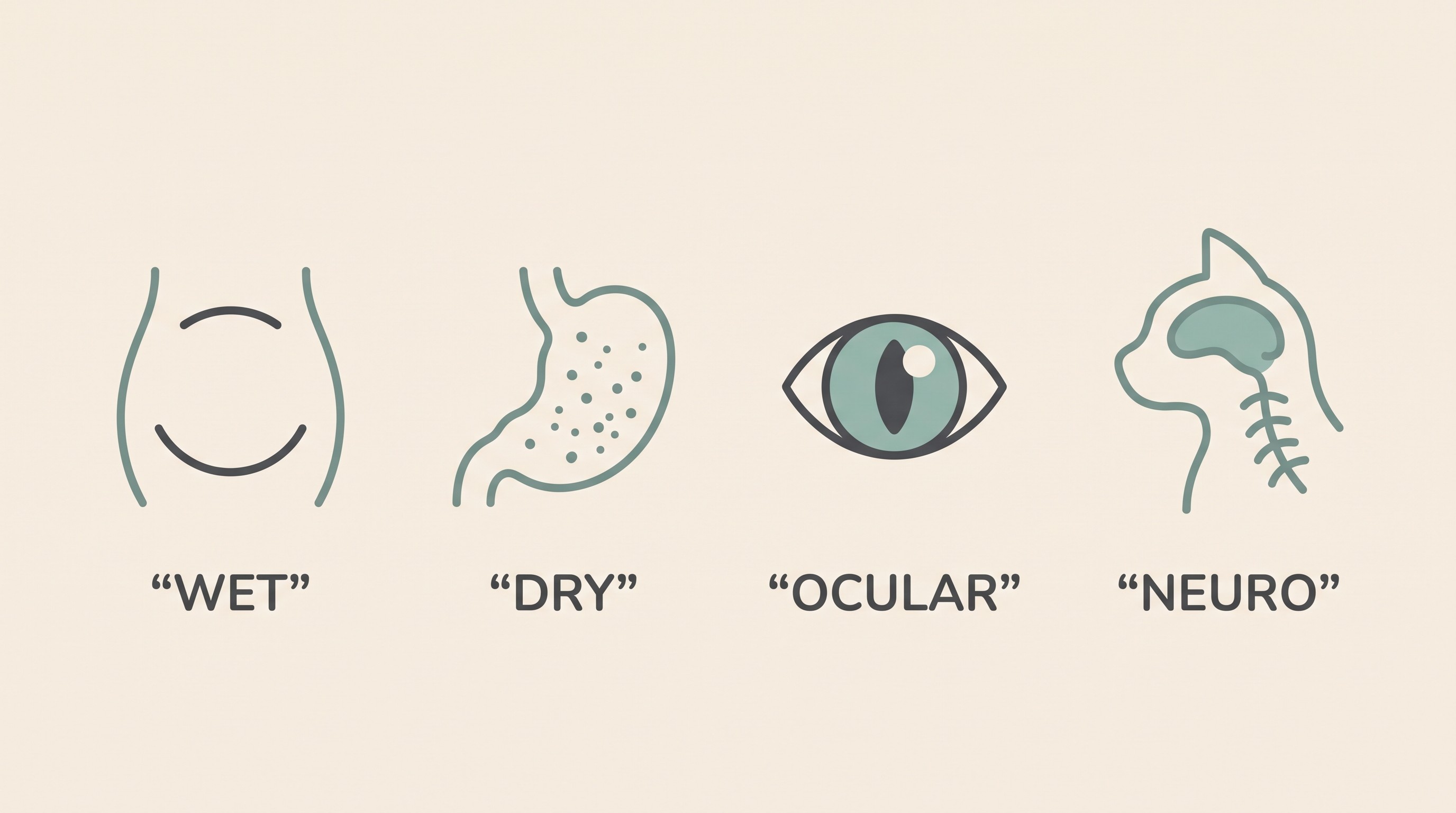
FIP does not look the same in every cat, and the form your cat has shapes what you'll see and what treatment involves. There are four broad presentations, and a cat can have more than one at once.
- Wet (effusive) FIP is the form that causes fluid to build up, most often in the belly, giving a swollen, rounded tummy, or sometimes in the chest, which makes breathing harder.
- Dry (non-effusive) FIP produces no free fluid, and instead causes small pockets of inflammation in the organs, so the signs are vaguer: weight loss, a wavering fever, low energy.
- Ocular FIP involves the eyes, which may look cloudy, change colour, or show signs of inflammation inside.
- Neurological FIP affects the brain and spinal cord, causing wobbliness, changes in behaviour, or seizures.
That is deliberately brief, because each form deserves proper space. The full picture of what to look for, and what each one means for treatment, is in the four forms of FIP.
FIP is rare, and that is exactly why good information is hard to find
One reason you may have struggled to find calm, current, trustworthy information is that FIP is genuinely uncommon. It is thought to account for somewhere around 0.3% to 1.4% of cat deaths seen at veterinary institutions (Pedersen, 2019). Because it is rare, most owners never encounter it, general awareness is low, and the loudest voices online tend to be from the years when nothing could be done.
Rare is a strange kind of comfort, though, and I won't pretend otherwise. When it is your cat, the statistic means nothing. Your cat's illness is not 1% real to you; it is total. Rare simply explains why the information landscape is so poor, not why you should feel any less frightened than you do.
The single fact the old internet won't tell you
Here is the turn, and it is the reason this whole part of the site exists.
FIP used to be almost untreatable. That changed with antiviral drugs, chiefly one called GS-441524 and a related injectable, that directly attack the virus. In real-world studies the results have been transforming. A UK study of 307 cats treated with legally sourced compounded antivirals found that 84.4% were still alive at the longest follow-up point (Taylor et al., 2023). A systematic review pooling many studies of GS-441524 reported a combined treatment success rate of around 84.6% (systematic review, 2018 to 2024). In plain terms, that is roughly eight to nine cats in ten coming through a disease that used to take nearly all of them.
Those numbers are real, they are cited, and I am not going to inflate them. Not every cat is saved, treatment is demanding and it is not cheap, and there is a genuinely hard outcome for a minority of families. Hope earned with evidence is worth far more than false comfort, so I will hold this exactly where the studies hold it: most cats treated for FIP now survive.
And crucially, in the UK you do not have to break any law or buy anything from a stranger online to get this treatment. It is legal here, and your own vet can prescribe it through a compounding pharmacy called Bova UK, under the veterinary prescribing cascade. That legal route is the only one worth your time, and it is set out fully in FIP is treatable now: the legal UK route. Please do not go looking for shortcuts on social media. The safe, legal path runs through your vet, and it works.
What happens from here
If your cat has not yet been given a firm diagnosis, the next thing worth understanding is why FIP is not confirmed with one tidy test, and why "consistent with FIP" is how a careful vet will talk. That uncertainty is normal and it is covered in is it FIP? Why there's no single test.
If treatment is on the table, the arc ahead is usually a course of daily medicine, commonly quoted as 84 days, followed by a further period of observation before a cat is spoken of as likely cured, though newer UK research is actively studying shorter courses (Taylor et al., ISFM update 2024 to 2025). Your vet's plan is the one to follow, and the FIP Treatment Companion is there to carry the daily remembering when you get to that stage.
For right now, the one thing to take with you is the sentence the old internet still won't say: FIP is usually treatable now, it is legal to treat in the UK, and the way in is a conversation with your vet.
References
- Thayer V, Gogolski S, Felten S, Hartmann K, Kennedy M, Olah GA. 2022 AAFP/EveryCat Feline Infectious Peritonitis Diagnosis Guidelines. Journal of Feline Medicine and Surgery. 2022;24(9):905-933.
- Taylor SS, Coggins S, Barker EN, et al. Retrospective study and outcome of 307 cats with feline infectious peritonitis treated with legally sourced veterinary compounded preparations of remdesivir and GS-441524 (2020-2022). Journal of Feline Medicine and Surgery. 2023;25(9).
- Efficacy of GS-441524 for Feline Infectious Peritonitis: A Systematic Review (2018-2024). Pathogens. 2025;14(7):717.
- Pedersen NC. An update on feline infectious peritonitis: diagnostics and therapeutics. UC Davis. 2019.
- Addie DD, et al. Feline coronavirus and feline infectious peritonitis (ABCD guidelines). 2022.
- Taylor SS, Tasker S, Barker EN, Gunn-Moore D, et al. An update on treatment of feline infectious peritonitis using antiviral drugs (ISFM living document, editions 2023/2024/2025).
Keep track of how your pet is doing
The owners who cope best are the ones who notice changes early. A simple health log shows you what is working, and what is not, before the next vet visit.
Start tracking, freeYou're not doing this alone
Compare treatment journeys and talk to owners managing feline infectious peritonitis (fip). Free to join.
Join PetsLikeMine