


Your Pet Has a Terminal Diagnosis: What Happens Now
Alastair Greenway
BVM&S MRCVS
Certain words change the air in a consulting room. "I'm so sorry." "There's nothing more we can do." "It's terminal." "The outlook is poor." Most owners walk out having held on to only half of what came after, having nodded at a plan they can no longer recall, the whole conversation gone quiet around a single sentence. That is not a failure to cope. That is shock, and it is completely normal.
Owners commonly take in only a fraction of what is said once a serious diagnosis lands, the bottom drops out and the rest of the conversation washes past half-heard, and this is recognised plainly in the pet-loss guidance written for exactly this moment (Blue Cross, n.d.; Ohio State University, 2024). So if you cannot remember what your vet told you to do next, you have not let your pet down. You have had a shock, and a shock does that to a person. It is entirely reasonable to ring the practice back and ask them to go over it again, slowly, perhaps with someone beside you this time.
This page is not going to march you anywhere. It has one job, and a gentle one: to slow your breathing, hand you a small and truthful map of the road ahead, and give you permission to plan without rushing you toward the end of it. I am going to tell you what the words actually mean, why a diagnosis is not a stopwatch, what the broad roads in front of you are, and why you are allowed to plan and to hope at the very same time. Nothing here has to be decided today. Let me just help you get your bearings.
First, the small steadying things
Before anything else, two or three calm anchors, not a list of homework. You are in no state for homework tonight, and you do not need it.
Write down the diagnosis, or ask the practice to write it down for you, even just the name of the condition. In the fog of the next few days you will be glad to have it on paper rather than trying to summon it from a memory that was not really recording at the time (Ohio State University, 2024). You do not have to decide anything today, and you should not feel pushed to. And when you go back for the next conversation, the one where decisions actually get made, take someone with you, a second pair of ears for the half you will not hear (Blue Cross, n.d.). That is the whole of it for now. Everything else can wait until you have caught your breath.
I will also say the difficult thing early, because grief and the small hours so often arrive together. A terminal diagnosis can floor a person completely. If the dread is swallowing your sleep, your appetite or your ability to get through the day, or if you find yourself thinking that you cannot go on, please pause here and ring the Samaritans on 116 123. It is free, from any phone, at any hour, and you do not have to be in crisis or "bad enough" to call (Samaritans, n.d.). Loving an animal this much, and being frightened of losing them, is a real and worthy reason to reach out. The rest of this page will keep.
"Terminal", "grave", "poor", "guarded": what the words really mean
When a vet uses one of these words, it is easy to hear all of them as the same thing, and to hear that thing as "imminent". It helps to know that they are not interchangeable, and that none of them is a date.
Broadly, a terminal condition is one that is expected to end life and cannot be cured. A grave prognosis means the outlook is very serious. Poor means a good outcome is unlikely. Guarded is the one most often misheard: it means your vet genuinely cannot yet predict how things will go, not that the news is secretly worse than they are letting on (Veterinary Cancer Society, n.d.). They are all estimates of likelihood, careful professional judgements about probability, and not one of them is a sentence with a date attached.
A prognosis is a probability drawn from many animals, not a clock set for yours. As the Veterinary Cancer Society tells owners directly, "the future of any patient is unknown," and even the best specialist "will not be able to tell you exactly what to expect" (Veterinary Cancer Society, n.d.). That cuts both ways, and I should say so plainly: things can sometimes move faster than feared as well as slower. The point is not a promise of time. The point is that a genuine, unsettling uncertainty has replaced a false certainty, and that is actually a kinder place to stand than the cliff edge your mind may have pictured when the word "terminal" first landed.
A diagnosis is not a timetable
You have been handed information, not a countdown. You have not been given a deadline.
You may have heard, or gone home and found online, an "average survival time" for whatever your pet has been diagnosed with. I understand the pull to read that number as a date in the diary, and I would gently ask you not to. Those figures are population estimates, and the profession is explicit that they "vary significantly between patients" depending on the type of disease, how far it has progressed, and what is done about it (Veterinary Cancer Society, n.d.). A median is a midpoint across many different animals, some of whom did far less well and some far better. Your pet is one individual, not a statistic, and they have not read the study. The number, if one was even quoted, is a rough aid for planning, not an appointment you have to keep.
This holds just as much for the older cat carrying a lymphoma or kidney diagnosis as it does for the dog whose owner has just heard the words "osteosarcoma" or "a mass on the spleen". A terminal diagnosis lands on cat owners and dog owners alike, and the shape of this reassurance is identical for both. Many pets go on to live comfortably for a meaningful stretch after a diagnosis like this. Nobody can promise you how long. But nobody has handed you a stopwatch either, and you do not have to act as though they have.
Three roads ahead, and not a ranking
So what actually happens now? Broadly, families facing a life-limiting diagnosis are choosing among, and very often moving between, three overlapping paths. I want to lay them out clearly, because having a map makes the ground feel walkable. But I want to be equally clear about what this is not: it is not a ranking from "trying hardest" down to "giving up". It is three legitimate roads, and the kindest one is simply the one that gives your particular pet the most good days.
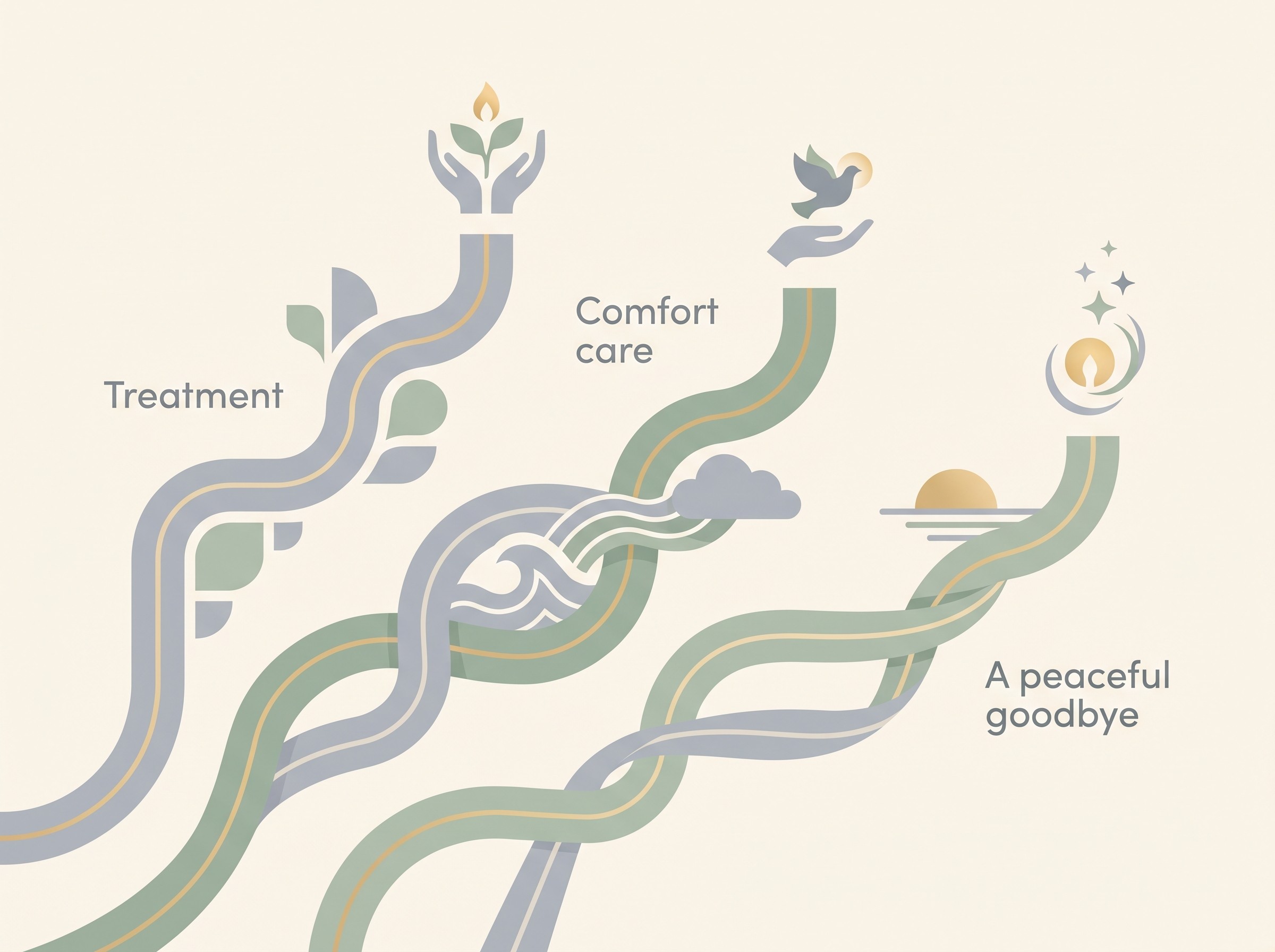
The first road is treatment aimed at the disease itself. This is the curative or disease-modifying route: surgery, chemotherapy, heart or kidney medication, and so on, depending on the diagnosis (Lap of Love, n.d.; AVMA, n.d.). Sometimes the aim is to cure. Far more often, with a terminal condition, the realistic aim is to buy good-quality time, to hold the disease back and keep your pet well and themselves for as long as can reasonably be managed.
The second road is palliative and comfort care, and there is an important point to make here, because the word "palliative" frightens people who hear it as code for "the end". It is not. Palliative care is symptom and pain management, and it "can be provided along with curative treatment" to ease suffering, "regardless of life stage" (AAHA, n.d.). It can run alongside disease treatment or instead of it. It is not the moment hope stops. It is comfort, and it can begin now, today, whichever other road you are also on.
The third road is knowing when to stop, and choosing a peaceful goodbye. This includes hospice-supported time and, when comfort can no longer be maintained, a gentle, planned ending. I am naming this road because it exists and a complete map shows every road, not because I am opening that decision tonight. You do not have to look down it yet. When and if the time comes, the decision is its own careful thing, and there is a piece that walks through it with you in how will I know when it is time. I will only say the one sentence that belongs here and then hand it on: no one can make this decision for you, but you do not have to make it alone, and your vet will help you weigh it.
Choosing comfort over more disease treatment is not giving up. Choosing to keep treating is not denial. Different families, different pets, different right answers, and not one of them is a failure of love. Most owners do not pick a single road and march down it anyway. They move between them as things change, which is exactly as it should be.
Palliative care and hospice are real, defined things
Because those two words get used loosely and frighten people, let me define them once, cleanly, and then point you to the place that does them justice.
Palliative care is the active, total care of a pet with a life-limiting illness, focused on comfort and quality of life rather than cure (IAAHPC, n.d.; AAHA, n.d.). Animal hospice is the next stage of that same care for a pet who is genuinely near the end, and the line I find owners hold onto is this: hospice "is not a place; it is a philosophy of care" (IAAHPC, n.d.). It includes planning gently for the decline, knowing what to do if a crisis arises, and thinking about how you would want your pet to die (AAHA, n.d.). Importantly, none of this is a DIY consolation prize you cobble together alone, and none of it shuts any door: "the decision to seek hospice care does not necessarily rule out euthanasia" (IAAHPC, n.d.). The veterinary profession frames good end-of-life care as letting a terminally ill animal "live comfortably," with the option of euthanasia included and the animal's comfort and quality of life always the guide, delivered by a team that includes a vet skilled in pain management (AVMA, n.d.).
That is the definition. The actual building of a comfort plan at home, the equipment, the day-to-day of it, and how to look after yourself while you do it, has its own full piece in pet hospice: comfort care at home. For now you only need to know that comfort care is a real, vet-directed thing, and that it can start whenever you and your vet decide it should.
The goal of every road is the same: a good life, for as long as it is good
Whichever path you find yourself on, the organising aim is not length at any cost. It is comfort and quality of life (AAHA, 2016; AVMA, n.d.). And here is something genuinely useful you can begin to do for yourself, even tonight: you can start to picture what "a good day" actually looks like for your pet. The Veterinary Cancer Society advises owners to "define what 'good quality of life' is for your pet" early in the process, because good quality of life is the thing that matters most, the thing every other decision serves (Veterinary Cancer Society, n.d.).
The profession has a shared yardstick for this, the Villalobos HHHHHMM scale, which scores seven everyday things: Hurt, Hunger, Hydration, Hygiene, Happiness, Mobility, and More good days than bad. I am naming it here only so the term is not a stranger when you meet it again. I am deliberately not going to teach it on this page, and I would gently steer you away from scoring your pet against it tonight, because a tool like that belongs further down the road, at the point where you have chosen to engage with the harder questions, not in the first stunned hours. When you want it, the scale dimension by dimension is laid out in measuring quality of life: the HHHHHMM scale. A score, when you do reach for it, is a prompt and a tracking aid. It is never a verdict.
You are allowed to plan and to hope at the same time
So many owners get caught between two unhappy extremes: a frantic denial that refuses to think about what may come, or a premature despair that has already given the pet up while they are still curled warm on the sofa. There is a steadier place to stand, and it is the healthiest one there is. You are allowed to do both at once.
Planning gently for what might come, talking openly to your vet about what the road could look like, thinking ahead about the practicalities, none of that means you have given up hope or that you are somehow wishing the loss closer. Holding hope and preparation together, uneasily but truly, in the same week, is not a contradiction. It is wisdom. And there is a quieter, related feeling that may already have crept in: a grief for a pet who is still here, still eating, still pleased to see you. If you have caught yourself mourning an animal who is presently very much alive, that is normal, and it is not disloyal, and you are not being morbid. The grief that begins before the loss even has a name, and there is a whole piece written for it in anticipatory grief: mourning a pet who is still here. I will not develop it here, except to say: that feeling is allowed, and you are in a great deal of company.
Why a calm plan now beats a forced decision later
Wondering whether it is too soon to be reading any of this, whether thinking ahead is somehow getting ahead of yourself? Here is the strongest practical reason to orient gently now rather than later.
Decisions made in a crisis feel forced, and forced decisions are crueller to everyone, you most of all. The Ohio State Honoring the Bond programme puts it plainly: "it is recommended that you start thinking about these issues early in the process, when your mind may be more clear. Decisions may seem forced or pressured if you wait until there is a crisis" (Ohio State University, 2024). Lap of Love say the same thing in their own words, that you should not wait until you are facing a crisis to raise your concerns, that it is genuinely all right to start planning for the future, and that your vet is "your partner in this process" (Lap of Love, n.d.).
So planning now is not rushing toward the end. It is the opposite. It is a kindness to the calmer version of you who will be very glad, on some harder day down the line, not to be deciding everything at once in a panic at three in the morning. You are not bringing anything closer by thinking about it. You are simply making sure that, whatever comes, you meet it with clear eyes rather than under ambush.
Assembling your support
Your vet and the practice team are your partners and your single best source for what this diagnosis means for your pet (Lap of Love, n.d.; AAHA, n.d.). When you go back, take the questions you could not think of in the room, because it is normal to go blank in there, and the ones worth asking are gathered for you in the questions to ask your vet about a poor prognosis. Tell the people close to you how hard this is, and let them in. And know that the rest of this space is laid out as the road itself, with a room for each part of it: comfort care at home when you want it, the decision when and if it comes, and, far off or near, the pieces that will meet you there. You do not have to read any of them tonight. They will be there when you need them.
And here is the thing most owners genuinely do not know: you are allowed to ask for support now, while your pet is still alive and breathing beside you. You do not have to wait for a loss to be permitted to grieve or to be helped. The Blue Cross Pet Bereavement Support Service exists for exactly this, and it says so plainly: it supports people facing the anticipated loss of a pet, not only those who have already said goodbye. It is free and confidential, open every day of the year from 8.30am to 8.30pm, on 0800 096 6606 and by email, staffed by people trained specifically in pet loss (Blue Cross, n.d.). Reaching out today, with your pet asleep at your feet, is not too soon. The Ralph Site, a free pet-loss resource founded by a vet, offers information, online memorials and a community of people who understand (The Ralph Site, n.d.). If you have a cat, Cats Protection's Paws to Listen runs a free, confidential line on 0800 024 94 94, Monday to Friday, 9am to 5pm, staffed by trained volunteer listeners, for anyone affected by the loss of a cat, including loss through euthanasia (Cats Protection, n.d.). And Dogs Trust offers gentle bereavement support, with the decent guiding line that you may grieve in your own way and at your own pace (Dogs Trust, n.d.). The fuller directory, for whenever you need more of it, is gathered in pet loss support: where to turn.
Nothing has to be decided today. You have been given information, not a deadline, and the road ahead has far more rooms in it than just the last one. You are allowed to walk it slowly, hoping and planning at the same time, leaning on your vet and on the people who love you, and on the ones, right now, who will pick up the phone while your pet is still here. Tonight has no task in it at all except to breathe, to be near them, and to let yourself off the hook for not having it all worked out yet. That part can wait. They are still here, and so are you.
References
- American Animal Hospital Association (AAHA). (n.d.). End-of-Life Care for Pets (12 Things Pet Owners Should Know About End-of-Life Care for Dogs and Cats).
- American Veterinary Medical Association (AVMA). (n.d.). Veterinary End-of-Life Care (AVMA policy); End-of-Life Care for Your Pet.
- Bishop, G., Cooney, K., Cox, S., Downing, R., Mitchener, K., Shanan, A., Soares, N., Stevens, B., & Wynn, T. (2016). 2016 AAHA/IAAHPC End-of-Life Care Guidelines. Journal of the American Animal Hospital Association, 52(6), 341-356.
- Blue Cross. (n.d.). Pet bereavement and pet loss support; Preparing to say goodbye to your pet.
- Cats Protection. (n.d.). Paws to Listen grief support service.
- Dogs Trust. (n.d.). Coping with the loss of your dog (bereavement support).
- International Association for Animal Hospice and Palliative Care (IAAHPC). (n.d.). FAQs / Animal Hospice and Palliative Care.
- Lap of Love Veterinary Hospice. (n.d.). Discussing End-of-Life Options With Your Veterinarian; What Is Palliative Care for Pets?
- Ohio State University Veterinary Medical Center, Honoring the Bond Program. (2024). How Will I Know? Assessing Quality of Life and Making Difficult Decisions for Your Pet. The Ohio State University Veterinary Medical Center.
- Samaritans. (n.d.). Contact a Samaritan.
- Spitznagel, M. B., Jacobson, D. M., Cox, M. D., & Carlson, M. D. (2017). Caregiver burden in owners of a sick companion animal: a cross-sectional observational study. Veterinary Record, 181(12), 321.
- The Ralph Site. (n.d.). Support for pet loss.
- Veterinary Cancer Society. (n.d.). Pet Owner Resources.