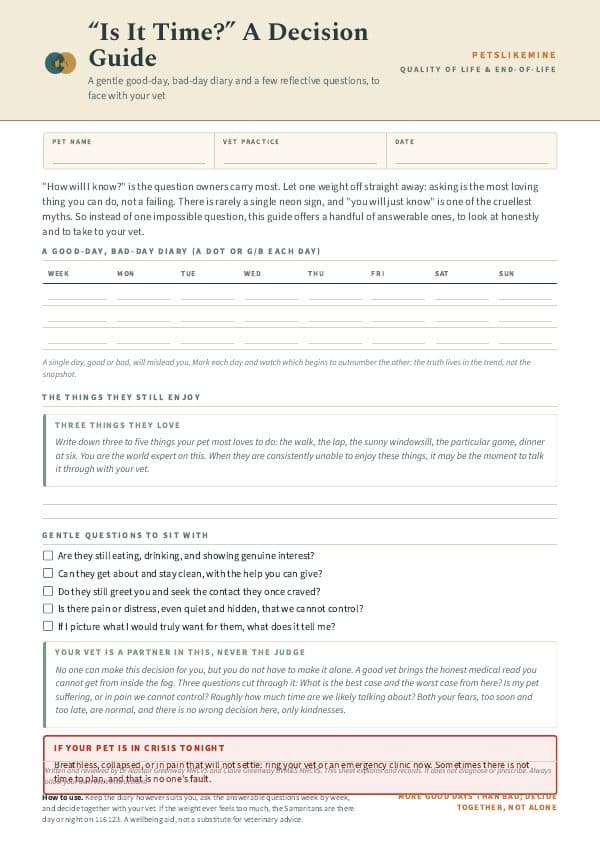
The Questions to Ask Your Vet About a Poor Prognosis
Alastair Greenway
BVM&S MRCVS
A scene plays out in the consult room more often than you would think. I say the word, the grave one, the one that changes the shape of the next few weeks, and something behind the owner's eyes simply closes. They nod. They say "right," or "okay." And every question they meant to ask, the careful, sensible questions they had half-formed on the drive over, dissolve on the spot. Then they get to the car, sit in the cold for a minute, and the questions come flooding back all at once, with no one left to answer them.
The most useful thing I can tell you is this. Going blank in that room is not a failure of nerve or love. It is what shock does to a brain, and it happens to almost everyone, including, I promise you, to vets sitting on the other side of the table when it is their own animal. This page exists to put the questions back in your hands, so that the words are there even when you cannot find them. It is a toolkit for a conversation, nothing more and nothing less. If you have only just been told and the ground is still moving, your pet has a terminal diagnosis: what happens now is the gentler place to start, and the feelings of this stage, the ache of grieving a pet who is still here, are held in anticipatory grief: mourning a pet who is still here. What I want to give you here is narrower and very practical: the questions that get you out of that room understanding what you are facing, instead of just carrying the dread.
Why the mind goes blank, and why that is normal
Let me dispense with the shame of it properly, because owners are so hard on themselves for it. When you are frightened, the part of your brain that plans calm, ordered questions is the first thing to go offline. You are not being scatty or stupid. You are being human in the exact circumstance human brains find hardest. The point of writing the questions down in advance, or printing the checklist at the foot of this page, is not that you are incapable. It is that nobody, in the worst news of their year, should have to also generate the right questions from scratch. You bring the list; the list does the remembering for you.
There is a second reason this matters, and it is the one that gives you permission to ask at all. You are not imposing on a busy professional by asking questions. You are doing precisely what the system is built around. Under the Royal College of Veterinary Surgeons' Code of Professional Conduct, informed consent "can only be given by a client who has had the opportunity to consider a range of reasonable treatment options (including euthanasia and the option to monitor the animal without further tests or treatment), with associated fee estimates" (RCVS Code, supporting guidance 11.2). Your vet is professionally expected to explain the nature, purpose and benefits of any treatment, and "the likely outcomes of any treatment or procedures with a clear indication of both common and serious risks presented in a way that the client understands" (RCVS Code, 11.2). More than that, the Code says vets and nurses "should encourage clients to take a full part in any discussion and to ask questions about their options or any other aspect of their animal's care" (RCVS Code, 11.13), and "should use language appropriate for the client and explain any clinical or technical terminology that may not be understood" (RCVS Code, 11.14). Asking is not a nuisance. It is the thing a good consult is supposed to contain, and a good vet welcomes it.
It helps to know that the conversation you want is the one most owners want too, and that having it well genuinely changes how the whole thing feels. When researchers looked at how pet owners experience veterinary consultations, most, 64.9%, expressed a strong preference for sharing the decision with their vet rather than being handed a verdict or left to decide alone, and owners' satisfaction with the consultation correlated significantly with how much that shared decision-making actually happened (Spearman's rho 0.526, p < 0.001), while the vet's own sense of how shared it had been did not predict the owner's satisfaction at all (Ito et al., 2022). In other words, the half of the conversation that is yours matters, and asking these questions is how you take it up.
A handful of questions, grouped so you can actually hold them
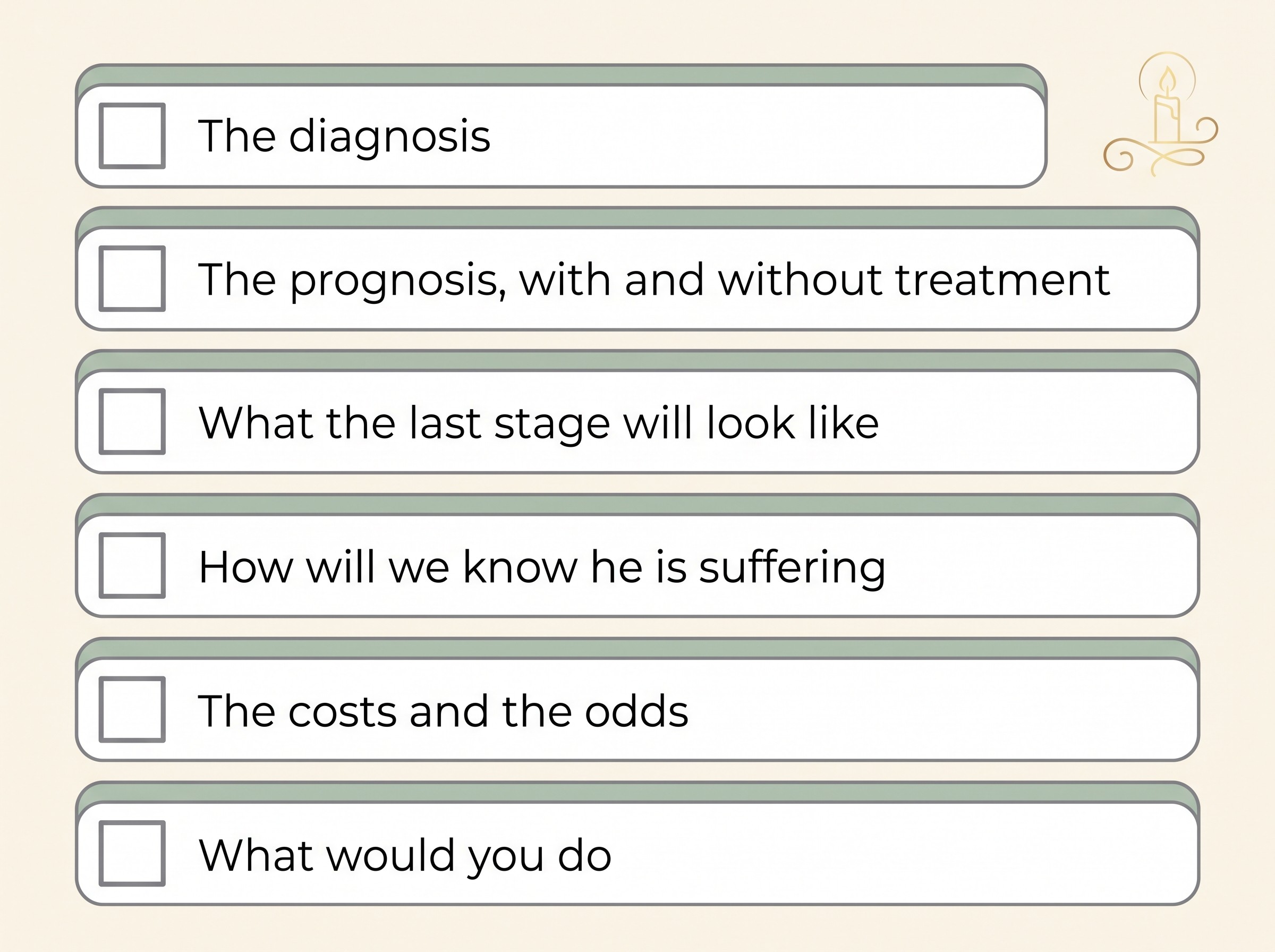
You do not need twenty questions. You need a handful, in an order that follows the shape of the decision, so that one answer leads naturally to the next. I think of them in six small groups. Take them in whatever order the conversation allows, and do not worry about getting through all of them in one sitting.
1. What exactly is the diagnosis, and how certain are you? Start here, because everything downstream depends on it. Is this a confirmed diagnosis or a strong suspicion? What is it based on, and is there a test that would make it more certain, and would that test change what we do next? It is entirely fair to ask a vet to say, plainly, how sure they are. "We cannot be certain" is not a dodge or a sign of a vet who does not know their job. It is often the most truthful answer medicine can give, and hearing it as candour rather than evasion will serve you well through everything that follows.
2. What is the realistic outlook, with treatment and without it? This is the prognosis, and the single most important thing to understand about it is that a prognosis is information, not a countdown. If your vet offers a survival figure, ask what kind of figure it is. A median survival time, the number most often quoted, is a statistical midpoint and nothing more: it is the point at which half of the animals in a study group had died and half were still living, which means individual animals with the very same diagnosis can live a good deal shorter or a good deal longer, and the spread around that middle number is often wide (this is simply how a median works, and veterinary oncologists are careful to stress it, dvm360 oncology proceedings). So the question to ask is not "how long has he got," which no vet can truthfully answer, but "what is the realistic range, and what does the best case and the worst case look like from here?" Ohio State's Honoring the Bond programme suggests asking exactly this: "What are the best and worst case scenarios for the available options?... Are you able to estimate my pet's life expectancy?" (Ohio State, 2024). Ask it for both forks, with the treatment on the table and with no treatment at all, because you cannot weigh a path until you can see where both roads lead.
3. What will the last stage actually look like? This is the question owners most want to ask and most fear asking, and I want to give you explicit permission for it, because knowing the answer in advance is one of the kindest things you can do for both of you. You are allowed to say: "I would rather know what to expect, even the hard parts, so I am not blindsided." Knowing the likely trajectory ahead of time "enables practical and emotional preparation" (Lam et al., 2023), and it is a normal, answerable question that a good vet will not flinch from. You do not need the full picture of what the end looks like here on this page, that belongs further along in this space, but you do need to know that asking for it, in the room, is entirely reasonable. The vets who deliver this kind of news are taught to follow your lead on how much you want to hear (the established framework, the SPIKES model, literally builds in a step, the Invitation, where they invite you to say how much detail you want) (Shaw & Lagoni, 2007). So tell them. Inviting the knowledge, from your side, gives them permission to be straight with you.
4. How will we know if he is suffering? This is the pivot. Everything else is detail around this one. Ask your vet plainly: how will I be able to tell if he is in pain or distress, what should I be watching for at home, and what would tell us his comfort is slipping? Here, more than anywhere, the vet is your trusted broker, and I will come back to that role at the end because it is the heart of all this. For now hold the question itself: not "is it time," which no one can answer for you, but "how will I know he is suffering," which your vet can genuinely help you learn to see. The framework for reading that yourself, once you are home, is owned by how will I know when it is time?; here it is simply a question to ask.
5. What will it cost, what are the odds, and what will it ask of him and of me? Three things sit in this group, and all three are fair game. Cost first, because owners agonise over whether they are even allowed to raise it. You are, completely. The RCVS requires your vet to provide fee estimates and to agree financial limits with you, advises that "it is wise for any estimate to be put in writing, or on the consent form, and to cover the approximate overall charge for any procedure or treatment including VAT" (RCVS Code, 11.24), and requires that if it becomes evident an estimate or a client-set limit "is likely to be exceeded, the client should be contacted and informed" (RCVS Code, 11.25). Money is a legitimate, expected part of this conversation, and asking "what will this cost, and what are the chances it buys him meaningful time?" is not shameful in the slightest. Everyone has limits; that is human, not cruel, and I will not have an owner feel otherwise in my room or on this page. Second, the odds: "how likely is this treatment to work, and what does 'work' mean here, a cure, more time, or just feeling better for a while?" Third, and just as important, the burden on your pet and on you. Ask "what will treatment actually be like for him, day to day?" not only "will it work?" Ohio State's own self-questions are worth borrowing here: will his "pain or anxiety about upcoming procedures be well-controlled," is the procedure "likely to give my pet good quality of life for some period of time," and can you sustain the caregiving it asks of you, the "lifting or assisting with walking, assisting with bathroom functions... giving medication, preparing special food, or monitoring overnight" (Ohio State, 2024). A treatment that works on paper but is misery to deliver, for him or for you, is a different proposition from one that does not, and you deserve to see that clearly before you choose.
6. "What would you do, if he were yours?" I am often asked whether this question is fair to put to a vet, and my answer is yes, asked in the right spirit. It does not ask your vet to make the decision for you; it invites their candid perspective as someone who has stood where you are standing many times, and a good vet will frame their answer exactly that way, as one valuable view among the things you are weighing, not a verdict. Most owners want their vet's candid read (Ito et al., 2022), and there is nothing wrong with asking for it directly. Just hold it lightly: it is a window into what your vet genuinely thinks, not an instruction, and the decision remains yours.
Ask about comfort and palliative care, explicitly, by name
One question is so easily missed it deserves its own section, because the framing of these conversations can quietly trick you. It is natural to assume the choice is "treat to cure" or "do nothing," and to hear those as the only two doors. They are not. There is a whole middle path, palliative and comfort care, focused not on curing the disease but on keeping your pet comfortable and content for whatever time remains, and in my experience it is the option owners least often realise exists, partly because it is not always offered unless it is asked for.
So ask for it by name. "What are the options for keeping him comfortable, rather than treating the disease itself? What would 'doing less' look like, and is that a reasonable path here?" This is not giving up, and it is not a lesser kind of love. The RCVS explicitly names "the option to monitor the animal without further tests or treatment" as one of the reasonable options every client is entitled to consider (RCVS Code, 11.2), and the research on what owners actually value is clear that being shown the full menu matters: owners need "clear information about the probabilities of both positive and negative health outcomes," benefit when a vet is upfront about the downsides early, and value being told plainly that "there were options to managing his illness and quality of life: surgery and/or palliative treatment" (Lam et al., 2023). The professional consensus in small-animal end-of-life care is that the veterinary team should lay out the whole range, including palliative and hospice care, not just curative treatment or euthanasia (Bishop et al., 2016). The detail of how you build that comfort plan with your vet, the equipment, the day-to-day, belongs to pet hospice: comfort care at home in the final chapter. Your job in the consult is simply to make sure that door gets opened, by asking about it out loud.
Making sense of two answers that land oddly
A couple of the answers you get will land oddly if you are not ready for them, so let me translate them in advance.
When your vet says "we cannot be certain," hear honesty, not evasion. There is rarely a single clear answer in this territory, and the structured decision tools that exist in veterinary medicine are still maturing: a scoping review of end-of-life decision-making models in dogs, cats and equids screened the literature and found a limited and varied evidence base, with no single validated tool that resolves the question, which is precisely why the conversation between you and your vet carries the weight (Cameron et al., 2022). Uncertainty is not a gap in your vet's knowledge; it is the nature of the thing. The same goes for any survival figure: a median is the middle of a wide range, not a deadline, so ask for the range and hold the single number loosely.
And if a quality-of-life score comes up, hear a prompt, not a verdict. You may be encouraged to score your pet's quality of life, in the clinic or on a tool, and bringing structured observations to the consult is genuinely helpful, because it makes a vague worry concrete and gives you and your vet a shared language. But be clear-eyed about what a score is. Of nine generic quality-of-life tools reviewed, "although at least one aspect of reliability and validity was assessed for seven of the tools, none were validated across all measures" (Fulmer, Laven & Hill, 2022). A score is an observer-reported input to a conversation, never a definitive measure of your pet's wellbeing, and certainly never an instruction. The canonical scale most vets use, Dr Alice Villalobos's HHHHHMM, and how to use it well, has its own guide in measuring quality of life: the HHHHHMM scale. Treat the number as a way of starting the conversation, not ending it.
Running the appointment so it actually works
The questions only help if you can get the answers down and keep them. A few simple, doable things make an enormous difference, and none of them are cheeky to ask for.
Bring someone with you if you possibly can. A second person is a second memory, and will catch what shock makes you miss. Ohio State suggests enlisting trusted others, and specifically valuing the perspective of "someone who sees your pet less frequently, since your pet's gradual decline... may be more obvious to them" (Ohio State, 2024). Write the answers down as you go, or just ask: "do you mind if I record this on my phone, so I do not lose it?" Almost every vet will say yes. Ask them to write down the plan and to put any estimate in writing, which the RCVS already expects of them (RCVS Code, 11.14, 11.24). And if you can, book a longer appointment or the last slot of the day, so the conversation is not racing a waiting room. It also helps to start a simple diary of good days and bad to bring back next time: as the PDSA puts it, "it can help to keep a diary or a log to track changes over weeks, or even months" (PDSA). In the app, the Quality-of-Life Check walks you through a structured snapshot in a few minutes, a tidy thing to bring to the consult. If you would like that tracked and plotted over time, Sightline (sightline.vet), a separate ConciergeVet tool, runs a short adaptive weekly assessment with a quality-of-life focus mode built around exactly these frameworks, tracks a single composite score over time, and produces a Sightline Report PDF you can bring to your vet. There is no hard paywall on any of it, and you never need a tool to do this well: a written log, or our printable QoL sheet, does much the same job. The point is only to walk in with something concrete, rather than holding it all in your head on the worst day.
You do not have to decide in the room
Almost nothing has to be decided today. Unless your pet is in a genuine crisis right now, you are allowed to say, in the room, "I need to take this home and think. Can we book a time to talk again?" That is not weakness or indecision. It is wisdom. Ohio State's guidance puts it well: "it is recommended that you start thinking about these issues early in the process, when your mind may be more clear. Decisions may seem forced or pressured if you wait until there is a crisis" (Ohio State, 2024). Decisions made calmly, with the real picture in front of you, are far kinder to everyone than decisions wrung out of you in a panic across the consulting table while you are still reeling. Get the information today. Take the decision home. Book the next conversation. Almost always, you have more time to think than the fear in your chest is telling you that you do.
Your vet is your partner, never the judge
No one can make this decision for you, but you do not have to make it alone, and your vet will help you weigh it. A good vet will give you a clear medical read on what your pet is experiencing and what lies ahead, and will help you hold it up against everything else that matters, your pet's nature, your circumstances, your family. What a good vet will not do, and should not do, is hand down a verdict, because whether and when to let go is not a clinical fact to be looked up. It is a judgement made together, with the vet supplying the medicine and you supplying the knowledge of your own animal and your own life. Ohio State frames the role exactly: even though your veterinarian "cannot make the euthanasia decision for you," they can give you "an honest medical perspective about your pet's current condition and comfort" (Ohio State, 2024). That is what these questions are for. Not to extract a sentence from your vet, but to gather, openly and together, the information you need to face what is ahead with clear eyes.
If any of this is tipping from grief into a feeling that you simply cannot face it, that you cannot go on, please do not sit with that alone tonight. The Samaritans are there around the clock, free, on 116 123, and loving an animal this much is a real and worthy reason to reach out. The feelings side of all this, the dread and the pre-grief, is held gently in anticipatory grief: mourning a pet who is still here.
What walking in with these questions actually gives you
So picture the difference. Not the version where the word lands, everything you meant to ask dissolves, and you find yourself nodding at a verdict you do not fully understand. Instead: you walk in with the printed checklist below, you ask what it is and how sure they are, the realistic range with treatment and without, what the last stage looks like and how you will know if he is suffering, what it costs and what it asks of him, whether comfort care is an option, and, if it helps, what your vet would do. Then you take it home to decide, with a follow-up booked, your mind clearer than it could ever be in that room.
That is the whole point of these questions. Not to extract a verdict from your vet in one terrible appointment, but to leave understanding what you are facing, with a plan and a next conversation in the diary, so the decisions ahead are made with clear eyes rather than in panic. When you are ready to turn those answers into a way of reading your own pet, week by week, how will I know when it is time? is where to go next. For now, print the checklist, take it into the room, and let it carry the remembering for you. The bravest, most loving thing you can do here is exactly the thing you are already doing: walking in prepared to understand, rather than just to be afraid.
References
- Bishop, G., Cooney, K., Cox, S., Downing, R., Mitchener, K., Shanan, A., Soares, N., Stevens, B., & Wynn, T. (2016). 2016 AAHA/IAAHPC End-of-Life Care Guidelines. Journal of the American Animal Hospital Association, 52(6), 341-356.
- Cameron, A., Pollock, K., Wilson, E., Burford, J., England, G., & Freeman, S. (2022). Scoping review of end-of-life decision-making models used in dogs, cats and equids. Veterinary Record, 191(4), e1730.
- dvm360. Prognostic factors for veterinary oncology / Dispelling the myths of veterinary cancer and its treatment (conference proceedings, educational). dvm360.
- Fulmer, A. E., Laven, L. J., & Hill, K. E. (2022). Quality of Life Measurement in Dogs and Cats: A Scoping Review of Generic Tools. Animals, 12(3), 400.
- Ito, Y., Ishikawa, H., Suzuki, A., & Kato, M. (2022). The relationship between evaluation of shared decision-making by pet owners and veterinarians and satisfaction with veterinary consultations. BMC Veterinary Research, 18, 296.
- Lam, W. W. T., Fielding, R., & Choi, L. Y. (2023). Optimizing palliative care and support for pets: perspectives of the pet-parent and the veterinarian. Frontiers in Veterinary Science, 10, 1162269.
- Ohio State University Veterinary Medical Center, Honoring the Bond Program. (2024). How Will I Know? Assessing Quality of Life and Making Difficult Decisions for Your Pet (rev. March 2024). The Ohio State University Veterinary Medical Center.
- PDSA (People's Dispensary for Sick Animals). How can I tell if my pet still has a good quality of life? PDSA Pet Health Hub.
- Royal College of Veterinary Surgeons (RCVS). Code of Professional Conduct for Veterinary Surgeons, supporting guidance Chapter 11: Communication and consent (clauses 11.2, 11.13, 11.14, 11.24, 11.25). RCVS.
- Shaw, J. R., & Lagoni, L. (2007). End-of-life communication in veterinary medicine: delivering bad news and euthanasia decision making. Veterinary Clinics of North America: Small Animal Practice, 37(1), 95-108.
Free downloads
Companion worksheets to put what you've read into practice. Free PDFs, print at home.