

Weight and body condition in the senior years
Alastair Greenway
BVM&S MRCVS
One number quietly tells you the truth about your older pet, and most of us only glance at it once a year at the vet's. Their weight. The figure itself isn't magic. What matters is everything it sits on top of: the joints that have to carry it, the muscle that is or isn't still there, and the slow shifts inside an ageing body that show up on the scales long before they show up anywhere you'd notice over breakfast.
Weight is also the lever you have the most control over. You can't rewind your dog's hips or hand your cat younger kidneys. But you can hold their body in good condition, and in an older pet that's one of the most powerful, evidence-backed things you can do for the time you have left together. The catch is that the job changes as they age, and the change catches a lot of devoted owners out.
How the picture flips as they get older
For most of adult life, the weight worry runs one way: a softer middle, an extra biscuit too often, a waist that has gone missing. That's real, and we'll come to why it matters. But somewhere in the senior years the risk quietly turns around.
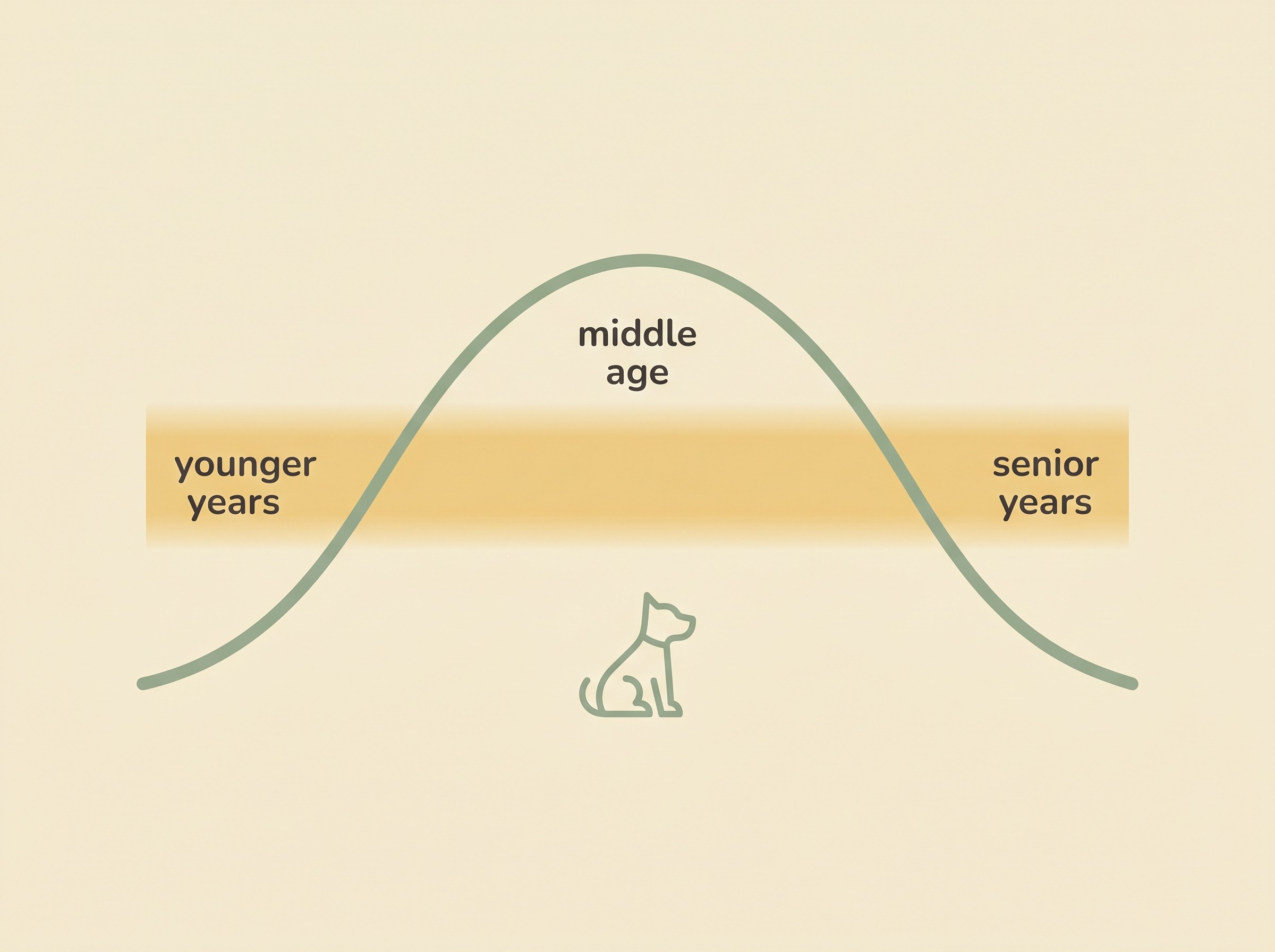
A very large study of dogs and cats seen in practice found that the proportion carrying too much weight climbs through adulthood, peaks in middle age, and then falls away again in the senior years. In other words, old pets are, as a group, more likely to be too thin than too fat. The careful long-term study of ageing cats tells the same story with numbers: cats' bodyweight tends to peak around ten and then drift downward toward sixteen, with the chance of being underweight rising and the chance of being obese all but vanishing in the oldest cats.
So the senior job is two-handed. If your dog or cat is still carrying a bit too much, getting them lean is genuinely worth doing. And if they're thriving at a good weight now, your job shifts to watching for the slide the other way, because in an older animal that slide is rarely "just old age." Holding both ideas at once is the whole skill.
Trimming a heavier older pet still pays off
If your pet has reached their later years still a little over their best weight, it's easy to feel it's too late to bother, or that a tubby old dog is a happy old dog. It is worth bothering, and here's the reason.
The most quoted evidence comes from a remarkable study that followed Labradors across their entire lives. Dogs fed to stay lean lived to a median of thirteen years, against just over eleven for their slightly heavier littermates, and the signs of age-related chronic disease showed up later in the lean dogs. That's close to two extra years, bought with nothing more exotic than a sensible body weight.
You don't need dramatic weight loss to feel the difference either. In overweight dogs with arthritis, lameness measurably improved once they had lost as little as six per cent of their body weight. For a 30 kg dog that's under 2 kg. Lighter joints, easier stairs, less reliance on pain relief, and you're barely a couple of kilos in. If your older pet has stiff hips or sore knees, weight is part of the treatment, and our arthritis space goes deeper on the whole picture.
Cats are not exempt. Carrying extra weight in cat-years is linked to diabetes, urinary problems and joint disease, and the cats most likely to be overweight are exactly the ones many of us own: neutered, indoor, middle-aged and fed mostly dry food. If that describes your cat and the years are starting to show, the window to gently trim them is now, while they're well, not after a diagnosis arrives.
One important rule before you change anything: weight loss in an older pet should be slow and supervised. Crash dieting an old cat is genuinely dangerous, and the right pace differs for dogs and cats, so this is a plan you make with your vet, not one you improvise from a feeding-guide on the back of a bag. Our piece on feeding an older pet walks through what actually changes in a senior diet, and how little "senior" on the label really tells you.
Reading the body, not just the scales
The number on the scales can stay almost the same while your pet's body quietly changes underneath it, because fat can creep on as muscle slips away, and the two roughly cancel out on the readout. So the weight looks "fine" while the animal is anything but.
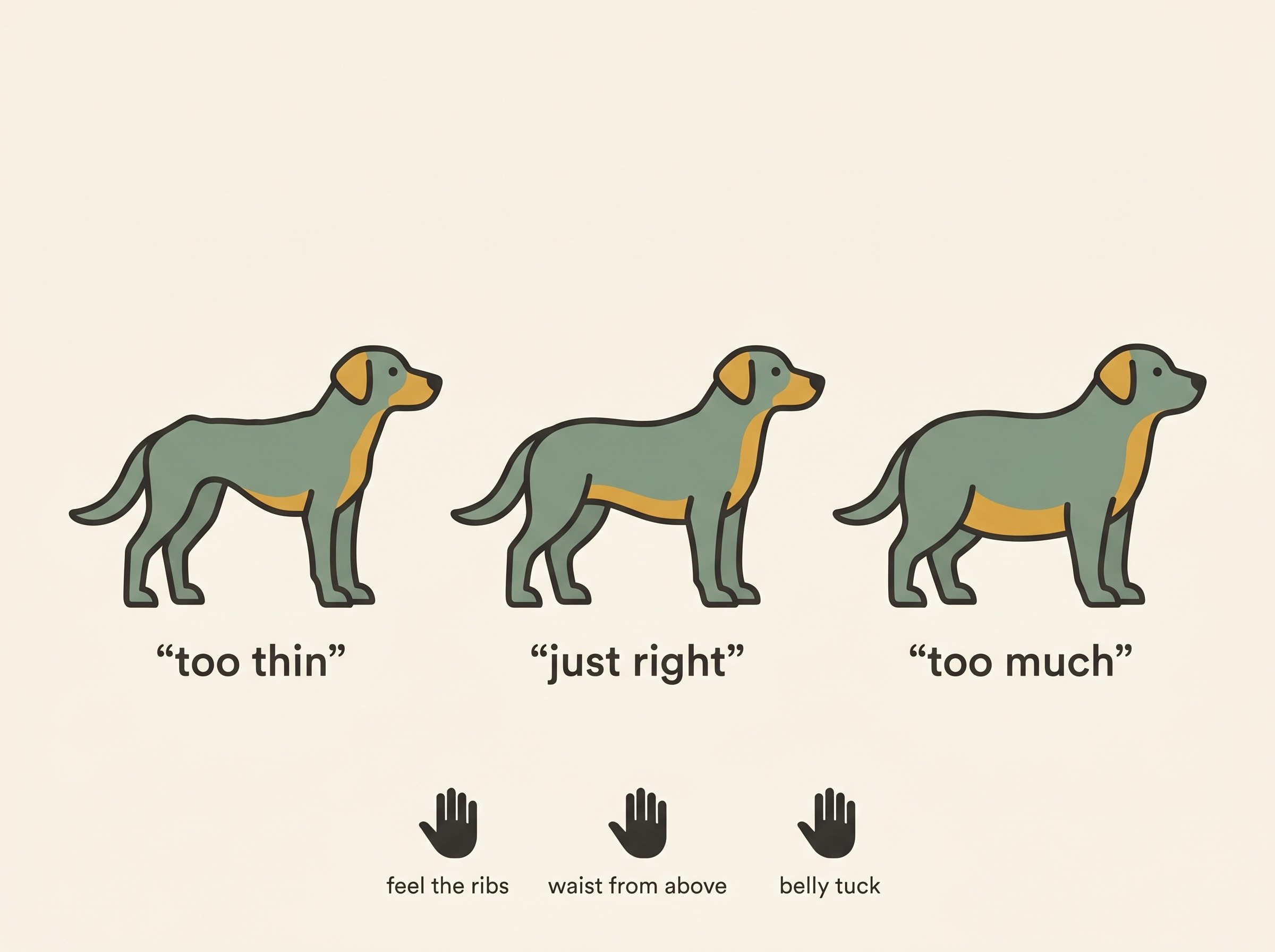
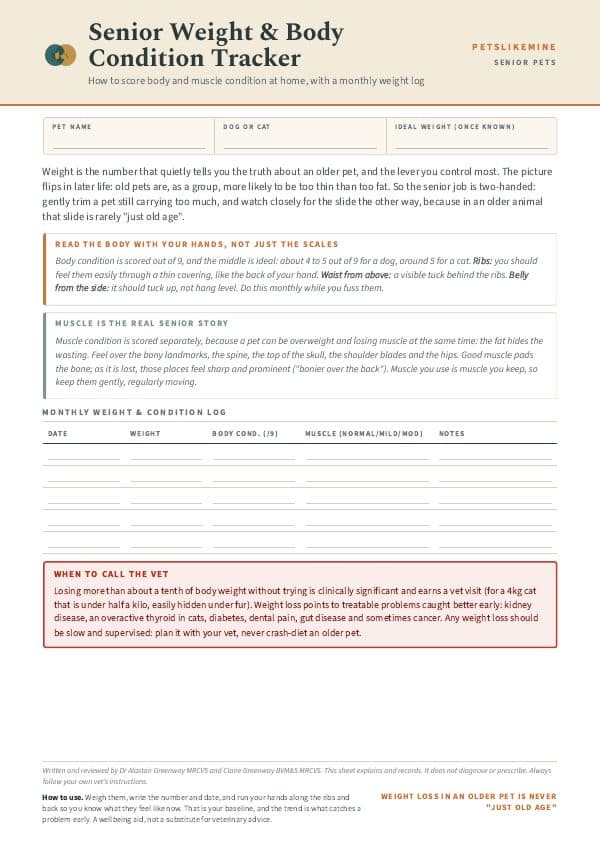
That's why vets score the body with their hands, not just the scales. The standard tool is the body condition score, a nine-point scale where the middle is ideal: around four to five out of nine for a dog, and five out of nine for a cat. You're checking three things, and you can learn to do all of them at home:
- Ribs: run your hands along the chest. In ideal condition you can feel the ribs easily through a thin layer of covering, the way you can feel the back of your own hand. If you have to press to find them, there's too much over the top. If they feel sharp and stark, there's too little.
- Waist from above: looking down, there should be a visible tuck inward behind the ribs. Straight-sided or bulging means too much; deeply hollowed means too little.
- Tummy from the side: the belly should tuck up behind the ribcage rather than hang level or sag.
Do this once a month while you're fussing them and you'll feel a change long before it becomes a problem, which is the entire point.
Muscle is the real senior story
If body condition is what you can pinch, muscle condition is what's underneath, and in older animals it's the bit that matters most. They're scored separately and on purpose, because a pet can be overweight and losing muscle at the same time. The fat hides the wasting.
You feel for muscle over the bony landmarks: along the spine, over the top of the skull, across the shoulder blades, and around the hips. Good muscle covers these so the bone feels padded. As muscle is lost, those same places start to feel sharp and prominent, and that's often the very first thing an owner notices when they say their old dog feels "bonier over the back" or their cat's spine has become a ridge they can run a finger along.
The careful study of ageing cats put numbers to it: muscle condition held steady until around ten, then dropped away more steeply toward sixteen, with the odds of mild muscle loss overtaking "none" by about ten and a half. By the oldest ages, getting on for half of those cats carried moderate-to-marked muscle loss. Age-related muscle loss runs the same way in dogs.
Some of this is the ordinary muscle loss of ageing, the kind that creeps in even in a healthy old animal, much as it does in older people. But muscle can also melt fast when something else is going on, from kidney disease to cancer, and the two can look identical from the sofa. That's exactly why muscle loss is worth a mention to your vet rather than a shrug, and why our companion piece on muscle loss in older pets covers the difference and the three things that genuinely slow it. The single most protective thing you can do at home is keep them gently, regularly moving: muscle you use is muscle you keep.
When the scales start to drop
Now the half that no older-pet owner should ignore. A falling weight in a senior dog or cat is a symptom, not a stage of life, and it's never safe to file it under "just getting old."
As a rough guide, losing more than about a tenth of body weight without trying is clinically significant and deserves a vet visit. For a 4 kg cat that's under half a kilo, which can vanish under a fluffy coat without you seeing a thing, so the scales catch what your eyes cannot. The faster it's happening, the sooner it should be looked at.
The reason to act is that genuine weight loss is one of the most useful early warnings we have, and it points at conditions that are far better caught early than late: kidney disease, an overactive thyroid in cats, diabetes, dental disease that makes eating hurt, tummy and bowel problems, and yes, sometimes cancer. None of those are made better by waiting. Our dedicated piece on weight loss in an older pet walks through exactly what to do this week, and you can route straight into the relevant condition space, whether that's kidney disease, diabetes or hormone health.
Cats deserve a special word here, because their bodies are good at hiding things. In an overactive thyroid, the weight starts falling a year or two before the diagnosis is usually made, and most of those cats are quietly losing muscle along with it. Tangled up in this is one of the trickiest combinations in older cats: an overactive thyroid and failing kidneys can sit side by side, and each can partly hide the other, so treating one sometimes reveals the other. This is not something to untangle alone. If your older cat is eating well but melting away, or has stopped holding their weight, that's a conversation with your vet, who will look at the whole picture and often keep an eye on both the thyroid and the kidneys together.
A home toolkit you already own
Your most valuable monitoring tool in this entire article is one you almost certainly already own, and the rest is a habit.
- Weigh them, and write it down. Small dogs and cats can go on the bathroom scales the simple way: weigh yourself, then weigh yourself holding them, and take the difference. Big dogs may need the scales at the surgery, where the nurse will usually weigh them for free between appointments. Once a month is plenty for a well senior. A single weight tells you little; a line of weights over months tells you everything, because it shows the direction of travel.
- Run your hands over them monthly. Ribs, waist, tuck, and the bony landmarks for muscle. You're not after a perfect score, you're after change.
- Let your vet score it properly twice a year. Body condition and muscle condition belong at every senior check, which is also where the scales meet the blood tests that explain a trend. Twice-yearly matters because a year is a big slice of an old animal's life for something to develop in.
This is the kind of slow, quiet change that memory is terrible at and a record is brilliant at. Logging your pet's weight, body condition and energy in the Senior Wellness Check is exactly what its Vitality score is built around, and it turns a vague "I think she's gone a bit thin" into a clear trend line you can hand straight to your vet. That single shift, from impression to evidence, is often what gets a problem caught months earlier than it otherwise would be.
And if all of this brings up the bigger, quieter worry that sits behind every weight check on an old friend, you're not the only one carrying it. Other people walking the same road are in the senior pets community, and when the day comes that comfort matters more than numbers, our companion through the final chapter is there. But that's for later. For most older pets, most of the time, this is the long good plateau, and a steady, well-held weight is one of the surest ways to keep them on it.
So here is the one thing to do today: weigh your pet, write the number and the date somewhere you'll keep, and run your hands along their ribs and back so you know what they feel like right now. That's your baseline. Everything useful about your pet's weight starts with knowing where it is this week.
Free downloads
Companion worksheets to put what you've read into practice. Free PDFs, print at home.
Sister tool · Sightline
Track quality of life over time
Sightline, a separate ConciergeVet tool, runs a short adaptive weekly assessment with a quality-of-life focus mode built around exactly these frameworks, tracks a single composite score over time so you can see the trend rather than judge a single bad day, and produces a Sightline Report PDF you can bring to your vet.
A written log, or our printable quality-of-life sheet, does much the same job.
See how Sightline tracks quality of lifeKeep track of how your pet is doing
The owners who cope best are the ones who notice changes early. A simple health log shows you what is working, and what is not, before the next vet visit.
Start tracking, freeYou're not doing this alone
Compare treatment journeys and talk to owners managing senior pets. Free to join.
Join PetsLikeMine