

Feeding an older pet: what changes, and what "senior diet" really means
Alastair Greenway
BVM&S MRCVS
The pet aisle has a particular bag of food: greying dog or softly lit cat on the front, the word "senior" in friendly letters, doing a lot of quiet emotional work. Your own pet's muzzle has frosted a little, and reaching for it feels like the responsible thing. I understand the pull, and I do want to help you feed your ageing dog or cat genuinely well. That is exactly why I have to start somewhere awkward: the word "senior" on that bag tells you almost nothing about what is inside it.
This is not a reason for cynicism, nor to panic about what you are already feeding. It is an invitation to ask a better question. Not "should I switch to a senior food?" but "what does this ageing animal actually need?" The answer is more individual, and in places it runs in the exact opposite direction to what the marketing implies. So let me walk you through what really changes when a pet gets older, where the myths are, and how to feed the animal rather than the label.
"Senior" is a marketing word, not a recipe
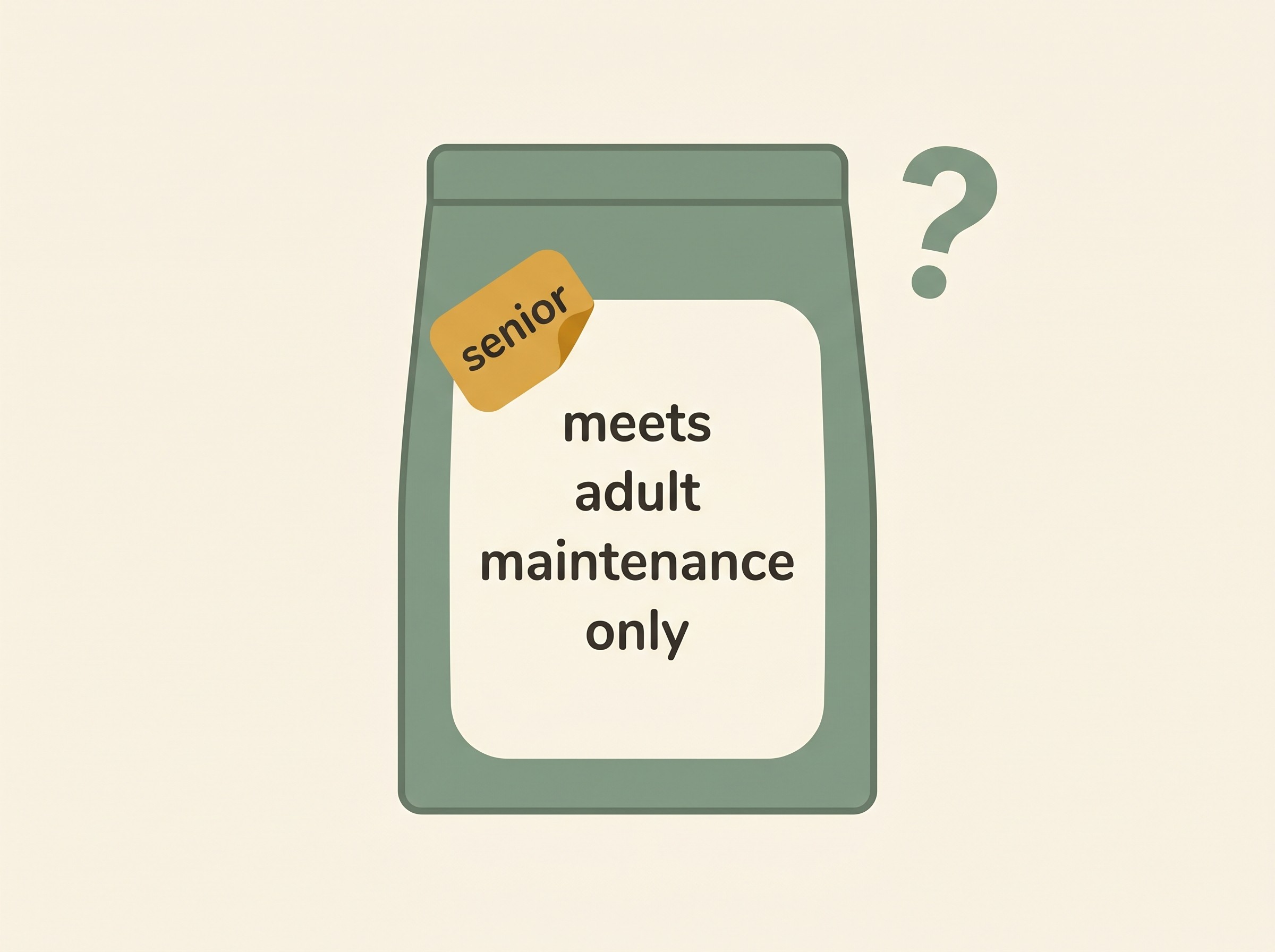
There is no legal definition of a senior pet food. The bodies that set the nutrient rules for pet food, chiefly AAFCO in the US and its equivalents, recognise life stages like growth and adult maintenance, but they have never defined a "senior", "mature" or "geriatric" profile at all. As the veterinary nutritionists at Tufts put it plainly, "there is no legal definition for 'senior' or 'geriatric' foods" and these diets "need to follow the same legal guidelines as diets for young or middle-aged adults" (Tufts Petfoodology). A large 2024 review of ageing pet nutrition reached the same conclusion: current nutrient profiles "include no specific requirements for senior pets, even at the macronutrient level" (Bermingham et al., Animal Frontiers, 2024).
So when a manufacturer writes "senior" on a bag, all that legally guarantees is that the food meets the ordinary minimums for an adult dog or cat. Everything else, what is added, what is taken away, how many calories sit in a cupful, is left entirely to that company's idea of what an old pet should eat, and those ideas vary enormously. When Tufts researchers analysed nearly forty commercial senior dog foods, the sodium content alone ranged from 33 to 412 milligrams per 100 kilocalories, and phosphorus varied roughly threefold from one bag to the next (Hutchinson, Freeman et al., 2011). Two foods side by side, both proudly labelled for seniors, can be almost completely different diets.
None of this means senior foods are bad, or that you should feel misled for buying one. Many are perfectly good. It means the label cannot do your thinking for you. What should drive your pet's bowl is the individual animal: their body and muscle condition, appetite, weight trend, and anything your vet has found on examination. As Tufts conclude, "working with your veterinarian can help you to find the diet that is truly best for your dog or cat, not just the diet with the best marketing" (Tufts Petfoodology). And because biological age and the number of birthdays are not the same thing, simply turning seven or ten or even fifteen is not, on its own, a reason to change anything.
Why low protein quietly costs old pets their muscle
If there is one belief I would most like to retire, it is that old dogs and cats need less protein. It is intuitive, it has been repeated for decades, and for most healthy older pets it is wrong in a way that actively harms them.
The myth grew from a worry that protein is hard on ageing kidneys, so easing off it might be protective. But the evidence does not support restricting protein in a healthy older animal, and there is a strong case for the opposite. Ageing bodies become less efficient at building and holding muscle, so an older pet arguably needs more good-quality protein, not less, simply to stand still. Otherwise healthy senior cats and dogs, in the words of one of the field's most-cited reviews, "require a high dietary protein provision to counteract an age-related decrease in protein synthesis and increase in nitrogen excretion" (Laflamme, summarised in VetTimes). Feed too little, and the body strips its own muscle to find the protein it needs.
This matters because muscle is not cosmetic. Maintaining lean body mass is one of the strongest predictors of how long a cat or dog lives (Bermingham et al., 2024). So a low-protein "senior" or "light" food, chosen with the best intentions, can quietly accelerate the very wasting you are trying to prevent. The current professional guidance is firm: protein should be restricted only where there is a confirmed, tested reason to, such as established kidney or liver disease, and never simply assumed because a pet is old (AAHA, 2023). Lower-protein diets are "not routinely recommended for senior pets" (VetTimes).
There is one exception worth naming, because it is the seed of the whole myth. When a pet does have a disease that needs a tailored diet, kidney disease being the classic one, that is a real and powerful intervention, but it is a prescription, decided and monitored by your vet on tests, and we will come back to it below. The headline for a well old pet, though, is the reassuring one: keep the protein up, and keep an eye on the muscle.
Senior weight comes in two phases, not one downhill slope
Most of us picture ageing as a single gentle decline, including in weight. The reality is two distinct chapters, and feeding well means knowing which one your pet is in.
The first chapter is the soft, comfortable middle age. As pets slow down and need less fuel, the calories that once kept them trim start to settle as fat. This is when most pets are at their heaviest, and it is the phase where overfeeding does real long-term harm. We know this with unusual certainty thanks to a study that followed forty-eight Labradors for life: the dogs kept lean, fed 25% less than their well-fed littermates, lived a median of 1.8 years longer and developed arthritis around 1.5 years later (Purina Life Span Study). Keeping an older pet slim is one of the most powerful and underrated things you can do for both their lifespan and their joints, which is why staying lean threads through everything in the Arthritis space too.
The second chapter catches devoted owners off guard, because it is the reverse. In the truly geriatric years, many pets start to lose weight and, more importantly, muscle. A large study following cats into old age mapped this: their body condition rose through middle age, peaking around the age of ten, then fell steadily, while their muscle declined gradually from about seven and dropped away faster after ten. By around fourteen, a cat was more likely to be too thin than overweight (Pye et al., CatPAWS, 2025). The same arc happens in dogs, with very old dogs tending towards underweight as lean tissue is lost (VetTimes).
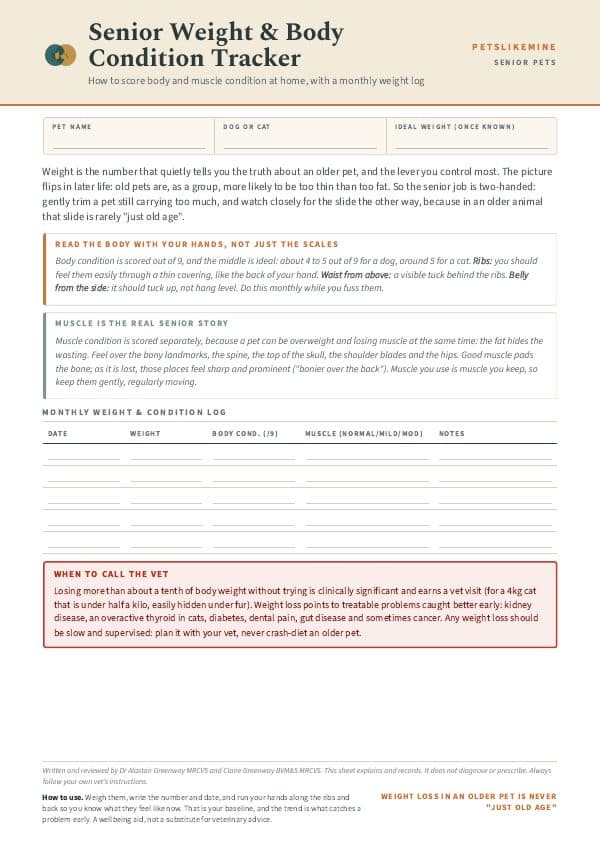
The practical lesson is the same in both chapters, and it is the single most useful feeding habit there is: do not just look at your pet, feel them and weigh them. Run your hands over the ribs, spine, shoulders and hips every week or two, the same way each time, so you would notice fat creeping on in the plump phase or muscle melting away in the thin one. Because a pet can lose real muscle while the scales barely move, the feel of them tells you what the number cannot. Logging the weight and a quick read of their Vitality (appetite, energy, muscle, mobility and how sociable they are) in the Senior Wellness Check turns those impressions into a line you and your vet can actually see.
The cat runs its engine the other way
Cats demand their own section, because in old age their nutrition does the opposite of a dog's. A dog's energy needs generally fall with age, in step with lost muscle and a quieter life. An old cat's do the reverse. Around the age of twelve to thirteen, having spent middle age slimming down, many cats see their energy requirement climb again (Perez-Camargo, via VetTimes). Part of the reason is that an ageing cat's gut becomes less efficient: fat digestibility, and to a lesser extent protein digestibility, declines with age, sometimes from about seven years old (Bermingham et al., 2024). The cat is, in effect, getting less out of the same bowl. Layer that onto old-age muscle loss, healthy geriatric cats carry roughly a third less muscle than young adults (Laflamme & Gunn-Moore, via VetTimes), and you have a real risk of an old cat slowly starving on a diet that looks adequate.
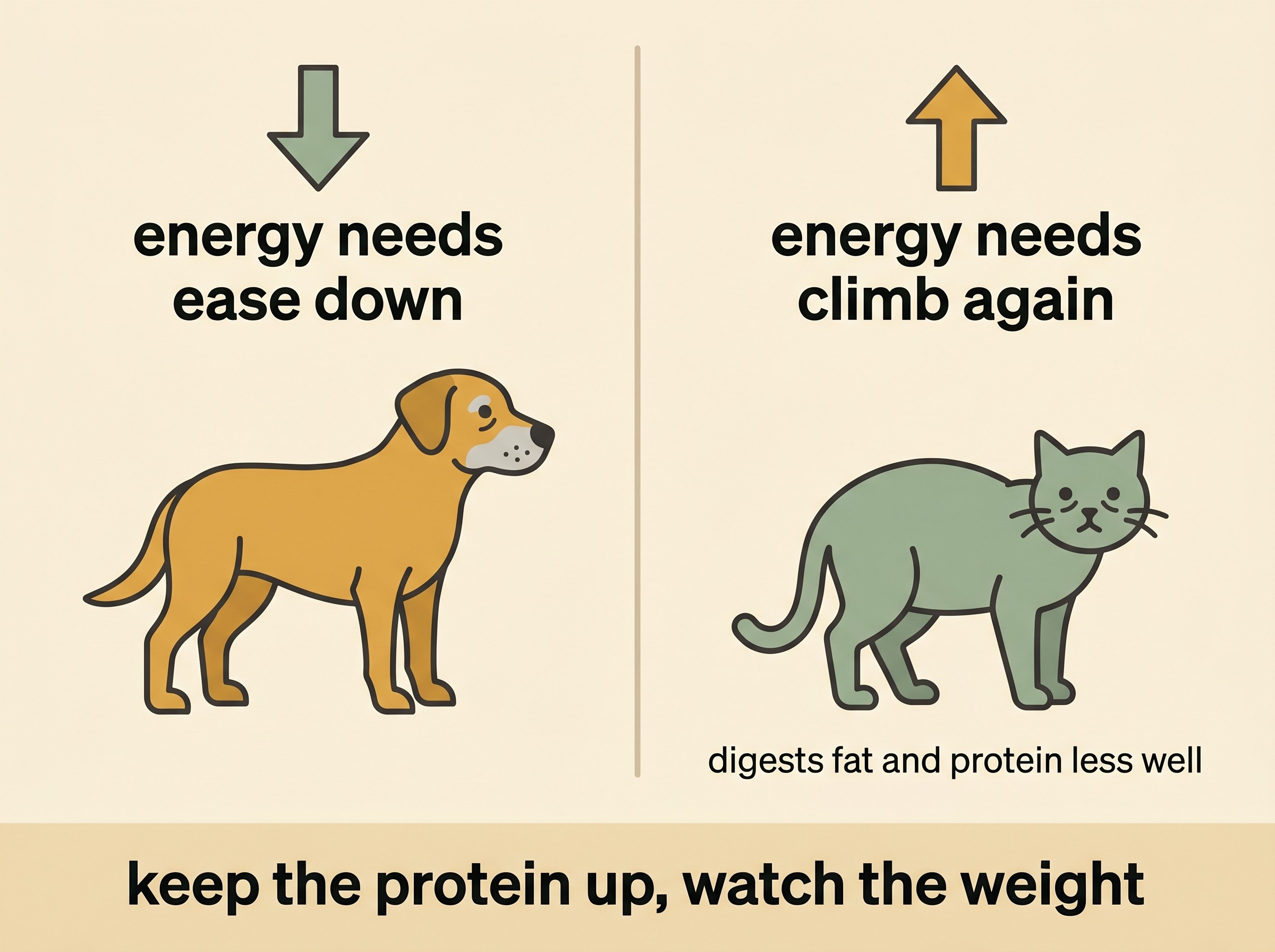
So the worst thing you can do for a thin, very old cat is reach for a "light" or weight-control food. What she usually needs is the opposite: a highly digestible, energy-dense, protein-rich diet that gets the most into a body extracting the least. The flip side is that her senses are working against her. Ageing dulls a cat's sense of smell and taste and blunts the thirst that should keep her topped up with water (VetTimes). That is the case for wet food in many older cats: it is easier to eat with an aged mouth, its smell can be lifted by warming it gently, and its high water content quietly helps hydration in an animal who will not drink enough on her own. Coaxing an old cat to eat is a common struggle, and if you are wrestling with it, the senior community is full of owners trading the tricks that worked for them.
When food becomes a treatment (and when it does not)
There is a category of diet that genuinely changes outcomes, and it is the reason the protein myth took root. When an older pet is diagnosed with certain conditions, the right therapeutic diet can be as important as any medicine. In feline kidney disease, for example, a kidney-specific diet that restricts phosphorus is associated with cats living substantially longer and having far fewer crises (Elliott, via IRIS guidance). That is real, evidence-based power.
But it is exactly the kind of diet you must never improvise. A therapeutic diet is a prescription: chosen for a tested diagnosis, balanced carefully, and monitored with follow-up bloods. Putting a healthy old pet on a kidney diet "just in case" can deprive them of protein they need; guessing at one for a sick pet can do harm. If your pet has been diagnosed with kidney disease, the Kidney space explains how the diet fits the bigger picture, and the same goes for the Diabetes space, the Hormone Health space for an overactive thyroid, and the Digestive Health space for a troubled gut. The decision sits with your vet, every time.
A gentler version of the same principle applies to diets and supplements aimed at an ageing mind. There is decent evidence that certain brain-support formulations, particularly those rich in medium-chain triglycerides, can modestly help memory and sharpness in older dogs (Pan et al., British Journal of Nutrition). They are worth a conversation, framed as modest help rather than a cure, and we weigh the help versus hype in treatments and supplements for an ageing mind.
One safety point here must never be skipped. Never give a cat a product made for dogs without checking. Cats are not small dogs; some ingredients that are fine for a dog are poisonous to a cat. The brain supplement Aktivait is the textbook example: the dog formulation contains alpha-lipoic acid, which is toxic to cats, and only the separate feline version is safe (International Cat Care). If you are ever unsure whether something is safe for your species of pet, ask your vet before it goes in the bowl.
Feeding well as the years catch up
Here is what good feeding actually looks like for an ageing dog or cat, none of it requiring a special bag.
Start by paying attention to how they are eating, not just whether the bowl empties. A pet who has gone off their food, started chewing on one side, dropping kibble or quietly eating less is rarely "just getting fussy in their old age." Appetite change is a symptom, and a sore mouth is one of the most common and missed causes, which is why "too old for a dental" is a myth worth busting (dental care for senior pets). For an old pet who tires at the bowl, smaller frequent meals, warmed slightly to wake up the smell, and a raised bowl that spares stiff joints all help; the home tweaks live in making your home work for an older pet. Make any diet change gradually, over a week or so, to spare an older tummy.
And keep one simple list. Older pets often end up on a diet, a supplement or two, and sometimes a medicine, and your vet needs to see the whole picture, because foods and supplements can interact with medication just as drugs can with each other. Tell your vet everything that goes into your pet, including the things that do not feel like "real" medicine, a habit we explain in the whole-pet view.
What to do this week
You do not need to overhaul anything today. You need to start watching the right things.
- Weigh them and feel them, and write it down. Use the vet's scales when you can, or weigh a cat or small dog by holding them on the bathroom scales and subtracting yourself, then run your hands over the ribs, spine, shoulders and hips. Log it in the Senior Wellness Check so a trend builds, because a falling line is the earliest warning you will get.
- Match the food to the phase, not the birthday. A plump middle-aged pet needs fewer calories, not a "senior" badge; a thin, very old cat needs more energy-dense, protein-rich, easy-to-eat food, never a "light" diet. Keep the protein up unless your vet has tested a reason not to.
- Treat weight loss or a changed appetite as a question for your vet, never as a cue to buy a different bag. Switching foods to chase a sliding weight only hides the clock; the reasons it never means "just old age" are laid out in why weight loss is never "just old age".
- Bring your diet-and-supplement list to the next check, and if your pet is on a prescription diet, let your vet steer it.
Hold on to the one idea underneath all of this. Feed the animal in front of you, not the word on the bag. A bag cannot see your pet, but you can feel their muscle and read their weight, and when that weight starts to fall, the right move is never a new diet. It is a phone call to your vet, while the answer is still an easy one to act on.
Free downloads
Companion worksheets to put what you've read into practice. Free PDFs, print at home.
Sister tool · Sightline
Track quality of life over time
Sightline, a separate ConciergeVet tool, runs a short adaptive weekly assessment with a quality-of-life focus mode built around exactly these frameworks, tracks a single composite score over time so you can see the trend rather than judge a single bad day, and produces a Sightline Report PDF you can bring to your vet.
A written log, or our printable quality-of-life sheet, does much the same job.
See how Sightline tracks quality of lifeKeep track of how your pet is doing
The owners who cope best are the ones who notice changes early. A simple health log shows you what is working, and what is not, before the next vet visit.
Start tracking, freeYou're not doing this alone
Compare treatment journeys and talk to owners managing senior pets. Free to join.
Join PetsLikeMine