

Muscle loss in older pets (sarcopenia): spotting it and slowing it
Alastair Greenway
BVM&S MRCVS
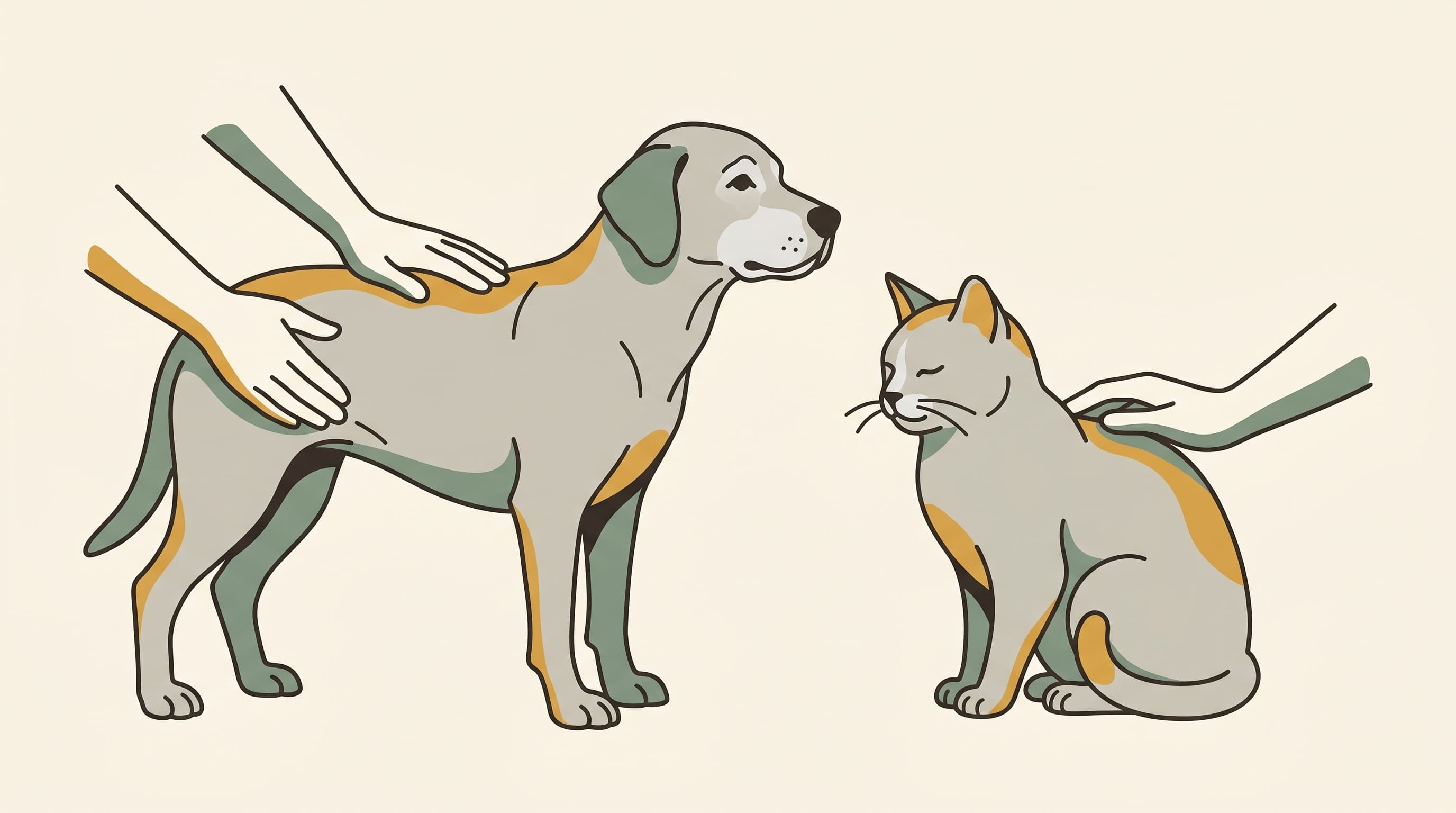
Most owners feel it before they ever see it. You lift your old cat and she seems to have hollowed out under the fur, lighter than her cuddly outline suggests. Or you run a hand down your dog's back and the muscle over his hips, the solid haunch that used to power him up the stairs, has softened into something flatter and bonier. Just a quiet sense that there is a bit less of them than there was, particularly at the back end. That feeling has a name, and the gradual loss of muscle and condition in an older animal is one of the most common and most overlooked parts of getting old. It is also, encouragingly, one of the most workable. So this is for the owner who wants to get ahead of it: how to notice strength slipping early, why the scales will quietly lie to you about it, and the three levers that genuinely slow it down.
Two kinds of muscle loss, and why the difference matters
Muscle can melt away for two very different reasons that need very different responses.
The first is ageing. The slow loss of muscle that comes with the years, in an otherwise well animal with no disease behind it, has a clinical name: sarcopenia. It is the muscle equivalent of greying at the muzzle, a normal part of an older body, and genuinely common. In one study of older dogs the gradual loss of lean muscle was documented to begin somewhere between nine and eleven years of age (Clinician's Brief), and under the microscope the muscle of geriatric dogs shows the real, biological fingerprints of ageing written into the tissue itself (Pagano et al., 2015). This is not a failing on your part, and not, by itself, a disease.
The second kind is more serious. Muscle can also waste because something is driving it: a chronic illness burning the body up from the inside. When muscle loss is caused by disease the clinical word is cachexia, and the usual culprits in an older pet are kidney disease, heart disease and cancer (Tufts Petfoodology). That is not gentle ageing, but a sign of a problem that needs finding and treating.
Now the uncomfortable truth: you cannot reliably tell the two apart from the sofa. The muscle thins either way, and the only way to know which is a proper look. That matters, because if it is ageing you can slow it and if it is disease you can often treat it, but only if someone goes looking. So one rule sits above everything else in senior care: slowing down, thinning out and losing condition are symptoms, not a stage of life to simply accept. And if your pet is genuinely losing weight rather than just changing shape, that is a red flag in its own right, never "just old age"; we explain what it points to in weight loss in an older pet.
The scales will lie to you: feel, do not just weigh
Before we get to spotting it, I have to dismantle the most misleading habit owners have, one that even catches vets who reach only for the scales: you can lose a great deal of muscle while the number on the scales barely moves.
Body weight is muscle and fat and everything else, bundled into one figure. As an animal ages, the body has a quiet habit of swapping lean muscle for fat, so an old pet can be genuinely wasting underneath while the scales read the same month to month, and a pet can even be a little overweight and losing significant muscle at once (Tufts Petfoodology): a round, comfortable-looking older dog is not automatically a well-muscled one. This is why your vet does not just weigh your pet. They score two separate things, body condition (the fat they carry, the BCS) and muscle condition (the muscle they have, the MCS), because the two move independently and the scales only ever see the sum. So the lesson at home is simple: do not just weigh your pet. Feel them.
The reassuring part is that the muscle condition score is not a specialist instrument. It is mostly a pair of hands. Vets and owners alike check the same four places, the spots the body draws muscle down from first when it is short (WSAVA muscle condition chart, via Purina Institute):
- Either side of the spine, along the back. This is the most important place and the earliest to show it (Tufts Petfoodology). In a well-muscled pet the backbone is padded and rounds gently into muscle; as muscle is lost it feels sharp, like a ridge you can hook a finger over.
- Over the skull, on top of the head. Healthy muscle keeps the head smoothly rounded; as it wastes, the bony crest and the hollows above the eyes show, and an old dog or cat takes on a gaunt, "sunken" look.
- Over the shoulder blades. These should feel covered. When they begin to stand out sharply, muscle is going.
- Over the hips and back legs. In dogs especially, this is where owners notice it most: the thighs lose their roundness and the hip bones become prominent, and a dog can be wasting behind while the front legs still look strong (PetMD, reviewed by Brittany Kleszynski DVM).
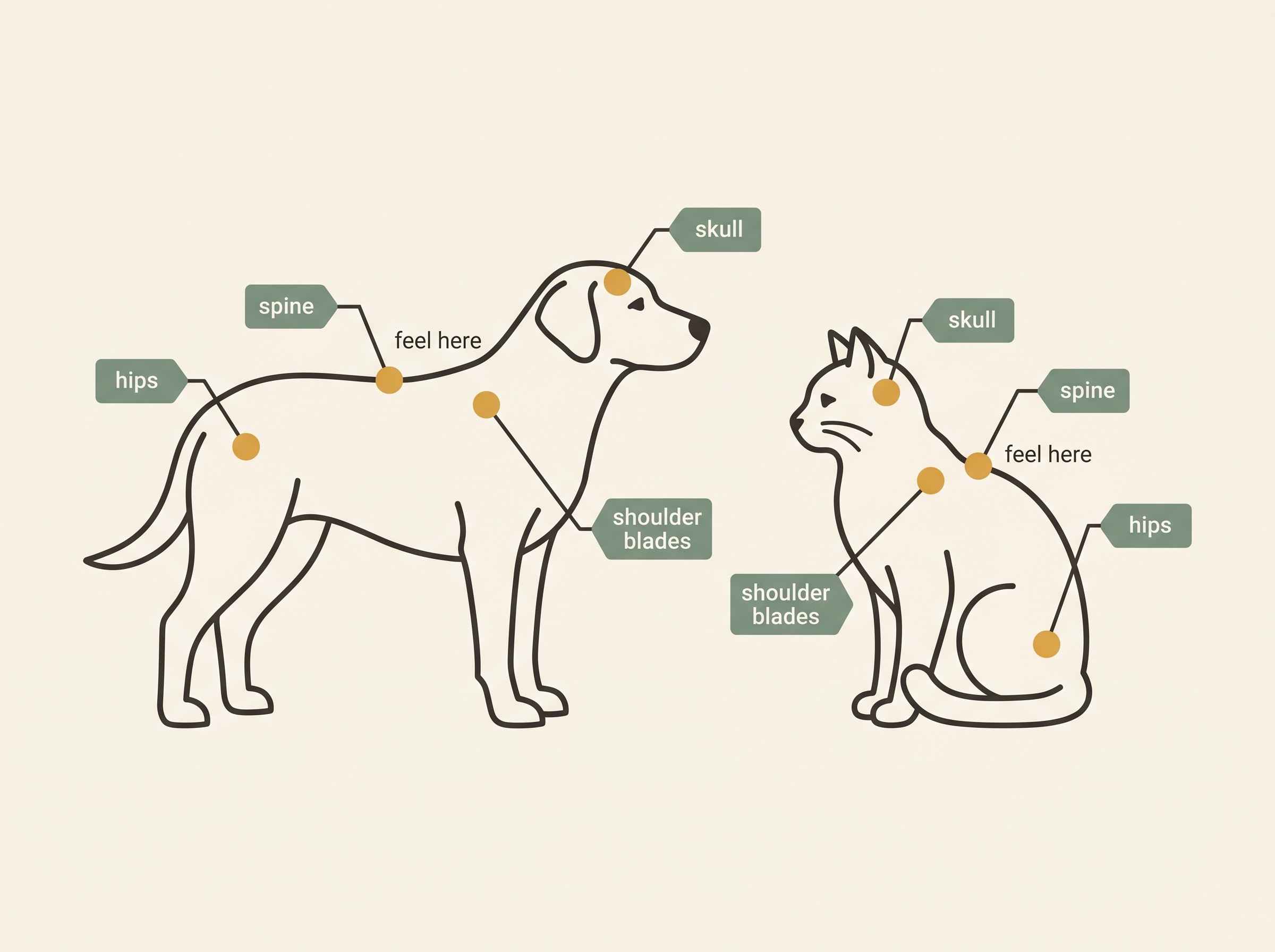
Make this a gentle monthly habit, greeting your older pet with your hands as well as your eyes, in the same order each time, so thinning over the spine or new hollows above the eyes stand out next month rather than creeping past over a year. If you would like a steadier record than memory, log what you feel in the Senior Wellness Check: muscle condition is one of the five everyday signs it tracks under your pet's Vitality, alongside energy, appetite, mobility and how sociable they are being, so a slow slide shows up as a line you can both see rather than a hunch in your head.
More than skin deep
It would be easy to treat muscle softening as a cosmetic part of looking old. It is not. Muscle holds an animal up and steadies them so they do not fall, and it is also a reserve the body draws on when it is ill, so losing it makes an animal weaker, dampens the immune system, and slows recovery from illness, surgery or injury (Tufts Petfoodology). An old pet with good muscle has something in the tank when a problem comes along; one who has wasted has little to fall back on. You can see how much this matters in cats: in a study of cats with cancer, reduced muscle was found at all the check sites in the great majority, most of them wasting even though their overall body condition still looked acceptable, and the cats in poorer condition lived markedly shorter lives, a median of around three months against more than sixteen for those who kept their condition (Baez et al., 2007). That is not a reason to panic over every softening haunch, but a reason to take muscle seriously as a measure of how your pet is doing, and to protect it while you can. So how?
Lever one: get the protein right
This is the lever most owners get wrong, through no fault of their own, because the pet food aisle quietly steers them the wrong way. There is a long-standing belief that old animals need less protein, and many "senior" diets are built around that idea. For a healthy older pet this is largely a myth, and a potentially harmful one: there is little evidence that restricting protein benefits a healthy older dog or cat, and lower-protein diets may actively feed the very muscle loss we are trying to prevent. It helps to know that "senior" on a bag of food has no legal meaning at all, so a senior diet meets exactly the same standards as any adult food and the word on the front tells you nothing reliable about what is inside (Tufts Petfoodology). The precise ideal level is still debated, but the direction of travel is clear: healthy ageing bodies need adequate, good-quality protein to hold on to muscle, not a restricted ration.
Cats deserve their own word, because their needs are even more emphatic. Cats are obligate carnivores, built to run on protein, and an ageing cat's body becomes less efficient at building and keeping muscle, so otherwise healthy senior cats need a generous, high-quality protein intake to counter that decline (Laflamme, summarised in Vet Times). There is an added twist: many old cats also become poorer at digesting their food, with roughly one in three less able to digest fat and one in five less able to digest protein (Vet Times). So a thin old cat may be eating plenty and still not getting enough out of the bowl, which is the opposite of a reason to cut back. For an old cat, aim for protein that is both generous and highly digestible.
Two guard rails before you change anything. First, this is guidance for an otherwise healthy older pet. If your pet has a diagnosed condition, kidney disease in particular, the protein question becomes individual and is a conversation for your vet, not the internet, because the right answer changes with the illness and its stage; what "senior diet" really means is covered in feeding an older pet. Second, a safety point on supplements: never give a cat a product formulated for dogs without checking, because some ingredients that are perfectly safe for a dog are toxic to a cat. If you are adding anything, even an everyday fish-oil omega-3, choose one meant for your pet's species and run it past your vet first.
Lever two: keep them moving (and comfortable)
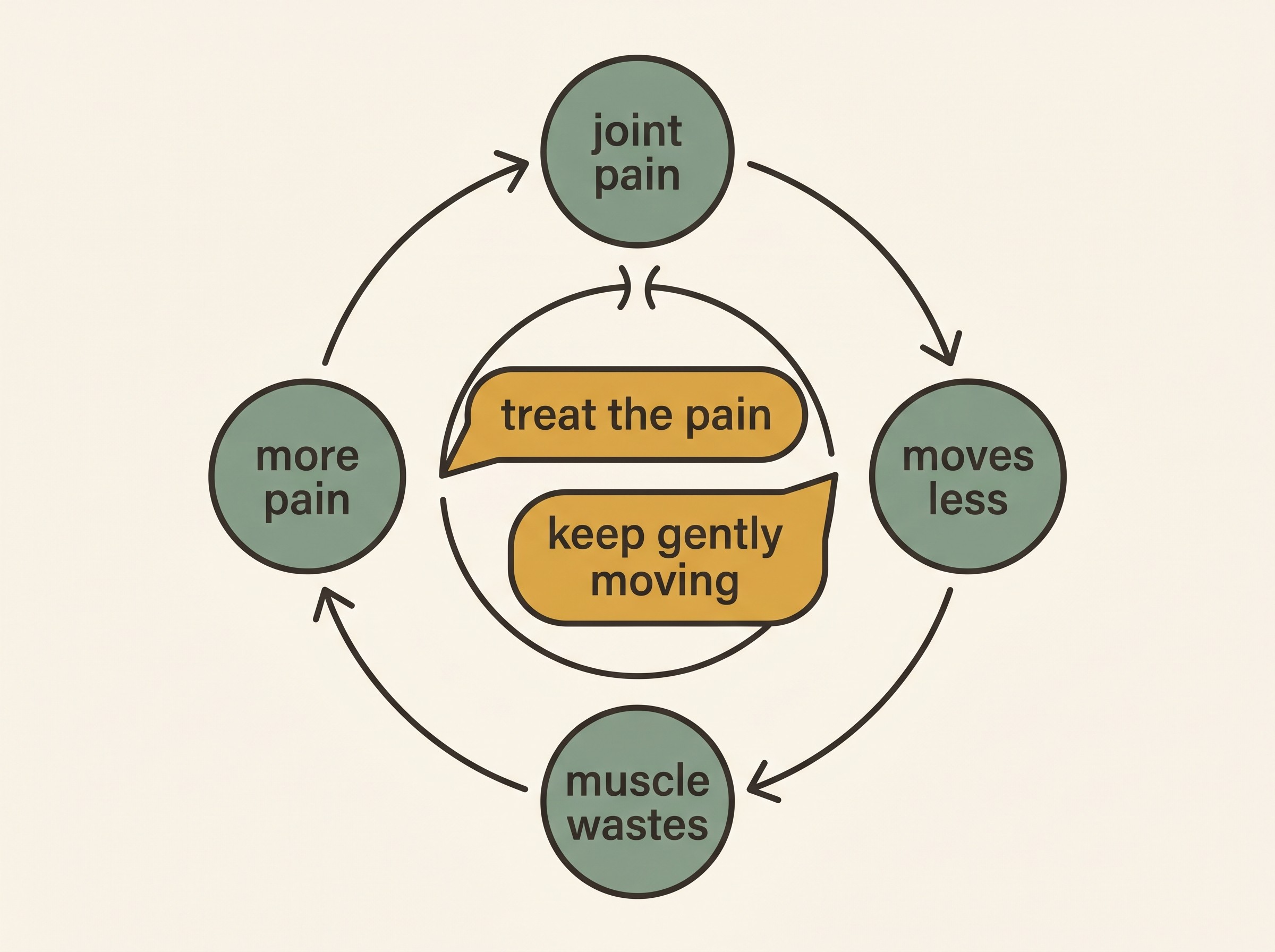
If protein is the building material, movement is the signal that tells the body to keep the muscle. And here lies one of the least appreciated traps in senior care, a vicious circle that quietly hollows out old pets. A pet gets sore, very often from arthritis, which is hugely common and badly under-treated in old dogs and cats. Because it hurts to move, they move less; because they move less, the muscle that supports the sore joints wastes; and because that muscle has wasted, the joints hurt even more, so they move even less, and round it goes. Muscle is built on use, and disuse accelerates its loss; in older dogs, low physical activity and poor mobility track closely with poorer outcomes (Frye et al., 2022). You break the circle by doing two things at once: control the pain so movement stops being a punishment, then keep them gently, regularly moving.
The encouraging part is that the right kind of movement genuinely helps. In dogs on weight-loss programmes, exercise preserved lean muscle, and the veterinary view is that combining gentle activity with good nutrition is the sensible way to reduce the toll of age-related muscle loss (Frye et al., 2022). For an old pet that means little and often: short, regular lead walks rather than one exhausting weekend route, and low-impact options like hydrotherapy that load the muscles while sparing the joints. Cats need this too, in their own currency: a few short bursts of gentle play a day, a wand toy or a treat rolled across the floor, anything that gets a stiff old cat stretching, climbing and pouncing keeps muscle on the frame far better than sleep alone.
But comfort comes first, because a pet in pain will not move, so getting on top of arthritis pain is one of the most powerful muscle-saving things you can do; the Arthritis space is built around exactly that, and the Mobility Check tracks how your pet is getting about. For how to pitch exercise without overdoing it, see keeping an older pet moving.
Lever three: catch it before it gets a head start
The third lever is the quietest and, over years, the most powerful. Muscle that has wasted a long way is hard to rebuild: an old pet can often regain some of what they have lost, but rarely all of it (PetMD). That single fact is the argument for catching it early, and it is what twice-yearly senior checks are for. At every visit your vet should weigh your pet, score their body condition and, separately, score their muscle, because that score builds into a trend that tells the real story long before any one snapshot would (AAHA 2023 Senior Care Guidelines). A score that holds steady year on year is reassuring; one drifting downward is a prompt to ask why while there is still time to act. Between visits, your monthly feel test and the Senior Wellness Check keep the picture current, so you hand your vet a clear line rather than trying to remember whether she felt bonier "a while ago." A trend you can act on together; a vague memory is not.
What to do this month
Muscle loss is one of those senior problems where small, steady habits genuinely change the outcome, and the first few you can do today.
- Do the feel test. Run your hands slowly over the four places, starting either side of the spine, then the head, shoulder blades and hips, so thinning would stand out next month. Add a dated photo from above and the side.
- Weigh them, and write both down. The vet's scales are ideal; bathroom scales while holding them work for a cat or small dog. The scales only tell half the story, which is why the feel test comes first.
- Check the protein, do not cut it. For an otherwise healthy older pet, make sure they get plenty of good-quality protein rather than a restricted "senior" ration, and for an old cat especially, lean generous and digestible. If your pet has kidney disease or another diagnosed condition, ask your vet before changing anything.
- Keep them gently moving, and comfortable. Little and often: short regular walks for a dog, short bursts of play for a cat. If pain is what stops them, treat that first, because a comfortable pet is a moving pet, and a moving pet keeps their muscle.
- Log it in the Senior Wellness Check, so muscle and Vitality become a line you can watch rather than a worry you carry, and ask for a muscle score at the next check.
If you are managing this alongside other things, as the senior years so often go, you are not on your own: our senior community is full of owners walking the same road.
And keep one short list to one side, because these are the moments not to watch and wait but to ring your vet this week:
- Genuine weight loss, not just a change of shape, or muscle melting away quickly rather than slowly.
- Struggling to rise, wobbling, or the back legs giving way or sliding out.
- Muscle loss alongside drinking more, a change in appetite, sickness or a clear drop in energy.
Slow, gentle softening in a well old pet is sarcopenia, and you now have the three levers to push back against it. Fast wasting, or wasting with any of those other signs, usually has a treatable reason behind it, and the sooner it is found, the more you can do.
Free downloads
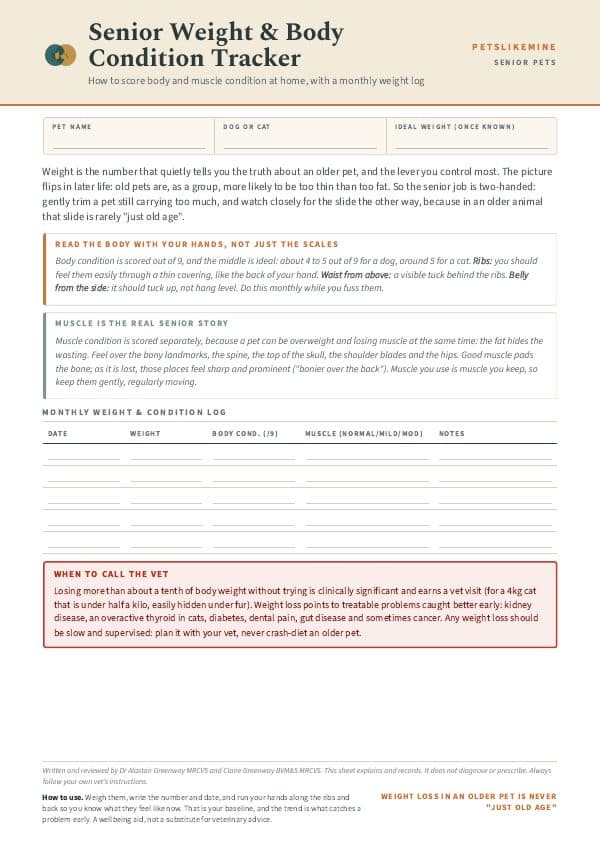
Companion worksheets to put what you've read into practice. Free PDFs, print at home.
Sister tool · Sightline
Track quality of life over time
Sightline, a separate ConciergeVet tool, runs a short adaptive weekly assessment with a quality-of-life focus mode built around exactly these frameworks, tracks a single composite score over time so you can see the trend rather than judge a single bad day, and produces a Sightline Report PDF you can bring to your vet.
A written log, or our printable quality-of-life sheet, does much the same job.
See how Sightline tracks quality of lifeKeep track of how your pet is doing
The owners who cope best are the ones who notice changes early. A simple health log shows you what is working, and what is not, before the next vet visit.
Start tracking, freeYou're not doing this alone
Compare treatment journeys and talk to owners managing senior pets. Free to join.
Join PetsLikeMine