

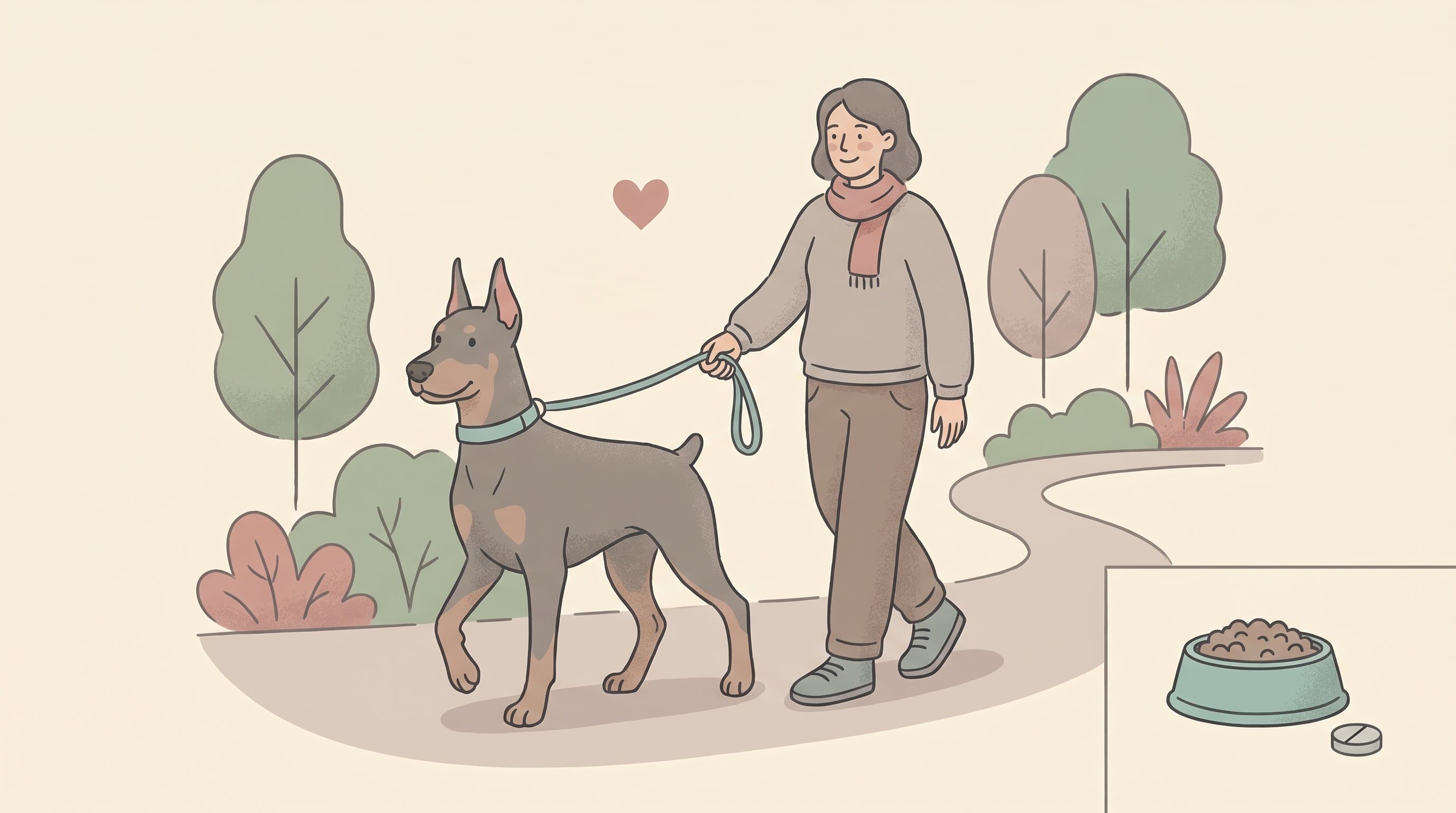
Living With a DCM Dog: Diet Correction, Exercise and Monitoring
Alastair Greenway
BVM&S MRCVS
The name dilated cardiomyopathy sounds final, and a "weak heart muscle" is harder to picture than a leaky valve, so a diagnosis can feel as though it has taken matters out of your hands. In practice, day-to-day life with a DCM dog sits far more within your control than it first appears. The medicines do a great deal, but so do you. What goes in the bowl, how you exercise your dog, how closely you watch the breathing, and how reliably the tablets go in all genuinely move the needle. This article is the practical handbook for that daily work.
If you are still getting your head around what DCM actually is, the difference between the genetic and diet-associated forms, or the silent phase before signs appear, start with dilated cardiomyopathy explained and come back here once you are ready to think about management. And if your dog's DCM was linked to their food, the full story of how that connection was made lives in the grain-free question. This page picks up where those leave off: the doing.
Correcting a diet-associated case: what the change actually involves
For some dogs, the most powerful single thing you can do is change the food. Since 2018, a subset of DCM cases in dogs have been associated with certain diets, often grain-free, legume-heavy or from smaller "boutique" brands, including in breeds not normally prone to the disease (Freid et al., 2021). The full account of why, and how strong the evidence is, belongs to the grain-free question. What matters for daily life is this: if your dog falls into that group, a diet change made under veterinary guidance can sometimes lead to real, measurable improvement in heart function over the following months. That is a genuinely hopeful situation, and it is worth doing properly.
Doing it properly means a few specific things. First, do not change the food on a hunch or a forum post alone. Your vet, ideally alongside a cardiologist, decides whether yours is a case where diet is likely playing a part, because the workup and the follow-up only make sense as a pair. Second, the new diet is usually one that meets established quality criteria: a recognised manufacturer with veterinary nutritionists on staff, proper feeding trials behind the product, and a more conventional formulation. The WSAVA guidelines on selecting a pet food are the usual yardstick here, and your vet can point you to specific options. Third, your vet may check a blood taurine level, although many diet-associated cases are not taurine-deficient, so a normal result does not mean diet is off the hook (Kaplan et al., 2018). Some dogs are also started on taurine and sometimes L-carnitine supplements while things are sorted out.
The part owners most need to hear is that this is a slow story rather than a quick fix. Improvement, when it comes, unfolds over months and is judged by a repeat echocardiogram (a heart ultrasound), not by how your dog seems day to day. So the plan is simple: change the diet, keep up any medication, and book the follow-up scan rather than quietly assuming it has worked or has not. Resist the urge to keep swapping foods in the meantime, because if you change three things at once you will never know which one helped.
Watching the breathing: your most useful daily habit
Whatever the cause of your dog's DCM, the single most valuable thing you can do at home is count the resting respiratory rate. This is the number of breaths your dog takes in a minute while genuinely asleep or settled and relaxed, not panting after a walk, not on a hot day, not dreaming. A normal resting rate for most dogs sits comfortably under about 30 breaths a minute. A rate that creeps up and stays up is often the very first sign that fluid is beginning to back up into the lungs, frequently a day or two before your dog looks unwell to you, which hands you and your vet a precious head start.
I am not going to explain the count itself in detail, because it has a proper home: the resting respiratory rate guide walks you through exactly how to do it and what your dog's personal baseline means. What I will press on you is the habit. Log the number, do not just glance at it, because trends are what matter and human memory is hopeless at trends. The breathing rate tracker lets you record it over time and actually see a line forming, so the difference between "she seems a bit faster lately" and a clear upward drift becomes obvious. A tracked resting breathing rate is the closest thing you have to an early-warning system at home.

Alongside the breathing, keep a casual eye on the broader picture: appetite, energy on walks, any new cough, restlessness at night, a swollen belly, or fainting and collapse. Fainting deserves a special mention in DCM, because in some breeds, Dobermans above all, the disease disturbs the heart's rhythm and a faint can be the first warning of a dangerous arrhythmia. That particular risk has its own article in Dobermans and sudden death, and any collapse or fainting episode is a reason to phone your vet promptly rather than wait and see.
Sensible exercise for a weakened heart
Owners often freeze on the question of exercise, terrified that a walk might tip their dog over. The reality is more reassuring, and more nuanced, than wrapping them in cotton wool. A DCM heart can usually still manage gentle, regular, predictable activity perfectly well, and keeping your dog moving and engaged is good for muscle, weight, digestion and mood. What a weakened heart copes badly with is sudden, intense, flat-out exertion: the explosive sprint after a squirrel, the frantic ball-chasing session, the heat of midday in summer.
So the rule of thumb is steady over strenuous. Favour regular lead walks at a pace your dog sets, on cool parts of the day, over occasional bursts of high-octane play. Let your dog stop and rest when they want to, and learn to read the early signs of having had enough: lagging behind, slowing right down, heavier breathing that does not settle quickly, or wanting to sit. If your dog is in the heart-failure phase your vet may want activity dialled down further, but for many stable DCM dogs, gentle daily exercise is not just allowed, it is genuinely good for them. When in doubt, ask your vet to set a ceiling specific to your dog, because the right amount depends on the stage and on whether arrhythmias are in the picture.
Medicines and rechecks: the unglamorous half that matters most
Most of the heavy lifting in DCM is done by medication, and the most important thing you can do with it is the dullest: give it reliably, on time, every day, and do not stop or change a dose without speaking to your vet. DCM drugs work by keeping the heart and circulation in a careful balance, and that balance depends on steady levels in the body rather than the odd missed or doubled tablet. Pimobendan, which helps the heart muscle contract more effectively and eases the load on it, is a mainstay; the PROTECT trial showed it delayed the onset of heart failure and prolonged survival in Dobermans with preclinical DCM, which is a large part of why catching the disease early matters so much (Summerfield et al., 2012). If your dog has already gone into heart failure, the medicine cabinet grows, but the full regimen for that phase is owned by the heart failure medication toolkit, and the day-to-day handling of the diuretic specifically lives in managing furosemide at home, so I will send you there rather than half-cover it.
Build a system so adherence does not rely on memory: a pill organiser, an alarm on your phone, pairing the dose with a fixed daily event like breakfast. If you ever miss one, do not double up to catch up; just ask your vet what to do, because the answer differs between drugs. And keep the rechecks your vet books. These visits are where the plan is kept on track, where blood tests check that the kidneys and electrolytes are coping with treatment, and where doses are nudged as the disease slowly shifts. None of that is a sign things are going wrong; it is simply the maintenance that keeps a DCM dog well, and it is also the natural moment to ask whether a cardiologist's eye on the plan would be worth it, especially in a breed prone to arrhythmias or if things are not settling as expected.
When to pick up the phone
A lot of the fear drains out of daily life once you know where the line sits between "mention it at the next recheck" and "ring now", so here it is plainly.
Phone your vet during normal hours, in the next day or so, if you notice a resting breathing rate that has climbed above your dog's usual baseline and stayed there, a new or worsening cough, a noticeable drop in appetite or energy, or a belly that looks more swollen than usual. These are the soft signals, and catching them early is exactly what the home monitoring is for.
Treat it as an emergency, out of hours if need be, if your dog is breathing fast and hard at rest and not settling, breathing with obvious effort or an open mouth, has gums that look blue, grey or very pale, collapses or faints, or simply seems to be struggling to breathe. Do not wait until morning for any of these. The full crisis plan, including what to do in the car on the way in, is set out in recognising a heart failure crisis, and it is the one piece worth reading before you ever need it, with your vet's out-of-hours number saved in your phone tonight.
If the question underneath all of this is how much time your dog really has, and how much these efforts change the answer, that deserves a frank and hopeful reply rather than a half-remembered forum statistic, and you will find it in DCM prognosis and the value of catching it early.
References
- Freid KJ, Freeman LM, Rush JE, Cunningham SM, Davis MS, Karlin ET, Yang VK. (2021). Retrospective study of dilated cardiomyopathy in dogs. Journal of Veterinary Internal Medicine, 35(1), 58-67.
- Kaplan JL, Stern JA, Fascetti AJ, Larsen JA, Skolnik H, Peddle GD, Kienle RD, Waxman A, Cocchiaro M, Gunther-Harrington CT, Klose T, LaFauci K, Lefbom B, Machen Lamy M, Malakoff R, Nishimura S, Oldach M, Rosenthal S, Stauthammer C, O'Sullivan L, Visser LC, William R, Ontiveros E. (2018). Taurine deficiency and dilated cardiomyopathy in golden retrievers fed commercial diets. PLOS ONE, 13(12), e0209112.
- Summerfield NJ, Boswood A, O'Grady MR, Gordon SG, Dukes-McEwan J, Oyama MA, Smith S, Patteson M, French AT, Culshaw GJ, Braz-Ruivo L, Estrada A, O'Sullivan ML, Loureiro J, Willis R, Watson P. (2012). Efficacy of pimobendan in the prevention of congestive heart failure or sudden death in Doberman Pinschers with preclinical dilated cardiomyopathy (the PROTECT Study). Journal of Veterinary Internal Medicine, 26(6), 1337-1349.
Keep track of how your pet is doing
The owners who cope best are the ones who notice changes early. A simple health log shows you what is working, and what is not, before the next vet visit.
Start tracking, freeYou're not doing this alone
Compare treatment journeys and talk to owners managing heart health. Free to join.
Join PetsLikeMine