

The Resting Respiratory Rate: The Most Useful Heart-Monitoring Skill You Can Learn at Home
Alastair Greenway
BVM&S MRCVS
Count how fast your pet breathes while they are fast asleep. It takes about thirty seconds, it costs nothing, and it tells you more about their heart between vet visits than almost anything else you can do at home. No equipment, no special training, and once it becomes a habit it slots quietly into the evening rather than feeling like a chore. This single number, the resting respiratory rate, is the closest thing we have to an early-warning system for congestive heart failure, and counting it properly is one of the most powerful things an owner of a heart patient can learn.
So many of the other articles in this space point you here, and on purpose: this is the page that owns the technique end to end. The method is the same whether your pet has just been diagnosed, is being watched in the pre-clinical stage, or has already been through a heart failure crisis. The breathing-rate tracker is built to log each count so you can see a trend, but the counting itself starts here.
What you are actually counting, and why it tells you so much
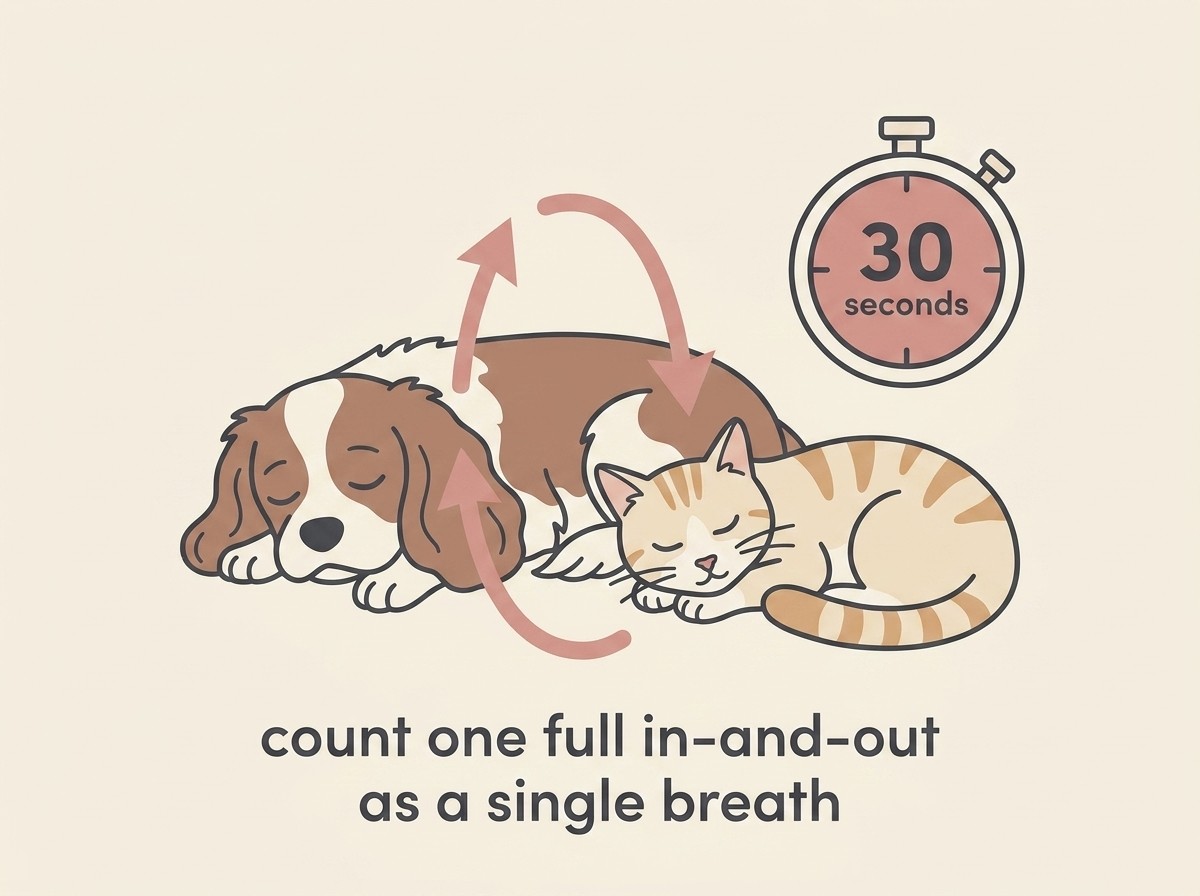
The resting respiratory rate, often shortened to RRR, is simply the number of breaths your pet takes in one minute while genuinely at rest or asleep. One breath is one full in-and-out: the chest rises as they breathe in, falls as they breathe out, and that complete cycle counts as a single breath, not two. You will sometimes also see the term sleeping respiratory rate, or SRR, which is the same idea measured while the pet is asleep; the two are very close, and a sleeping count tends to run a fraction lower because a sleeping pet is as calm as they will ever be (Porciello et al., 2016).
The reason this number carries so much weight comes down to where heart failure shows itself first. When a struggling heart starts to let fluid back up into or around the lungs (pulmonary oedema in most dogs, often fluid around the lungs in cats), the lungs become less efficient at moving air, and the body's first response is to breathe a little faster to compensate. That happens before the cough, before any obvious struggle, and often before your pet seems unwell to you at all. A breathing rate that creeps up while your pet is resting is frequently the very first visible sign that fluid is gathering, sometimes a day or two ahead of a crisis (Ohad et al., 2013; Porciello et al., 2016). That head start is the whole point: it can be the difference between a calm dose adjustment at home and an emergency dash in the small hours.
There is a quieter benefit too. For owners of pets in the pre-clinical stage, who have a murmur but no symptoms, a low and steady breathing rate night after night is reassuring evidence that the heart is coping, and many owners describe the nightly count as the thing that finally lets them stop hovering anxiously. The fuller picture of watchful waiting in that stage lives in the pre-clinical monitoring guide, the natural companion to this one.
Counting it, step by step
The technique is simple, and the most important part is choosing the right moment. You want your pet genuinely settled, not panting from a walk, not hot, not stressed, not excited, and ideally fast asleep. Panting from heat, exercise or anxiety has nothing to do with the heart, and counting then will only give you a frightening, meaningless number. The ideal time is when your pet is curled up asleep in the evening, deeply relaxed and breathing quietly, which is also why so many owners fold this into their bedtime routine.
When your pet is settled, watch the chest, or the flank just behind the ribs, rising and falling. Count one breath for each complete rise-and-fall. You have two reliable ways to get a per-minute figure:
- Count the breaths over a full 60 seconds, which gives you the rate directly. This is the most accurate method.
- Or count the breaths over 30 seconds and double the number. This is quicker and perfectly good for a nightly habit.
Either way you are aiming for breaths per minute. Avoid counting over just ten or fifteen seconds and multiplying up, because in a slow, sleeping pet a single missed or extra breath gets magnified into a much bigger error; thirty seconds doubled, or a full minute, is the sweet spot (Tufts Cummings School of Veterinary Medicine, HeartSmart). Try not to rouse your pet while you count, since waking them even halfway will nudge the rate up and spoil the reading. If they sigh, shift position or briefly dream mid-count, simply wait for them to settle and start again.
Reading the numbers
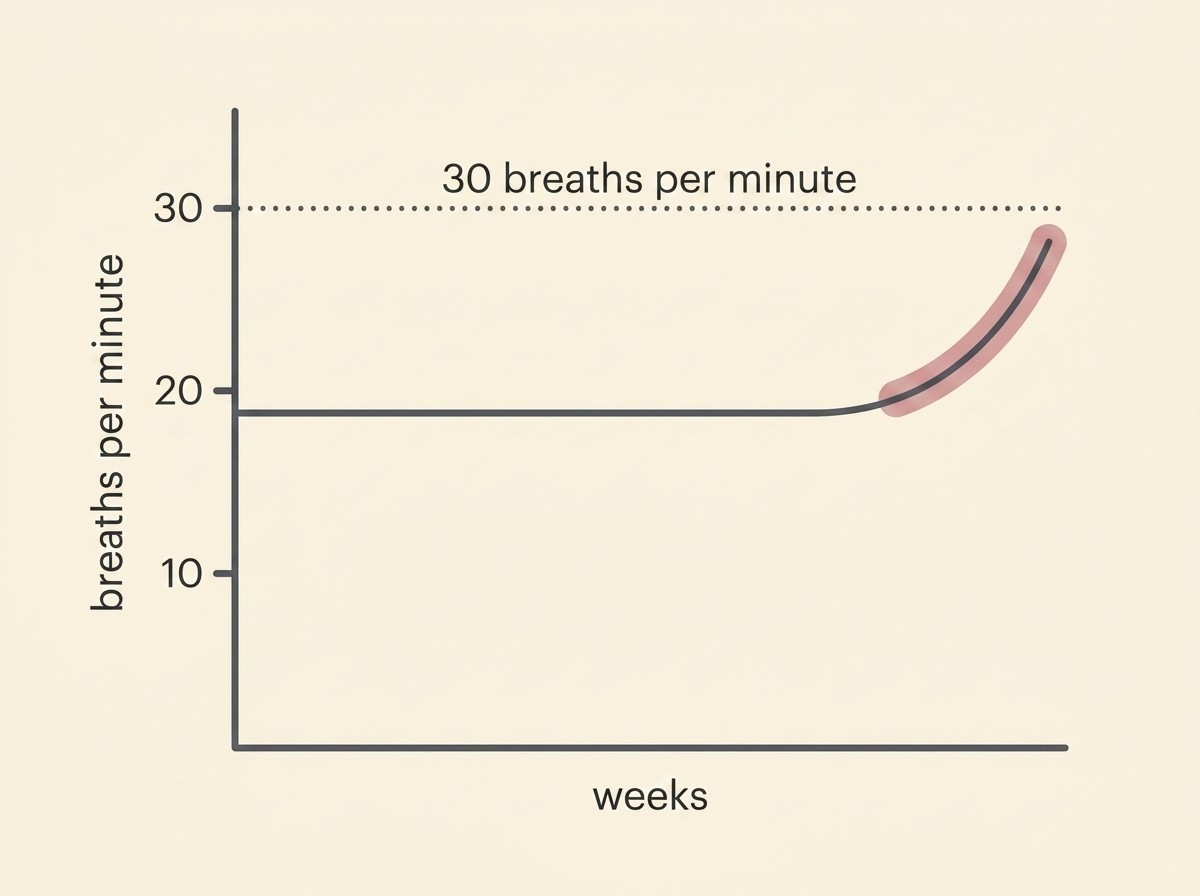
Here is the reassuringly simple part. A healthy resting or sleeping respiratory rate is reliably under 30 breaths per minute, and this holds true for both dogs and cats (Porciello et al., 2016; Ljungvall et al., 2014). Most healthy pets sit comfortably below that: studies of healthy dogs at home found average sleeping rates well under 25 breaths a minute (Rishniw et al., 2012), and healthy cats around 20 (Ljungvall et al., 2014). Even dogs and cats whose heart failure is well controlled on medication usually keep their resting rate under 30 (Porciello et al., 2016). So the figure of 30 is not an average to expect; it is a ceiling that a well pet stays comfortably beneath.
That gives you a clear, practical framework for what a count means:
- Consistently under 30 breaths a minute at rest: reassuring. This is what a coping heart looks like.
- Persistently over 30, or a clear upward trend over a few days: a same-day call to your vet. A rate that has climbed above 30 and stayed there, or one that is steadily rising night after night, is the early signal that fluid may be gathering, and it is exactly the kind of change your vet wants to catch early rather than late.
- Sustained 40 or more, or breathing that is visibly laboured: treat this as an emergency. A resting rate up around 40 and beyond, especially with effortful breathing, an outstretched neck, open-mouth breathing in a cat, or gums that look blue or grey, is not a number to log and watch. It is a reason to act now (Cornell Riney Canine Health Center, 2025). What a genuine crisis looks like, and exactly what to do in the moment, is set out in full in recognising a heart failure crisis.
One honest caveat: you will sometimes see slightly different ceilings quoted, such as 35 rather than 30, with some vet schools using that figure for a pet whose failure is already being managed (Tufts Cummings School of Veterinary Medicine, HeartSmart). The differences are small and the principle is unchanged. Under 30 is the gold-standard target for a well pet, and the most important threshold to remember is your own pet's normal, which we come to next.
Why the trend beats any single count
The key idea is simple: a trend matters far more than a single reading. A single count of 32 on one restless evening is not, on its own, a crisis. The same number, reached after three nights of steady climbing from a baseline of 18, is a meaningful warning. Human memory is hopeless at trends, which is precisely why logging each count, rather than just glancing at it, is what turns this skill into an early-warning system. A rising line on a chart is obvious in a way that "she seemed a bit puffed lately" never is, and that is the entire reason the breathing-rate tracker exists.
This is also why a baseline, taken while your pet is well, is so valuable. Every pet has their own normal: one dog's settled rate might be 16, another's 24, and both are perfectly healthy. That personal figure is what makes a future change meaningful, because a reading of 28 means something quite different in a dog whose baseline is 16 than in one whose baseline is 26. So the best time to start counting is not the day something goes wrong; it is now, while your pet is well, a couple of times a week, so the tracker quietly learns the shape of their normal. You are not waiting for an alarming number. You are learning what "different" will look like before you ever need to.
Making it part of real life
The owners who get the most from this build a light, sustainable habit rather than counting obsessively. A count a few evenings a week, while your pet is already curled up beside you, is plenty in the pre-clinical stage. For a pet already in heart failure, or one recovering from a crisis, your vet will usually want it counted daily, because that is when a one-day head start matters most, and a logged trend becomes part of the clinical team's information at every recheck.
Two practical notes make it stick. Log the number straight away rather than trusting yourself to remember it. And do not panic over one odd reading: dreaming, a warm room or a moment of excitement can all nudge a single count up, so if a number surprises you, let your pet settle fully and count again. If a genuinely raised rate persists, that is your cue to ring the vet, not to keep re-counting until you get a number you like.
It is worth saying plainly what this number can and cannot do. The resting respiratory rate is superb at catching fluid building on the lungs, which is the most common way heart failure declares itself. It will not warn you about an irregular heart rhythm, and nothing you can count at home reliably will, so it sits alongside your vet's rechecks rather than replacing them. But for the single most common and most dangerous turn that heart disease takes, it is the best home tool there is, and that is why every other article keeps sending you here. The fuller picture of what congestive heart failure is, and how this number fits into the whole story, lives in congestive heart failure explained.
So if you do one new thing after reading this, make it this. Pick a quiet evening, watch your sleeping pet's chest rise and fall, count for thirty seconds and double it, and write the number down. Do it a few more times this week to learn their normal. You will have built, in a handful of calm minutes, the most useful early-warning habit in all of heart care.
References
- Porciello F, Rishniw M, Ljungvall I, Ferasin L, Häggström J, Ohad DG. Sleeping and resting respiratory rates in dogs and cats with medically-controlled left-sided congestive heart failure. Vet J. 2016;207:164-168.
- Ohad DG, Rishniw M, Ljungvall I, Porciello F, Häggström J. Sleeping and resting respiratory rates in dogs with subclinical heart disease. J Am Vet Med Assoc. 2013;243(6):839-843.
- Ljungvall I, Rishniw M, Porciello F, Häggström J, Ohad D. Sleeping and resting respiratory rates in healthy adult cats and cats with subclinical heart disease. J Feline Med Surg. 2014;16(4):281-290.
- Rishniw M, Ljungvall I, Porciello F, Häggström J, Ohad DG. Sleeping respiratory rates in apparently healthy adult dogs. Res Vet Sci. 2012;93(2):965-969.
- Cummings School of Veterinary Medicine at Tufts University. Monitoring Heart Disease Treatment at Home. HeartSmart.
- Cornell University College of Veterinary Medicine, Riney Canine Health Center. Recognizing and Responding to Canine Respiratory Distress. Updated 2025.
- Cardiac Education Group. Monitoring Your Pet's Respiratory (Breathing) Rate.
- Keene BW, Atkins CE, Bonagura JD, et al. ACVIM consensus guidelines for the diagnosis and treatment of myxomatous mitral valve disease in dogs. J Vet Intern Med. 2019;33(3):1127-1140.
Keep track of how your pet is doing
The owners who cope best are the ones who notice changes early. A simple health log shows you what is working, and what is not, before the next vet visit.
Start tracking, freeYou're not doing this alone
Compare treatment journeys and talk to owners managing heart health. Free to join.
Join PetsLikeMine