

Congestive Heart Failure Explained: What It Is, What "Congestive" Means, and What You Can Do
Alastair Greenway
BVM&S MRCVS
If your vet has used the words "congestive heart failure", or you have seen them written on a discharge note, they can land like a verdict. They sound final, and they sound frightening. So the first thing worth saying plainly is this: congestive heart failure is a serious diagnosis, but for a great many pets it is a manageable one, often for a good while, with the right medication and support at home. This article is the plain-English explanation of what those words actually mean, why your pet's heart has reached this point, and the single most useful thing you can do between vet visits.
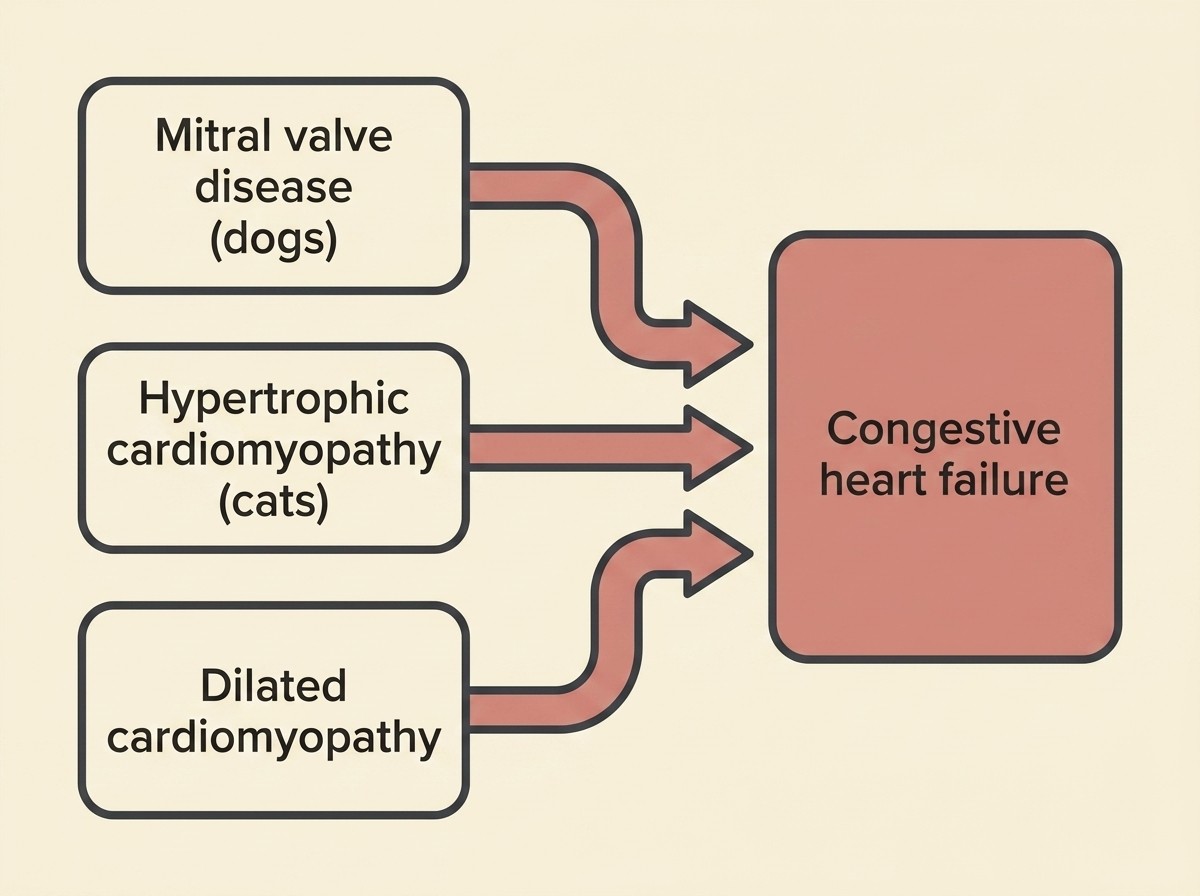
Congestive heart failure is not really a disease in its own right. It is a stage that several different heart diseases arrive at.
One destination, several different roads
Different hearts fail for different reasons. In dogs, by far the most common road to heart failure is myxomatous mitral valve disease, a slow wearing-out of one of the heart's valves that lets blood leak backwards, and it accounts for roughly three-quarters of canine heart disease (Keene et al., 2019). In cats, the usual cause is a cardiomyopathy, a disease of the heart muscle itself, most often hypertrophic cardiomyopathy in which the muscle walls thicken and stiffen (Luis Fuentes et al., 2020). In some dogs, and occasionally cats, the muscle instead grows thin, weak and baggy, which is dilated cardiomyopathy. These are genuinely different diseases of different parts of the heart, and each has its own story, its own at-risk patients and its own monitoring, which is why this space gives each one its own home in when mitral valve disease becomes heart failure, when a cat with HCM goes into heart failure and when DCM becomes heart failure.
What they share is where they end up. When any of these diseases progresses far enough, the heart can no longer keep up with moving blood around the body at the rate it is needed, and that shared end point, that common destination, is congestive heart failure. So when you read that MVD, HCM and DCM all "lead to heart failure", it does not mean they are the same illness. They are different illnesses that eventually meet at the same crossroads. Understanding that crossroads is useful no matter which road your pet travelled to reach it, and if you would like to see how a healthy heart is meant to work before it falters, how your pet's heart works lays the groundwork.
What "congestive" actually means
The word that does the work in "congestive heart failure" is congestive, and once it clicks it explains almost everything an owner sees. Think of the heart as a pump on a closed circuit. When the pump cannot move blood forward as fast as it arrives, blood and pressure back up behind it, the way traffic backs up behind a blockage. That rising pressure pushes the watery part of the blood out through the thin walls of the smallest vessels, where it gathers in the surrounding tissues and body spaces as fluid. That backed-up fluid is the "congestion". So congestive heart failure is, in everyday terms, a heart that has fallen behind, with fluid pooling where it should not because of the pressure building up behind the struggling pump (Ware, Merck Veterinary Manual).
Here is why that matters. Nearly every sign of heart failure you will notice at home is a sign of that fluid, rather than of the heart itself. A pet does not gasp because the heart hurts; they gasp because fluid has gathered in or around the lungs. The belly is not swollen by the heart directly; it is swollen because fluid has pooled there. Once you understand that the trouble is misplaced fluid driven by backed-up pressure, the medicines make sense too, because the cornerstone of treatment is simply helping the body shed that excess fluid.
Left side, right side, and where the fluid goes
Which signs you actually see depends on which side of the heart has fallen behind, because the two sides of the heart serve two different circuits, and fluid backs up into whichever circuit is congested.
The left side of the heart receives freshly oxygenated blood from the lungs and pushes it out to the body. When the left side fails, pressure backs up into the lungs and fluid seeps into the delicate air spaces themselves. This is pulmonary oedema, and it is the most common picture in dogs with heart failure (Keene et al., 2019). The signs are all about breathing: fast or laboured breathing, an effortful rise and fall of the chest, restlessness and an inability to settle or lie down comfortably, and in many dogs a soft cough. The cough deserves a careful word, because owners reach for it as the classic warning sign and it is not always reliable; in dogs it often comes not from the fluid directly but from the enlarged heart pressing on the airways above it, so it can lag behind or run ahead of the fluid. Breathing effort and rate are the more trustworthy signals.
The right side of the heart receives used blood back from the body and sends it to the lungs. When the right side fails, pressure backs up into the body's circulation instead, and fluid gathers in the belly as ascites, giving a rounded, swollen, sometimes tense-looking abdomen, or in the chest cavity around the lungs as a pleural effusion, which again shows as breathing difficulty because the lungs cannot expand against the surrounding fluid (Ware, Merck Veterinary Manual). In cats, fluid in the chest cavity is a particularly common pattern, whichever side of the heart is primarily at fault (Luis Fuentes et al., 2020). Many pets, in time, develop a mixture of both.
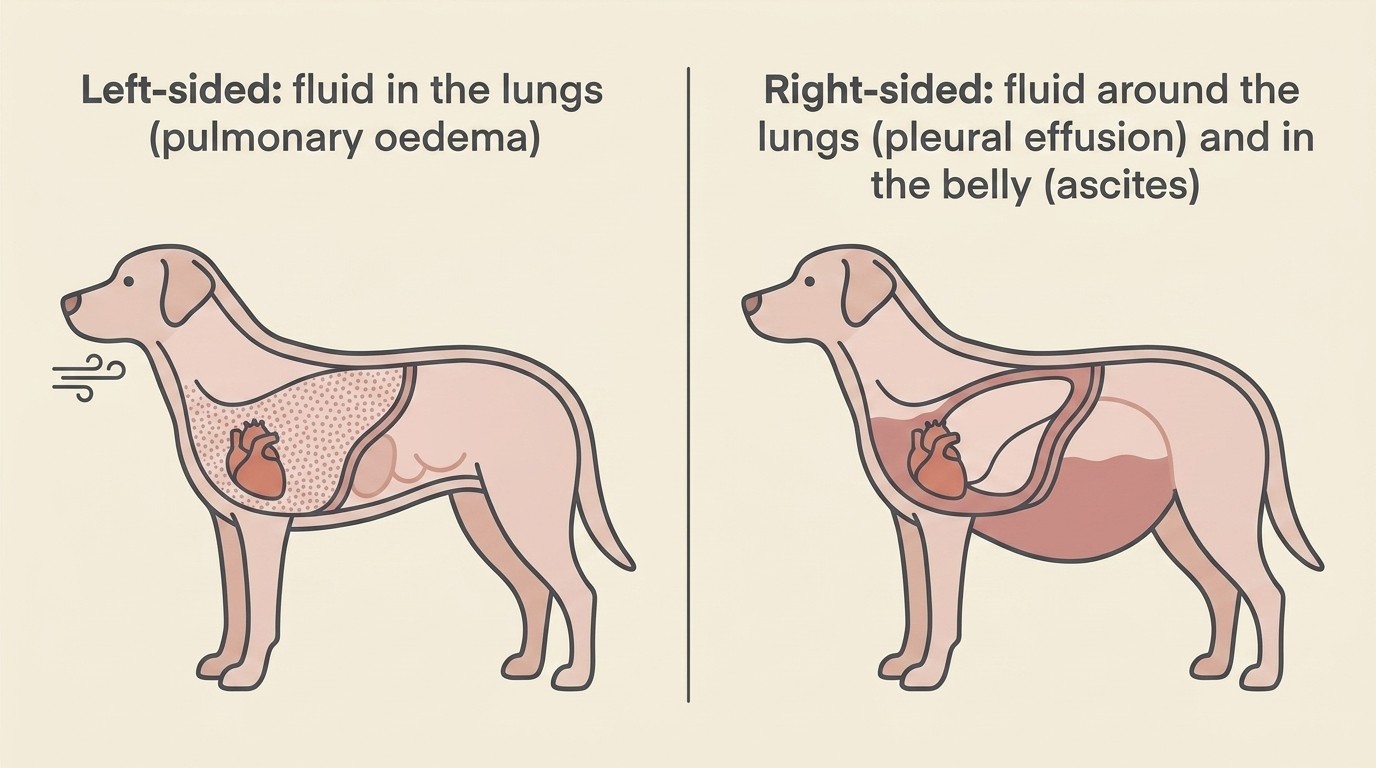
You do not need to diagnose the side yourself, and the boundaries blur in real patients. Knowing the difference simply helps the signs make sense: breathing trouble points to fluid in or around the lungs, a swelling belly points to fluid backing up into the body, and either one is a reason to be in touch with your vet.
Counting the breathing: the one habit worth keeping
The single most valuable thing an owner of a pet in or approaching heart failure can do is count the resting or sleeping respiratory rate, the number of breaths your pet takes in a minute while genuinely settled or asleep. It is free, it takes thirty seconds, and it is the closest thing you have to an early-warning system, because fluid gathering in the lungs pushes the breathing rate up before the cough and before the obvious struggle, often a day or two ahead.
The reassuring science behind it is simple. Dogs and cats with stable, well-controlled heart failure almost all breathe at fewer than thirty breaths a minute while resting or asleep, so a rate that climbs and stays persistently above roughly thirty is an early signal that fluid may be building and that your pet should be seen (Porciello et al., 2016). A rising trend away from your pet's own usual number matters just as much as the threshold itself, which is why home breathing-rate counts are now a standard part of monitoring a heart patient (VCA Animal Hospitals, Home Breathing Rate Evaluation; Rishniw and Porciello, Veterinary Partner).
The full method, what counts as a settled breath, how to count it accurately and what your pet's normal looks like, lives in the resting respiratory rate guide, and the breathing-rate tracker lets you log the number each day so a rising line is obvious at a glance. I will not re-teach the count here, because that guide owns it; the point to carry away is that this one number, tracked over time, is your best friend in living with heart failure.
Serious, but manageable
It would be dishonest to call congestive heart failure anything other than serious. It usually means the underlying heart disease is advanced, and it cannot be cured or reversed. But seriousness is a long way from hopelessness, and the gap between those two things is where good treatment lives. The medicines used in heart failure are one of the genuine success stories of veterinary cardiology: they can pull a pet back from a frightening first episode and buy a good stretch of comfortable, ordinary life.
The cornerstone is a diuretic, usually furosemide, the drug that draws excess fluid out of the body through the kidneys so the lungs clear and breathing eases, often within hours of the first proper doses; the practical detail of living with it is covered in managing furosemide at home. Furosemide rarely works alone, and most pets in failure are on a small team of medicines, each doing a different job, which together hold the condition steady; how that team fits together is the subject of the heart failure medication toolkit. Alongside the tablets, a sensible low-salt diet helps the diuretic work rather than fighting it, because loading the body with sodium pulls fluid back in, and a low-sodium diet for heart failure sets out what to feed and which everyday treats are the hidden offenders. Large studies show that the right heart medication, started at the right time, can meaningfully delay and manage the failing of the heart rather than merely treating the crisis of the moment (Boswood et al., 2018). None of this is a cure, but a lot of it is good, comfortable time, which is what most of us are really hoping for.
The signs that mean go now
Living well with heart failure means knowing the difference between a number that is creeping up, which is a phone-the-vet situation, and a pet in genuine crisis, which is a go-now situation. A heart failure crisis is fluid flooding into or around the lungs faster than the body or the medicines can cope, and it is one of the few veterinary emergencies where a prepared owner acting in the right minutes can change the outcome.
Treat these as urgent, get to a vet the same hour, and do not wait for morning:
- Open-mouth breathing or panting in a resting cat. A cat at rest should breathe quietly through its nose with its mouth shut. A cat that is open-mouth breathing or panting like a dog is in respiratory distress until proven otherwise, and this is always a true emergency (Luis Fuentes et al., 2020).
- Laboured, fast or distressed breathing, especially a pet that cannot settle, keeps standing or sitting up through the night, or is breathing with its neck stretched out and elbows held away from the body.
- Blue, grey or very pale gums, which mean the blood is not carrying enough oxygen.
- Collapse, fainting or sudden weakness.
This article does not own the crisis; recognising a heart failure crisis does, and it walks you through exactly what to do in the moment and how to build an emergency plan before you ever need it. If you are unsure whether what you are seeing crosses the line, that page is the one to have bookmarked.
Where to go from here
Understanding what congestive heart failure is changes it from a frightening verdict into something you can get your arms around: a stage that different heart diseases reach, in which a heart that has fallen behind lets fluid back up where it should not, and which good medication and careful home monitoring can hold steady for a worthwhile time. Where you go from here depends on what you need next. For the specifics of your pet's particular disease, follow the link above to the MVD, HCM or DCM heart-failure article that fits. To set up your home routine, the resting respiratory rate guide and breathing-rate tracker are the place to start. And for the longer arc, about what good days look like and how to keep weighing them honestly, quality of life with heart failure and, for the day the medicines start to lose ground, when heart failure stops responding talk through the road ahead plainly and kindly. You are not walking it alone, and you have already taken the hardest first step, which is understanding what you are dealing with.
References
- Keene BW, Atkins CE, Bonagura JD, et al. ACVIM consensus guidelines for the diagnosis and treatment of myxomatous mitral valve disease in dogs. J Vet Intern Med. 2019;33(3):1127-1140.
- Luis Fuentes V, Abbott J, Chetboul V, et al. ACVIM consensus statement guidelines for the classification, diagnosis, and management of cardiomyopathies in cats. J Vet Intern Med. 2020;34(3):1062-1077.
- Boswood A, Gordon SG, Häggström J, et al. Longitudinal Analysis of Quality of Life, Clinical, Radiographic, Echocardiographic, and Laboratory Variables in Dogs with Preclinical Myxomatous Mitral Valve Disease Receiving Pimobendan or Placebo: The EPIC Study. J Vet Intern Med. 2018;32(1):72-85.
- Porciello F, Rishniw M, Ljungvall I, et al. Sleeping and resting respiratory rates in dogs and cats with medically-controlled left-sided congestive heart failure. Vet J. 2016;207:164-168.
- Ware WA. Heart Failure in Dogs and Cats. Merck Veterinary Manual (Professional). Last reviewed 2024.
- VCA Animal Hospitals. Congestive Heart Failure in Dogs.
- VCA Animal Hospitals. Home Breathing Rate Evaluation.
- Rishniw M, Porciello F. Sleeping and Resting Respiratory Rates of Dogs and Cats with Heart Disease. Veterinary Partner (VIN).
Keep track of how your pet is doing
The owners who cope best are the ones who notice changes early. A simple health log shows you what is working, and what is not, before the next vet visit.
Start tracking, freeYou're not doing this alone
Compare treatment journeys and talk to owners managing heart health. Free to join.
Join PetsLikeMine