


Recognising a Heart Failure Crisis: The Emergency Signs and Your Action Plan
Alastair Greenway
BVM&S MRCVS
A heart failure crisis is fluid flooding into or around the lungs faster than the body or the medicines can cope, and it can come on over hours. If your pet has heart disease, the time to read this is before you need it, and then again the moment something feels wrong. There is real comfort in one fact: this is one of the few veterinary emergencies where a prepared owner who acts in the right minutes can change the outcome. A rehearsed plan beats panic every time. So this article does two things. It teaches you the red flags so you recognise a crisis early, and it gives you a clear, rehearsed sequence to follow so that when adrenaline hits, your hands already know what to do.
This is the page that owns the acute emergency for the whole Heart Health space. The other articles will keep pointing you here, and on purpose: the slow, day-to-day management of heart failure lives elsewhere, and the crisis lives here.
The red flags: what a heart failure emergency actually looks like
The single most important sign, across both dogs and cats, is a change in breathing. Healthy pets breathe quietly, with the chest doing gentle, easy work and the mouth shut. In a heart failure crisis, fluid in or around the lungs (pulmonary oedema in most dogs, often pleural effusion in cats) means the body has to fight for every breath, and that effort shows.
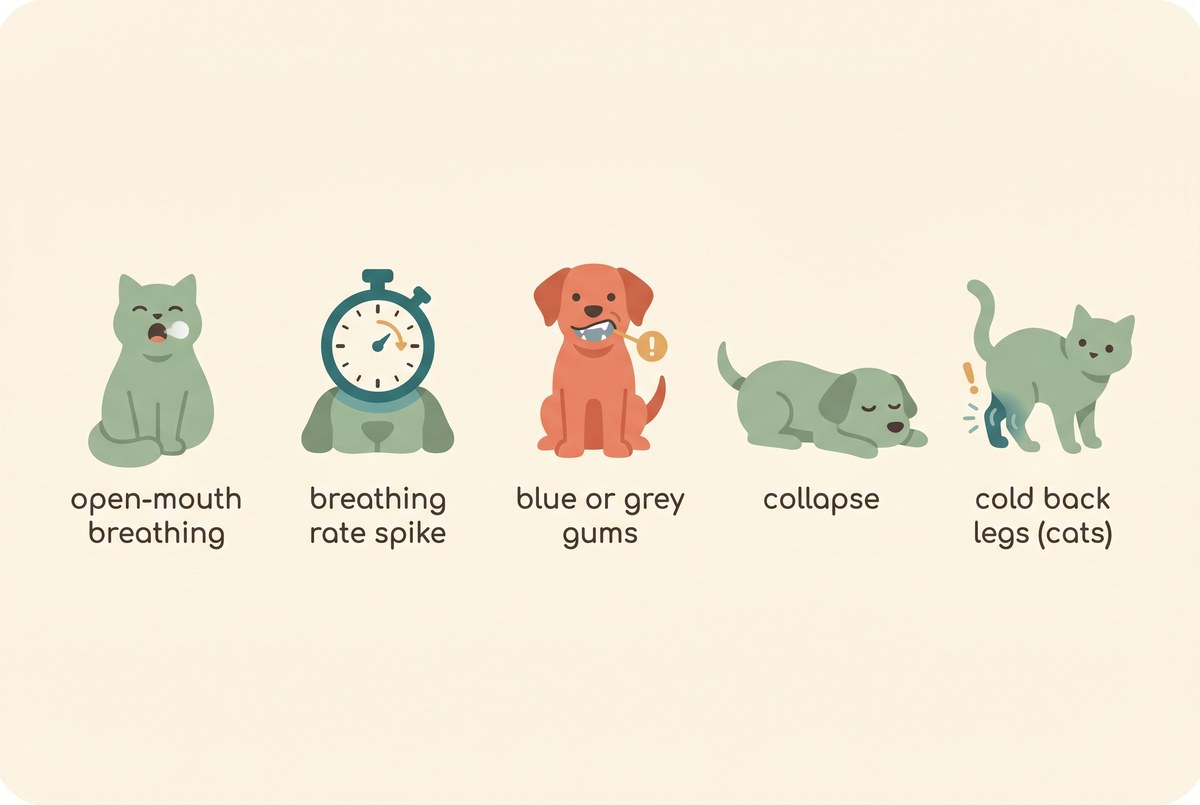
Watch for these, and treat them as urgent:
- Open-mouth breathing or panting in a resting cat. Burn this one into memory. A cat at rest should breathe through its nose with a closed mouth. A cat that is open-mouth breathing, panting like a dog, or breathing with its neck stretched out and elbows held away from the body is in respiratory distress until proven otherwise, and this is a true emergency that needs a vet the same hour, not the next morning (Fox et al., 2018). Cats are masters at hiding illness, so by the time breathing is visibly affected, things have usually been building for a while.
- A sustained spike in the resting respiratory rate. This is your early-warning system, often flagging trouble a day or more before obvious distress. If you have been counting your pet's resting breaths and the number is climbing well above their own normal baseline, or sitting persistently above roughly 40 breaths a minute while truly settled or asleep, that is a serious red flag (Boswood et al., 2018; Porciello et al., 2016). The full method, what counts as normal and how to track the trend lives in the resting respiratory rate guide, and the breathing-rate tracker lets you log it so a rising line is obvious at a glance. I will not re-teach the count here, because that guide owns it.
- Laboured, fast or distressed breathing in a dog, especially with a soft cough that will not settle, restlessness, or an inability to lie down and get comfortable. A dog that keeps standing or sitting up, repeatedly trying and failing to settle through the night, is often a dog that cannot breathe lying flat because of fluid on the lungs.
- Blue, grey or unusually pale gums. Press a fingertip gently against the gum above a tooth and look at the colour. Healthy gums are bubblegum pink. A bluish or greyish tinge (cyanosis) means the blood is not carrying enough oxygen, and that is a go-now sign. Very pale or white gums matter too.
- Collapse, fainting or sudden weakness, particularly any episode where your pet goes down, loses consciousness briefly, or buckles and cannot get up.
- In a cat, sudden pain and dragging back legs. A cat that screams or cries out and suddenly cannot use one or both hind legs, with paw pads that feel cold and look pale or blue, may have thrown a clot from the heart, a feline arterial thromboembolism (sometimes called a saddle thrombus). It is agonising and it is an emergency, and it is sometimes the very first sign that a cat had heart disease at all. The signs, the prevention and what the vet can do are covered in full in the feline arterial thromboembolism article; the one thing to know in the moment is to get to a vet immediately and not to wait to see if the leg recovers.
If you are ever unsure whether what you are seeing crosses the line, our Is this a heart emergency? triage tool walks you through the key questions and tells you whether to go now, ring the same day, or monitor and log. When in doubt, treat breathing trouble as the emergency it usually is and make the call.
In the moment: getting your pet to help
When a crisis hits, your job is to get your pet to oxygen and a vet with the least possible stress on their heart, because stress and exertion make oxygen demand worse at exactly the wrong time. Here is the sequence.
1. Stay calm and keep your pet calm. This sounds soft, but it is medicine. A frightened, struggling pet uses more oxygen, and your own panic transmits straight down the lead or through your hands. Speak quietly, move slowly, and do not chase, restrain hard, or wrestle a distressed cat into a basket if you can avoid a fight. Let them choose the position they can breathe in, which is often sitting upright; never force a struggling pet onto its side or back.
2. Minimise exertion. Do not make your pet walk to the car if you can carry them or bring the carrier to them. Carry a dog rather than letting it climb stairs. Every avoided exertion is oxygen saved.
3. Keep them cool and give fresh air. Open a window in the car, avoid a hot stuffy room, and do not bundle them up. Overheating worsens breathing distress.
4. Give the rescue dose only if your vet has agreed one in advance. Many vets will pre-arrange a rescue (or "pill-in-the-pocket") dose of furosemide for owners of pets in heart failure, with a specific amount and a specific trigger. If, and only if, you have that plan in writing for your pet, give the agreed dose now, and then still get help. A rescue dose is a bridge to veterinary care, not a substitute for it, and it must never be improvised or guessed; the practicalities of dosing it safely are covered in managing furosemide at home. If you do not have a pre-agreed rescue dose, do not give extra heart medication on a hunch. Phone the vet and go.
5. Phone ahead, then go now. Ring your practice or the out-of-hours emergency clinic as you are leaving so they can prepare oxygen and a quiet space for your arrival. Telling them "I think my pet is in a breathing crisis, we are five minutes away" genuinely changes how fast your pet is seen.
One firm caution: a true respiratory crisis, with open-mouth breathing, gasping, blue gums or collapse, is not a moment for a tablet and a wait-and-see at home. That is a same-hour, go-now situation. The rescue-dose protocol is for a settled pet whose breathing rate is creeping up, not for a pet that is already fighting to breathe.
Build the plan on a calm afternoon
The owners who cope best in a crisis are the ones who did the boring work before it arrived. Build your plan now and you will never have to find it at 3am.
Keep these where you can grab them instantly, ideally written down and also saved in your phone:
- The numbers. Your daytime vet's phone number, and separately, the out-of-hours emergency provider, which is often a different clinic in a different place. Know who covers nights, weekends and bank holidays, because many first-opinion practices hand over to a dedicated emergency hospital out of hours. Find out now where it is and roughly how long it takes to get there.
- Your pet's medication list, with doses and timings, plus any pre-agreed rescue protocol written out in your vet's words.
- A recent note of your pet's normal resting respiratory rate, so you and the emergency vet have a baseline to compare against. This is one more reason the breathing-rate tracker earns its place.
- A carrier ready for a cat, somewhere accessible, ideally a top-opening one so you can lower a distressed cat in gently rather than posting it through a small front door during a crisis.
It is worth writing all of this onto a single emergency action plan, one page, stuck to the fridge or kept in the car, so that anyone in the household, including a pet-sitter or a panicking family member, can follow it. Ask your vet to help you fill in the rescue-dose and out-of-hours sections so the plan is specific to your pet rather than generic.
At the clinic: what the vet will do
Knowing what happens next takes some of the fear out of the door. An emergency team's first priority is almost always oxygen, not tests. Your pet will usually be placed in an oxygen-rich kennel or given flow-by oxygen and left to settle, because a pet in severe respiratory distress can be too fragile to handle, and the gentlest, most life-saving first move is simply to let them breathe richer air in peace (Fox et al., 2018). Diagnostics that would stress them are deliberately delayed until they are more stable.
Alongside oxygen, the vet will typically give an injectable diuretic (usually furosemide, given into the vein or muscle so it works fast and hard) to start pulling fluid off the lungs, and they may add other medicines depending on the picture. In cats with fluid in the chest cavity rather than the lung tissue, draining that fluid with a needle (thoracocentesis) can bring dramatic, immediate relief and is sometimes the single most important thing done. Once your pet is breathing more easily, gentler tests follow: listening to the chest, a quick ultrasound look for fluid, often X-rays, and blood tests to check the kidneys and salts. The aim of that whole first phase is simple and humane: get the breathing safe, then work out the detail.
After a crisis: what changes
Surviving a heart failure crisis is a genuine milestone, and many pets go on to have good time afterwards, but it usually marks a turning point rather than a return to exactly how things were. Expect your vet to review and very often adjust the medication, frequently increasing the diuretic dose or adding to the regimen, and to recheck blood tests within days to make sure the kidneys and electrolytes are coping with the change. The whole in-failure medication team and how it fits together is covered in the heart failure medication toolkit.
This is also the moment that home monitoring stops being optional and becomes the backbone of care. A pet that has had one crisis is at risk of another, and the resting respiratory rate is your best early warning between visits, so daily counts and a logged trend are how you catch the next episode a day earlier instead of an hour too late. If you have not already set up the breathing-rate tracker, now is the time, and the resting respiratory rate guide shows you exactly how.
Finally, be straight with yourself and your vet about the bigger picture. Sometimes a crisis is a one-off that good medication adjustment holds at bay for many more comfortable months. Sometimes the crises come closer together despite everyone's best efforts, and the medicines start losing ground. If you find yourself in that second story, you are not failing, and you are not out of options or out of support; when heart failure stops responding talks through the next chapter plainly, including the shift towards comfort, and the Heart Health community is full of people who have sat exactly where you are sitting. For now, though, you have done the most important thing: you have a plan, and you know the signs. Keep them close.
References
- Fox PR, Keene BW, Lamb K, Schober KA, Chetboul V, Luis Fuentes V, Wess G, Payne JR, Hogan DF, Motsinger-Reif A, et al. (2018). International collaborative study to assess cardiovascular risk and evaluate long-term health in cats with preclinical hypertrophic cardiomyopathy and apparently healthy cats: The REVEAL Study. Journal of Veterinary Internal Medicine, 32(3), 930-943.
- Boswood A, Haggstrom J, Gordon SG, Wess G, Stepien RL, Oyama MA, Keene BW, Bonagura J, MacDonald KA, Patteson M, et al. (2018). Longitudinal analysis of quality of life, clinical, radiographic, echocardiographic, and laboratory variables in dogs with preclinical myxomatous mitral valve disease receiving pimobendan or placebo: The EPIC Study. Journal of Veterinary Internal Medicine, 32(1), 72-85.
- Porciello F, Rishniw M, Ljungvall I, Ferasin L, Haggstrom J, Ohad DG. (2016). Sleeping and resting respiratory rates in dogs and cats with medically-controlled left-sided congestive heart failure. The Veterinary Journal, 207, 164-168.
Keep track of how your pet is doing
The owners who cope best are the ones who notice changes early. A simple health log shows you what is working, and what is not, before the next vet visit.
Start tracking, freeYou're not doing this alone
Compare treatment journeys and talk to owners managing heart health. Free to join.
Join PetsLikeMine