

Saddle Thrombus: The Sudden Clot Every HCM Owner Should Know
Alastair Greenway
BVM&S MRCVS
A cat who seemed entirely well an hour ago is abruptly screaming in pain, dragging its back legs, and unable to stand. There is one feline emergency that frightens vets as much as it frightens owners, and this is it. To an owner it can look like a broken back, a stroke, or a fall, and the truth is crueller than any of those: a blood clot, thrown from the heart, has lodged in the artery to the back legs. This is feline arterial thromboembolism, almost always called a saddle thrombus, and for a heartbreaking number of cats it is the very first sign they had heart disease at all.
The other feline heart articles point you here on purpose, because this emergency is completely different from a breathing crisis and you should be able to tell the two apart in seconds. If the diagnosis of a thickened heart is new to you, feline HCM: the thickened heart, and why cats hide it is the place to start. This article is about the clot itself, written for the owner who may be reading it in the worst hour of their cat's life.
What a saddle thrombus actually is
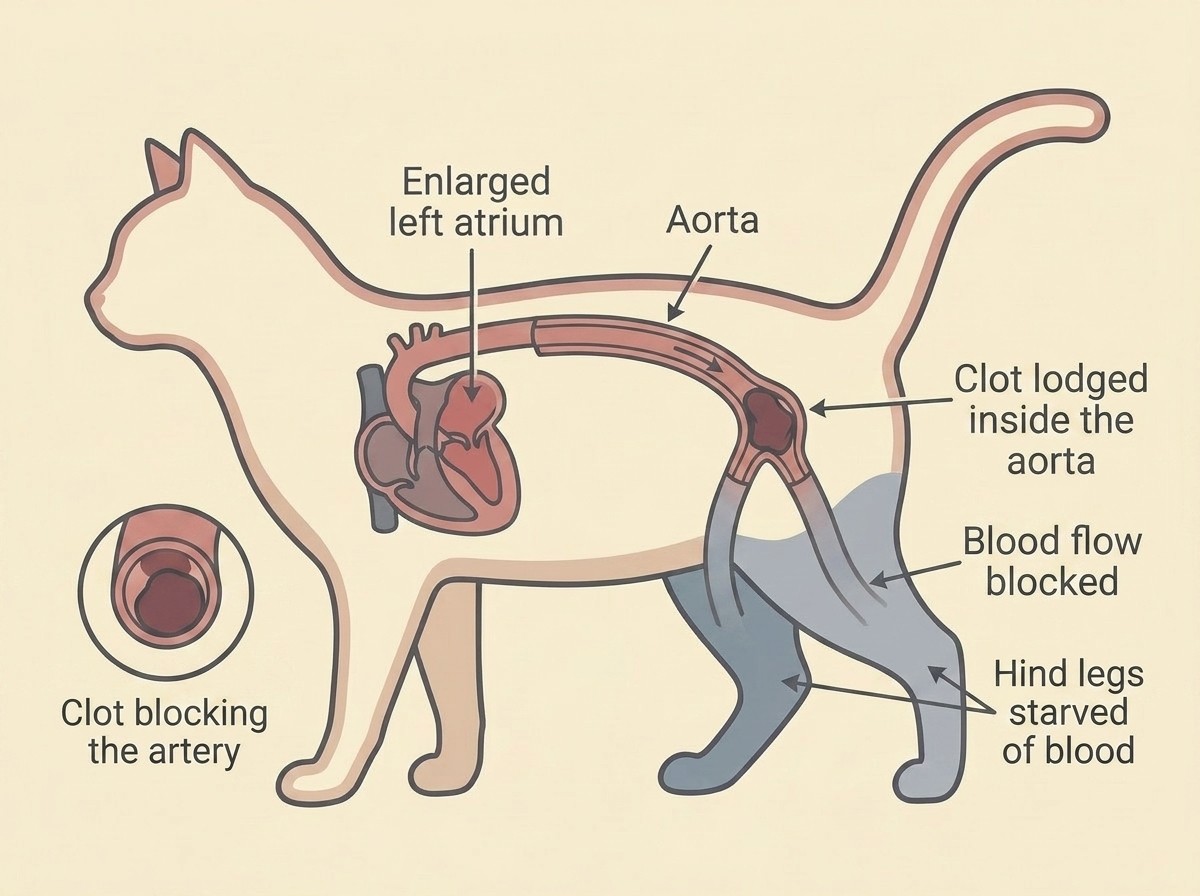
To understand the clot, you have to start with the heart. In hypertrophic cardiomyopathy the muscular wall of the main pumping chamber thickens and stiffens, and the chamber just upstream of it, the left atrium, gradually enlarges as it works against that stiffness. Blood that should sweep briskly through a normal atrium instead begins to swirl and pool in this enlarged, sluggish chamber. Stagnant blood clots. It is one of the oldest principles in medicine, and it applies just as much to a cat's left atrium as to a human leg vein (Luis Fuentes et al., 2020).
A clot that forms in that pooling atrium can break loose and travel out through the aorta, the body's main artery. The aorta runs down the back and then divides, like an upside-down Y, into the two arteries that supply the hind legs. The clot is carried down until the vessel narrows too much for it to pass, and it wedges firmly at that fork, straddling the division like a saddle over a horse's back, which is where the name comes from. Lodged there, it blocks the blood supply to both back legs at once. The tissue downstream is suddenly starved of oxygen, which is what causes the dramatic pain and paralysis. Less often a clot lodges elsewhere, blocking a single front leg, but the classic, devastating presentation is the saddle that takes out both hind limbs together (Smith et al., 2003).
How it looks, and why you will know it once you have seen it
A saddle thrombus announces itself loudly. There is rarely any mystery in the moment, only shock. The signs come on over minutes, not hours, and they are dramatic. What owners typically describe is some combination of the following:
- Sudden, agonising pain. Many cats cry out, yowl, or scream in a way their owner has never heard before. This is genuine, severe pain from tissue losing its blood supply, and the cat may be panting, restless, or frantic.
- Sudden paralysis or weakness of the back legs. The cat cannot stand on one or both hind legs. It may drag itself forward on its front legs, the back end trailing limp behind it. Owners often think the spine is broken.
- Cold paws with pale or blue pads. Because the blood supply is cut off, the affected legs feel noticeably cold compared with the rest of the body, and the pads and nail beds look pale, grey, or bluish rather than healthy pink.
- No pulse, and firm, painful muscles. A vet checking the affected limb will find no pulse where there should be one, and the leg muscles often become hard and painful within hours.
- Fast, distressed breathing. Many of these cats are also in heart failure at the same time, so rapid or open-mouthed breathing frequently sits alongside the leg signs (Smith et al., 2003).
The reason this matters is that the picture is unmistakable once you know it, and knowing it saves time. An owner who has read this will not waste precious minutes wondering whether their cat fell awkwardly. They will recognise the cold, paralysed back legs and the crying for what they are and head straight for a vet.
A genuine emergency: what to do
A saddle thrombus needs a vet immediately, the same hour, day or night. This is not a wait-and-see situation, and it is not something to manage at home. The speed matters for two reasons: the cat is in severe pain that needs urgent, strong veterinary pain relief, and many of these cats are simultaneously in heart failure, which is itself life-threatening.
If you ever see these signs, the plan is simple. Phone your vet or the out-of-hours emergency clinic as you are leaving, tell them you think your cat has thrown a clot and is in severe pain, and go. Handle your cat as gently as you can, because they are frightened and hurting, and a cat in this state may bite or scratch from the pain without meaning to. Support the back end, keep them warm and quiet, and avoid a struggle. Do not give any human painkillers: many, including paracetamol and ibuprofen, are highly toxic to cats and can be fatal. The pain relief this needs can only come from a vet.
The first thing a good veterinary team will do is treat the pain, often before any tests, because relieving it is both humane and urgent (Borgeat et al., 2014). Alongside pain relief, they will assess the heart, because the clot and the underlying heart disease have to be managed together. What happens next, and the honest conversation that often comes with it, is the hardest part of all.
The honest prognosis: serious, but not always hopeless
This is the section owners most need, and it deserves the plain truth without either false comfort or needless despair. A saddle thrombus is serious. It carries a guarded prognosis, and a significant number of affected cats do not survive the event or are gently put to sleep because of it. But it is not an automatic death sentence, and some cats recover meaningful function. Both of those things are true at once, and you deserve to hold both.
- Some cats are euthanased on welfare grounds, and that can be the kind choice. When a cat is in severe pain, has lost the use of both back legs, is in heart failure, and faces a difficult recovery with a real chance of the clot returning, many owners and vets together decide that putting the cat to sleep is the most compassionate path. If you face it, please know it is a legitimate and loving decision, not a failure. The underlying heart disease does not go away, and quality of life has to lead.
- Some cats survive and regain limb function over weeks. With pain relief, supportive care, and time, a proportion of cats do recover use of the affected legs, sometimes partially and sometimes remarkably well. Recovery is slow, measured in weeks rather than days, and it asks a great deal of nursing and patience. Survival of the initial crisis sits at roughly a third to under half of cats in larger general-practice and referral series, with the cats most likely to do badly being those with both back legs affected, a very low body temperature, or concurrent heart failure (Smith et al., 2003; Borgeat et al., 2014). The point of those numbers is not to predict your individual cat, which no one can, but to set honest expectations.
- Recurrence is common. Even a cat that recovers well from one clot remains at real risk of throwing another, because the heart that produced the first clot is still there. This is why clot prevention becomes so central afterwards, and part of why the decision around a first episode is so weighty.
Your vet will be able to talk you through where your individual cat sits, and that conversation, however painful, is the one that should guide the decision.
Often the first sign of heart disease at all
One of the cruellest features of a saddle thrombus is how often it is the opening act rather than a later chapter. In a great many cats, the clot is the very first sign anyone has that the cat had heart disease at all (Payne et al., 2015). There was no murmur the owner knew about, no cough, no warning. Cats are extraordinarily good at hiding illness, and HCM frequently causes no outward sign until something tips over, so the clot arrives like a bolt from a clear sky in a cat everyone believed was healthy.
If this has just happened to you, please hear this clearly: you did not miss something obvious, and you are not to blame. There was, in all likelihood, nothing to see. This is the nature of the disease, not a failure of care. It is precisely why vets push so hard on screening at-risk cats and on counting the resting breathing rate at home once HCM is known: to try to find the hearts at risk before this day arrives, rather than after.
Lowering the risk in cats already diagnosed with HCM
For cats already diagnosed with HCM, particularly those whose hearts have changed in the ways that breed clots, an enlarged left atrium and sluggish, swirling blood, there is something genuinely worth doing to lower the risk. The mainstay is a daily anti-clotting tablet called clopidogrel, which makes the blood platelets less sticky so a clot is less likely to form in the first place. This is one of the very few interventions in feline heart disease backed by a proper clinical trial: the FAT CAT study compared clopidogrel with aspirin in cats that had already survived one clot and found that cats on clopidogrel went substantially longer before a repeat event (Hogan et al., 2015), and on the strength of that the 2020 ACVIM consensus statement recommends it for cats judged to be at increased risk of thromboembolism (Luis Fuentes et al., 2020). It does not make a clot impossible, and a cat on clopidogrel can still, sadly, throw one. What it does is meaningfully shift the odds against the cruellest complication of the disease, which is well worth having.
The full story of how that tablet works, and the very practical business of getting a notoriously bitter pill into a cat every single day, has its own home in preventing clots: clopidogrel and the FAT CAT evidence. I will not specify a dose here, and you should never guess one: the right amount is a decision for your vet, who weighs your cat's heart, its size, and its individual risk. Whether to start it at all, and when, belongs to that same conversation, because not every cat with HCM needs it, and the cats who benefit most are those whose hearts have already remodelled.
The honest summary is this. A saddle thrombus is one of the worst things that can happen to a cat with heart disease: sudden, painful, and often the first warning that anything was wrong. The outlook is serious, and it sometimes forces a terrible decision in the space of an evening. But it is not uniformly hopeless. Some cats recover, the pain can always be relieved, and in cats already known to be at risk there is a real, evidence-backed way to make it less likely. If you are facing this now, be gentle with yourself, lean on your vet for the honest picture of your own cat, and let your cat's comfort lead whatever comes next.
References
- Hogan DF, Fox PR, Jacob K, Keene B, Laste NJ, Rosenthal S, Sederquist K, Weng HY. (2015). Secondary prevention of cardiogenic arterial thromboembolism in the cat: The double-blind, randomized, positive-controlled feline arterial thromboembolism; clopidogrel vs. aspirin trial (FAT CAT). Journal of Veterinary Cardiology, 17(Suppl 1), S306-S317.
- Luis Fuentes V, Abbott J, Chetboul V, Cote E, Fox PR, Haggstrom J, Kittleson MD, Schober K, Stern JA. (2020). ACVIM consensus statement guidelines for the classification, diagnosis, and management of cardiomyopathies in cats. Journal of Veterinary Internal Medicine, 34(3), 1062-1077.
- Smith SA, Tobias AH, Jacob KA, Fine DM, Grumbles PL. (2003). Arterial thromboembolism in cats: acute crisis in 127 cases (1992-2001) and long-term management with low-dose aspirin in 24 cases. Journal of Veterinary Internal Medicine, 17(1), 73-83.
- Borgeat K, Wright J, Garrod O, Payne JR, Luis Fuentes V. (2014). Arterial thromboembolism in 250 cats in general practice: 2004-2012. Journal of Veterinary Internal Medicine, 28(1), 102-108.
- Payne JR, Borgeat K, Brodbelt DC, Connolly DJ, Luis Fuentes V. (2015). Risk factors associated with sudden death vs. congestive heart failure or arterial thromboembolism in cats with hypertrophic cardiomyopathy. Journal of Veterinary Cardiology, 17(Suppl 1), S318-S328.
- Cornell Feline Health Center, Cornell University College of Veterinary Medicine. Hypertrophic Cardiomyopathy. Feline Health Topics. Accessed 2026.
Keep track of how your pet is doing
The owners who cope best are the ones who notice changes early. A simple health log shows you what is working, and what is not, before the next vet visit.
Start tracking, freeYou're not doing this alone
Compare treatment journeys and talk to owners managing heart health. Free to join.
Join PetsLikeMine