


Dilated cardiomyopathy explained: what DCM is, which dogs get it, and why it stays silent for so long
Alastair Greenway
BVM&S MRCVS
Dilated cardiomyopathy is one of the most serious heart diseases of dogs, and there is no point pretending otherwise. It is also one of the most misunderstood, partly because it behaves so differently from the slow-creeping valve disease most owners have heard of, and partly because it can hide in a perfectly well-looking dog for years. Whether your dog has just been diagnosed, or you own one of the at-risk breeds and want to understand it before anything goes wrong, this is the place to start. This article covers what the disease is, which dogs are prone to it, why it stays quiet for so long, the two very different ways it can show itself, and what treatment is trying to achieve. The deeper specifics, screening, the Dobermann's particular danger, the diet question and the longer view, each have their own article, and I will point you to them as we go.
What dilated cardiomyopathy actually is
The name tells you most of it once you unpack it. "Cardiomyopathy" means a disease of the heart muscle itself, as opposed to a faulty valve. "Dilated" describes what that diseased muscle does. In DCM, the heart muscle weakens and loses its power to contract, and as it weakens the chambers stretch and balloon outwards, so the heart becomes large, thin-walled and floppy rather than the firm, briskly-squeezing muscle it should be (McCauley et al., 2020).
The consequence is a failing pump. A healthy heart empties most of the blood it holds with every beat. A heart with DCM squeezes feebly and stretches wide, so it holds more blood but pushes less of it onward. For a long time the body compensates and from the outside the dog looks entirely normal. But the underlying problem is mechanical and progressive: a muscle getting weaker and a chamber getting wider, slowly losing the argument with the work it has to do.
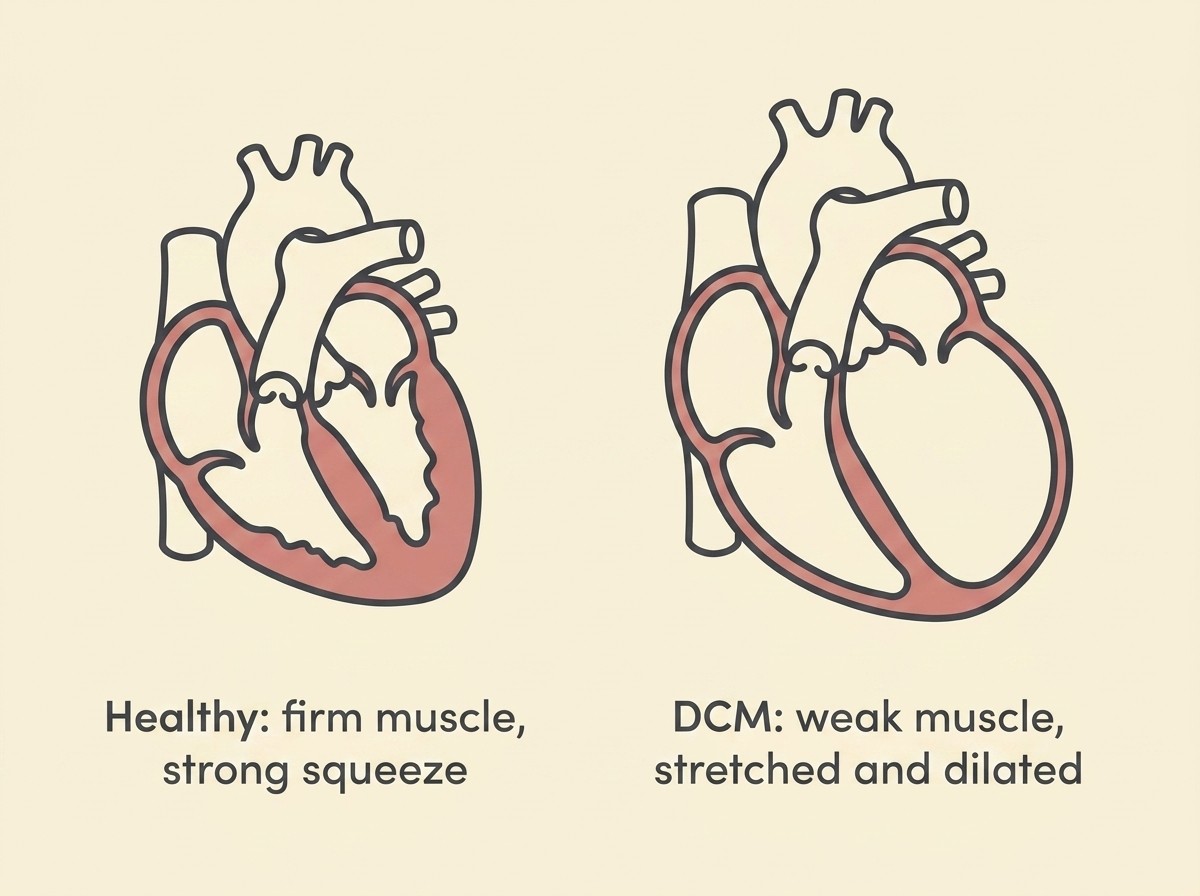
It is worth being clear about what this is not. DCM is a primary disease of the muscle, usually inherited, and in most affected dogs it is not caused by anything the owner did or failed to do. There is one important and more hopeful exception, a form linked to diet, which we will come to. But the classic, breed-related disease this article is mostly about is something a dog is born predisposed to, written into the muscle from the start and waiting to declare itself.
Which dogs get it
DCM is overwhelmingly a disease of large and giant breeds, and in most of those breeds it runs in families. The breeds with the best-documented inherited risk are the Dobermann (often spelled Doberman), the Great Dane, the Irish Wolfhound, the Boxer and the Cocker Spaniel, and several other large and giant breeds carry recognised risk too (McCauley et al., 2020). If you share your life with one of these dogs, that does not mean your dog will get DCM, but it does mean the disease is common enough in the breed to take seriously and to screen for.
Within that list there are real differences worth knowing. In the Dobermann the disease is not only common but frequently brings a dangerous heart rhythm with it, which is why this breed has a reputation, sadly earned, for sudden death. A long European study of the breed found a strikingly high lifetime prevalence, rising steeply with age, and confirmed that many affected dogs spend a long stretch with the disease before any sign appears (Wess et al., 2010). The giant breeds such as the Irish Wolfhound and Great Dane tend towards a progressive, both-sided heart failure. And in some breeds the picture is bound up with nutrition: the American Cocker Spaniel, classically, develops a DCM linked to low taurine that could improve substantially when taurine and carnitine were supplemented, which is not how genetic DCM usually behaves (Kittleson et al., 1997). The headline is simple. This is a big-dog disease, it tends to run in bloodlines, and a handful of breeds carry most of the burden.
In the Dobermann specifically, researchers have identified gene variants associated with the disease, including a mutation affecting a protein called PDK4, although it does not account for every case and the genetics differ between populations (Meurs et al., 2012). The practical relevance of genetic testing, and how it sits alongside the heart scans that look at the actual heart, is covered in screening at-risk breeds.
Why it stays silent for so long, and why that matters
Here is the single most important thing to understand about DCM, and the thing that makes it so different from the heart murmurs owners are used to hearing about. For a long time, often years, a dog with DCM looks and behaves completely normally. The muscle is weakening and the chambers are stretching on the inside, but the dog eats, walks, plays and greets you at the door exactly as before. Cardiologists call this the occult or preclinical phase, and it is genuinely silent. You could not spot it from the sofa, and often a vet cannot hear it through a stethoscope either (Wess et al., 2017).
That silence is the cruel heart of the disease, because it means DCM frequently announces itself only when it is already advanced, either as a sudden crisis of breathing or as a dog who collapses without warning. But the same silence is also the reason there is hope, and the reason screening exists. The occult phase is a long window in which the disease is present and measurable but has not yet caused harm, and that is precisely the window in which we can find it, monitor it and, in some cases, treat it before it does its damage. You cannot act on a problem you have not found, and a well-looking dog gives you no reason to look. Screening manufactures that reason.
Because the disease hides from ordinary examination, finding it in the silent phase takes specific tests. An echocardiogram, an ultrasound scan of the heart, looks at the structure and measures how enlarged the chambers have become and how weakly the muscle is squeezing. A Holter monitor, a small ECG worn in a vest for twenty-four hours, looks for the abnormal beats that signal electrical instability and the risk of sudden death; a brief in-clinic ECG misses these because the rhythm trouble comes and goes. A blood test called proBNP, which rises when heart muscle is under strain, can act as a useful first filter to decide which dogs most need a scan, though a normal result does not clear the heart (Wess et al., 2017). The full account of who to screen, how often, and how these tests work together belongs to screening at-risk breeds, which owns that ground.
The two ways DCM shows itself
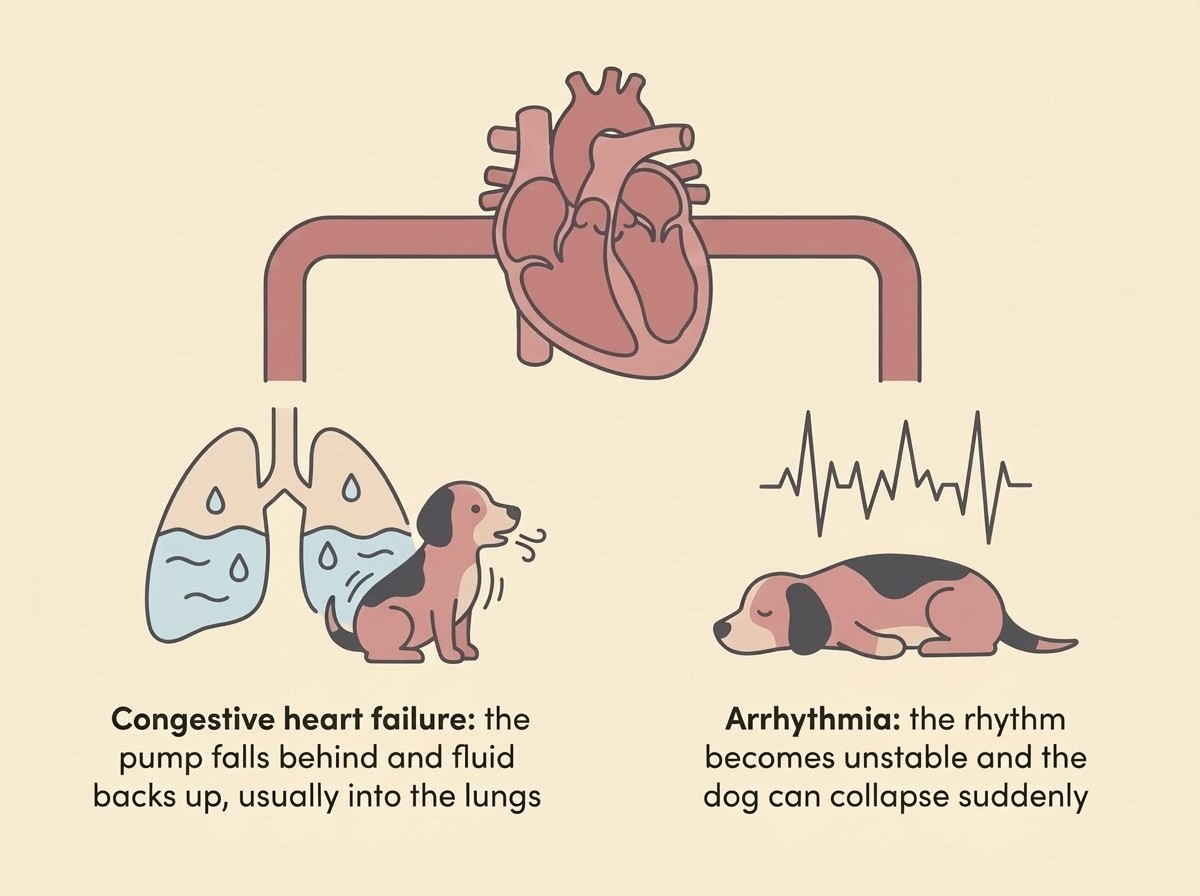
When DCM finally does break its silence, it does so in one of two very different ways, and understanding both is the key to understanding the whole disease.
The first is congestive heart failure. As the weak pump falls further behind, blood backs up behind it and fluid begins to gather, most often in the lungs. This is the slower, more visible face of the disease, showing as increased effort or rate of breathing, a soft cough, tiredness, and sometimes a swollen belly in the giant breeds where the right side of the heart is involved. It is a hard moment when it arrives, but it is also the point at which DCM becomes properly treatable with medication that can clear a crisis and hand many dogs back a stretch of comfortable life. What changes when the disease tips into congestion, and how it is managed, is covered in when DCM becomes heart failure.
The second way is far more abrupt, and it is the one that frightens owners most. The diseased muscle can become electrically unstable and fire off chaotic, rapid beats from the main pumping chambers, an arrhythmia that can stop the heart pumping effectively and cause sudden collapse and death, sometimes as the very first sign that anything was ever wrong. This is most associated with the Dobermann, in which a substantial proportion of affected dogs can die suddenly, and it can happen during the occult phase before any heart failure at all (Wess et al., 2010). Because this danger is real and largely invisible, it has its own dedicated article, Dobermans and sudden death, which explains the arrhythmia, the monitoring that catches it, and what can be done. Many dogs, it should be said, travel both roads, dealing with a failing pump and a dangerous rhythm at the same time, and that is the everyday reality of managing established DCM.
A word on the diet-associated form
You may have heard "grain-free" mentioned in the same breath as DCM, and it is worth knowing why, because it is a genuinely different route into the disease with a genuinely different outlook. Since around 2018, a number of dogs, often breeds not normally prone to DCM, have developed dilated, weakened hearts that appear linked to certain grain-free, legume-heavy or "boutique" diets, sometimes alongside low taurine (Freeman et al., 2018). The crucial difference is that a meaningful proportion of these dogs improve, sometimes dramatically, when the diet is changed, which the genetic form almost never does.
This matters enormously for hope, which is why the first thing a good vet wants to know after a DCM diagnosis is what your dog has been eating. I am not going to relitigate the whole grain-free debate here, because the evidence is nuanced, still evolving and deserves the full treatment: the grain-free question lays out what is known and what to feed now. The point to carry from here is this. Do not let anyone, including yourself, write a dog off until the diet question has been properly explored, because the two causes have such different outlooks that lumping them together gives a falsely bleak picture.
What treatment is trying to do
There is no cure for the genetic form of DCM. The muscle does not regrow, and treatment cannot reverse the structural disease. What treatment can do, and does well, is buy time, comfort and quality of life, and on this front canine cardiology has genuinely good news to offer.
The cornerstone medicine for the pump side of DCM is pimobendan, a drug that helps the weakened muscle contract more strongly and eases the load it works against. Its value in the silent phase was established by an important trial known as PROTECT, a randomised, blinded, placebo-controlled study of pimobendan in Dobermanns with preclinical DCM, dogs who had the disease on screening but no symptoms yet. The dogs given pimobendan went significantly longer before reaching the trial's hard endpoint of heart failure or sudden death, and lived longer overall, than the dogs given a placebo (Summerfield et al., 2012). In plain terms, treating the silent heart before it had caused any outward trouble bought meaningful extra time of normal life, which is what turned occult-phase screening in this breed into a recommended standard of care. (PROTECT studied Dobermanns specifically; your vet will judge how its lessons apply to other breeds.)
Once the disease has tipped into congestive heart failure, the treatment broadens to include medicines that clear the gathered fluid and further support the failing circulation, and when a dangerous rhythm is present, antiarrhythmic medication may be added to target the electrical side of the disease. These are separate jobs aimed at separate problems, and a dog may well be on medication for both at once, which is normal rather than a sign things have gone badly wrong. The day-to-day business of living alongside the disease, the routines, the monitoring and the sensible adjustments, is covered in living with a DCM dog.
The honest outlook, and where to go next
It would be wrong to end without being straight about prognosis, and equally wrong to strip out the hope, because both are true at once. DCM is a serious disease and its outlook is guarded; it shortens lives, and once heart failure has arrived the horizon is measured more often in months than years for many dogs. That is the hard half, and you deserve to hear it plainly.
But sit with the other half too. A dog whose DCM is found in the silent phase, treated early and monitored well stands in a far better place than one whose disease surprises everyone. Early pimobendan has been shown to push back the day failure arrives, diet-associated cases can genuinely improve, and even after heart failure the right medicines hand many dogs a real stretch of happy, comfortable, normal-looking life. The realistic range of what to expect, and why the silent-phase head start matters so much, is laid out with the numbers in DCM prognosis.
One last practical thing, useful whether your dog is being screened or is already diagnosed. The single most valuable measurement you can take at home is your dog's resting respiratory rate, counted while they sleep. A sustained climb in that number is often the earliest sign that fluid is starting to gather, frequently before a cough or any visible struggle. The resting respiratory rate guide explains exactly how to count it, and the breathing rate tracker turns it into a quiet thirty-second habit that can give you a real head start if anything ever changes.
References
- Wess G, Schulze A, Butz V, et al. Prevalence of dilated cardiomyopathy in Doberman Pinschers in various age groups. Journal of Veterinary Internal Medicine. 2010;24(3):533-538.
- Summerfield NJ, Boswood A, O'Grady MR, et al. Efficacy of pimobendan in the prevention of congestive heart failure or sudden death in Doberman Pinschers with preclinical dilated cardiomyopathy (the PROTECT Study). Journal of Veterinary Internal Medicine. 2012;26(6):1337-1349.
- Wess G, Domenech O, Dukes-McEwan J, et al. European Society of Veterinary Cardiology screening guidelines for dilated cardiomyopathy in Doberman Pinschers. Journal of Veterinary Cardiology. 2017;19(5):405-415.
- Meurs KM, Lahmers S, Keene BW, et al. A splice site mutation in a gene encoding for PDK4, a mitochondrial protein, is associated with the development of dilated cardiomyopathy in the Doberman pinscher. Human Genetics. 2012;131(8):1319-1325.
- Freeman LM, Stern JA, Fries R, Adin DB, Rush JE. Diet-associated dilated cardiomyopathy in dogs: what do we know? Journal of the American Veterinary Medical Association. 2018;253(11):1390-1394.
- McCauley SR, Clark SD, Quest BW, Streeter RM, Oxford EM. Review of canine dilated cardiomyopathy in the wake of diet-associated concerns. Journal of Animal Science. 2020;98(6):skaa155.
- Kittleson MD, Keene B, Pion PD, Loyer CG. Results of the Multicenter Spaniel Trial (MUST): taurine- and carnitine-responsive dilated cardiomyopathy in American Cocker Spaniels with decreased plasma taurine concentration. Journal of Veterinary Internal Medicine. 1997;11(4):204-211.
- Cornell University College of Veterinary Medicine, Riney Canine Health Center. Dilated cardiomyopathy. Accessed 2026.
Keep track of how your pet is doing
The owners who cope best are the ones who notice changes early. A simple health log shows you what is working, and what is not, before the next vet visit.
Start tracking, freeYou're not doing this alone
Compare treatment journeys and talk to owners managing heart health. Free to join.
Join PetsLikeMine