

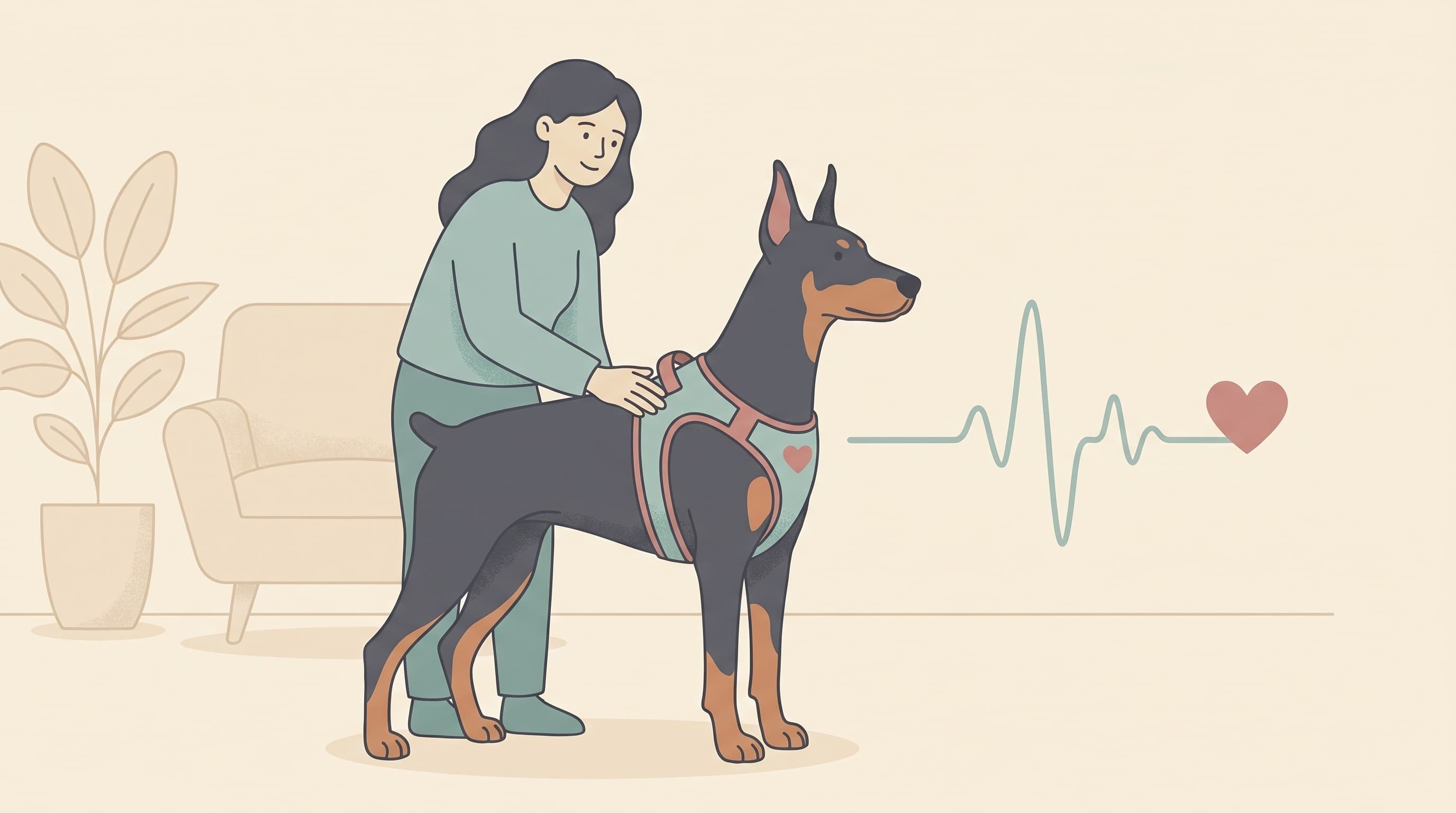
Dobermans and Sudden Death: Arrhythmias, Monitoring, and What Can Be Done
Alastair Greenway
BVM&S MRCVS
Of all the heart problems a dog can have, the one that frightens Doberman owners most is the one that arrives with no warning. You have probably heard about it already, from a breeder, a forum, or a vet picking their words carefully, and you deserve a straight answer rather than false comfort or fatalism. In Dobermans, dilated cardiomyopathy can disturb the heart's electrical rhythm so badly that a dog collapses and dies suddenly, sometimes as the very first sign that anything was ever wrong. That is the reality this article is about. It is also only half the story, because the other half is what monitoring and treatment can do to push back, and that part has improved a great deal.
This article assumes you already know what DCM is from the anchor guide to dilated cardiomyopathy in dogs, so we will not re-tread the basics of the weak, enlarged heart here. Instead we will focus on the thing that makes the Doberman different from almost every other DCM breed: not just a failing pump, but a dangerous rhythm.
What sets this breed apart
In most large and giant breeds with DCM, the heart muscle weakens, the heart enlarges, and trouble announces itself gradually as the pump struggles. Dobermans get all of that, and they also carry an unusually strong tendency towards ventricular arrhythmias, electrical short-circuits arising in the main pumping chambers. This is not a minor footnote to the disease. In this breed it is often the most dangerous part of it.
The reason is partly genetic. Doberman DCM is a heritable, breed-specific form of the disease, and a particular gene mutation affecting a protein called PDK4 has been linked to it in many North American Dobermans, although it does not explain every case and European lines appear to differ (Meurs et al., 2012). What matters for you as an owner is the consequence: a Doberman heart can become electrically unstable, and it can do so while the dog still looks entirely well. A long European study following Dobermans through the disease found that a substantial proportion died suddenly, and that sudden death could occur during the occult phase, before any congestive heart failure and sometimes before any outward clue at all (Wess et al., 2010). That is the fact that sits behind the fear, and it would be wrong to soften it.
It helps to understand why an arrhythmia can be lethal. The normal heartbeat is an orderly electrical wave. When the diseased ventricle fires off rapid, chaotic extra beats, the heart can no longer fill and empty properly, and it can tip into ventricular fibrillation, a quivering that pumps no blood at all. A few seconds of that and the dog faints; a little longer and it does not recover. This is why a Doberman can be lost in an instant rather than over the slow weeks of fluid building up in heart failure.

Catching a silent danger: Holters, fainting and VPCs
The cruel feature of this disease is that the electrical instability is largely silent. A dog can have dangerous arrhythmias and still run, eat and greet you at the door as normal. So how is it ever caught in time? The honest answer is that you cannot reliably feel or hear it at home, and a single normal examination at the vet does not rule it out. The arrhythmia comes and goes, and a one-minute listen with a stethoscope can easily fall in a quiet patch.
This is exactly why cardiologists reach for a Holter monitor. A Holter is a small recorder, worn in a little vest, that captures every heartbeat continuously for twenty-four hours or more while your dog goes about an ordinary day. Over that long window it will catch the extra beats that a brief consult misses. Those abnormal beats are called ventricular premature complexes, or VPCs, and counting them over twenty-four hours is one of the most useful early warnings we have in this breed. A healthy Doberman heart produces very few; a meaningfully raised count, often taken as more than fifty to a hundred VPCs in twenty-four hours, or the presence of fast runs of consecutive abnormal beats, raises real concern about both the disease and the sudden-death risk (Wess et al., 2010). How breed screening is organised, how often to test, and how Holter sits alongside echocardiography all belong to screening at-risk breeds, which owns that ground; here the point is simpler, that the Holter exists precisely because the danger is invisible to the naked eye.
There is one sign you can watch for, and you should know it well. Fainting, properly called syncope, is when a dog suddenly collapses, often goes briefly limp or stiff, and then recovers within seconds, frequently getting straight back up as if puzzled. In a Doberman, an episode like this must never be dismissed as the dog "tripping" or "having a funny turn". It can be the heart briefly stopping, a survived version of the event that kills, and it is an emergency reason to seek a cardiac work-up quickly. Collapse during or just after exercise or excitement is particularly worrying. If you see it even once, treat it as a warning the heart has given you, and act on it.
Owners understandably confuse syncope with a seizure. A cardiac faint is usually brief, the dog is floppy rather than rigidly convulsing, and there is rarely the paddling, drooling or disorientation that follows a true seizure, with a quick and complete recovery. You cannot always be certain at home, which is exactly why any collapse in this breed earns a prompt veterinary assessment rather than a wait-and-see.
Antiarrhythmic drugs, and their real limits
If a Holter shows a dangerous burden of arrhythmia, your vet or cardiologist may recommend an antiarrhythmic medication. The aim of these drugs is to calm the ventricle's tendency to fire off chaotic beats and, in doing so, to lower the chance of a fatal rhythm. The most commonly used in this setting is sotalol, sometimes combined with mexiletine, and the choice and dosing are very much a job for a vet experienced in canine cardiology rather than something to attempt from a website.
Here, though, candour matters more than reassurance. These medications can reduce the number of abnormal beats and make some dogs feel better, particularly those who have been fainting. What they cannot do is guarantee that a dog will not die suddenly. Antiarrhythmic therapy lowers risk; it does not abolish it, and a dog on well-chosen medication can still, sadly, be lost to an arrhythmia. There is a further hard truth: some antiarrhythmic drugs can occasionally provoke rhythm problems of their own, so these are not treatments to start lightly or without monitoring. The right framing is that medication shifts the odds in your favour, sometimes meaningfully, without ever moving them to zero.
It is worth separating this from the other arm of treatment, because Dobermans often need both. The rhythm problem and the failing pump are two different fronts. The drug pimobendan, shown in the PROTECT study to delay the onset of heart failure and prolong survival in Dobermans with occult DCM, supports the weak muscle and is a cornerstone of managing the pump side of the disease (Summerfield et al., 2012). That is a separate decision from the antiarrhythmic, which targets the electrical side. A Doberman with both problems may well be on medication for each, and that is normal, not a sign things have gone badly wrong. The full picture of pump-directed treatment and what happens as the disease moves into congestion is covered in when DCM becomes heart failure, so we hand that off rather than duplicate it.
Talking honestly about the risk
Even with the best monitoring and medication available today, sudden death cannot be entirely prevented in this breed. A Holter tells you the risk on the day it was worn, not a guarantee for the months after, so it is a snapshot rather than a certificate, which is why repeat testing matters in a dog known to be affected. A dog can do everything right, take every tablet, and still be the unlucky one. If that frightens you, it should, a little. It is the truth of loving this breed.
Sit with the other half of it too, though, because it is just as true. Catching the arrhythmia gives you choices you would not otherwise have. It lets you start medication that tilts the odds. It lets you make sensible decisions about exercise and excitement. It removes the particular cruelty of a death that came with no warning at all, and it gives many dogs more good time than they would have had unwatched. Plenty of Dobermans live happy, active lives for years after a diagnosis is made and acted upon. The goal here is not a false promise of safety. It is to trade blind luck for informed management, and that trade is worth making.
One practical kindness to yourself: know what an emergency looks like before it happens, so that if your dog ever does collapse or struggle to breathe you are not learning what to do in the worst moment. The acute crisis and the exact steps to take are owned by recognising a heart failure crisis, and reading it once, calmly, while your dog is well, is one of the most useful things you can do.
How screening shifts the odds
Everything above points to a single, hopeful conclusion: the worst outcome in a Doberman is the disease nobody knew was there. The silent arrhythmia, the heart quietly enlarging, the dog who looks perfect right up until the day it does not. Screening exists to break that silence, and in this breed it is not a luxury, it is the single most valuable thing you can do.
The argument for proactive screening, who to test, how the Holter and echo work together and how often to repeat them, is made in full in screening at-risk breeds. Once a diagnosis is in hand, the day-to-day side of supporting a dog through this, sensible exercise for a heart that may be electrically fragile, medication routines and what to watch for, lives in living with a DCM dog. And for the realistic range of what the future holds, including how much early detection genuinely changes the story, DCM prognosis lays it out.
For the home stretch between vet visits, the one number worth tracking yourself is your dog's resting respiratory rate, counted while they sleep, which can give early warning that fluid is starting to gather long before a dog looks unwell. The resting respiratory rate guide explains exactly how to count it, and the breathing rate tracker lets you log it so a creeping trend shows itself early. It will not warn you of an arrhythmia, nothing at home reliably will, but for the pump side of the disease it is the most useful habit you can build. The truest thing to hold on to is this: a Doberman heart problem found and managed is a far better place to stand than one left to surprise you, and finding it early is the whole reason this breed is screened at all.
References
- Meurs KM, Lahmers S, Keene BW, White SN, Oyama MA, Mauceli E, Lindblad-Toh K. (2012). A splice site mutation in a gene encoding for PDK4, a mitochondrial protein, is associated with the development of dilated cardiomyopathy in the Doberman pinscher. Human Genetics, 131(8), 1319-1325.
- Wess G, Schulze A, Butz V, Simak J, Killich M, Keller LJM, Maeurer J, Hartmann K. (2010). Prevalence of dilated cardiomyopathy in Doberman Pinschers in various age groups. Journal of Veterinary Internal Medicine, 24(3), 533-538.
- Summerfield NJ, Boswood A, O'Grady MR, Gordon SG, Dukes-McEwan J, Oyama MA, Smith S, Patteson M, French AT, Culshaw GJ, Braz-Ruivo L, Estrada A, O'Sullivan ML, Loureiro J, Willis R, Watson P. (2012). Efficacy of pimobendan in the prevention of congestive heart failure or sudden death in Doberman Pinschers with preclinical dilated cardiomyopathy (the PROTECT Study). Journal of Veterinary Internal Medicine, 26(6), 1337-1349.
Keep track of how your pet is doing
The owners who cope best are the ones who notice changes early. A simple health log shows you what is working, and what is not, before the next vet visit.
Start tracking, freeYou're not doing this alone
Compare treatment journeys and talk to owners managing heart health. Free to join.
Join PetsLikeMine