


The Grain-Free Question: Diet-Associated DCM, Explained Fairly
Alastair Greenway
BVM&S MRCVS
Few topics in canine heart health have stirred up as much worry, and as much heated argument, as the link between grain-free food and dilated cardiomyopathy. Maybe a frightening headline sent you here, or your vet asked, pointedly, what your dog has been eating. Either way you deserve a straight account: what is actually known, what is genuinely unsettled, and what a sensible owner should do about it tonight. The honest answer is more nuanced than either the alarmist version ("grain-free food is poisoning dogs") or the dismissive one ("it is all a myth"). The truth sits in between.
A quick orientation before we start. If you want the disease itself explained first, what dilated cardiomyopathy is and what it does to the heart, read dilated cardiomyopathy explained and come back. And if you want the broader picture of how food relates to a heart patient generally, salt, taurine, fish oil and so on, that lives in diet and the heart. This page zooms in on one specific thread: the grain-free, or "BEG", diet story and the recovery hope that makes it unlike classic DCM.
Where the concern began
The story has a fairly precise starting point. In July 2018, the United States Food and Drug Administration announced that it was investigating reports of dilated cardiomyopathy in dogs eating certain diets, many of them labelled "grain-free", that used a high proportion of peas, lentils, other legume seeds (collectively, pulses) and potatoes in place of grains. What caught everyone's attention was not DCM itself, which is a well-known disease in certain large and giant breeds, but the pattern of dogs being affected. Cases were turning up in breeds not traditionally prone to DCM at all, including some small and medium dogs, which is not how an inherited, breed-linked heart disease is supposed to behave (FDA, 2018).
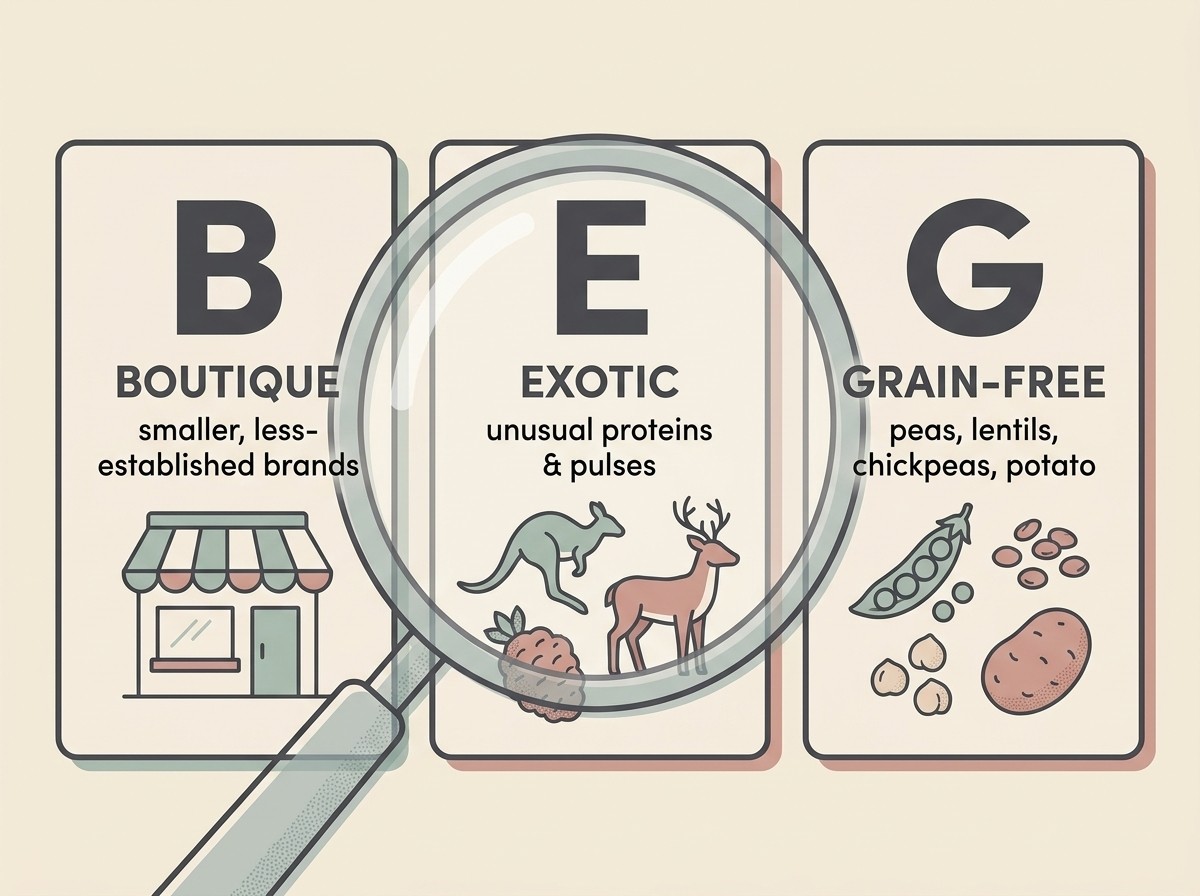
Veterinary cardiologists were noticing the same thing in their own caseloads, and a group of them set out the emerging concern in a widely read viewpoint in the Journal of the American Veterinary Medical Association (Freeman et al., 2018). They coined a useful shorthand for the diets that kept appearing in these cases: BEG diets, standing for boutique brands, exotic ingredients, and grain-free formulations. It is worth being precise about what that label does and does not mean. It is not a verdict that these foods are dangerous. It is a description of a common set of features in the diets of affected dogs, offered as a signal worth investigating rather than a proven cause.
The taurine clue, and why it only half-fits
The first place researchers looked was taurine, and for good reason. Taurine is an amino acid the heart muscle depends on, and there is a famous precedent: in cats, taurine deficiency was identified in the late 1980s as a major cause of DCM, and correcting it could reverse the disease. So when grain-free DCM appeared, taurine was the obvious suspect, and in some dogs it fit beautifully. A series of Golden Retrievers eating non-traditional diets were found to be taurine-deficient, and many of them improved when their taurine was restored and their diet changed (Kaplan et al., 2018). Studies grouping DCM dogs by diet found that those on grain-free, legume-rich foods were considerably more likely to be taurine-deficient than those on conventional diets (Adin et al., 2019).
That looked like a tidy answer for a while. The problem is that it does not fit all the cases, or even most of them. A substantial proportion of dogs with diet-associated DCM have entirely normal blood taurine levels, yet still improve when the diet is changed (Freeman et al., 2018; Kaplan et al., 2018). If a simple taurine deficiency were the whole story, that should not happen. So taurine is part of the picture for some dogs, particularly certain breeds and certain diets, but it cannot be the single explanation. Something else about these foods appears to be involved, and exactly what remains the central unanswered question.
The honest position, then, is that the mechanism is not understood. Candidate ideas have been floated, that the pulses themselves carry some factor, that they interfere with how the body makes or uses taurine, that the issue lies in how these diets are formulated or digested, but none has been confirmed, and a single tidy cause has not been pinned down. Research is ongoing, and it is genuinely difficult research to do well.
A real association, genuinely under debate
It is important to be fair to the scientific uncertainty here, because it is real and it is not merely academic caution. What we have is an association: a repeated observation that affected dogs are disproportionately eating a certain kind of diet, supported by the striking fact that some of them recover when that diet is removed. An association of that strength is not nothing, and it would be irresponsible to wave it away.
But an association is not the same as a proven cause, and this one has been actively contested. Critics have pointed out that much of the early evidence came from reported cases and case series rather than controlled studies, that grain-free food makes up a large and growing share of the market so some overlap is expected by chance, and that confirmed numbers are small against the millions of dogs eating these diets without apparent harm. These are reasonable points, and the debate between cardiologists, nutritionists, the pet food industry and the regulator has at times been pointed. Reflecting that unsettled state, in late 2022 the FDA said it would not issue further public updates unless meaningful new scientific information emerged, having received well over a thousand case reports but being unable to establish a causal link from those reports alone (AVMA, 2022). That is not a verdict that the concern was unfounded; it is an acknowledgement that the question is complex and that adverse-event reports, by themselves, cannot settle it.
So the fair summary is this. There is a real, repeatedly observed association between certain diets and DCM in some dogs, strong enough that the veterinary profession takes it seriously, but it is not a proven, simple cause, the mechanism is unknown, and thoughtful experts still disagree about how big the risk really is. Holding both of those truths at once, taking it seriously without panicking, is the grown-up way to read this story.
The genuinely hopeful part: some of these dogs recover
This next part is the reason the whole topic matters so much, and it is the bit most worth holding onto. Classic, genetically driven DCM is a one-way street: the heart muscle weakens and does not come back. Diet-associated DCM appears, for a meaningful proportion of dogs, to be different. When the diet is changed, sometimes with taurine supplementation, some of these dogs partially or even substantially recover heart function over the following months (Freeman et al., 2018; Adin et al., 2019).
This is not a fringe observation. A retrospective study of DCM dogs found that those eating non-traditional diets who had their food changed showed greater improvement in heart measurements, and lived significantly longer, than similar dogs whose diet was not changed (Freid et al., 2021). A later prospective study following dogs on non-traditional diets reported improvement in cardiac size and function after a diet change as well (Freeman et al., 2022). The improvement is not guaranteed, and it is rarely instant, but the very possibility transforms the outlook. It is exactly why the first question a good vet asks after a DCM diagnosis is what the dog has been eating. The answer may change what kind of disease your dog turns out to have, and that distinction is explored further in DCM prognosis.
A word of caution within the hope. A recovering heart still needs proper veterinary management, including any heart medication your vet prescribes, and the diet change is made and monitored as part of that care rather than instead of it. The aim is to give the heart its best chance while the underlying disease is treated, not to swap food and hope.
What a sensible owner should actually do
None of this calls for panic, and a panic-switch of food on the strength of a headline is itself a mistake. Here is the measured, evidence-aligned approach.
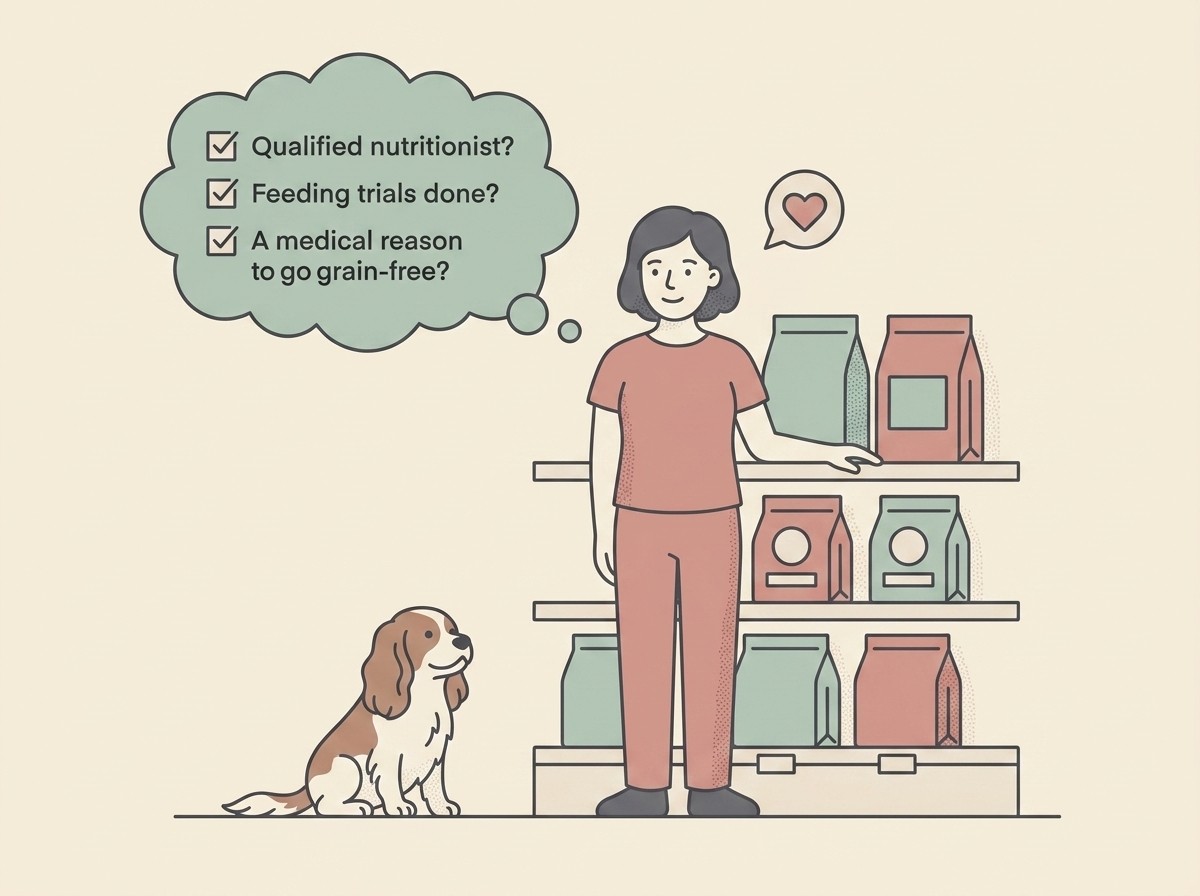
First, favour diets that meet established quality standards. The widely used yardstick is the set of questions in the World Small Animal Veterinary Association's guidelines on selecting a pet food (WSAVA Global Nutrition Committee, 2021). The thrust is simple: prefer foods from established manufacturers that employ a qualified nutritionist (someone with a PhD in animal nutrition or board certification), that run proper feeding trials rather than only formulating on paper, and that can answer straightforward questions about how their food is made and tested. These criteria are not about brand snobbery; they are about whether there is real nutritional expertise behind the bowl.
Second, be cautious about boutique grain-free diets unless there is a specific medical reason for one. Grain-free is a marketing position, not a health requirement; the great majority of dogs have no need to avoid grains, and a genuine grain allergy is uncommon. If your dog is currently thriving on a conventional, well-formulated food, there is no reason in this story to change it.
Third, and most importantly, talk to your vet before changing anything, especially if your dog already has a heart murmur, a DCM diagnosis, or is on heart medication. If your dog has diagnosed DCM and has been eating a non-traditional diet, your vet may check a blood taurine level (remembering that a normal result does not rule diet out), guide a switch to a suitable food, and sometimes recommend taurine or other supplements while things are reviewed. The practical detail of making and following up that change lives in living with a DCM dog. If your dog has no heart disease and simply eats a grain-free food, the conversation is calmer: a question to raise at the next routine visit, not a reason for a midnight switch.
And whatever you feed, the single most useful thing you can do at home for any dog at risk of heart trouble is to learn to count the resting breathing rate while your dog sleeps. A sustained rise in that number is often the earliest sign that fluid is starting to gather, well before a cough or visible distress. The resting respiratory rate guide explains exactly how, and the breathing-rate tracker turns it into a quiet thirty-second habit that gives you a head start if anything ever changes. That nightly number, far more than the fine print of the food label, is what tends to catch heart trouble early.
References
- Freeman LM, Stern JA, Fries R, Adin DB, Rush JE (2018). Diet-associated dilated cardiomyopathy in dogs: what do we know? Journal of the American Veterinary Medical Association, 253(11), 1390-1394.
- U.S. Food and Drug Administration (2018, updated 2022). FDA Investigation into Potential Link between Certain Diets and Canine Dilated Cardiomyopathy.
- American Veterinary Medical Association (2022). Until more science is available, FDA will end public updates on potential link between certain diets and canine dilated cardiomyopathy.
- Adin D, DeFrancesco TC, Keene B, et al. (2019). Echocardiographic phenotype of canine dilated cardiomyopathy differs based on diet type. Journal of Veterinary Cardiology, 21, 1-9.
- Kaplan JL, Stern JA, Fascetti AJ, et al. (2018). Taurine deficiency and dilated cardiomyopathy in golden retrievers fed commercial diets. PLoS ONE, 13(12), e0209112.
- Freid KJ, Freeman LM, Rush JE, et al. (2021). Retrospective study of dilated cardiomyopathy in dogs. Journal of Veterinary Internal Medicine, 35(1), 58-67.
- Freeman LM, Rush JE, Adin DB, et al. (2022). Prospective study of dilated cardiomyopathy in dogs eating nontraditional or traditional diets and in dogs with subclinical cardiac abnormalities. Journal of Veterinary Internal Medicine, 36(2), 451-463.
- WSAVA Global Nutrition Committee (2021). Guidelines on Selecting Pet Foods (Selecting a Pet Food for Your Pet). World Small Animal Veterinary Association Global Nutrition Toolkit.
Keep track of how your pet is doing
The owners who cope best are the ones who notice changes early. A simple health log shows you what is working, and what is not, before the next vet visit.
Start tracking, freeYou're not doing this alone
Compare treatment journeys and talk to owners managing heart health. Free to join.
Join PetsLikeMine