

Working With a Veterinary Cardiologist: Referral, Costs and What to Expect
Alastair Greenway
BVM&S MRCVS
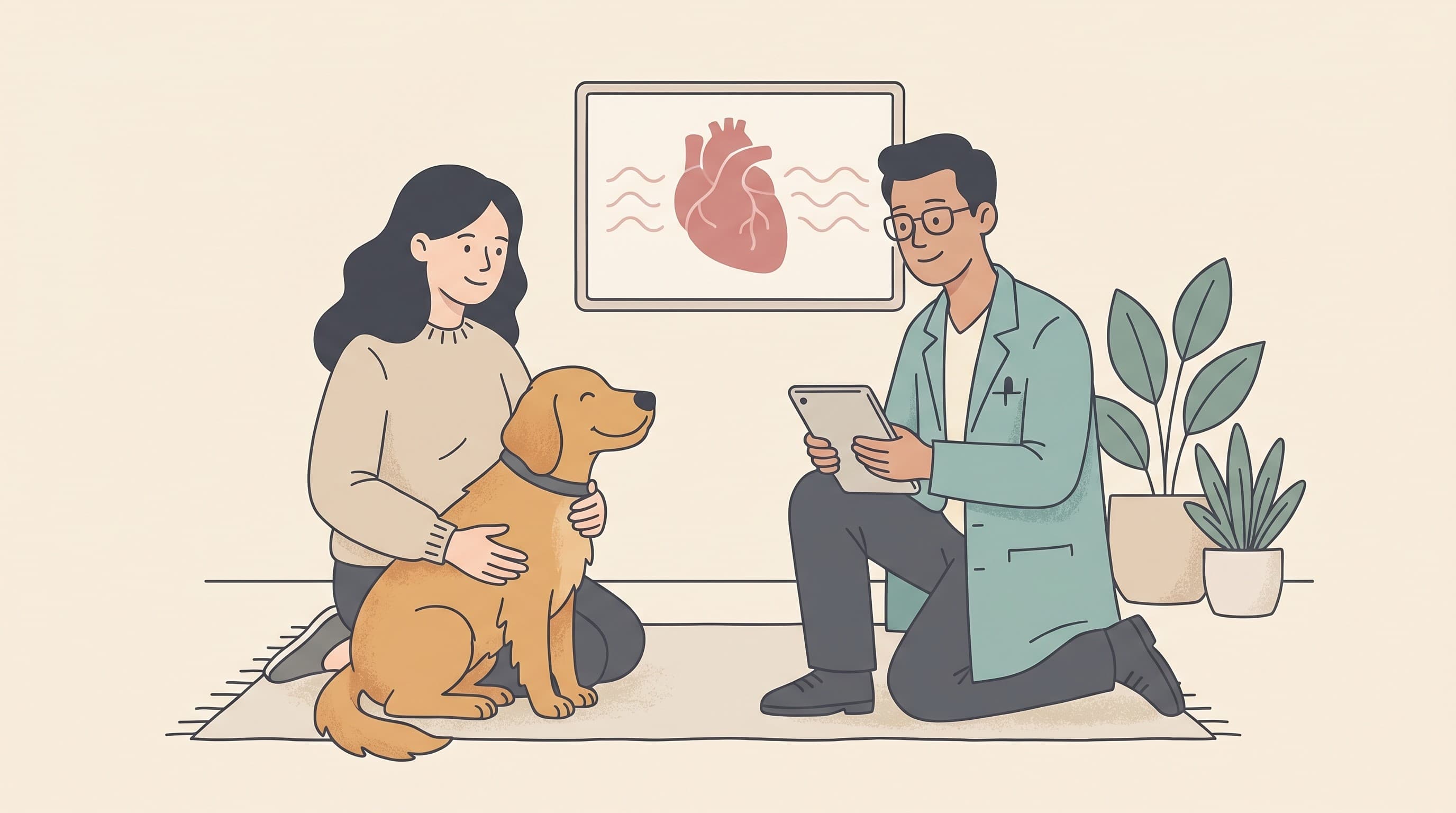
A referral to a veterinary cardiologist is a normal step, and for some hearts it genuinely changes the outcome rather than just the bill. It can sound expensive and serious, and it can feel as though your familiar vet is handing your pet over to a stranger. None of that is quite what is happening. Your own vet stays involved, the appointment is usually more reassuring than people expect, and the value depends a good deal on how you arrive. This is the plain guide to whether and when it is worth it, what actually happens on the day, what it tends to cost, and how to prepare so you get every penny back out of it.
What a cardiologist adds over your own vet
Your regular vet is a generalist, and a good one can manage a great many heart patients well. A veterinary cardiologist is a specialist who has done years of additional training and examinations in heart disease alone, and who, crucially, scans hearts all day. That last point matters more than the certificate. The single most useful thing a cardiologist brings is a detailed, accurately measured echocardiogram, the ultrasound scan of the beating heart, because a heart scan is only as good as the person interpreting it. We cover what each heart test does in heart tests explained; here the point is simply that the echo is the test where expertise changes the answer most.
Beyond the scan, a specialist brings a few things a busy general practice often cannot. There is precise staging, placing your pet's disease at an exact point on the recognised scale so the treatment matches the moment rather than the guess. There is familiarity with the unusual and the advanced: arrhythmias that need a Holter monitor to catch, congenital defects in young animals, the option of a pacemaker, or keyhole valve repair. And there is fluency with the evidence, because cardiology is one of the better-studied corners of veterinary medicine, and the right move at each stage is often defined by a specific trial result rather than opinion.
When referral genuinely changes the plan
Referral is not always necessary, and a good cardiologist will tell you so. Here is where it most often earns its keep.
The clearest example in dogs is the decision point in the common leaky-valve disease, myxomatous mitral valve disease. There is a stage, known as B2, where the valve leaks and the heart has enlarged but your dog still seems completely well. This is the treatment turning point, because the landmark EPIC trial showed that starting the medication pimobendan at this precise stage delayed the onset of heart failure by roughly fifteen months on average (Boswood et al., 2016). The catch is that "enlarged enough to treat" is a measurement, taken on the echo, and getting it right is exactly the kind of judgement a cardiologist makes confidently. A clear-cut B2 found on a good scan is one of the most worthwhile reasons to refer, because the reward is months of extra symptom-free life. The ACVIM stages explained article walks through what each stage means.
A handful of other situations make the case just as strongly. An unclear or contradictory picture, where the murmur, the x-ray and the symptoms do not quite add up, is worth a specialist eye to avoid either over-treating a healthy heart or missing a sick one. Anything surgical or device-based, such as a pacemaker for a dangerously slow rhythm or mitral valve repair, has to go through a referral centre. Suspected congenital disease in a puppy or kitten, where the question of whether to operate is time-sensitive, deserves early specialist assessment. And cats with heart disease are a special case in their own right, because feline heart disease hides, scans are harder to read, and the stakes around anaesthesia are higher, which is why we have a dedicated piece on feline HCM and anaesthesia.
It is just as fair to say when referral may not change much. A small dog with a soft murmur and a normal-sized heart on x-ray, with no symptoms, often simply needs monitoring, and your own vet can do that perfectly well. An elderly pet already settled and stable on heart failure medication may get more comfort from continuity than from a new clinic. A cardiologist who tells you "keep doing what you are doing, come back if anything changes" has still done you a service.

Inside the appointment
Knowing the shape of the day takes a lot of the dread out of it. Most cardiology referrals follow the same arc.
You arrive with your pet and, ideally, with the records and images your own vet has already sent ahead, which saves repeating tests. The cardiologist takes a history, asking about exercise, coughing, any fainting or collapse, breathing at rest, appetite and what you have noticed at home. Then comes a thorough physical examination, listening carefully to the heart and lungs, feeling the pulse, checking the colour of the gums and the jugular veins in the neck.
The centrepiece is the echocardiogram. Your pet lies on their side, usually on a padded table with a cut-out so the probe can reach from underneath, and a patch of fur over the chest is clipped so the ultrasound gel makes good contact. It is painless, involves no needles into the heart and no radiation, and the great majority of pets need no sedation at all, just gentle handling and a calm voice; a tense or fractious cat may be offered a mild sedative. The scan itself takes anywhere from twenty minutes to the better part of an hour, because measuring properly is slow, careful work. Depending on the case, the cardiologist may add a chest x-ray, an ECG to read the rhythm, or a blood pressure check, each of which we describe in heart tests explained.
The part owners remember most is the conversation at the end. A good cardiologist will show you the images, explain in plain terms what they found, give you a stage and a likely outlook, and set out the options with their pros, cons and costs. Most consultations are done in a single morning or afternoon and your pet comes home with you the same day, none the wiser. You should leave with a written report, usually copied to your own vet, and a clear plan for who does what next.
Ballpark costs and insurance
This is the question people are too polite to ask first, so let us be plain about it. Costs vary widely by country, region and clinic, and the figures below are broad UK ballparks to set expectations, not quotes, so always ask the referral centre for their own estimate before you book.
A first cardiology consultation with an echocardiogram commonly runs to a few hundred pounds, often in the region of £300 to £600, with the scan being the bulk of it. Adding tests such as an x-ray, an ECG or a Holter monitor increases that. The medications that may follow, pimobendan and others, are an ongoing monthly cost we cover in heart medications explained. Advanced interventions such as a pacemaker or open-heart valve repair run into the thousands, and those are decisions made carefully with the specialist, not on the day.
The single most useful piece of advice on cost is to check your insurance before you go, and to check it properly. Most lifetime policies cover specialist referral and diagnostics, which is precisely what these policies are for, but two traps catch people out. The first is the per-condition limit, the cap on what a policy pays for any one condition across the pet's life, which heart disease can reach because it is lifelong. The second is the pre-existing exclusion, because if a murmur was noted before the policy began, the insurer may class the whole heart as pre-existing and decline the claim. Phone your insurer, quote the likely procedure, and get the answer in writing before the appointment, not after. Many referral centres will also help you submit a pre-authorisation so you know where you stand.
If insurance will not cover it, or there is no policy, say so openly to the cardiologist. They would far rather tailor a realistic plan around your budget than have you decline a referral in silence. There is almost always a version of good care that fits what you can spend, and a frank conversation gets you there faster.
Getting the most out of the appointment
A cardiology consultation is a concentrated burst of expensive expertise, and a little preparation roughly doubles its value. A few things make a real difference.
Ask your own vet to send the records and images ahead, including any previous x-rays and blood results, so nothing is repeated and the specialist starts fully informed. Bring a written list of your pet's current medications, with doses, rather than trying to recall them. Most valuable of all, bring data from home. If you have been counting your pet's resting respiratory rate, the number of breaths per minute while they sleep, bring the log, because it is the single most useful real-world measure of how the heart is coping and a cardiologist will read it with interest. Our resting respiratory rate guide shows you how to count it, and you can record it in the breathing rate tracker and simply show the chart at the appointment. A short phone video of any coughing, breathing or fainting episode is worth a great deal too, because these events rarely happen to order in the consulting room.
Then write down your questions before you go, because the conversation moves quickly and good questions are easy to forget under stress. A useful core set: what stage is my pet at, and what does that mean for how long and how well they will live? Does anything change today, in treatment or in what I watch for? What would a setback look like, and what should I do if I see it? How often should we re-scan or review? And, asked plainly, what will all of this cost? Do not be shy of asking the cardiologist to write the key points down or to confirm them in the report, because you will not remember everything, and you should not have to.
Finally, remember that a referral is a partnership, not a transfer. Your own vet stays at the centre of your pet's care, sees you for the ordinary visits and the repeat prescriptions, and works from the specialist's plan. The cardiologist is there for the detailed scan, the difficult decision and the advanced option, and then hands the day-to-day reins back. If your pet is heading towards or living with heart failure, the thread that ties the two together between appointments is the number you track at home: keep counting that breathing rate, because it is the early-warning system that tells you, and your vet, when something is changing and it is time to pick up the phone.
References
Keep track of how your pet is doing
The owners who cope best are the ones who notice changes early. A simple health log shows you what is working, and what is not, before the next vet visit.
Start tracking, freeYou're not doing this alone
Compare treatment journeys and talk to owners managing heart health. Free to join.
Join PetsLikeMine