

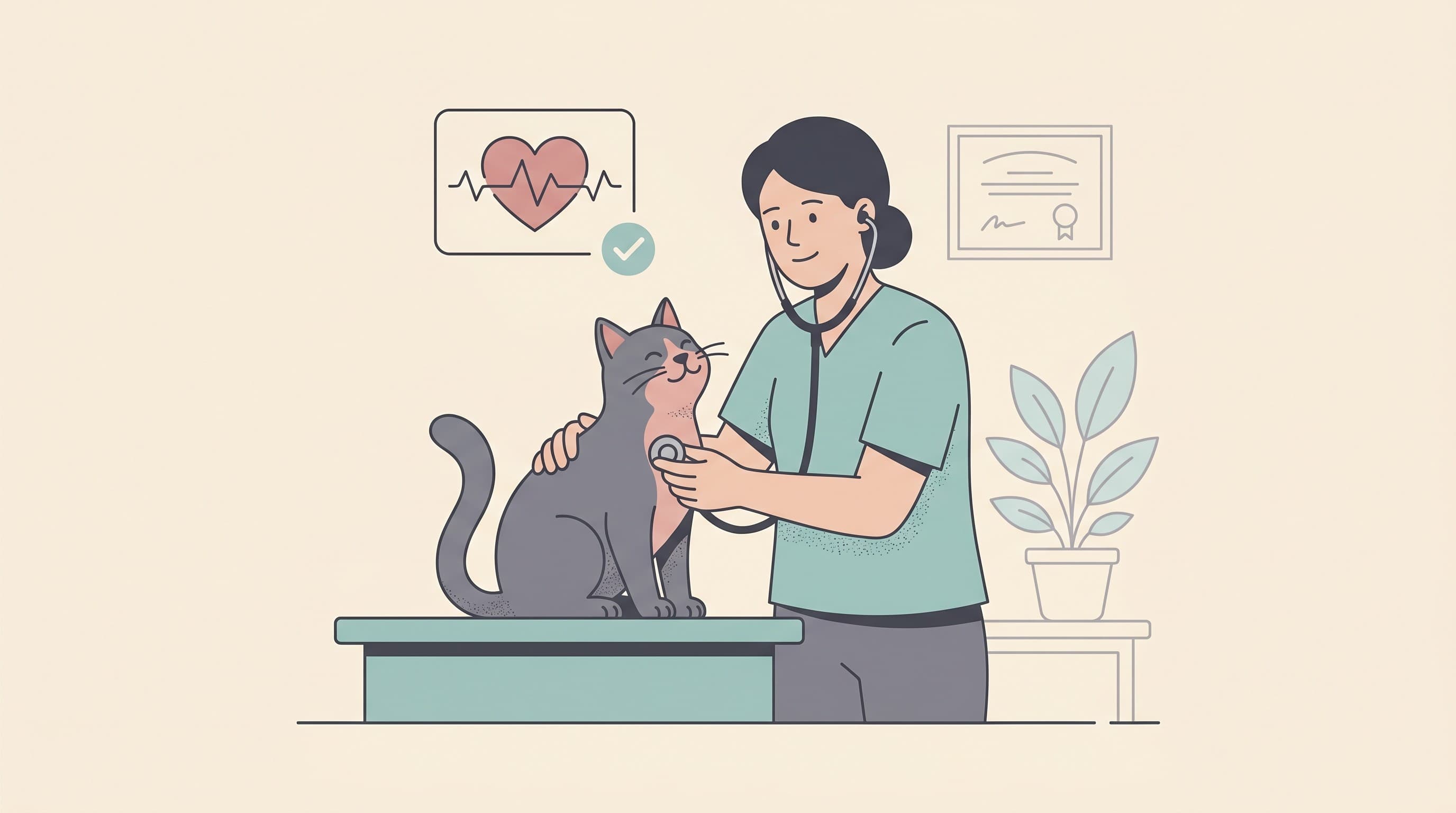
HCM and Anaesthesia: Why Screening Before a Routine Op Matters
Alastair Greenway
BVM&S MRCVS
Most cats sail through a neuter, a dental or a lump removal without a hitch, and modern feline anaesthesia is genuinely safe. There is one quiet exception worth understanding, though, because it is both real and largely preventable: the cat with hidden hypertrophic cardiomyopathy. A stiff, thickened heart copes poorly with the very things a routine procedure involves, the stress, the drugs and the drip, and in a cat whose disease nobody knew about, an ordinary operation can be the moment heart failure first appears. So this article walks through why that happens, who is most at risk, and the simple checks that move an at-risk cat firmly into the safe column. If you want the basics of the disease itself first, the feline HCM explainer covers what a thickened heart is and why cats hide it.
A problem hiding in plain sight
The reason this matters at all is that HCM is common and silent. In a study of apparently healthy cats, roughly one in seven, about 15%, turned out to have echocardiographically detectable cardiomyopathy, and almost all of it, 15 of the 16 affected cats, was HCM (Paige et al., 2009). A large UK study of cats in rehoming centres found much the same picture, with HCM in around 15% (Payne et al., 2015). Put plainly: in any waiting room of cats booked in for a "routine" op, a meaningful minority are carrying undiagnosed heart disease, and most of their owners have no idea.
What makes it harder still is that a normal-sounding heart does not rule it out. It is tempting to assume that if the vet listens and hears nothing alarming, the heart is fine. Unfortunately a murmur is an unreliable signpost in cats: many cats with HCM have no murmur at all, while plenty of perfectly healthy cats do have one. In that same UK study, around four in ten healthy cats had a murmur, yet most of those murmurs were innocent and only about 15% of the cats had HCM, which is why the researchers concluded that detecting a murmur is simply not a reliable indicator of cardiomyopathy in apparently healthy cats (Paige et al., 2009; Payne et al., 2015). A gallop sound or an irregular rhythm carries more weight than a murmur and is more worth acting on (Luis Fuentes et al., 2020). But the reality is that listening alone, however careful, cannot promise you a healthy heart.
Why a stiff heart struggles under anaesthesia
To see why this disease and anaesthesia interact badly, it helps to picture what the HCM heart is dealing with. The wall of the main pumping chamber is thickened and stiff, so the chamber cannot relax and fill properly between beats. That leaves it depending on three things to keep working: enough time to fill, which means a steady rather than a racing heart rate; enough filling volume, but not too much; and a maintained blood pressure.
Anaesthesia, and the stress and pain around it, can disturb all three at once. Fear, pain or a light plane of anaesthesia can send the heart rate up, and a fast heart has less time to fill. Generous intravenous fluids, routine and helpful in a normal cat, can overload a heart that simply cannot accommodate the extra volume, tipping it into fluid on or around the lungs (Luis Fuentes et al., 2020). And some anaesthetic drugs drop blood pressure. None of this is a problem for a healthy heart with room to spare. For a stiff one already working at its limit, each of these is a push in the wrong direction.

There is one more wrinkle worth naming, because owners sometimes read about it and worry. In some HCM cats the mitral valve gets drawn into the outflow tract as the heart contracts, a phenomenon called systolic anterior motion, or dynamic obstruction. A fast heart, a low filling volume and dilated blood vessels all make it worse, and under anaesthesia it can occasionally cause sudden, severe drops in blood pressure. It is a genuine concern for the team managing the anaesthetic. What it is not, and this is the nuance that gets garbled online, is a sign of a shorter life: the consensus is clear that in cats this dynamic obstruction has not been shown to worsen long-term survival (Luis Fuentes et al., 2020). The two things are simply different questions. The minute-to-minute physiology on the operating table is one matter; the years ahead are another.
Matching the screening to the risk
This is where the guidance gets refreshingly concrete, so you are not left thinking every cat needs a heart scan before a nail trim. The 2020 ACVIM consensus, the authoritative reference here, recommends that further cardiac investigation be considered in older cats when an anaesthetic, intravenous fluids or certain long-acting corticosteroids are planned, and it flags in particular cats aged nine years or older undergoing interventions that could precipitate heart failure, which includes general anaesthesia (Luis Fuentes et al., 2020). For the predisposed breeds, the Maine Coon, the Ragdoll and their relatives, the threshold to look is lower at any age, because occult disease turns up in them even when young. In one small screening study of asymptomatic Maine Coons, nearly one in ten already had clear wall thickening, and more again sat in a borderline range (Gundler et al., 2008). Some of these breeds also carry recognised HCM gene variants, which is why a low threshold for them makes sense; the screening and genetics article covers the breed testing in full.
So the practical shape of it is this. An older cat, a known at-risk breed, or a cat with a gallop, an arrhythmia or a murmur of uncertain meaning, facing a non-urgent procedure, is exactly the cat worth a closer look beforehand. A young, ordinary domestic shorthair with a clean exam needing an urgent procedure is a very different proposition. The point is to match the effort to the risk, not to screen everyone.
What pre-op screening actually involves
Screening is tiered, and it helps to be clear about what each step can and cannot do. The deeper detail of each test lives in the tests explained; here is what matters for the pre-op decision specifically.
The first step is a thorough physical examination and careful listening for a murmur, a gallop or an irregular beat. It is quick and costs nothing extra, but as above, a clean exam does not exclude HCM.
The second step is an NT-proBNP blood test, a marker that rises when heart muscle is under strain, used as a triage tool. Here precision matters, because the test comes in two forms with very different performance. The quantitative laboratory version separates occult cardiomyopathy from normal hearts reasonably well, with around 86% sensitivity and 91% specificity (Fox et al., 2011). The in-clinic point-of-care version, the SNAP-type test run in the practice, is much weaker as a blanket screen in apparently healthy cats: in general-practice use it picked up only around 43% of affected cats, rising to about 71% if used only in cats that already had a murmur (Lu et al., 2021). The takeaway is that a positive proBNP meaningfully raises suspicion and should prompt a scan, but a negative in-clinic result does not reliably clear the heart. It is a useful nudge, not an all-clear certificate.
The third step, and the only one that truly diagnoses or excludes HCM, is an echocardiogram, an ultrasound scan of the heart (Luis Fuentes et al., 2020; Fox et al., 2011). For an at-risk cat facing a non-urgent procedure, a pre-anaesthetic echo, often arranged through a referral practice or a visiting cardiologist, is the single highest-value step. It is also the part with real-world friction: access and cost vary, and a scan usually means a referral. The working with a cardiologist article covers what that involves, and the screening and genetics article goes deeper into the proBNP-versus-echo decision.
Screening for planning, not pills
It is worth being clear about the goal, because it is easy to assume that finding HCM means starting lifelong medication, and that is not why we look before an operation. The consensus is unambiguous that no treatment, not the ACE inhibitors, not spironolactone, not the beta-blocker atenolol, has been shown to slow progression or improve survival in subclinical HCM (Luis Fuentes et al., 2020). So pre-op screening is not a hunt for a reason to medicate. Its value is entirely in planning: it lets the team tailor the anaesthetic and the fluid rate, decide whether a non-urgent procedure should go ahead now, be deferred, or be done at a referral centre with more monitoring, and inform decisions about clot-prevention medication where the heart is enlarged. Finding the disease changes the plan, and that is the whole point.
What a cardiac-aware anaesthetic looks like
You do not need the drug detail, and a good team will not expect you to. But it helps to know roughly what changes once heart disease is on the radar, so the conversation makes sense. In broad strokes, a cardiac-aware plan aims to keep the heart calm and steady and to avoid overloading it.
That starts before your cat even leaves the house, by minimising stress and handling: a calm carrier routine, sometimes a calming medication such as gabapentin given beforehand to take the edge off, and a quiet, unhurried admission. Once in theatre, the team will usually give oxygen by mask for a few minutes before anaesthesia is induced. The drug choices then lean towards keeping the heart rate steady and avoiding agents that race it, so drugs like ketamine and the anticholinergics such as atropine are generally avoided in HCM, or used only for a specific reason (Wiese, 2018). The plan tends to favour cardiac-stable choices instead: the opioid painkillers have little negative effect on the cardiovascular system, the benzodiazepine sedatives calm without depressing the heart and lungs much, and alfaxalone tends to preserve heart rate (Wiese, 2018). Crucially it means judicious, conservative fluids rather than generous ones, because overload is a key risk in this disease (Luis Fuentes et al., 2020). And it means close monitoring throughout, in particular the pulse and pulse oximetry that UK data have specifically linked to fewer feline anaesthetic deaths (Brodbelt et al., 2007).
That last point is the reassuring frame for all of this. Anaesthesia in cats is generally very safe: the large UK CEPSAF enquiry put the overall death risk at around 0.24%, roughly one in four hundred. But it rose sharply in unwell cats, to around 1.4%, about one in seventy-one, with poorer health status, increasing age and, tellingly, fluid therapy among the identified risk factors (Brodbelt et al., 2007; Brodbelt et al., 2008). Read that the right way round: screening is not about fear. It is about finding the hidden heart problem that would otherwise move a cat into the higher-risk group, and tailoring the day so it does not.

Three questions before a dental or neuter
If your cat is older, an at-risk breed, or has ever been noted to have a murmur or an odd rhythm, and a non-urgent procedure is being booked, a short conversation is all it takes. You do not need to medicalise every routine op, just ask the questions that matter for this one:
- Has my cat's heart been listened to recently, and is there a murmur, a gallop or an irregular beat?
- Given my cat's age and breed, would an NT-proBNP blood test or an echo be worthwhile before we go ahead?
- Will the fluid rate and the choice of drugs take a possible heart problem into account?
Those three questions put you and your vet on the same page, and they are exactly the prompts a cardiologist would want an owner to raise.
One last thing for afterwards. In the days following any anaesthetic, the most useful thing you can do at home is keep an eye on your cat's resting breathing rate while they sleep, because a sustained climb is the earliest sign that fluid may be gathering. The resting respiratory rate guide explains exactly how to count it, and the breathing-rate tracker turns it into a quiet nightly habit. If you ever see fast, laboured or open-mouthed breathing, treat it as an emergency and ring your vet straight away; what that decompensation looks like, and why it happens, is covered in the feline heart failure article. For the wider picture of living well with a diagnosed cat, including the recheck rhythm and day-to-day stress reduction, living with feline HCM picks up where this leaves off.
References
- Paige CF, Abbott JA, Elvinger F, Pyle RL. Prevalence of cardiomyopathy in apparently healthy cats. Journal of the American Veterinary Medical Association. 2009;234(11):1398-1403.
- Payne JR, Brodbelt DC, Luis Fuentes V. Cardiomyopathy prevalence in 780 apparently healthy cats in rehoming centres (the CatScan study). Journal of Veterinary Cardiology. 2015;17(Suppl 1):S244-S257.
- Luis Fuentes V, Abbott J, Chetboul V, Cote E, Fox PR, Haggstrom J, Kittleson MD, Schober K, Stern JA. ACVIM consensus statement guidelines for the classification, diagnosis, and management of cardiomyopathies in cats. Journal of Veterinary Internal Medicine. 2020;34(3):1062-1077.
- Gundler S, Tidholm A, Haggstrom J. Prevalence of myocardial hypertrophy in a population of asymptomatic Swedish Maine coon cats. Acta Veterinaria Scandinavica. 2008;50(1):22.
- Fox PR, Rush JE, Reynolds CA, DeFrancesco TC, Keene BW, Atkins CE, Gordon SG, Schober KE, Bonagura JD, Stepien RL, Kellihan HB, MacDonald KA, Lehmkuhl LB, Nguyenba TP, Sydney Moise N, Lefbom BK, Hogan DF, Oyama MA. Multicenter evaluation of plasma N-terminal probrain natriuretic peptide (NT-pro BNP) as a biochemical screening test for asymptomatic (occult) cardiomyopathy in cats. Journal of Veterinary Internal Medicine. 2011;25(5):1010-1016.
- Lu TL, Cote E, Kuo YW, Wu HH, Wang WY, Hung YW. Point-of-care N-terminal pro B-type natriuretic peptide assay to screen apparently healthy cats for cardiac disease in general practice. Journal of Veterinary Internal Medicine. 2021;35(4):1663-1672.
- Wiese AJ. Sedation for cats with cardiovascular disease. Today's Veterinary Practice. 2018;8(5):September/October.
- Brodbelt DC, Pfeiffer DU, Young LE, Wood JLN. Risk factors for anaesthetic-related death in cats: results from the confidential enquiry into perioperative small animal fatalities (CEPSAF). British Journal of Anaesthesia. 2007;99(5):617-623.
- Brodbelt DC, Blissitt KJ, Hammond RA, Neath PJ, Young LE, Pfeiffer DU, Wood JLN. The risk of death: the confidential enquiry into perioperative small animal fatalities. Veterinary Anaesthesia and Analgesia. 2008;35(5):365-373.
Keep track of how your pet is doing
The owners who cope best are the ones who notice changes early. A simple health log shows you what is working, and what is not, before the next vet visit.
Start tracking, freeYou're not doing this alone
Compare treatment journeys and talk to owners managing heart health. Free to join.
Join PetsLikeMine