

Incontinence and toileting accidents: dignity and practical help
Alastair Greenway
BVM&S MRCVS
A wet patch on the bed, a damp corner of the rug, a puddle by the back door where they used to scratch to be let out. It is one of the commonest things owners quietly worry about in an old pet, and it usually arrives with a flush of embarrassment, then a twist of guilt for feeling embarrassed about an animal you love.
Start with one fact. Your old dog or your old cat is not being naughty, lazy, spiteful or "letting themselves go." Toileting accidents in an ageing pet are almost always a medical or physical problem, not a behavioural one, and almost never something they are choosing. As one hospice-vet team puts it plainly, this is "a common and manageable part of aging for many senior pets, not a failure of training or care." That matters, because it points you at the one thing that actually helps: finding out what is really going on.
"Incontinence" is a bucket, and the fix depends on which problem is in it
When owners say "she's become incontinent," they usually mean "urine is appearing where it shouldn't." But that single description hides several completely different problems with completely different solutions, and getting the right label is most of the battle.
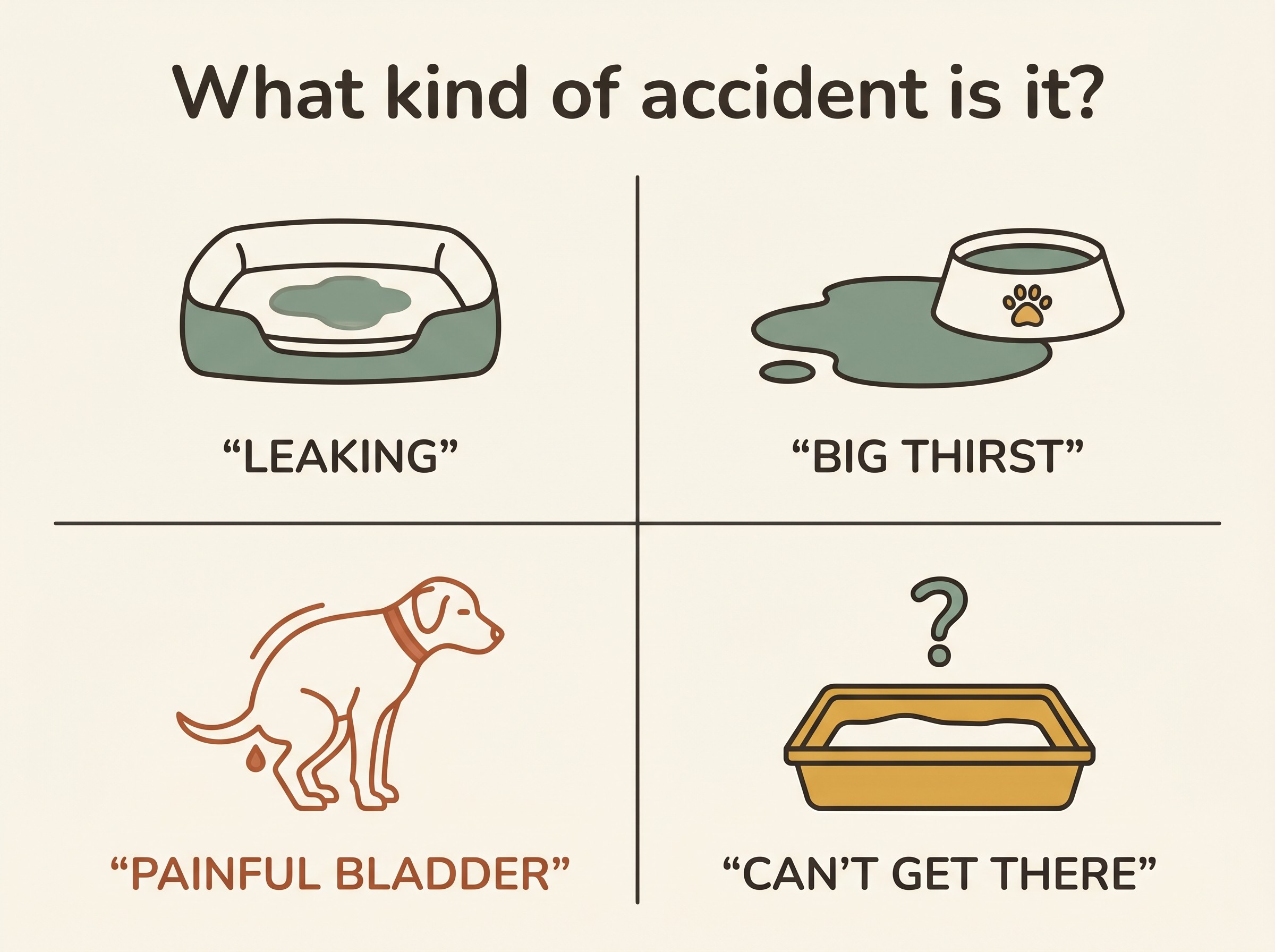
True incontinence has a specific meaning: the involuntary, unconscious leakage of urine, where the pet genuinely does not know it is happening. That is a different thing from a pet making far too much urine, a pet whose bladder hurts, and a pet who simply cannot get to the right place in time. Each needs its own fix, so the most useful thing you can do is not buy nappies but help your vet work out which one you are dealing with. Nearly all of these causes are very treatable or hugely improvable, and the few that are not still respond to the practical help further down.
When the leak is genuinely involuntary
Here is the classic picture of true incontinence: a damp patch where your pet was lying, urine that escapes while they are relaxed or fast asleep, and a pet who is completely unaware it has happened. They squat and wee normally the rest of the time, and they do not posture or strain when it leaks. They just leave a wet bed.
In dogs, by far the most common reason is a weakening of the muscle that holds the bladder closed, which your vet will call urethral sphincter mechanism incompetence, or USMI. In plain terms, the tap no longer seals tightly enough, so a little urine seeps out when everything relaxes. It is most common in spayed female dogs, linked to the drop in sex hormones after neutering, and it turns up more often in larger breeds, dogs carrying extra weight, and as dogs get older. It is multifactorial, which is why your vet treats it as a diagnosis of exclusion: they will check a urine sample to rule out an infection first, because a bladder infection causes very similar wet patches but needs a completely different treatment.
The reassuring bit comes next. Once it is diagnosed, USMI usually responds well to a daily medicine that helps tighten that sphincter. The two mainstays in the UK are phenylpropanolamine (you may see it as Propalin) and the hormone estriol (Incurin), and in most cases the treatment is very successful, although it is given for life and the dose may be adjusted over time. We name the drugs so you recognise them, not so you dose them: the choice, amount and timing are entirely your vet's call, especially in an older pet on other medicines. No single therapy is perfect, and roughly half of dogs are fully controlled on one approach long-term, with others needing a combination, so it can take a little tuning. That is normal, not failure.
In cats, true involuntary leakage of this kind is much less common, and that difference matters. A cat who is genuinely dribbling without knowing, or leaving wet bedding, is more likely to have a problem with the bladder or nerves, or to be unwell in a way that deserves a proper look. So if your cat is leaking rather than choosing the wrong spot, treat that as a reason to book a vet visit, not a quirk of old age.
The big one not to miss: when the body is simply making more urine
This is the cause that matters most, because mistaking it for "just old age" can let a treatable illness run unchecked. Sometimes the puddles are not a failing bladder at all, but a bladder overwhelmed because the body is producing far too much urine, a separate problem vets call polyuria and which must be told apart from true incontinence.
Volume and thirst are the tell. You are mopping up large puddles, the water bowl empties far quicker than before, and your pet may be drinking from unusual places, perhaps while losing weight despite a normal or bigger appetite. None of that is benign ageing. A noticeably thirstier older pet, especially one losing weight, is one of the clearest signals that something needs investigating: the usual suspects are chronic kidney disease and diabetes in both species, an overactive thyroid in older cats, and Cushing's disease in dogs (both in the Hormone Health space). These are exactly what a senior wellness screen is built to catch early. If the picture is "huge puddles and a big thirst," the answer is not nappies but a vet visit and, very often, a simple blood and urine test. Tracking how much your pet drinks is genuinely useful here, and our Thirst and Wee tracker gives you and your vet a real number to work from rather than a vague impression.
When it hurts: the painful bladder
A third pattern looks different again, because here your pet is very aware of the problem: their bladder is uncomfortable. The signs are straining, squatting again and again to pass only small amounts, blood in the urine, licking at themselves, or crying at the tray or in the garden. A previously spotless pet may suddenly start going right by the back door because they could not hold on. This is the look of a urinary tract infection, bladder stones, or in cats the painful inflammation known as cystitis or FIC. It is almost always worth a vet visit, and the relief when it is treated can be quick and complete.
One situation here is a genuine emergency, worth knowing cold. A male cat straining repeatedly and producing little or nothing, often pacing, crying or going in and out of the tray, may have a blocked bladder. That is a same-day, do-not-wait emergency, because a fully blocked cat can become very ill within hours. If you see it, ring your vet straight away rather than reading on.
When they want to do the right thing and simply cannot get there
This cause is enormous in older pets and the one owners most often miss, because it hides as "she's gone in the house" when the real story is "she physically could not make it." Your pet has not forgotten their training and their bladder may be fine. They just cannot get to the right place in time.
Picture the obstacle course an accident represents for a stiff old body. For a dog, sore joints from arthritis, hind-end weakness or fading sight and hearing stretch the gap between "I need to go" and "I'm outside" until accidents become inevitable. For a cat the barrier is usually the tray itself: a high-sided box is a small climb, and a cat with sore joints finds it painful to climb in and crouch, so they may stand half-in and go over the edge, or quietly decide the soft rug nearby is kinder on their hips. As International Cat Care notes, a high tray can lead a cat to associate the toilet with pain and avoid it altogether.
The fix is not to change your pet but to remove the obstacles (below) and treat the underlying stiffness. If your pet is slowing down generally, our Mobility Check helps you and your vet gauge how much pain or weakness is in the picture, and pain, age or disease? walks through the wider decode.
The ageing mind, ruled in last, not first
There is one more cause, and it carries its own quiet grief: the changes in an ageing brain that we gently call confusion or losing their sharpness, and which vets call cognitive dysfunction. Toileting accidents are one of its recognised signs. In the DISHA description of canine cognitive change, the "H" stands for house soiling, and the picture is distinctive: a dog who was beautifully house-trained now leaving puddles on the floor or their bed, or messing indoors without asking to go out, sometimes right after coming in from the garden. Cats show the same thread in the feline version (the "H" in DISH), where an old cat may forget where the tray is or lose habits they have had for years.
One rule protects your pet here, and it is firm: the ageing mind is a diagnosis of exclusion. Confusion is the last explanation to reach for, not the first. Pain, a bladder infection, the body making too much urine, stiff joints and fading senses all have to be ruled out before accidents are put down to the mind, because all of those are treatable and none should be missed. Cornell's own advice on dog dementia begins by telling owners to see the vet to rule out bladder infections first. If cognitive change does turn out to be part of it, you are not alone with that, and there is real help in the living with canine cognitive dysfunction and feline cognitive dysfunction guides, including the medicines (such as selegiline) and routines that can ease it.
Faecal accidents are their own thing
Accidents are not only about urine, and the messier business of faecal accidents deserves its own line, because owners often suffer it in silence. Most of the time the cause is mechanical: a stiff or weak old pet who cannot get into position or to the right place in time, or constipation (very common in older cats) where a full, sluggish bowel leaks around the blockage. Both are treatable, and constipation should be checked rather than managed at home, because the causes behind it matter.
Less commonly, true faecal incontinence means the nerves and muscles controlling the back passage are no longer doing their job. In older dogs this can come from problems in the lower spine, including degenerative myelopathy, a slowly progressive spinal-cord disease whose later stages bring hind-end weakness and, eventually, loss of bowel and bladder control. Telling apart "couldn't get there" from "genuinely cannot control it" is a job for your vet and changes both the outlook and the plan, so raise it specifically rather than lumping it in with the urine.
Daily help that keeps their dignity, whatever the cause
While your vet works out the why, you can make daily life kinder straight away. These help across every cause above, and the thread running through all of them is dignity: your pet's, and yours.
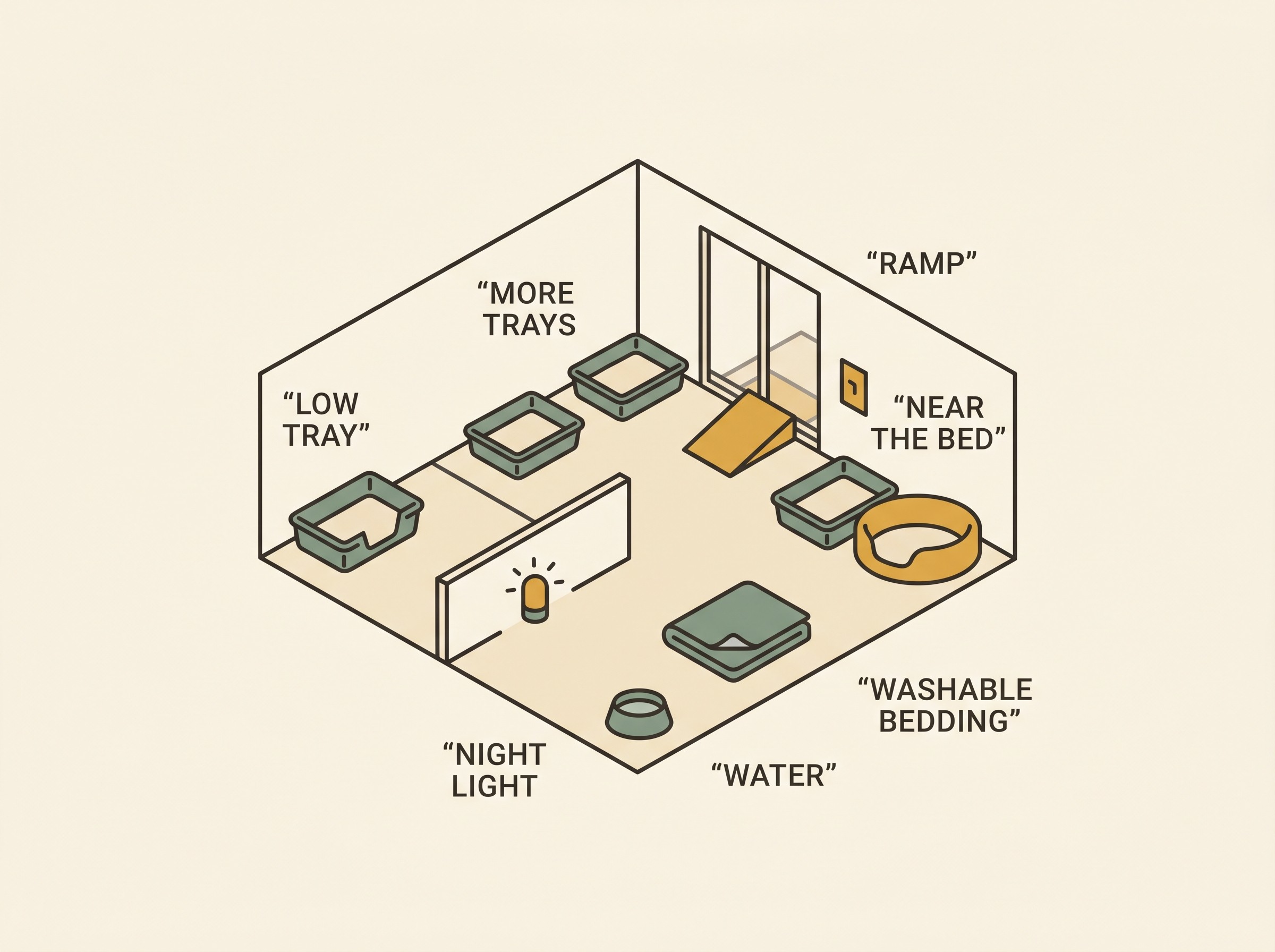
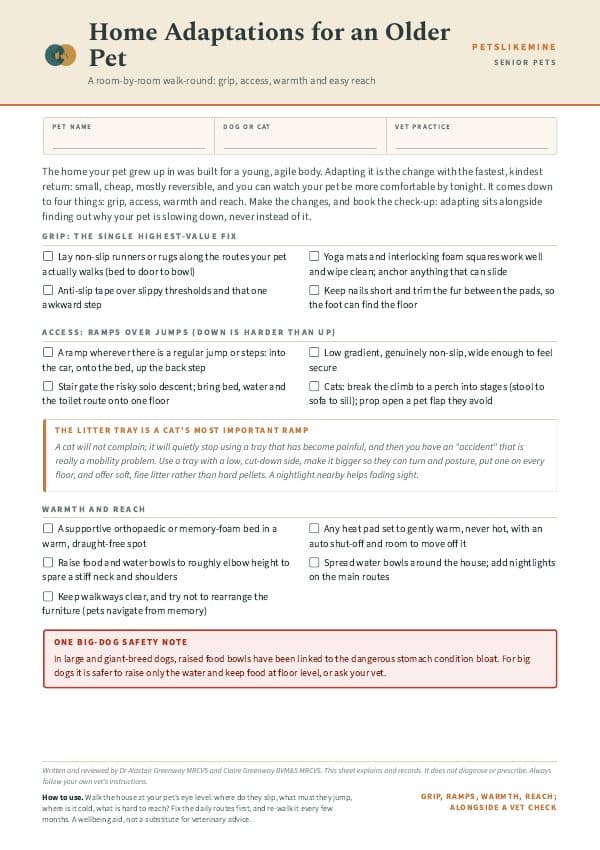
Make getting there easy. Offer more frequent trips outside, and always one last thing at night. For cats, switch to a low-entry tray: sides around four to six centimetres, or simply cut a low doorway into a large storage box. Provide more trays than you think you need, at least one per cat plus one, with one on each floor and one near where they sleep, so the tray is never a long, painful journey away. A ramp to the garden, a night light for a pet whose sight is dimming, and keeping the furniture, bed and tray in fixed places all help a pet whose senses or memory are fading find their way in time. The home-adaptation guide goes further on grip and access.
Protect their skin. Urine left on the skin causes a painful rash called urine scald, so keep your pet clean and dry. Trim the fur under the tail and around the genitals, clean and dry the skin promptly, and ask your vet about a barrier cream. A gentle wipe-down with warm water and a soft towel after an accident protects both their comfort and their dignity.
Use containment as a tool, not a defeat. Washable waterproof bedding under their favourite spot saves your sanity and their comfort. Absorbent pads, belly bands and pet nappies have their place too, but only alongside skin care, never instead of it: change them often, and never leave a wet one against the skin. They help, they do not hide the problem.
Clean up so they do not go back. Pets are drawn to re-use a spot that still smells of urine, so clean accidents with an enzymatic cleaner that neutralises the odour rather than masking it. Avoid ammonia-based or vinegar-based cleaners, because to a pet's nose they smell like urine and draw them back.
And please, never punish an accident. Your pet cannot connect a telling-off with something earlier, and cannot help what is involuntary. Punishment only teaches an old, vulnerable animal to be frightened of you and to hide when they go, which makes everything worse. Once any medical cause is ruled out, if a non-medical behaviour is genuinely in play, the Behaviour space can help, gently and without blame.
What to track, and when not to wait
Half of getting the right diagnosis is noticing the pattern, and patterns are hard to hold in your head when you are tired. So jot it down. Note whether the accidents are wet beds (unaware) or puddles by the door (caught short), how big the volumes are, whether the thirst has changed, whether there is straining or blood, and whether it happens more at night or by day. Logging this in your pet's Senior Wellness Check, alongside their Vitality and their Mind and Sharpness, turns a worrying blur into something concrete you can hand straight to your vet, who can often read the cause from the pattern alone.
Some signs mean book in soon rather than mention it next time: a sudden change, straining or being unable to pass urine, blood, a big new thirst, weight loss, or any sign of pain. And to say it once more, a male cat straining and producing nothing is a same-day emergency.
It is easy, stripping another bed at 3am, to wonder whether this is the beginning of the end. It usually is not. Incontinence on its own is a manageable problem, not a reason to think about goodbye, and most of the causes above improve a great deal once they are named. You are not the only person up doing this laundry, and the senior community is full of people who have lived exactly this and come out the other side with their old friend still beside them. If the accidents are one part of a wider decline and you find yourself weighing how things are overall, that is a tender, separate question, best held gently with the quality-of-life tools and, much further down the road, the Rainbow Bridge space. Not today. Today, the most loving and most useful thing you can do is book the appointment, bring your notes, and let your vet tell you which of these it is, because the odds are very good there is something to be done.
Free downloads
Companion worksheets to put what you've read into practice. Free PDFs, print at home.
Sister tool · Sightline
Track quality of life over time
Sightline, a separate ConciergeVet tool, runs a short adaptive weekly assessment with a quality-of-life focus mode built around exactly these frameworks, tracks a single composite score over time so you can see the trend rather than judge a single bad day, and produces a Sightline Report PDF you can bring to your vet.
A written log, or our printable quality-of-life sheet, does much the same job.
See how Sightline tracks quality of lifeKeep track of how your pet is doing
The owners who cope best are the ones who notice changes early. A simple health log shows you what is working, and what is not, before the next vet visit.
Start tracking, freeYou're not doing this alone
Compare treatment journeys and talk to owners managing senior pets. Free to join.
Join PetsLikeMine