

Hepatic diets: Royal Canin Hepatic vs Hill's l/d, honestly
Alastair Greenway
BVM&S MRCVS
Your vet has handed you a bag of prescription food with "Hepatic" or "l/d" on the label, quoted you a price that made you blink, and told you it's for your pet's liver. You've come home, looked at the ingredients, and found yourself wondering the obvious thing: is this actually doing something, or is it an expensive way of feeling like you're helping? It's a fair question, and it deserves a straight answer rather than a shrug or a sales pitch.
So here's the honest version. A hepatic diet is not "lighter food to give a tired liver a rest", which is the mental picture most owners start with. It's a specific piece of engineering, and for some liver problems it does real, measurable work. For others it's reasonable but not essential, and for a well pet with one mildly raised enzyme it's often not needed at all. The trick is knowing which situation you're in, and that depends far more on your pet's actual diagnosis than on the words on the bag.
What a hepatic diet is actually designed to do
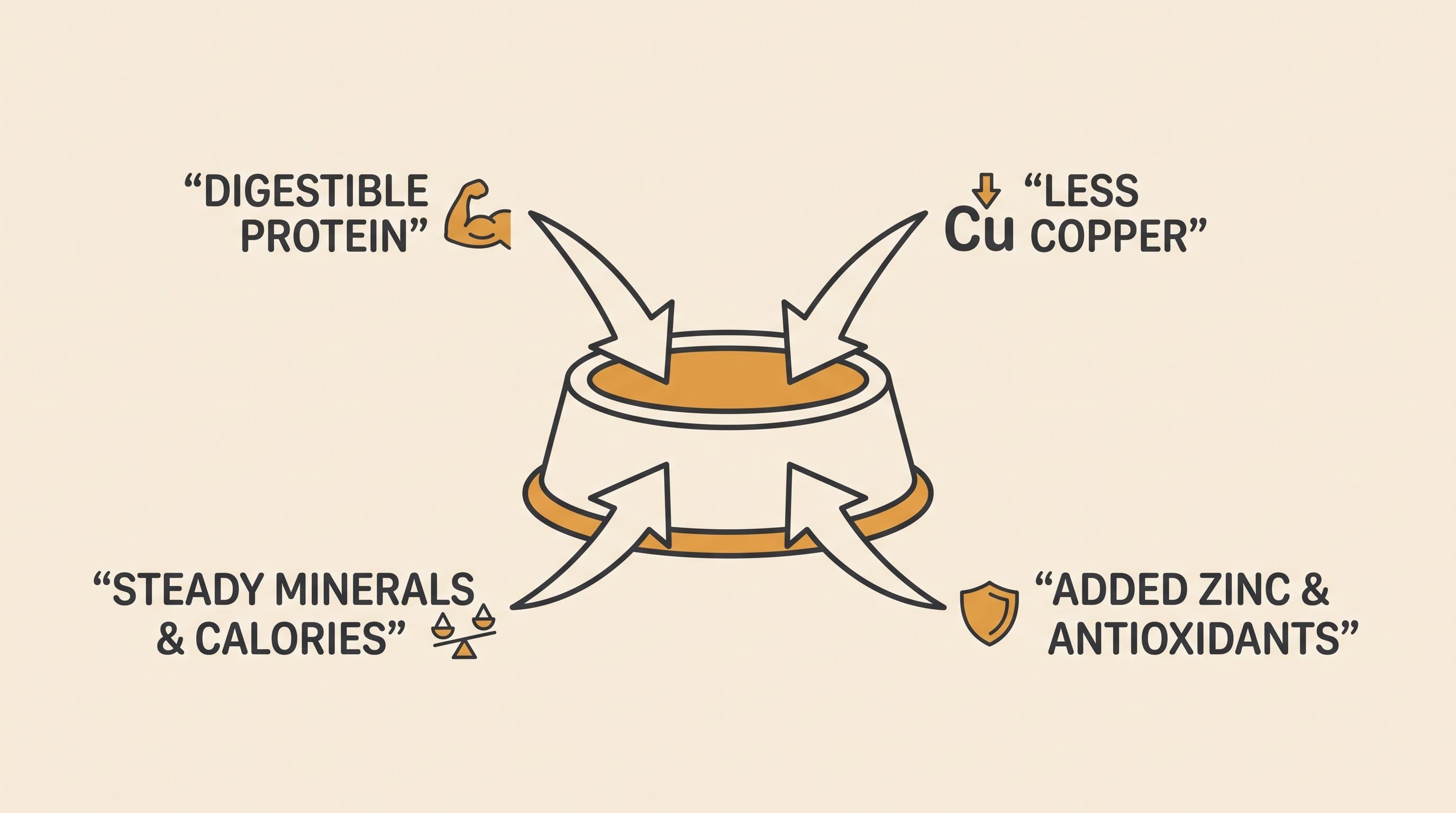
A prescription liver diet is built around four ideas at once, and it helps to take them one at a time because each one is aimed at a different liver problem.
First, protein that is high quality and highly digestible, in a carefully judged amount. When the liver struggles to process the ammonia that comes from protein digestion, that ammonia can build up and, in the worst cases, affect the brain (hepatic encephalopathy). The old fix was to slash protein, but we now know that backfires (more on that below). The modern approach is to provide protein your pet can absorb and use efficiently, so you get the muscle-preserving benefit for less ammonia burden.
Second, restricted copper. Copper is an essential nutrient, but in dogs with copper-associated liver disease it accumulates and damages the liver. A hepatic diet caps the copper deliberately. Royal Canin Hepatic, for example, is formulated with a copper maximum of around 7.2 mg/kg, with typical measured levels lower than that, and Hill's l/d sits in a similar low range at roughly 3.9 mg/kg (ppm). For context, the therapeutic target for a copper-loaded dog is often quoted as under about 1.2 mg per 1,000 kcal of food (Cornell Riney Canine Health Center).
Third, added zinc and antioxidants. Zinc competes with copper for absorption in the gut, which is why it turns up in liver diets, and antioxidants such as vitamin E are included because a struggling liver is under oxidative stress.
Fourth, controlled minerals and steady, easily used calories, so your pet can hold their weight without asking the liver to do unnecessary work. Put together, those four choices are what separates a hepatic diet from ordinary food. Whether your pet needs all four, or only one, is the real question.
When it genuinely matters, and when it's a default
This is where honesty earns its keep, because a hepatic diet is not equally useful for every liver on the books.
It matters most for copper-associated hepatopathy. Here the copper cap is the entire point, and diet is a genuine part of treatment rather than a nicety. There's now direct evidence that dogs fed copper-restricted diets accumulate less liver copper than those on copper-replete diets (Fieten and colleagues' line of work, and a 2026 JAVMA study on copper accumulation). If your dog has confirmed copper loading on a biopsy, the diet is doing real work. We cover the day-to-day of this in feeding the copper-restricted dog.
It matters for shunts and hepatic encephalopathy, where the protein-quality logic is the point: enough good protein to keep muscle on, in a form that generates less ammonia. If your dog has a portosystemic shunt, diet is part of the management plan (see liver shunts: surgery or medical management?).
It is reasonable but not always essential in chronic hepatitis, depending on what the biopsy showed. And for the reader who found us because of a single, mildly raised ALP in an otherwise well dog, a prescription hepatic diet is usually not the answer at all. That situation is about rechecking and watching a trend (see high liver enzymes but my pet seems fine), not about buying special food. Feeding a therapeutic diet to a liver that doesn't need one isn't dangerous, but it isn't treatment either, and it's your money.
The two UK products, compared fairly
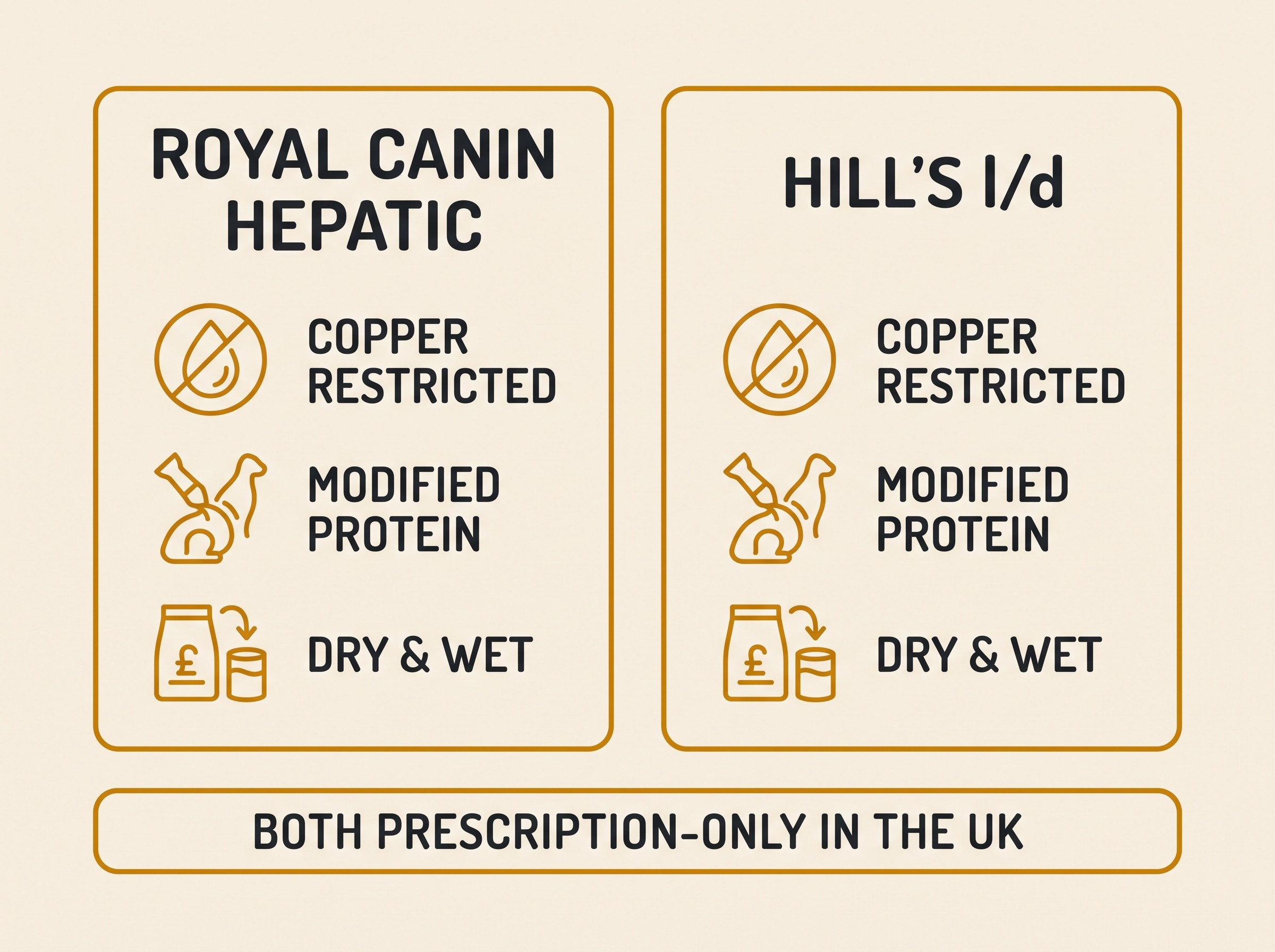
The two prescription hepatic diets you're most likely to be offered in the UK are Royal Canin Hepatic and Hill's Prescription Diet l/d (Liver Care). Both are prescription-gated, meaning your vet has to authorise them, and both are built on the same four principles above. Neither is "the best one", and any page that tells you one is clearly superior is guessing.
The practical differences are the ones that matter to you day to day. Both restrict copper into a similar low range (Royal Canin's stated maximum around 7.2 mg/kg, Hill's around 3.9 mg/kg). Both provide modified, digestible protein. Where they tend to differ is in format, palatability and texture, and that is not a trivial point. The best hepatic diet is the one your pet will actually eat consistently, so if your dog turns their nose up at one brand's kibble but happily eats the other's, or prefers the wet over the dry, that preference is a legitimate deciding factor. Both ranges offer dry and wet options; ask your vet which formats they can supply and whether you can try a small quantity before committing to a big bag.
One honest caveat: exact formulations and nutrient figures change over time as manufacturers reformulate, so treat any specific number here as a starting point to confirm with your vet or the current product datasheet rather than a permanent fact.
The protein myth, corrected
If you take one thing from this article, make it this, because it's the single most common mistake in feeding a liver patient.
For years the standard advice was to restrict protein hard in any dog with liver disease, on the logic that less protein means less ammonia. We now understand that this does real harm. The liver is a regeneration and repair organ, and repair needs protein. A dog that is under-fed protein loses muscle, and muscle loss in a liver patient is genuinely bad news, both because muscle helps mop up ammonia itself and because a wasting animal copes worse with everything else. The modern position, reflected in the ACVIM consensus on canine chronic hepatitis (Webster et al., 2019), is to feed adequate, good-quality protein and to restrict it only where hepatic encephalopathy actually demands it, and even then to moderate rather than eliminate.
So if you've read a forum post telling you to strip the protein out of your dog's diet to "protect the liver", please don't act on it without your vet. In most liver patients, under-nutrition is the bigger threat than protein itself.
The cat caveat, which is not optional
Everything above is written mostly with dogs in mind, because dogs are where most of the specific liver diets and copper questions live. Cats need their own paragraph, and it's a firm one.
Cats are obligate carnivores. Their entire metabolism is built around a high-protein diet, and they cannot safely have protein restricted the way a dog sometimes can. Restricting a cat's protein to "protect the liver" is the wrong move and can do harm. More importantly, the single most dangerous thing for a cat with any liver problem is not eating. A cat that stops eating can tip into hepatic lipidosis (fatty liver) within days, and that is a genuine emergency (see your cat has stopped eating: a liver emergency). So the rule for cats is blunt and it overrides almost everything else: an eating cat on an imperfect diet is in a far better place than a cat refusing the "correct" prescription food and sliding towards lipidosis. If your cat won't touch the diet the vet recommended, that is not a failure to push through, it's a problem to solve quickly with your vet, because getting calories in matters more than getting the perfect calories in.
Getting your pet onto it, and what to ask
If a hepatic diet is right for your pet, a slow transition helps. Mix a little of the new food into the old over a week or so, increasing the proportion gradually, so you don't trigger a tummy upset or a hunger strike. Warming wet food slightly, or adding a splash of its own juices, can help fussy eaters. If your pet flatly refuses it, tell your vet rather than quietly giving up, because there are usually alternatives, and in a cat especially, a refused diet needs sorting out fast.
And bring the right questions to your appointment. For a dog, ask whether quantitative copper was measured on any biopsy, because that tells you whether the copper restriction is treating something real or just a precaution (see copper and the liver: the dog-food copper debate, honestly). Ask what the protein target is for your pet specifically, and whether encephalopathy is a concern. A hepatic diet works best when it's matched to a diagnosis, not prescribed as a reflex, and you're entitled to know which one yours is. A supplement is a common companion question here too, and we've set out what the evidence actually says about liver supplements separately, because that one is more nuanced than the shop shelf suggests.
References
- Webster CRL, Center SA, Cullen JM, et al. ACVIM consensus statement on the diagnosis and treatment of chronic hepatitis in dogs. Journal of Veterinary Internal Medicine 2019; 33(3): 1173–1200. doi:10.1111/jvim.15467
- Fieten H, Biourge VC, Watson AL, et al. Nutritional management of inherited copper-associated hepatitis in the Labrador retriever. The Veterinary Journal 2014; 199(3): 429–433.
- [2026 JAVMA copper-restricted diet study] Lower risk for liver copper accumulation in dogs fed copper-restricted diets versus those fed copper-replete diets. Journal of the American Veterinary Medical Association 2026; 264(2). doi:10.2460/javma.25.05.0295
- Cornell University Riney Canine Health Center. Copper hepatopathy and dietary management.
- Royal Canin. Veterinary Diet Canine Hepatic product datasheet (copper maximum ~7.2 mg/kg).
- Hill's Pet Nutrition. Prescription Diet l/d Liver Care product datasheet (copper ~3.9 mg/kg).
Keep track of how your pet is doing
The owners who cope best are the ones who notice changes early. A simple health log shows you what is working, and what is not, before the next vet visit.
Start tracking, freeYou're not doing this alone
Compare treatment journeys and talk to owners managing liver & gallbladder. Free to join.
Join PetsLikeMine