

Feeding the copper-restricted dog: the practical guide
Alastair Greenway
BVM&S MRCVS
Your dog has a diagnosis now. The biopsy came back, the word "copper" was in the report, and your vet has told you that diet is going to be part of how you manage this from here on. Which is reassuring in one way, because there's something concrete you can do, and daunting in another, because suddenly the food bowl feels like a minefield and you're not sure what's safe to put in it.
This is the practical guide for exactly that moment. Not the science of whether dietary copper causes liver disease in the first place (that debate has its own home in copper and the liver: the dog-food copper debate, honestly), and not the breed genetics (see the copper-storage breeds). This is the day-to-day: what to feed, what to keep out of the bowl, where the treats and the human food fit, and how to know whether it's working. First, though, one important line to keep you sane through all of it.
This is for confirmed copper loading, not a hunch
Copper restriction is a real treatment with real trade-offs, and it belongs to dogs whose copper loading has been confirmed, ideally by measuring the actual copper concentration on a liver biopsy sample (quantitative hepatic copper). It is not something to start on the strength of a raised enzyme, a breed reputation, or a scary article. If you're reading this because your dog has been properly diagnosed, you're in the right place. If you're here because you're worried about copper in general and your dog hasn't been worked up, the honest advice is to sort out the diagnosis first, because restricting copper in a dog that doesn't need it has its own downsides, and copper is an essential nutrient your dog genuinely needs in the right amount.
With that established, let's fill the bowl.
The foundation: a prescription low-copper diet
For most confirmed copper dogs, the backbone of the diet is a prescription hepatic diet rather than an ordinary "low copper" food off the shelf, because these diets are formulated to a controlled copper level and balanced for everything else your dog needs at the same time. The two you're most likely to be offered in the UK are Royal Canin Hepatic, which is formulated with a copper maximum of around 7.2 mg/kg, and Hill's Prescription Diet l/d, at a similar low level of roughly 3.9 mg/kg. We compare them evenly in hepatic diets: Royal Canin Hepatic vs Hill's l/d, honestly; the short version is that neither is "the best", both are prescription-gated, and the one your dog will reliably eat is the one to go with.
The target the diet is aiming for, in nutritional terms, is often quoted as under about 1.2 mg of copper per 1,000 kcal of food (Cornell Riney Canine Health Center). You don't need to do that maths yourself, and that's rather the point of a prescription diet: it's already been done. There's now direct evidence backing the approach, too, with dogs fed copper-restricted diets accumulating less liver copper than those fed copper-replete diets (a 2026 JAVMA study). So the therapeutic diet isn't box-ticking. It's the intervention.
If a home-cooked diet is being considered instead, that's a conversation to have with a veterinary nutritionist, not something to improvise from internet recipes, because a home diet has to be complete and balanced as well as low in copper, and getting one right without hidden copper or missing nutrients is genuinely difficult.
What to keep out of the bowl
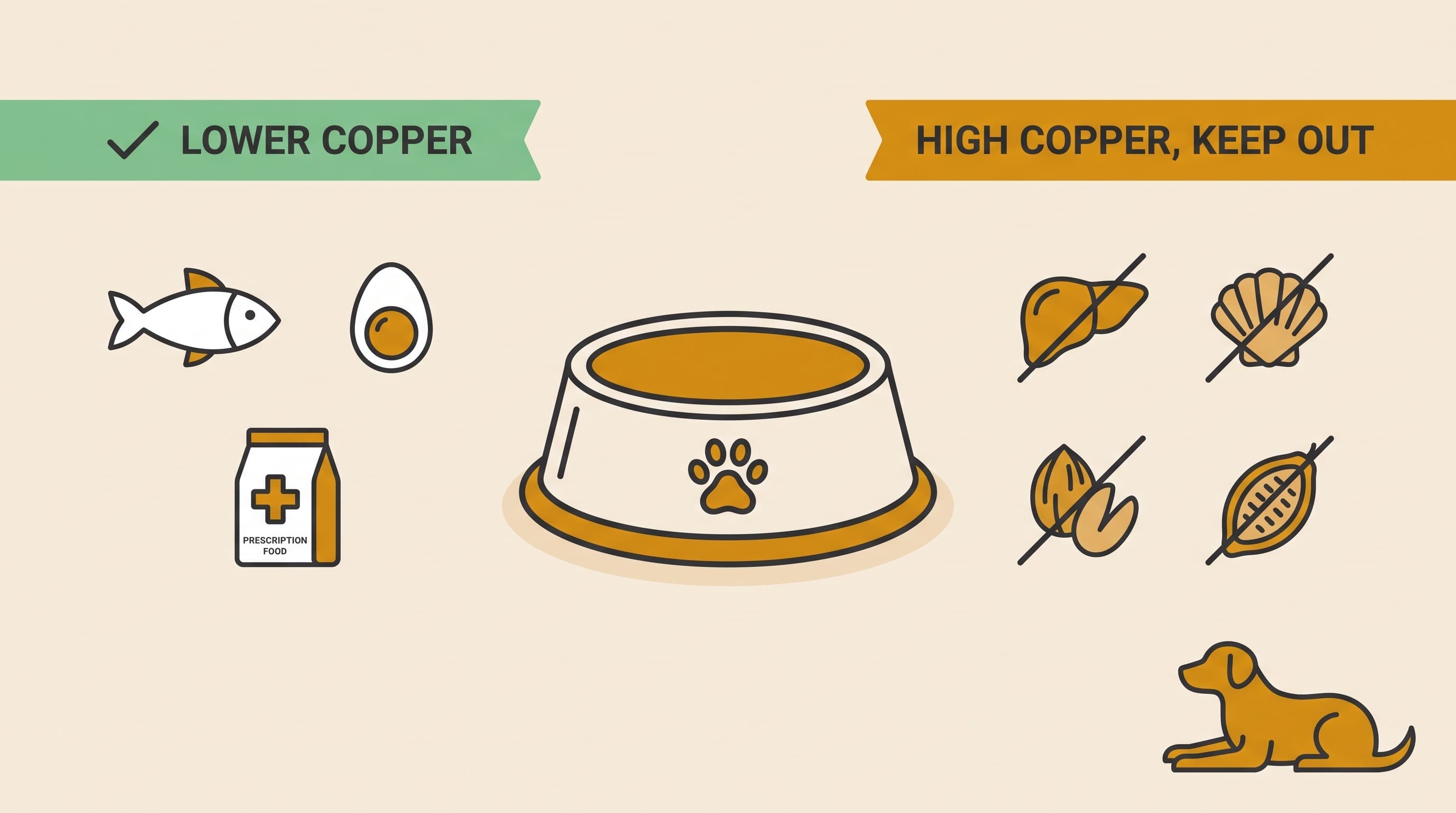
Here's where you have real control day to day, because the foods highest in copper are, luckily, mostly the ones easy to identify and avoid. The big ones to keep out are organ meats, especially liver, and also kidney and heart, which are the single richest sources of copper in a dog's world. That includes liver-based treats and chews, which trip up a lot of well-meaning owners because "liver treat" and "low copper" are opposites. Also high in copper are shellfish (mussels, prawns and the like), nuts, seeds, mushrooms, legumes such as lentils and chickpeas, cocoa and chocolate (which your dog shouldn't have anyway), and some whole grains and cereals (Cornell; Today's Veterinary Practice).
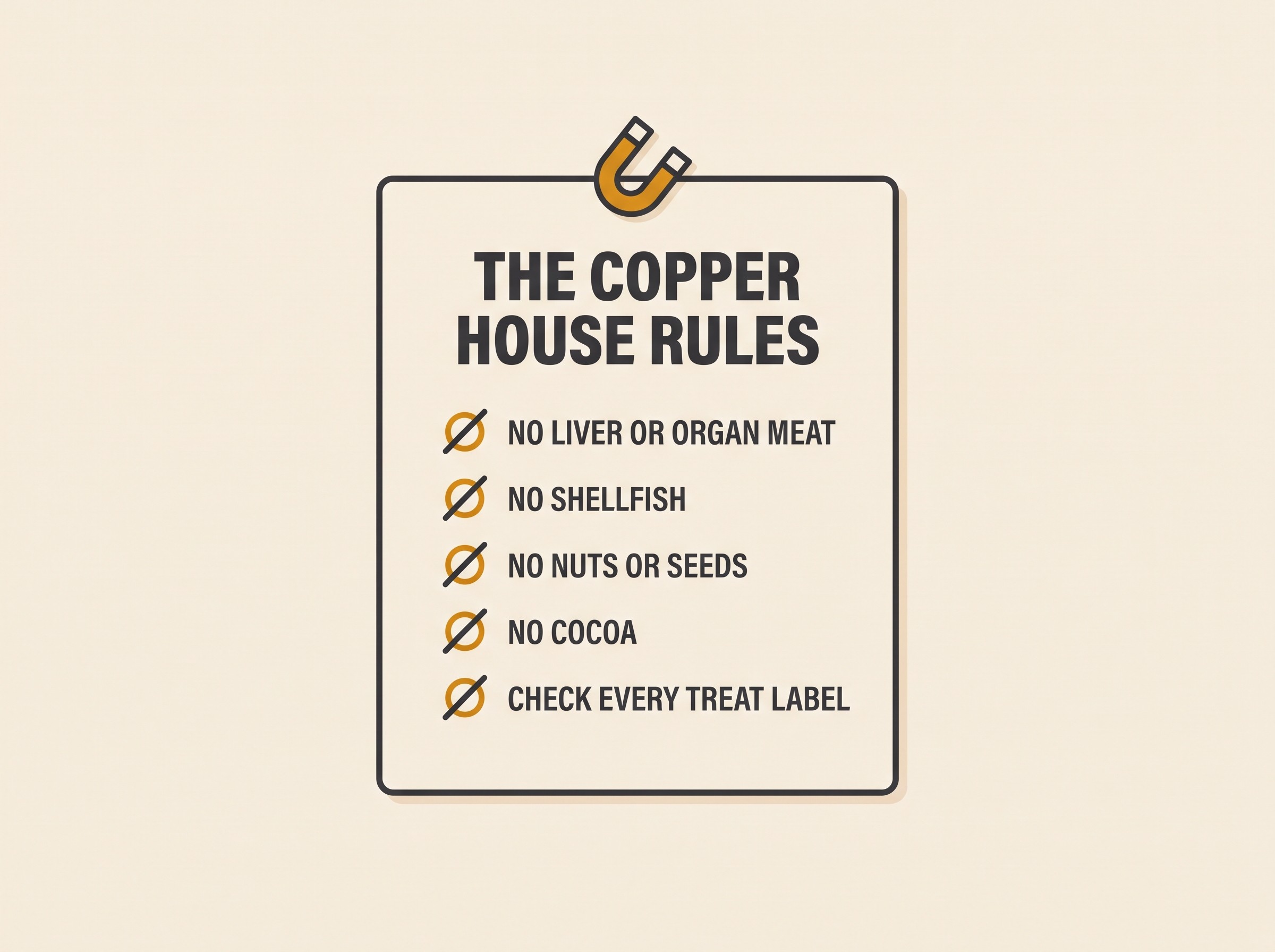
So the practical rule is simple to remember: no liver, no organ meat, no shellfish, no nuts, no cocoa. Those five cover most of the accidental copper that sneaks in through treats and table scraps. Read the label on any treat or chew you buy, and if it lists liver or organ meat high up, leave it on the shelf.
Treats, chews and the human-food question
This is the part owners find hardest, because a special diet is one thing but a dog with sad eyes at dinnertime is another, and you don't want the whole family sneaking your dog copper-rich scraps out of kindness.
The good news is you don't have to cut treats out entirely, you just have to be choosy. Many prescription diet ranges make matching low-copper treats, and those are the safest bet. Beyond that, small amounts of lower-copper foods can work as treats: plain cooked white fish, egg, and some plain vegetables are generally lower in copper, though it's worth checking specifics with your vet rather than assuming any "healthy" human food is safe. What you're avoiding is the enthusiastic relative feeding your dog a bit of liver pâté off their toast, or a handful of trail mix, because those undo the careful work the diet is doing. It genuinely helps to get the whole household on the same page, and to keep a short "yes list" and "no list" on the fridge so nobody has to guess.
Dental chews and dog treats vary enormously in copper content and most don't declare it, so when in doubt, ask your vet for a specific recommendation rather than guessing from the packet.
Where zinc fits, and where it doesn't
You may have read that zinc helps, because zinc competes with copper for absorption in the gut, and you may be tempted to add a zinc supplement yourself. Please don't do this without your vet, because the timing and the situation really matter.
Prescription hepatic diets already include some zinc for this reason. Adding extra zinc on top is a separate decision, and the evidence is more mixed than you'd expect: at least one study found that adding zinc gluconate to a copper-restricted diet gave no extra benefit over the diet alone. More importantly, zinc and copper-chelation drugs (such as penicillamine, which some dogs need to actively strip copper out) work against each other, so a dog that is being chelated should generally not be getting zinc at the same time. Where zinc does have a clearer role is often after successful chelation, as part of long-term maintenance to help stop copper building back up, alongside the low-copper diet. All of which is to say: zinc is a real tool, but it's a vet-directed one with a specific place in the sequence, not a supplement to add off your own bat.
The same goes for chelation itself. Drugs like penicillamine are for confirmed, significant copper loading and are prescribed and monitored by your vet. They are not something to seek out on the strength of diet alone.
Water, the small stuff, and how you'll know it's working
A couple of finishing details. If your household water comes through copper pipes, particularly older plumbing, it's a reasonable question to raise with your vet, though for most dogs the diet is the far bigger lever than the water bowl. And be a little wary of over-the-counter multivitamins and "immune boosters", which often contain copper you didn't know you were adding; check with your vet before giving your copper dog any supplement at all.
Finally, the reassuring part: you'll actually be able to see whether this is working. Copper management is a long game, and the way you and your vet judge it is through serial blood tests over time, watching whether the liver enzymes settle and hold, and in some cases through a repeat biopsy down the line to re-measure the copper directly. This is exactly the situation the Liver Values Tracker was built for, because one blood result tells you very little, but a line of them over months tells you whether the diet and any medication are doing their job.
So the day you left the vet with a copper diagnosis and a bag of special food, feeling like the fun had gone out of feeding your dog, is not the whole story. Get the prescription diet in, keep the five copper-rich culprits out of the bowl, get the household reading treat labels, leave the zinc and chelation decisions to your vet, and then watch the trend. That's the whole job, and it's a very manageable one. If you want to understand the bigger picture of why copper matters and how much of it is genuinely your dog's problem, the dog-food copper debate is the honest, two-sided version.
References
- Cornell University Riney Canine Health Center. Copper hepatopathy and dietary management.
- Nutritional Management of Copper Hepatopathy. Today's Veterinary Practice.
- Fieten H, Biourge VC, Watson AL, et al. Nutritional management of inherited copper-associated hepatitis in the Labrador retriever. The Veterinary Journal 2014; 199(3): 429–433.
- [2026 JAVMA copper-restricted diet study] Lower risk for liver copper accumulation in dogs fed copper-restricted diets versus those fed copper-replete diets. Journal of the American Veterinary Medical Association 2026; 264(2). doi:10.2460/javma.25.05.0295
- Webster CRL, Center SA, Cullen JM, et al. ACVIM consensus statement on the diagnosis and treatment of chronic hepatitis in dogs. Journal of Veterinary Internal Medicine 2019; 33(3): 1173–1200. doi:10.1111/jvim.15467
- Royal Canin. Veterinary Diet Canine Hepatic product datasheet (copper maximum ~7.2 mg/kg).
- Hill's Pet Nutrition. Prescription Diet l/d Liver Care product datasheet (copper ~3.9 mg/kg).
Keep track of how your pet is doing
The owners who cope best are the ones who notice changes early. A simple health log shows you what is working, and what is not, before the next vet visit.
Start tracking, freeYou're not doing this alone
Compare treatment journeys and talk to owners managing liver & gallbladder. Free to join.
Join PetsLikeMine