

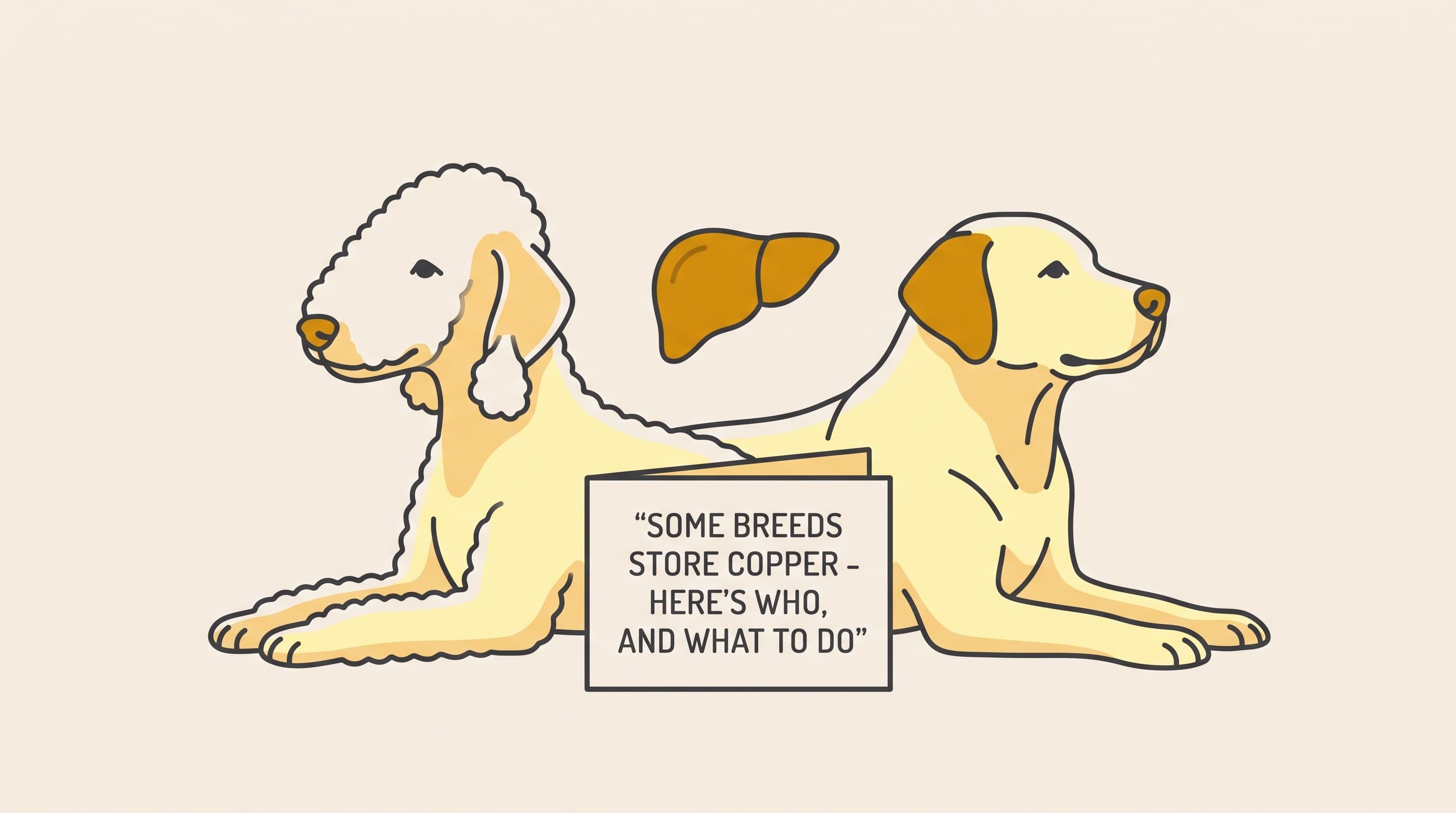
The Copper-Storage Breeds: Bedlingtons, Labradors and the Rest
Alastair Greenway
BVM&S MRCVS
If you share your home with a Bedlington Terrier, a Labrador, a Dobermann, a West Highland White or a Dalmatian, and the words "copper" and "liver" have come up together, you want breed-specific facts, not general reassurance. Which breeds genuinely store copper in the liver? Is it the same problem in each of them? Can you test for it before your dog is ever ill? And what should you actually do differently as the owner of one of these dogs?
Let's answer those directly. Copper-associated hepatopathy, where copper accumulates in the liver and eventually damages it, is more common in some breeds than others, and in a few of them it is a specific inherited trait with a known gene and a DNA test. But the breeds are not all the same, the mechanisms differ, and, crucially, owning a listed breed is a reason to be informed and to test appropriately, not a reason to treat a healthy dog as a patient. We will go breed by breed, then turn to what testing actually looks like and what you can do at home.
Why "copper-storage breed" means something specific
Every dog needs copper, and every dog's liver both stores a little and excretes the excess into bile. Copper-associated hepatopathy happens when that balance tips, either because the liver cannot excrete copper properly or because more copper is coming in than it can handle, so copper builds up in the liver cells and, over time, injures them.
Breeds land on the "copper-storage" list for one of two broad reasons. In some, there is a defined genetic defect in copper excretion, so the problem is primarily one of the dog's own biology. In others, the breed is over-represented among affected dogs without a single clean genetic cause identified, so the picture is more likely a mix of genetic susceptibility and dietary copper load. That distinction matters, because it changes whether a DNA test exists and how much diet is likely to be part of the story.
The Bedlington Terrier: the textbook genetic case
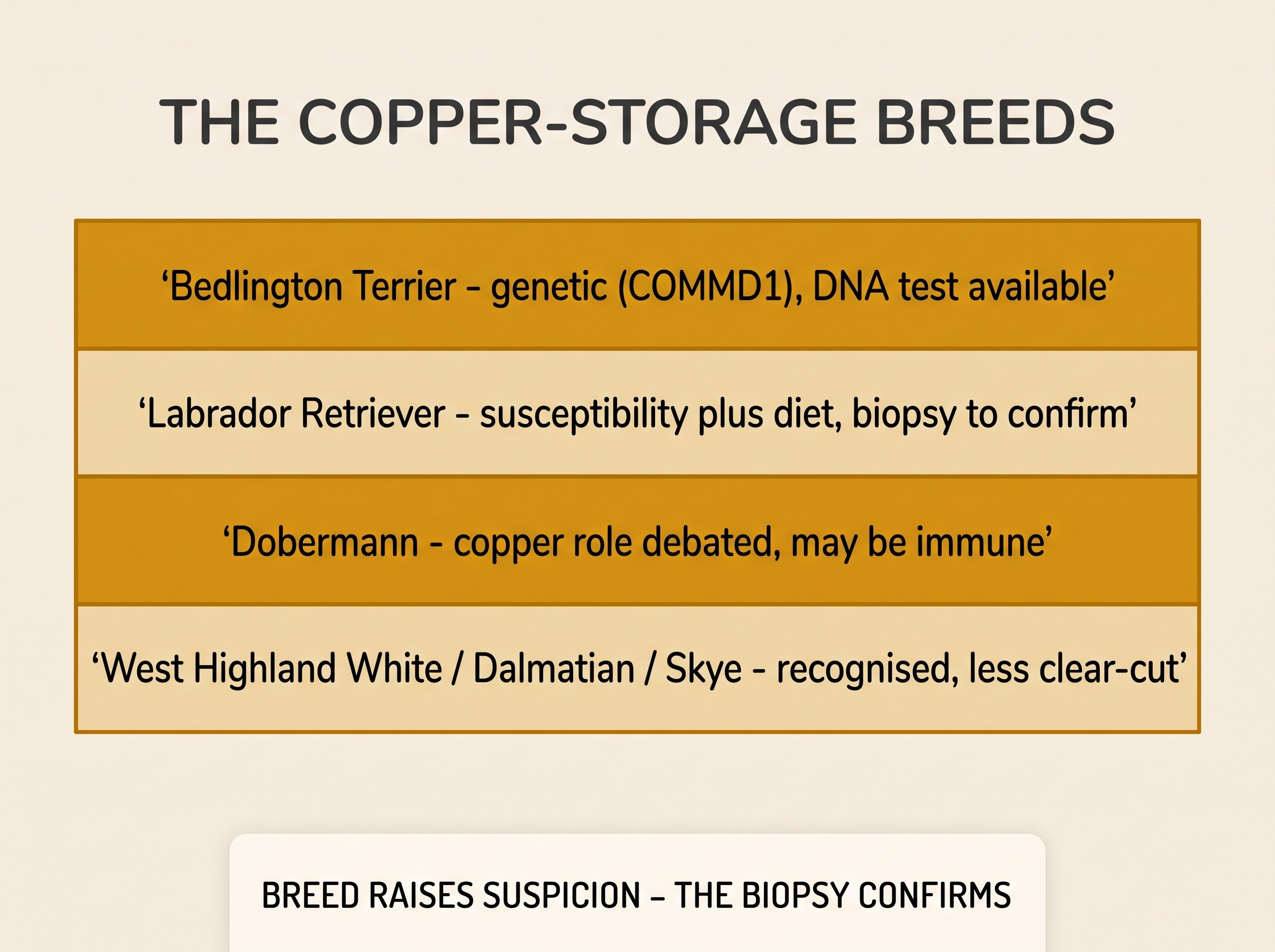
The Bedlington Terrier is the classic, best-understood copper-storage breed, and it is the one where genetics is unambiguously the driver. Bedlingtons can carry a mutation in a gene called COMMD1 that impairs the liver's ability to excrete copper into the bile. With the excretion pathway faulty, copper accumulates relentlessly, and affected dogs can develop severe liver disease.
There are two genuinely good pieces of news for Bedlington owners. First, because the genetic basis is known, a DNA test is available, so you can find out your dog's status. Second, responsible breeding informed by that testing has changed the breed's picture over the years, reducing the frequency of severely affected dogs. If you have a Bedlington, knowing their COMMD1 status is one of the most concrete, actionable things in this entire topic. It is not vague breed anxiety, it is a specific test with a specific answer.
The Labrador Retriever: the common one that matters most
For most owners reading this, the Labrador is the breed that matters most, simply because Labradors are everywhere and copper-associated hepatopathy is genuinely recognised in them. The Labrador's version is not as cleanly genetic as the Bedlington's; there is no single copper gene test that settles it the way COMMD1 does for Bedlingtons. Instead, it appears to be a susceptibility that interacts with dietary copper, which is exactly why the Labrador features so often in the wider debate about whether the copper in dog food has been climbing.
The practical consequence is straightforward. A Labrador with persistent or rising liver enzymes is a dog in whom copper genuinely belongs on the list of possibilities, and if a liver biopsy is done, the copper concentration should be measured on the sample rather than assumed. Because diet plausibly interacts with the Labrador's susceptibility, this is also the breed for which the honest dog-food copper debate is most directly relevant reading.
The Dobermann, the Dalmatian and the West Highland White
A few other breeds sit on the list, each with its own character.
Dobermanns are prone to a chronic hepatitis that can be aggressive, and there has been long-running debate about how much copper contributes to it as opposed to an immune-mediated process. This ambiguity is itself the lesson: in a Dobermann you cannot assume the cause from the breed, which is exactly why measuring copper on the biopsy, alongside assessing the histology for immune features, is what sorts it out.
Dalmatians have been reported with copper-associated hepatopathy, and it is worth being aware of because Dalmatian owners already have to think about their dog's unusual metabolism in other respects. West Highland White Terriers are another breed historically associated with copper accumulation, and they are often cited alongside Bedlingtons in older literature, though the picture in Westies appears less severe and less clearly progressive than in Bedlingtons. Skye Terriers and a handful of others appear in the specialist literature too, which is a useful reminder that the list is not closed and that breed is a prompt to investigate, not a complete map.
The honest framing across all of these is the same one that runs through this whole topic: breed raises the suspicion, and the biopsy confirms or rules out copper for the individual dog. No breed on this list means "your dog definitely has a copper problem", and no breed off it means "copper is impossible".
What testing actually looks like
If you own one of these breeds, testing comes in two quite different forms, and it helps to know which is which.
DNA testing applies where a specific gene is known, which in practical terms mostly means the Bedlington and COMMD1. A DNA test tells you about your dog's genetic risk, and it is most valuable before breeding and as an early heads-up, but it tells you about predisposition, not about how much copper is actually sitting in the liver right now.
Quantitative copper on a liver biopsy is the test that tells you what is actually happening in your dog's liver. A tissue sample is taken and the laboratory measures the copper concentration directly. This is the only reliable way to confirm copper-associated hepatopathy in an individual dog, and it is the test that should be requested if your predisposed-breed dog has liver disease and a biopsy is being done. It is entirely reasonable, and worth doing, to ask your vet directly: "Given the breed, will you be measuring copper on the sample?"
What you should not rely on is trying to diagnose copper loading from blood enzymes, breed alone, or the food label. Enzymes tell you liver cells are being damaged, not why. Breed tells you the odds, not the answer. And the diagnosis, and therefore any decision about copper-restricted diets or chelation medication, rests on the measured copper, because those treatments are for confirmed loading and carry real downsides if applied to the wrong dog.
When copper loading is confirmed: what changes
If a biopsy confirms copper loading, the plan for these breeds becomes more specific, and it is worth knowing the shape of it so it is not a surprise. Treatment usually has two arms. The first is reducing how much copper is going in, through a copper-appropriate diet, which is where the prescription hepatic diets and the practical guide to feeding the copper-restricted dog become relevant. The second, in dogs with significant accumulation, is helping the body remove the copper already stored, using a chelation medicine such as penicillamine, which binds copper so it can be excreted. Zinc is sometimes used as well, because it can reduce copper absorption from the gut, though it is used as an adjunct and on veterinary direction rather than as a first move.
None of this is something to start on your own, and that is the whole reason confirmation matters so much in these breeds. Chelation and heavy copper restriction are the right tools for a genuinely copper-loaded liver and the wrong tools for a dog whose raised enzymes turn out to have another cause entirely. The management is also monitored over time with repeat bloods, because, as with all liver disease, the trend tells you whether the plan is working. Plotting those serial values, which the Liver Values Tracker on PetsLikeMine is designed to do, turns a copper-management plan into something you can actually see progressing rather than guess at.
What you can do as the owner of a copper-storage breed
You do not need to do anything drastic, and you certainly do not need to panic-change your healthy dog's food on the strength of the breed alone. But a few sensible habits are worth adopting.
Keep up with the routine blood tests your vet recommends, and do not dismiss a raised liver enzyme just because your dog seems well, because in these breeds a persistent elevation deserves a proper workup rather than indefinite re-checking. If your dog is a Bedlington, find out their COMMD1 status. If a biopsy is ever done, make sure copper is measured on it. And if copper loading is confirmed, then, and only then, diet becomes a central part of the plan, at which point the practical guide to feeding the copper-restricted dog and the comparison of prescription hepatic diets will help you do it properly.
Above all, hold the two halves of this together. Your dog's breed is a genuine reason to be attentive and to test appropriately. It is not, on its own, a diagnosis, and a healthy dog of a copper-storage breed with normal blood tests is simply a healthy dog. The most useful next step, if the wider copper story is worrying you, is the honest account of the dog-food copper debate, which puts the breed risk you have just read about into the bigger, and genuinely unresolved, scientific context.
References
- Webster CRL, Center SA, Cullen JM, et al. ACVIM Consensus Statement on the diagnosis and treatment of chronic hepatitis in dogs. *Journal of Veterinary Internal Medicine* 2019;33(3):1173-1200.
- Bedlington Terrier copper toxicosis and the COMMD1 gene; availability of DNA testing.
- Labrador Retriever copper-associated hepatopathy.
- Dobermann chronic hepatitis and the debated role of copper.
- West Highland White Terrier, Dalmatian and Skye Terrier copper-associated hepatopathy.
Keep track of how your pet is doing
The owners who cope best are the ones who notice changes early. A simple health log shows you what is working, and what is not, before the next vet visit.
Start tracking, freeYou're not doing this alone
Compare treatment journeys and talk to owners managing liver & gallbladder. Free to join.
Join PetsLikeMine