

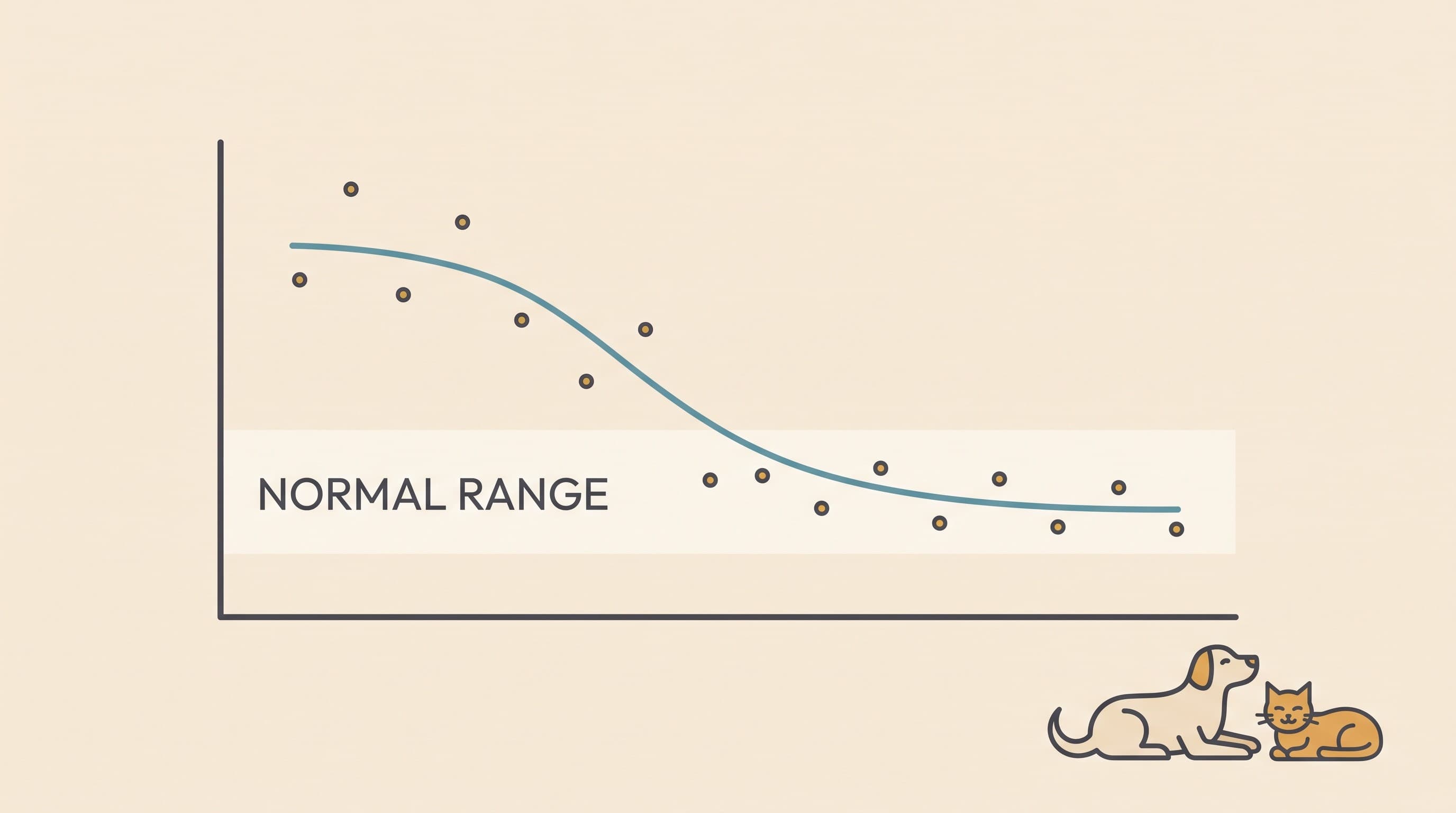
Tracking liver values over time (and why the trend beats the number)
Alastair Greenway
BVM&S MRCVS
Most of the fear in liver disease lives in a single number. The vet says "the ALT is up again" or "the ALP has come down a bit", you catch one figure on a printout, and your whole week hinges on whether it sounds high. It's an exhausting way to live with a diagnosis, and the good news is that it's also the wrong way to read the bloods.
Here's the shift that makes everything calmer and, honestly, more accurate. A liver value on a single day is a snapshot. It tells you very little on its own, because these numbers naturally bounce around, they're affected by the lab, the sample and the day, and one figure can't tell you whether things are getting better or worse. What actually matters, the thing your vet is really watching, is the trend: the same values measured again and again over weeks and months, plotted so you can see the direction of travel. Is the ALT falling on treatment? Is the albumin holding steady? That line, not any single dot on it, is the story of your pet's liver.
This is the piece that goes with the Liver Values Tracker, and its whole job is to teach you to read the trend instead of the number, so that a recheck becomes something you can interpret with understanding rather than dread.
Why one number tells you so little
Liver enzymes are genuinely noisy. The same pet, sampled twice in a fortnight with nothing having changed, can show meaningfully different figures. That variation comes from real biology (enzymes rise and fall through the day and with digestion, activity and other illnesses), from the sample itself (a fasted versus a fed sample, how it was handled), and from the laboratory (different analysers and different reference ranges, so a "normal" on one lab's report is not the same threshold as another's). None of that is a fault. It's just the nature of the measurement.
The practical consequence is important. A one-off figure that's a little higher than last time is not, by itself, bad news, and a one-off figure that's a little lower is not, by itself, a cure. You need several points before a pattern is trustworthy. This is exactly why your vet rarely wants to make a big decision on a single result and instead asks you to come back and repeat it. They're not being cautious for the sake of it. They're waiting for the noise to settle so the signal can show.
There's a second reason a single number misleads, and it's the most useful idea in this whole space.
Leak versus function: the distinction that reframes the trend
Liver blood tests measure two completely different things, and confusing them is where most of the unnecessary panic comes from.
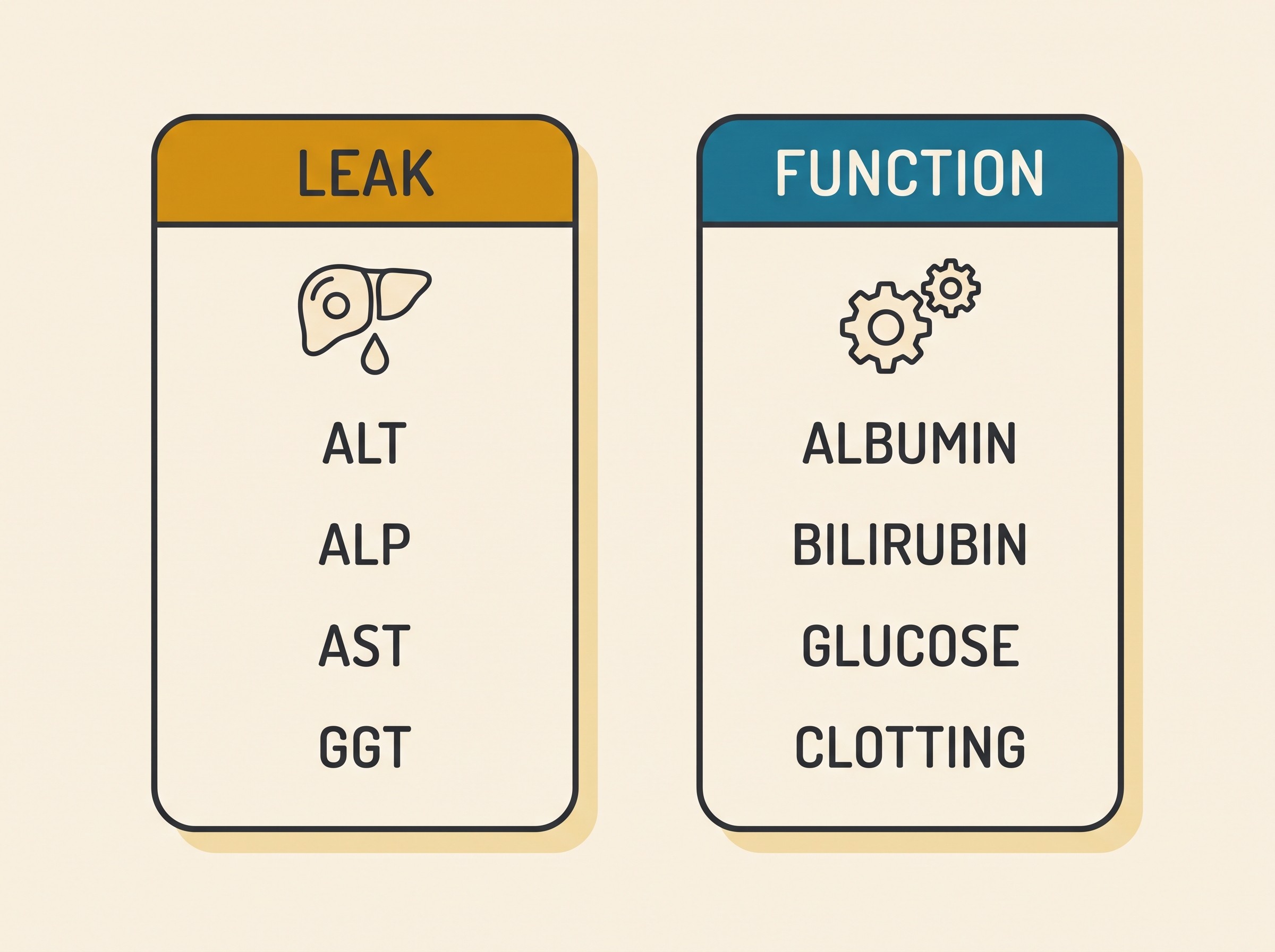
Enzymes measure leak. ALT, ALP, AST and GGT are enzymes that live inside liver cells and the cells lining the bile ducts. When those cells are irritated or damaged, they leak enzymes into the blood, and the level goes up. So a raised enzyme tells you there's some injury or irritation going on. What it does not tell you is how well the liver is actually working. A pet can have strikingly high enzymes and a liver that is still doing its job perfectly well, and, unnervingly, a pet can have near-normal enzymes and a liver that is genuinely failing, because so many cells have already been lost that there aren't many left to leak.
Function markers measure the liver working. These are the values that tell you whether the organ is still doing its actual jobs, making proteins, handling waste, keeping the blood chemistry steady. The ones to know are:
- Albumin, a protein the liver makes. A liver in real trouble makes less of it, so a falling albumin is a genuine warning sign.
- Bilirubin, a waste pigment the liver clears. A rising bilirubin means the liver or bile system is struggling to shift it, and it's what turns gums and eyes yellow (jaundice).
- Glucose and urea, both partly the liver's business. A liver that can no longer keep blood sugar up, or that lets urea drop very low, is a liver under strain.
- Clotting and bile acids, which speak to the liver's manufacturing and its blood flow respectively.
Hold these two columns side by side and the whole picture gets clearer. When you're watching a trend, you're not just asking "are the enzymes coming down?" You're asking two questions at once: is the leak settling (enzymes falling on treatment, a good sign), and is the function holding (albumin steady, bilirubin normal, glucose fine)? The reassuring pattern is enzymes drifting down while function stays solid. The pattern that earns a phone call is function markers slipping, even if the enzymes look unchanged.
The values worth plotting, and what a good direction looks like
You don't need to become a clinical pathologist. You need to know what each line on the chart is telling you and which way is the good way. Here's the honest, plain-English version for the values the Liver Values Tracker is built to plot.
ALT (alanine aminotransferase). The workhorse enzyme for liver-cell injury in dogs and cats. Rising ALT means active irritation of liver cells; falling ALT on treatment is one of the clearest signs the inflammation is settling. On a chronic hepatitis case, "is the ALT trending down?" is often the single most-watched question of the whole plan.
ALP (alkaline phosphatase). The one that causes the most confusion, because in dogs it rises for so many reasons that aren't the liver at all, steroids (there's a canine-specific steroid-induced form), Cushing's disease, other drugs, and bone growth in a young dog. Some breeds, including Scottish Terriers, Siberian Huskies and Miniature Schnauzers, can run a high ALP for life with no liver disease at all. All of which is exactly why the trend matters more than the figure: a stable, unchanging high ALP in a well dog is a very different thing from an ALP that's climbing.
AST and GGT. AST is a rougher parallel to ALT and also comes from muscle, so it's read alongside the others rather than alone. GGT tends to track with ALP and helps separate the causes of a raised ALP.
Bilirubin, albumin, glucose. The function markers above. On the chart, you want bilirubin low and flat, albumin steady, glucose normal. Movement in the wrong direction here carries more weight than any enzyme wobble.
Bile acids. A dedicated function-and-blood-flow test rather than a routine part of every panel, usually run as a fasted-then-fed pair. It's especially relevant for shunt dogs and for judging function when the enzymes are ambiguous. There's a fuller explanation in the bile acids test, explained.
For every one of these, the question is never "is today's number good?" It's "which way is the line pointing, and over how many points?"
Reading a trend without frightening yourself
A few habits turn a run of results from a source of anxiety into something genuinely reassuring to look at.
Give it enough dots. Two points make a line, but not a trustworthy one. Three or four rechecks over a few months tell you far more than any single pair, because they let you see past the noise. If one value jumps and then settles back on the next check, you've just watched normal variation happen, and you didn't have to panic through it.
Compare like with like. Where you can, keep the conditions similar, same lab, and fasted if your vet asks for fasted samples, so that a change on the chart is a real change and not a difference in how the blood was taken. The Tracker lets you note the sample conditions alongside each value for exactly this reason.
Watch the enzymes and the function markers together. Enzymes coming down while albumin and bilirubin stay normal is the picture of treatment working. Enzymes unchanged but albumin quietly falling is the picture that needs a conversation, even though the "headline" number didn't move.
Read the direction, not the target. Especially early in treatment, you're hoping to see movement the right way, not perfection. Some values are simply slow to come good and lag well behind how well your pet looks and feels. A number that's better but not yet normal is still good news.
Expect the occasional wobble. A single result that ticks the wrong way, on its own, is far more likely to be noise than a relapse. It's a reason to keep to the recheck plan, not to lie awake. If a wobble is real, the next point will confirm it, which is precisely what the recheck is for.
The honest limit: there's nothing to score at home
It's worth being straight about something this space won't pretend otherwise. Unlike a pet with arthritis, where you can watch mobility day to day, or a diabetic pet whose glucose you can check at home, there is no home liver score you can take. The liver is measured by blood the vet draws and a laboratory runs. That's simply the nature of the organ, and any tool claiming to let you grade a liver from the sofa would be misleading you.
So your job as the owner isn't to self-manage the liver. It's to do the three things that genuinely move the needle: partner with your vet, keep the recheck cadence they set (the intervals exist for a reason, and skipping them is the commonest way a quiet deterioration gets missed), and watch the trend rather than react to any single figure. That's not a consolation prize. Keeping to the schedule and reading the direction of travel is exactly what tilts the odds in a managed liver condition, and it's a real, active job that you, not the vet, are best placed to do.
What the Tracker is actually for
The Liver Values Tracker exists to do one thing well: take the numbers off scattered printouts and turn them into lines you can read. You enter each recheck's ALT, ALP, AST, GGT, bilirubin, albumin and bile acids as they come back, and it plots them over time so the pattern is visible at a glance instead of buried in a folder of PDFs.
Two ways to use it that owners find genuinely helpful. First, take it to the appointment. Instead of hearing "the ALT is 180" in isolation, you can say "so it's gone from 400 down to 180 over three checks", and ask your vet to talk you through the direction rather than the dot. That's a far more useful conversation, and it's one you're now equipped to have. Second, use it to hold yourself to the cadence, because seeing the gap since the last check is a quiet, effective nudge to book the next one.
If you've arrived here still rattled by a single high figure, that's completely understandable, and it may help to start with high liver enzymes but my pet seems fine: do I panic? and your dog's liver enzymes are high: what it actually means, which put that first frightening number in context. Then come back and start plotting. Watching a line settle over a few months, in your own pet, with your own numbers, does more to lower the temperature than any single reassuring result ever could. And once you know the trend, the companion skill is knowing which changes can't wait for the next scheduled check, which is what the liver red flags are for.
References
- Webster CRL, Center SA, Cullen JM, et al. ACVIM consensus statement on the diagnosis and treatment of chronic hepatitis in dogs. *Journal of Veterinary Internal Medicine* 2019;33(3):1173-1200.
- Enzymes as markers of hepatocellular and cholestatic leak versus synthetic-function markers (albumin, bilirubin, glucose, clotting, bile acids).
- Steroid-induced ALP isoenzyme in dogs and non-hepatic causes of raised ALP (steroids, Cushing's, other drugs, bone growth).
- Breed-associated benign or idiopathic high ALP (Scottish Terrier vacuolar hepatopathy; Siberian Husky; Miniature Schnauzer).
- GGT tracking with cholestasis and helping differentiate causes of a raised ALP; AST also of muscle origin.
- Biological and inter-laboratory variation in liver enzymes; value of serial, like-for-like (same lab, fasted where required) sampling.
Free downloads
Companion worksheets to put what you've read into practice. Free PDFs, print at home.
Keep track of how your pet is doing
The owners who cope best are the ones who notice changes early. A simple health log shows you what is working, and what is not, before the next vet visit.
Start tracking, freeYou're not doing this alone
Compare treatment journeys and talk to owners managing liver & gallbladder. Free to join.
Join PetsLikeMine