

When to worry again: the liver red flags
Alastair Greenway
BVM&S MRCVS
When your pet has a liver or gallbladder condition that's been stable for a while, life settles into a rhythm: the medication, the diet, the rechecks. And then, quietly, a new worry moves in behind the calm. How will you know if something has changed? What's a normal off-day and what's the thing you were told to watch for? Most owners of a stable liver patient carry that question around, and not knowing the answer is its own kind of stress.
This article is the answer. It's the "ring the vet" list, sorted honestly by how fast you need to act, so that you can tell the difference between a change that means "book a recheck soon" and a change that means "get to a vet today", or even "this is an emergency, now". Knowing where the lines are does two things at once: it stops you rushing to the emergency clinic over a wobble that could have waited, and, far more importantly, it stops you waiting at home through something that couldn't.
A quick word before the list. This is about the liver decompensating, the point where the organ stops keeping up with its jobs, and it's exactly what good management is designed to prevent. Most stable liver patients never reach it. But the signs below are the ones that say the balance has tipped, and they're worth knowing cold.
The three tiers, in plain terms
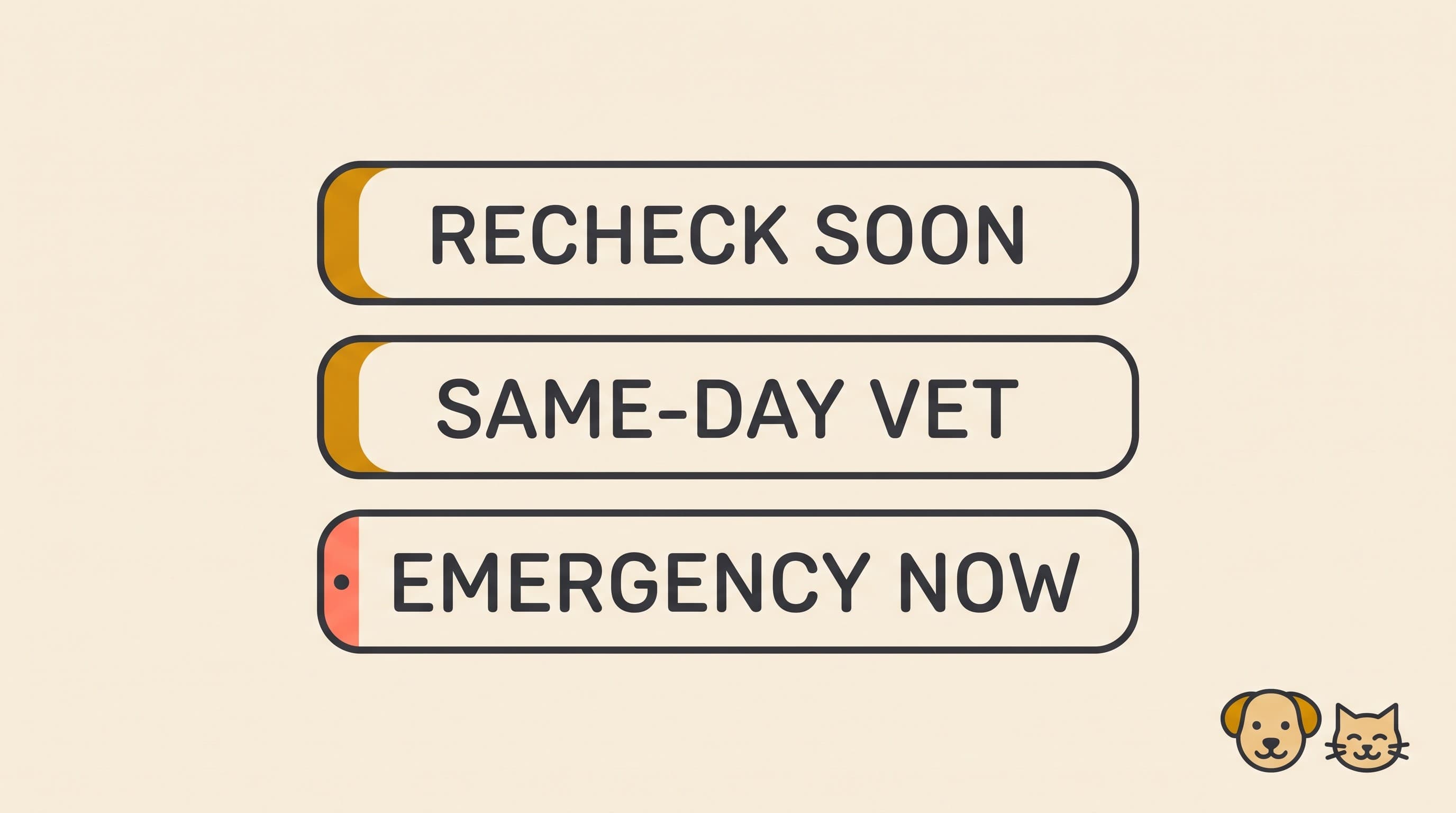
Before the specific signs, hold this simple frame in your head. Nearly everything that changes with a liver patient falls into one of three levels of urgency.
- Recheck soon. A small, stable change in a pet who's otherwise well, eating and bright. This is the world of the scheduled recheck and the blood trend, not the emergency room. A single liver value ticking the wrong way on a printout usually lives here.
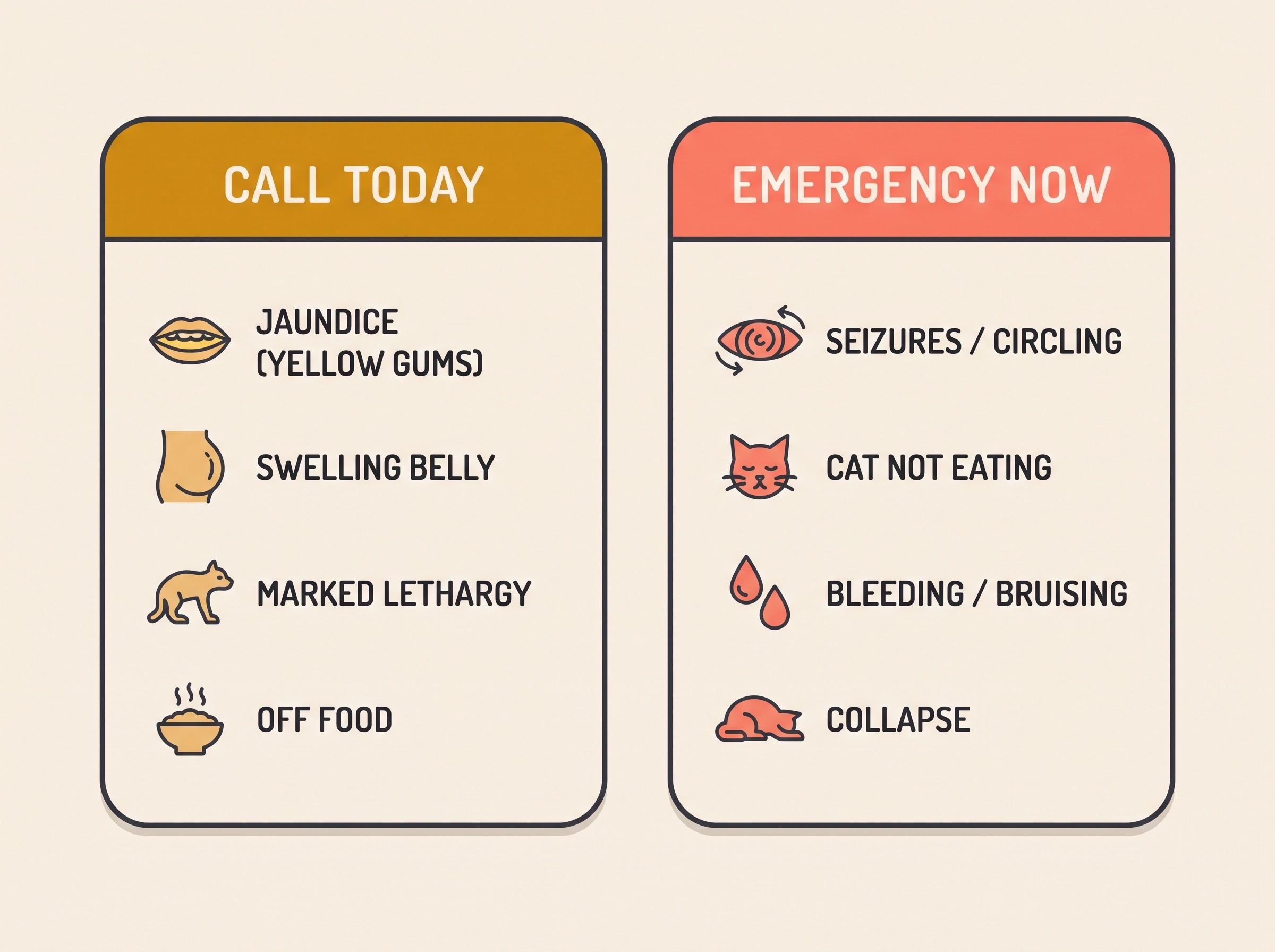
- Same-day vet. A genuine new clinical sign, jaundice, a swelling belly, real off-colour behaviour, that needs to be seen today but isn't, in this moment, a collapse. Don't wait for the weekend to pass.
- Emergency now. The signs that mean out-of-hours if it's out of hours: neurological crisis, uncontrolled bleeding, collapse, or a cat that has stopped eating. These don't wait for morning.
The rest of this piece places each red flag into one of those tiers. When in doubt, ring, that's what the practice phone is for, and describing the sign to a nurse or vet will place it far better than guessing.
Jaundice: yellowing gums, eyes or skin
Tier: same-day vet, and emergency in a cat that isn't eating.
Jaundice is a yellow tinge to the gums, the whites of the eyes, the ears or the skin, caused by bilirubin building up when the liver or bile system can't clear it. It's one of the clearest visible signs that the liver is struggling, and it should never be watched at home over days. Check the gums and the whites of the eyes in good daylight, because a mild yellow is easy to miss under indoor lighting.
In a dog, new jaundice warrants being seen the same day. In a cat, treat it as urgent full stop, and if your cat is also off its food, treat it as an emergency, because in cats jaundice and a loss of appetite together point towards serious liver disease, including the fatty-liver crisis described below. There's a fuller guide in jaundice in cats: what the yellow actually means.
A swelling belly (ascites)
Tier: same-day vet.
If your pet's abdomen looks or feels rounder or more distended than usual, particularly if it seems to sway or fill out low down, that can be ascites, fluid collecting in the belly. In a liver patient it's a meaningful sign, because it can reflect the liver failing to make enough albumin or pressure building in the liver's blood supply, both markers of the disease advancing. It usually comes on over days rather than seconds, so it's a same-day-vet sign rather than a middle-of-the-night one, but it does need to be assessed promptly, not monitored for a week. If the swelling is sudden and your pet is also in pain, dull or collapsing, move it up to emergency.
Hepatic encephalopathy: staring, circling, head-pressing, seizures
Tier: EMERGENCY NOW.
This is the one to know best, because it's the most serious and the most easily misread. When a damaged or bypassed liver can't clear toxins such as ammonia, they reach the brain, and the pet develops hepatic encephalopathy: staring blankly, seeming disorientated or "not there", circling or pacing, pressing the head into a wall or corner, drooling, apparent blindness, and in the worst cases collapse and seizures. A giveaway feature is that the signs are often worse after a meal, especially a protein-rich one, because feeding raises the toxin load the liver can't handle.
Two things make this dangerous. First, it can be mistaken for epilepsy, by owners and sometimes by first-opinion vets, and the treatment is genuinely different, so if your pet has a liver condition and starts having seizures or neurological episodes, make sure the liver is part of the conversation. The overlap and how they're told apart are covered in hepatic encephalopathy: the staring, circling and seizures, and the seizure side is explored in the epilepsy space. Second, an encephalopathic crisis is a true emergency: a pet that is stuporous, circling, seizuring or collapsing needs a vet immediately, not a medication tweak at home. Don't attempt to feed a fitting or severely disorientated animal.
A cat that has stopped eating
Tier: EMERGENCY (act, don't wait).
This one earns its own red flag because in cats it's uniquely time-critical, and because the instinct to "give it another day" is exactly the wrong one. A cat that stops eating for more than a couple of days can, within days, mobilise body fat faster than the liver can process it and tip into hepatic lipidosis (fatty liver), a condition that becomes dangerous quickly, especially in an overweight cat. The aim is to act on the not-eating alone, before jaundice appears, not after.
So for any cat, and doubly for a cat with a known liver condition, treat a real loss of appetite as urgent rather than something to monitor. Home syringe-feeding is a stopgap to discuss with your vet, never a substitute for being seen. The full story, and why acting early is the difference between a good outcome and a fatal one, is in your cat has stopped eating: a liver emergency. If you take one thing from this article about a cat, take this.
Unexplained bleeding or bruising
Tier: EMERGENCY NOW.
The liver makes most of the body's clotting factors, so a liver in serious trouble can leave the blood unable to clot properly. Watch for bruising or small pinpoint spots on the gums or belly skin, blood in the urine or stool, black tarry stools, bleeding gums, nosebleeds, or bleeding that won't stop from a minor knock. Any of these in a liver patient is a serious sign that needs an emergency vet, because a clotting problem can become dangerous fast, and it also changes how safely other procedures can be done.
Marked lethargy, weakness or collapse, and going right off food
Tier: same-day at least; emergency if collapsing.
A liver patient who becomes profoundly flat, weak, unsteady, or who collapses, or who goes from picking-at-food to eating nothing and perhaps vomiting, has crossed from "a bit under the weather" into "needs to be seen". Marked lethargy and anorexia together are how many liver crises actually announce themselves, often alongside one of the more specific signs above. If your pet is collapsing, cold, or clearly in pain, that's an emergency now. If they're markedly duller and off food but still up and about, it's a same-day call, and worth making rather than sleeping on. Trust the change from your pet's normal more than any single symptom in isolation.
What is usually a "recheck", not a red flag
It matters just as much to know what doesn't need the emergency clinic, because false alarms are exhausting and they wear down the very vigilance you need for the real thing.
A single liver blood value that has ticked the wrong way on a printout, in a pet who is otherwise well, eating and bright, is almost always a "watch the trend and recheck" situation, not an emergency. These numbers are naturally noisy, and one figure rarely tells the story, which is the whole reason the Liver Values Tracker plots them over time so you can see direction rather than react to a dot. There's more on reading that pattern in tracking liver values over time. Likewise, a pet who is a shade quieter for an evening but eats normally and is themselves the next morning, or a slightly reduced appetite for a single meal in a dog who's otherwise fine, usually belongs in the "keep an eye and mention it at the next recheck" bracket. The signs that change that calculation are the specific ones above: jaundice, a swelling belly, neurological changes, bleeding, a real appetite loss (urgent always in a cat), and marked lethargy or collapse.
Keep the list where you'll see it
The most useful thing you can do with this article is make it boring, familiar and to hand. Owners who know their red flags don't live in a state of low-grade dread, they get on with life and act decisively when they need to, which is exactly the calm confidence a stable liver patient's household should have.
So do the practical things. Keep your vet's daytime number and the out-of-hours number saved and findable by everyone in the house, not just you. Learn your own pet's normal, what their gums look like, how their belly feels, how they usually eat, because you'll spot a change against that baseline long before anyone else. And keep the trend of the bloods visible in the Liver Values Tracker, so that when something does change, you and your vet can read it against the whole story rather than a single frightening figure. You're not waiting for disaster. You're the person best placed to catch a change early, and now you know exactly what you're watching for.
References
- Webster CRL, Center SA, Cullen JM, et al. ACVIM consensus statement on the diagnosis and treatment of chronic hepatitis in dogs. *Journal of Veterinary Internal Medicine* 2019;33(3):1173-1200.
- Jaundice (icterus) as hyperbilirubinaemia from hepatic and post-hepatic disease; urgency in cats.
- Ascites in liver disease arising from hypoalbuminaemia and/or portal hypertension.
- Hepatic encephalopathy: clinical signs (staring, head-pressing, circling, blindness, seizures), post-prandial worsening, ammonia/toxin mechanism, distinction from primary epilepsy.
- Feline hepatic lipidosis develops within days of anorexia; overweight cats at higher risk; act before jaundice.
- Hepatic synthesis of clotting factors and coagulopathy/bleeding tendency in advanced liver disease.
Free downloads
Companion worksheets to put what you've read into practice. Free PDFs, print at home.
Keep track of how your pet is doing
The owners who cope best are the ones who notice changes early. A simple health log shows you what is working, and what is not, before the next vet visit.
Start tracking, freeYou're not doing this alone
Compare treatment journeys and talk to owners managing liver & gallbladder. Free to join.
Join PetsLikeMine