

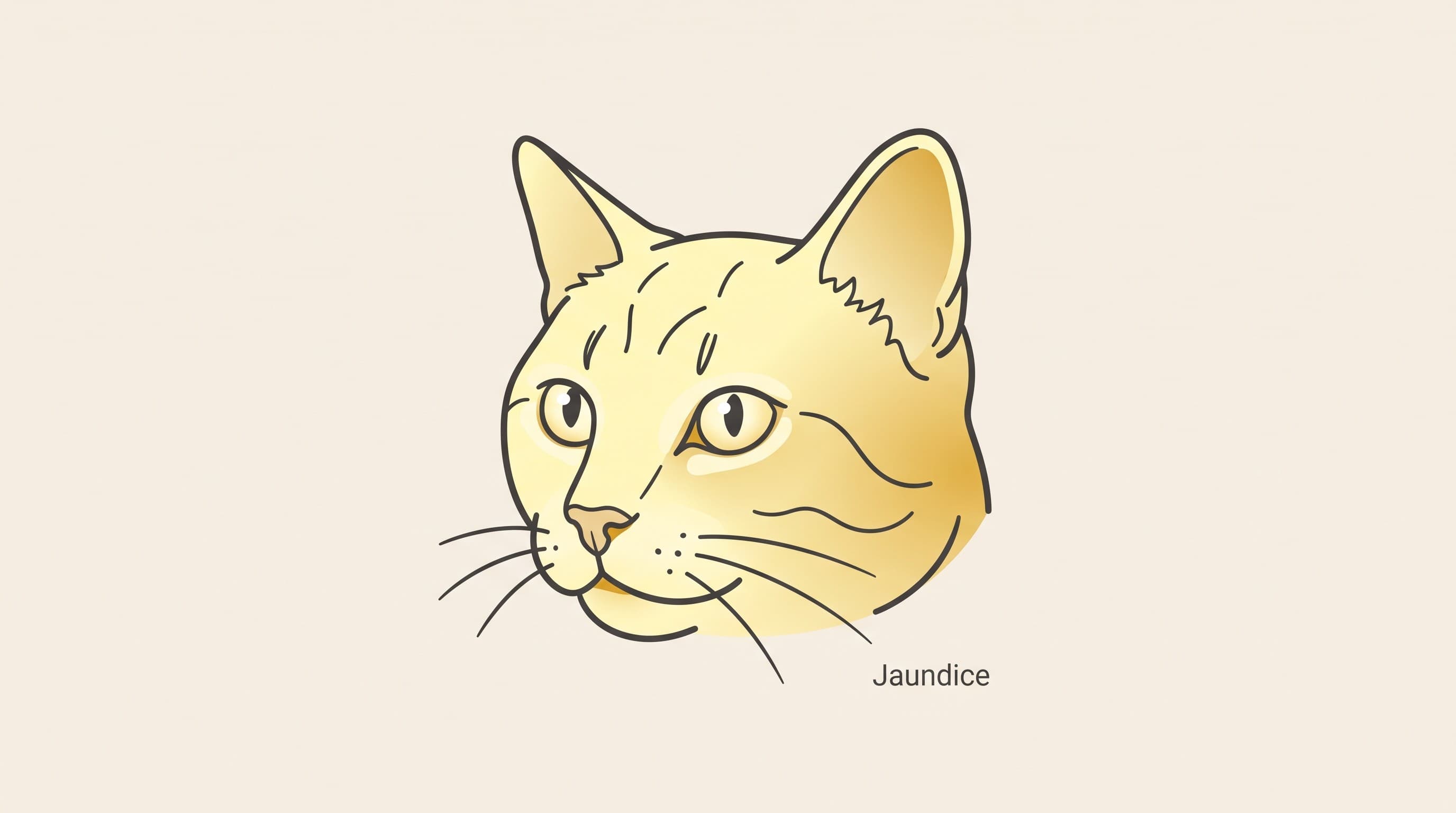
Jaundice in Cats: What the Yellow Actually Means
Alastair Greenway
BVM&S MRCVS
You have noticed something yellow. Maybe it was the gums when your cat yawned, or the whites of the eyes catching the light, or a faint tinge to the skin inside the ears. Once you see it, you cannot unsee it, and you are right to have stopped and looked twice. Let me be direct with you, because this is not a subject where I want to soften anything: yellow in a cat is always urgent. If you are fairly sure you are seeing it, this is a same-day veterinary visit, and if it is after hours, it is worth ringing the emergency service rather than waiting for morning.
I say that up front so that nothing else on this page gets in the way of it. Everything below is here to help you understand what the yellow is, why it appears, and what the range of causes is, so that you can walk into that appointment informed and ask good questions. But the understanding is for context. The action is not in doubt. A jaundiced cat needs to be seen, and quickly.
What jaundice actually is
Jaundice, which your vet may call icterus, is a yellow discolouration caused by a build-up of a pigment called bilirubin. Bilirubin is a normal waste product. It is made when the body breaks down old red blood cells, and in health the liver picks it up, processes it, and sends it out in the bile to be disposed of through the gut. It is, in effect, part of the body's recycling system, quietly happening all the time without you ever seeing it.
You only see yellow when that system backs up and bilirubin accumulates in the blood and then stains the tissues. Because it is a pigment, it shows up first and most clearly in the places with the least fur and the palest surfaces: the gums, the whites of the eyes, and the thin skin inside the ears. That is why those are the spots to check. In a cat with dark gums it can be harder to spot, which is one more reason to have a professional look rather than to rely on your own eye alone.
The important idea to grasp is that jaundice is a sign, not a diagnosis. It tells you that bilirubin is building up. It does not, by itself, tell you why. And the "why" can sit at three different points in that recycling pathway, which is the most useful way to understand the range of things your vet is thinking about.
One quick, honest note before we get to those causes. It is worth being a little careful about what counts as jaundice, because a few things can look yellowish without being it. Bright artificial or evening light can lend a warm cast to pale surfaces, and some cats have naturally slightly yellow-tinged fur or skin oils, especially pale or white cats. Genuine jaundice tends to be a consistent lemony-yellow that shows in more than one of the classic spots at once, the gums, the whites of the eyes and the inner ears together, rather than a faint warmth in a single place under a particular lamp. If you are unsure, look at the whites of the eyes in daylight, and compare them to how they normally look. And if any doubt remains, that is exactly the point: uncertainty here is a reason to get your cat checked, not a reason to wait and keep looking.
The three places it can go wrong
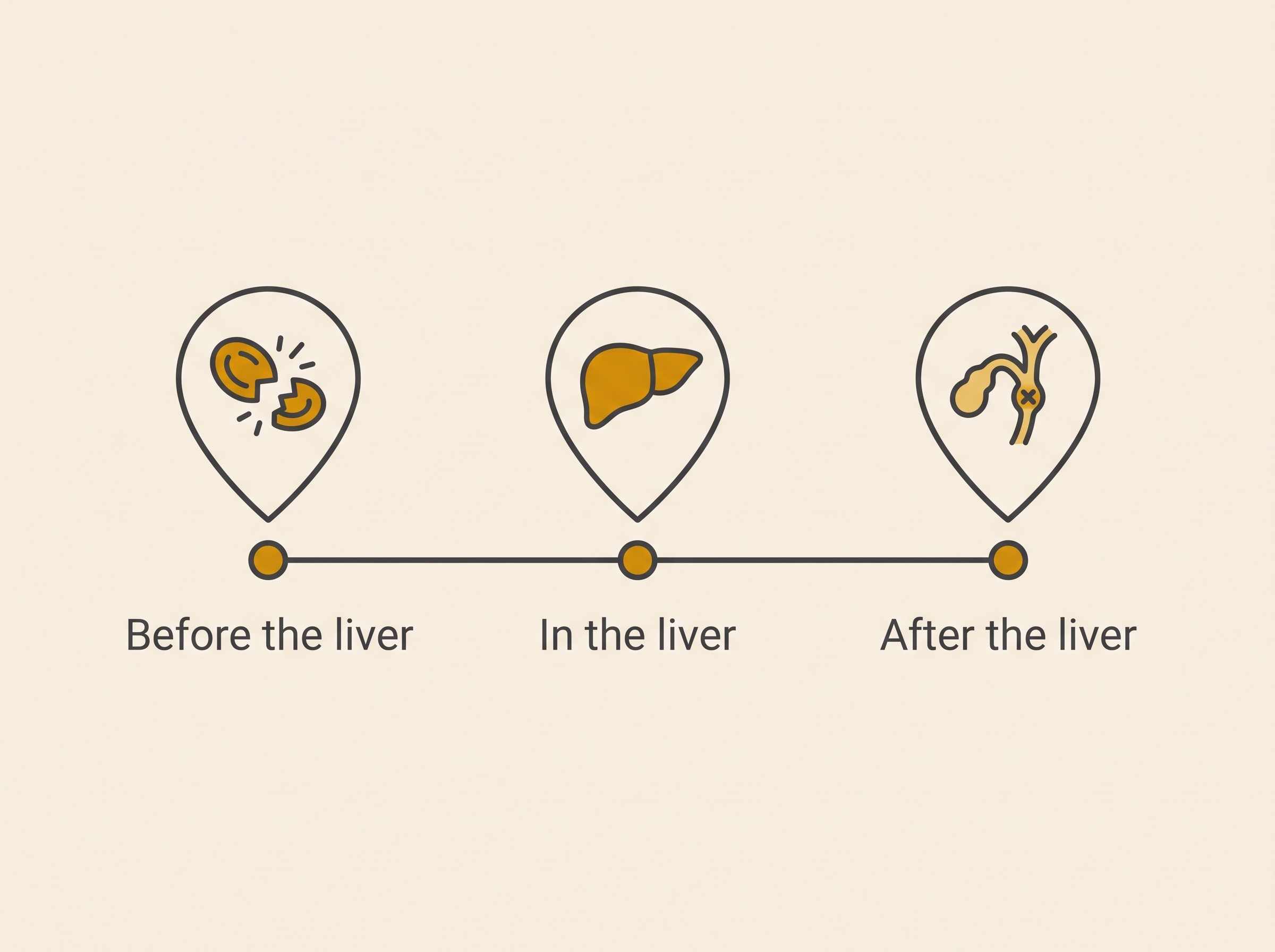
Vets tend to sort the causes of jaundice by where in the bilirubin journey the problem lies: before the liver, in the liver, or after the liver. You do not need to diagnose your cat from this, that is your vet's job, but understanding the three buckets will make the workup make sense.
Before the liver (pre-hepatic). This is when red blood cells are being destroyed too fast, faster than even a healthy liver can keep up with. The recycling system is simply overwhelmed by the sheer amount of bilirubin being produced. In cats this can happen with certain blood parasites, immune conditions that attack red cells, or some toxins. A cat with this type is often also anaemic, and may seem weak, breathless or have very pale gums underneath the yellow.
In the liver (hepatic). This is when the liver itself is not working properly and cannot process bilirubin as it should. This is the big category for cat owners, because it includes the two feline liver diseases that come up again and again: hepatic lipidosis (fatty liver), which develops when a cat stops eating (see Your cat has stopped eating: a liver emergency), and cholangitis (inflammation of the bile ducts and liver, see Cholangitis and triaditis). Other liver problems, infections and cancers can sit here too.
After the liver (post-hepatic). This is when the liver is doing its job but the bile cannot get out, because the plumbing downstream is blocked. Bile backs up, and with it the bilirubin. Causes include obstruction of the bile duct by inflammation, thickened bile, a stone, pancreatitis pressing on the duct, or a mass.
You will notice something reassuring and something sobering in that list. The reassuring part: several of the most common causes, hepatic lipidosis and cholangitis in particular, are treatable, sometimes very treatable, when caught in time. The sobering part: telling these apart, and picking up the more serious causes, genuinely requires veterinary tests. There is no way to know from the colour alone which of the three buckets your cat is in.
Why it is always urgent in a cat
You might reasonably ask: if some causes are milder than others, why treat every case as an emergency? Two honest reasons.
First, you cannot tell the mild from the serious by looking. The cat with early, treatable cholangitis and the cat with an obstructing mass or a life-threatening anaemia can present with the same yellow tinge. The only way to sort them is to test, and the sooner that happens, the more options there usually are.
Second, and this is specific to cats, jaundice often means the liver is already under real strain, and in cats that strain can spiral fast. Many jaundiced cats are also off their food, and a cat who is not eating is at risk of hepatic lipidosis piling on top of whatever started the problem. So the yellow is frequently a marker that a cat has already been unwell for a little while and that the clock is running. Waiting rarely makes a jaundiced cat easier to treat, and often makes them harder.
There is also the plain fact that by the time jaundice is visible, a fair amount has usually already happened inside. Yellow is not an early warning light. It is a sign that bilirubin has been building for a while. That is exactly why, in our companion pieces, we ask you not to wait for the yellow but to act on the not-eating that so often comes first. If you have got here having seen yellow, the message is simply: go now.
What your vet will do
Knowing roughly what happens next can take some of the fear out of the visit. Your vet will examine your cat and almost always run bloodwork, which confirms the raised bilirubin and starts to point toward which bucket you are in: a blood-cell problem, a liver problem, or an obstruction. They will usually want an ultrasound scan of the abdomen to look at the liver, gallbladder, bile ducts and pancreas, which is particularly good at spotting obstructions and changes in the liver and biliary system. Depending on what those show, they may recommend further tests such as sampling the liver or bile.
Treatment then depends entirely on the cause, which is the whole point of finding it: antibiotics or immune medication for cholangitis, aggressive assisted feeding for hepatic lipidosis, treatment for a blood parasite or immune condition, or surgery for an obstruction. Because the causes are so different, there is no single "jaundice treatment", and anyone who offers you one without a diagnosis is guessing. Alongside the specific treatment, supportive care matters a great deal in these cats, and keeping them eating, with anti-nausea medication or assisted feeding if needed, is often central.
What you should and should not do
Do get your cat seen today, or tonight if you are seeing it out of hours. Do take note of anything else you have observed, how long they have been off food, any vomiting, any weight loss, whether they have seemed weak or breathless, because that history genuinely helps your vet narrow things down. Do bring your cat in even if the yellow seems faint or you are not completely sure, because faint jaundice is still jaundice and early is better.
Do not wait to "see if it clears up". Jaundice does not resolve on its own without the underlying cause being treated. Do not try to treat it at home with supplements, tempting foods or anything from the internet, because you would be guessing at a cause you cannot see and losing time you do not have. And do not be reassured by your cat still purring or seeming reasonably bright, cats are famously good at masking illness, and a purring cat can still be a seriously ill one.
The bottom line
Yellow in a cat is one of the clearest "act now" signs in all of feline medicine. It means bilirubin is building up, it can come from before, in, or after the liver, and you cannot tell which from the colour. Several of the common causes are treatable when caught in time, which is precisely why the timing is on your side only if you move quickly.
So if you are still reading and you have seen the yellow, that is your cue to stop reading and make the call. When your cat is being looked after and you want to understand more about what might be behind it, come back to the not-eating emergency, cholangitis and triaditis, and high liver values in cats. But the reading can wait. Your cat should not.
References
- Icterus (jaundice) defined as tissue yellowing from bilirubin accumulation; normal bilirubin metabolism via hepatic uptake and biliary excretion.
- Classification of jaundice as pre-hepatic (haemolytic), hepatic, and post-hepatic (obstructive).
- Common hepatic causes of feline jaundice, including hepatic lipidosis and cholangitis.
- Pre-hepatic causes of feline jaundice: haemolysis from blood parasites, immune-mediated disease and toxins.
- Post-hepatic (obstructive) causes: biliary obstruction from inflammation, inspissated bile, choleliths, pancreatitis or neoplasia.
- First-line investigation of feline jaundice: biochemistry and abdominal ultrasound.
- Concurrent anorexia and hepatic lipidosis risk compounding jaundice in cats.
Free downloads
Companion worksheets to put what you've read into practice. Free PDFs, print at home.
Keep track of how your pet is doing
The owners who cope best are the ones who notice changes early. A simple health log shows you what is working, and what is not, before the next vet visit.
Start tracking, freeYou're not doing this alone
Compare treatment journeys and talk to owners managing liver & gallbladder. Free to join.
Join PetsLikeMine