

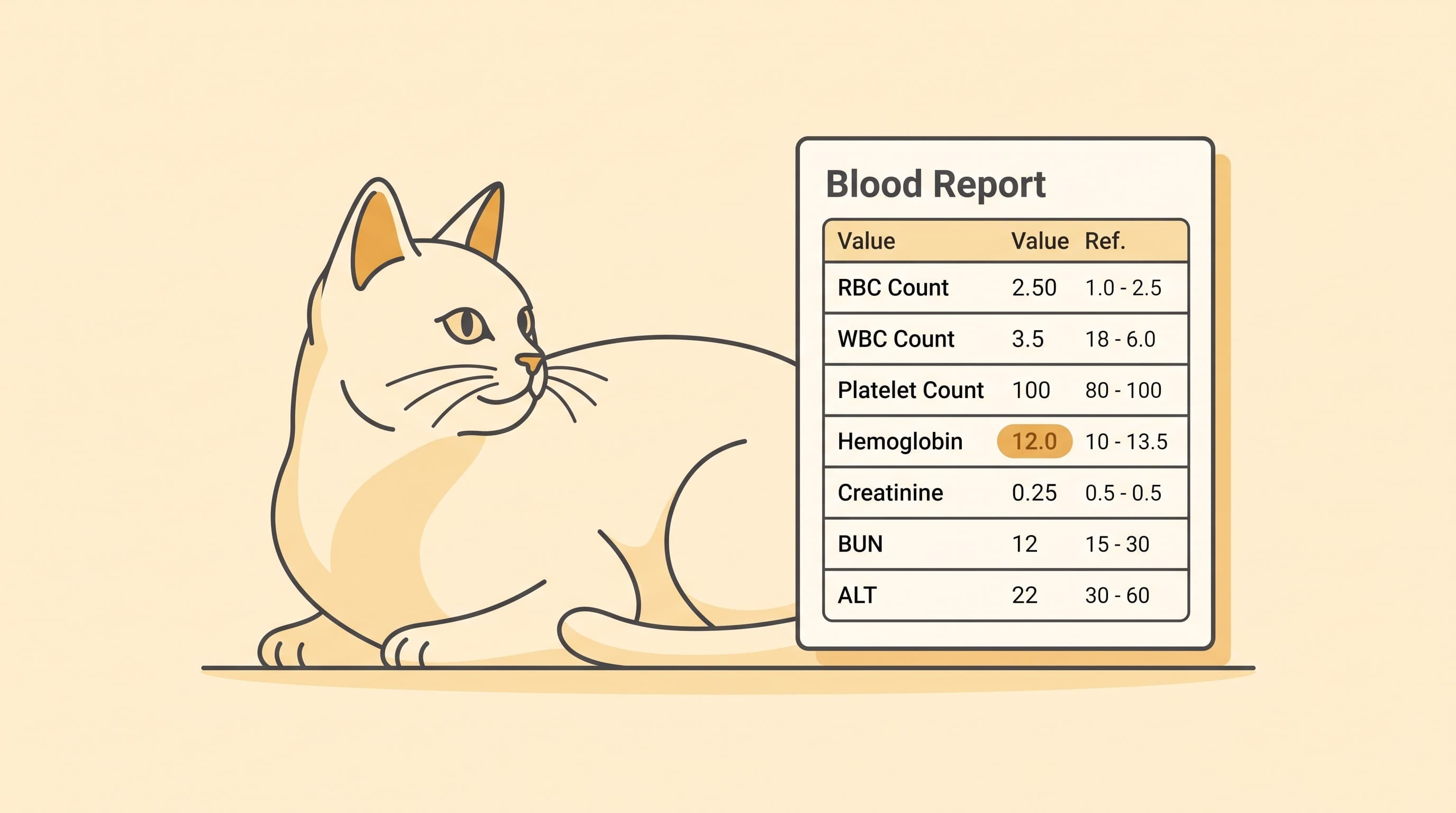
High Liver Values in Cats: Why It's a Different Conversation
Alastair Greenway
BVM&S MRCVS
You've done the sensible thing. Your cat's blood test flagged a liver value, you went looking for answers, and you found a lot of pages, almost all of them written about dogs. So now you're trying to translate advice about "mild elevations" and "recheck in a few weeks" onto your cat, and something feels off, because it is. A raised liver value in a cat is a genuinely different conversation from the same finding in a dog, and reading dog-focused reassurance and applying it to a cat can send you the wrong way in both directions: sometimes too worried, sometimes not worried enough.
Let me give you the feline version. The good news is that the core idea is the same, enzymes measure leak, not function, so a flagged number is a starting point, not a diagnosis. But cats have their own biochemistry, their own list of liver diseases, and one specific danger that doesn't have a real canine equivalent. Getting those differences straight is what lets you read your cat's result correctly instead of borrowing a dog's.
The same foundation: leak versus function
Start with the idea that anchors everything, because it's true across species. Liver enzymes measure leak, not work. Enzymes like ALT and ALP spill into the blood when liver cells are irritated, so a raised value tells you cells are leaking, not that the liver has stopped functioning.
Whether your cat's liver is actually working is measured by different numbers on the same panel, the function markers: albumin, glucose, urea, bilirubin and clotting. So the first useful thing you can do is find those. If they're holding steady, that's reassuring about function. But before you relax the way a dog owner might, you need to know why the enzymes themselves behave differently in cats.
Difference one: in cats, ALP is the serious one, and it's the opposite of the dog story
In dogs, ALP is the enzyme everyone over-worries about, precisely because it has so many innocent causes: steroids, Cushing's, bone growth, breed. In cats, almost none of that applies, and it flips the emphasis entirely.
Two feline facts drive this. First, cats don't have the steroid-induced ALP that dogs do, so the single biggest "don't worry, it's probably not the liver" explanation for a high ALP in dogs simply isn't available for cats. Second, feline ALP has a much shorter half-life and cats produce less of it, so it takes a real problem to push it up, and it clears quickly. The consequence is important: a raised ALP in a cat is generally more clinically significant than the same finding in a dog, and it deserves to be taken more seriously rather than shrugged off. In particular, an elevated ALP in a cat, especially alongside a raised bilirubin, is a classic pointer toward hepatic lipidosis (fatty liver), which I'll come to, because it's the reason cats have their own emergency page.
ALT in cats, as in dogs, points more toward liver-cell damage itself. And GGT becomes a useful companion: the relationship between ALP and GGT actually helps distinguish feline liver diseases, for instance, certain bile-duct and cholangitis problems tend to raise GGT more strikingly, while fatty liver often raises ALP more than GGT. Your vet reads these patterns together; the point for you is simply that a high ALP in a cat is not the routine, over-feared finding it often is in dogs.
Difference two: the emergency that changes everything
Here is the difference that matters most, and it's the reason I never want a cat owner to lean on dog-focused "watch and recheck" advice without this caveat.
A cat that stops eating can develop fatty liver (hepatic lipidosis) within days. When a cat doesn't eat, its body mobilises fat, and a cat's liver can be overwhelmed and clog with that fat far faster than a dog's. It can happen after almost any trigger, a stressful event, a house move, a diet change they didn't like, or another illness that put them off their food, and it can turn a "my cat's a bit quiet and not eating much" situation into a genuine liver crisis in a very short window.
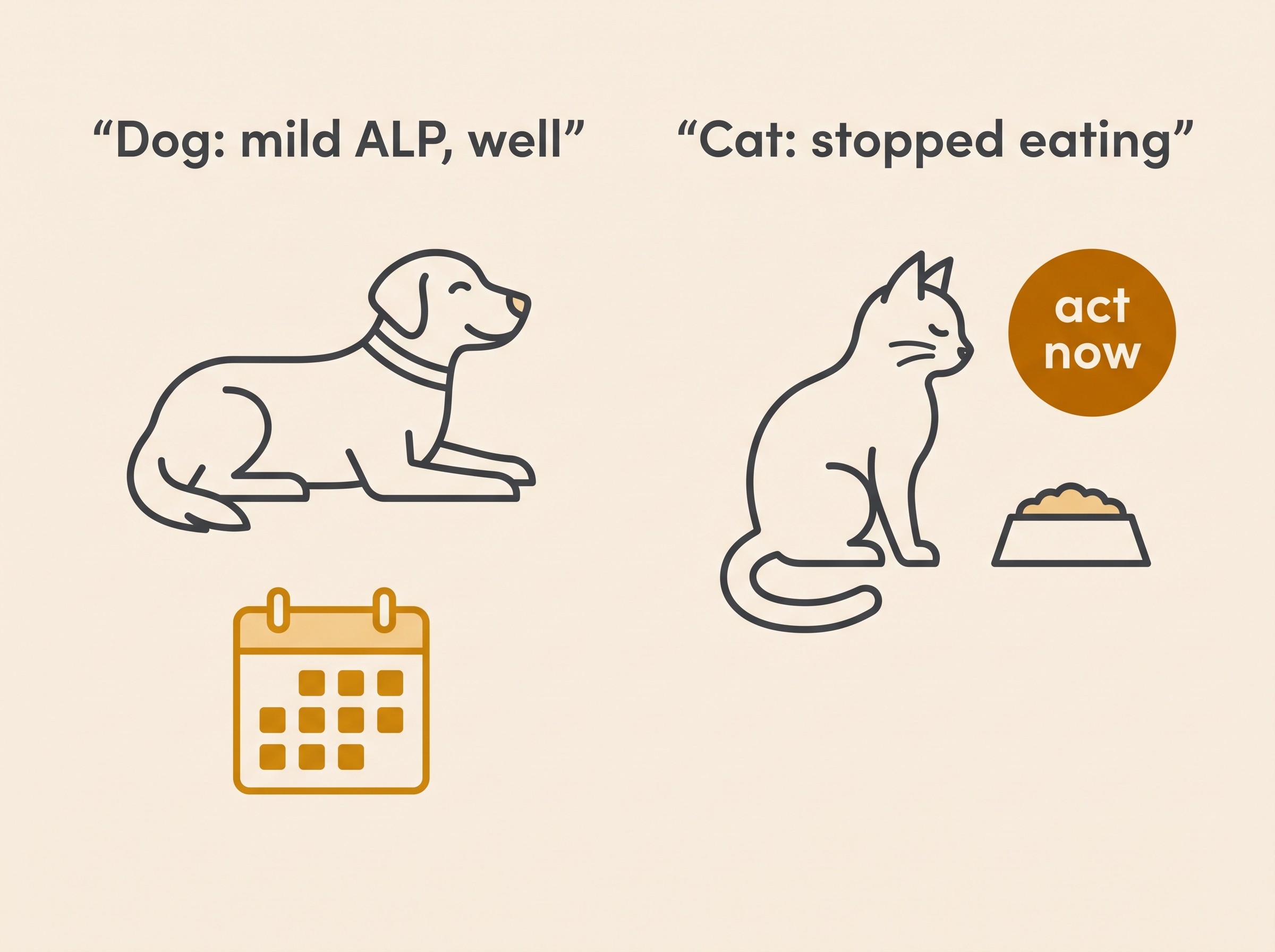
This completely changes how you read a raised liver value in a cat who is also off food. In a well, eating dog, a mild elevation is usually a recheck-in-a-few-weeks situation. In a cat who has stopped eating, even for a couple of days, the message is the opposite: act, don't wait. Watch for jaundice too, a yellow tinge to the gums, the whites of the eyes, the ears or the skin, which is the hallmark of a liver that's struggling, but the aim is to get help before the yellow appears, on the not-eating alone. If this is your situation right now, please stop reading the general advice and go straight to [Your cat has stopped eating: a liver emergency], then ring your vet today. This is the one place in the whole liver story where the honest answer is urgency, not patience.
Difference three: the feline liver diseases are their own set
When a cat's liver values are genuinely raised and it's not simply reflecting fatty liver, the list of likely causes is different from a dog's. Cats have their own leading players:
- Hepatic lipidosis (fatty liver), as above, often triggered by not eating and frequently secondary to another problem that stopped them eating in the first place, which also needs finding.
- Cholangitis and cholangiohepatitis, inflammation of the bile ducts and liver, which comes in more than one form and is a common feline liver disease in its own right. It's often tangled up with the gut and pancreas as part of what vets call triaditis (liver, pancreas and intestine inflaming together). Our piece [Cholangitis and triaditis: the liver-gut-pancreas triangle] explains this properly.
- Systemic illnesses that affect the liver secondarily, such as hyperthyroidism (very common in older cats and a frequent cause of mildly raised liver enzymes), infections, and others.
Notice that dog-specific stories you may have read, breed-benign ALP, steroid-induced ALP, the big copper-and-dog-food debate, largely don't map onto cats. That's not a gap in your reading; it's a real species difference. Chasing a canine explanation for a feline number is a common wrong turn.
So how do I read my cat's result?
Put the differences together and here's the practical approach for a raised liver value in a cat:
- Is your cat eating? This is the first and most important question. A cat who is bright and eating well, with a mild elevation, can often be investigated in a measured way, a fasted recheck, a look at the function markers, and a conversation about likely feline causes. A cat who is off food is a different, more urgent situation regardless of the exact number.
- Which value is raised, and is bilirubin up? A raised ALP in a cat is more significant than in a dog, and a raised bilirubin (which shows as jaundice when high enough) always deserves prompt attention. Yellow anywhere on a cat is urgent.
- Look for the wider picture. Weight loss, intermittent vomiting, off-days that come and go, or increased thirst can point toward the feline diseases above and toward conditions like hyperthyroidism.
- Don't apply dog reassurance wholesale. The "mild elevation, well pet, recheck later" model is sound for a genuinely well, eating cat, but it has a hard exception: the cat who has stopped eating.
Where this leaves you
A raised liver value in a cat is worth understanding on its own terms, not through a dog-shaped lens. The same foundation holds, enzymes measure leak not function, and a number is a starting point, so a well, eating cat with a mild elevation usually warrants a calm, measured look rather than a panic. But cats carry their own biochemistry (a high ALP means more in a cat), their own diseases (cholangitis, triaditis, fatty liver), and one genuine emergency that has no real canine twin: the cat who stops eating.
If your cat is bright and eating, book the fasted recheck, ask your vet which feline causes fit the picture, and log the result in the Liver Values Tracker so you can watch the trend rather than one number. If your cat is off food, or looks at all yellow, that's not a tracking situation, it's a same-day call. Read [Your cat has stopped eating: a liver emergency] and [Jaundice in cats: what the yellow actually means] next, and don't wait it out.
References
- Hepatic enzyme leakage versus hepatic function markers (albumin, glucose, urea, bilirubin, coagulation) in cats.
- Absence of a corticosteroid-induced ALP isoenzyme in cats; shorter half-life and lower magnitude of feline ALP, increasing the clinical significance of feline ALP elevation.
- ALP-to-GGT patterns distinguishing feline hepatic lipidosis from cholangitis/biliary disease.
- Rapid development of feline hepatic lipidosis following short-duration anorexia; jaundice as a hallmark; frequently secondary to an underlying illness.
- Hyperthyroidism as a common cause of mildly elevated liver enzymes in older cats.
- van den Ingh TSGAM, Cullen JM, Twedt DC, et al. WSAVA standards for the histological classification of feline hepatobiliary disease (including the feline cholangitis classification).
Free downloads
Companion worksheets to put what you've read into practice. Free PDFs, print at home.
Keep track of how your pet is doing
The owners who cope best are the ones who notice changes early. A simple health log shows you what is working, and what is not, before the next vet visit.
Start tracking, freeYou're not doing this alone
Compare treatment journeys and talk to owners managing liver & gallbladder. Free to join.
Join PetsLikeMine