

Cholangitis and Triaditis: The Liver-Gut-Pancreas Triangle
Alastair Greenway
BVM&S MRCVS
You have probably arrived here holding a diagnosis made of words you had never heard before last week. Cholangitis. Cholangiohepatitis. Triaditis. Your cat has been having a run of off-days, maybe some intermittent vomiting, a bit of weight coming off, an appetite that comes and goes, perhaps a bout of looking slightly yellow that then settled. And now there is a name for it, or several names, and you want to understand what is actually going on inside your cat and whether it can be controlled.
Let me give you the reassuring headline first: this is a condition we can very often manage well, sometimes for years. It is not usually a quick cure, and it can be a relapsing, up-and-down sort of illness rather than a one-and-done. But cats with cholangitis frequently live good, comfortable lives with the right treatment and a bit of vigilance from you. This piece will explain what cholangitis is, why in cats the liver, gut and pancreas so often flare up together (that is the "triaditis" part), how the different types are treated differently, and the one thing you must never let slide: your cat's appetite.
What cholangitis actually is
Cholangitis means inflammation of the bile ducts, the small channels that carry bile from the liver out toward the gut. When the neighbouring liver tissue is inflamed too, the term becomes cholangiohepatitis. For an owner, the useful thing to hold onto is that this is a disease of the biliary system and liver, and importantly it is not the same disease as the chronic hepatitis we see in dogs. Cats have their own liver problems, which is exactly why the dog-focused liver pages elsewhere on the internet can leave cat owners confused. Cholangitis is, alongside hepatic lipidosis, one of the most common liver diseases of cats.
Crucially, cholangitis is not one single thing. The internationally used framework, the WSAVA liver standardisation classification, divides feline cholangitis into three types, and the type matters enormously because it changes the treatment.
- Neutrophilic (also called suppurative or acute) cholangitis. This is driven by neutrophils, the white cells the body sends to fight infection, and it is often associated with bacteria that have travelled up from the gut into the biliary system. It tends to come on more acutely, with a cat who is suddenly unwell, off food, sometimes feverish or jaundiced.
- Lymphocytic (also called chronic) cholangitis. This is driven by lymphocytes and is a slower, smouldering, more immune-flavoured process. It tends to produce the on-and-off pattern many owners describe: a cat who is never dramatically ill but is never quite right, with grumbling weight loss and a wandering appetite over months.
- Cholangitis associated with liver flukes. In parts of the world where certain parasitic flukes are found, these can infest the biliary system and cause cholangitis. This form is geographically limited and is not a concern for cats who have never lived in or travelled to those regions.
Knowing which type your cat has is not academic. As you will see, it is the whole basis of how it is treated.
Why "triaditis" happens: the plumbing explains it
Here is the piece that ties everything together, and it comes down to feline anatomy.
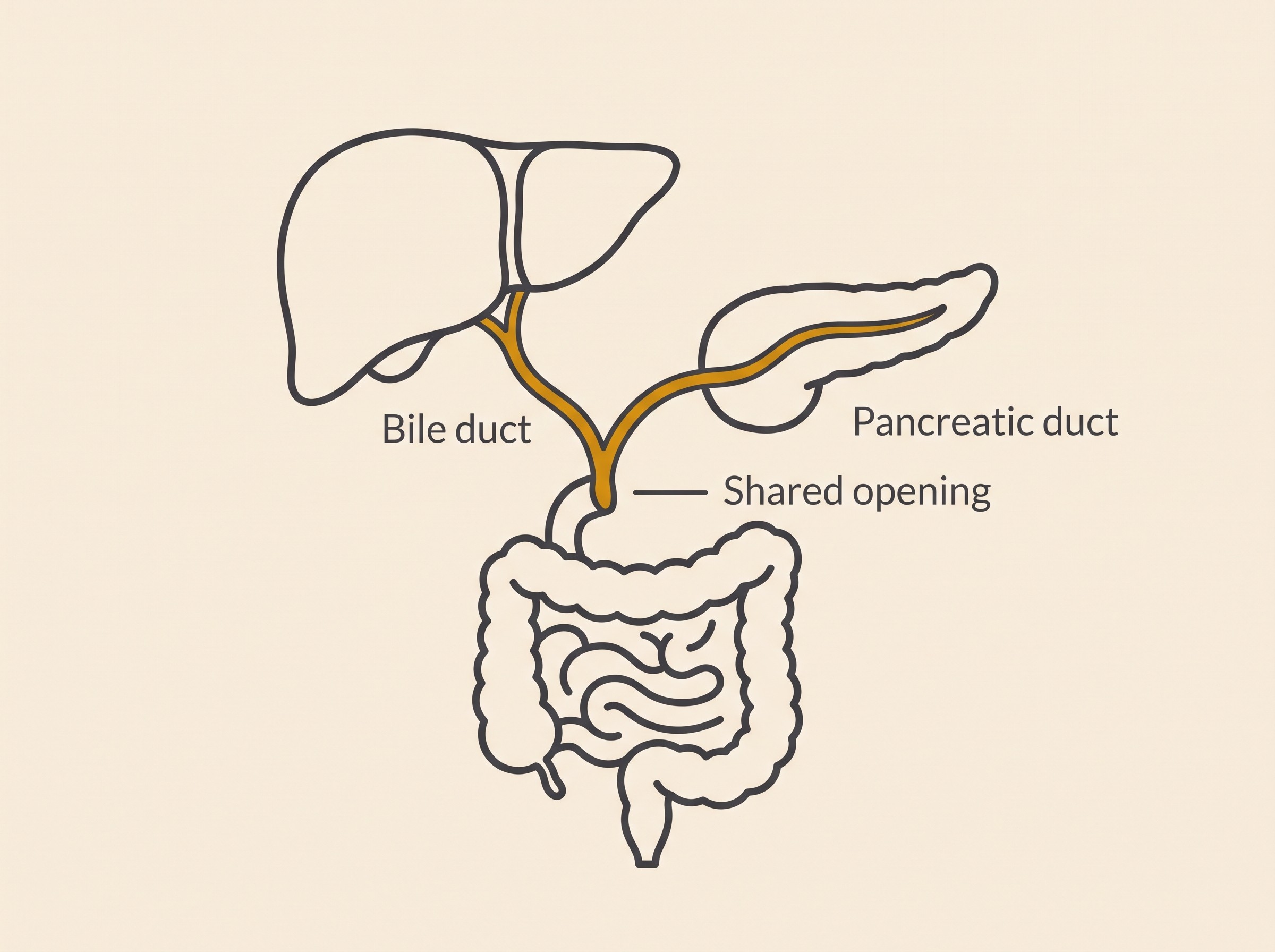
In a cat, the duct that drains the pancreas and the duct that drains the bile from the liver join together and share a common opening into the intestine. That shared plumbing means that inflammation, and any bacteria travelling up from the gut, does not stay politely in one organ. Trouble in the intestine can spread to the biliary system and the pancreas, and vice versa, because they are all connected at the same junction.
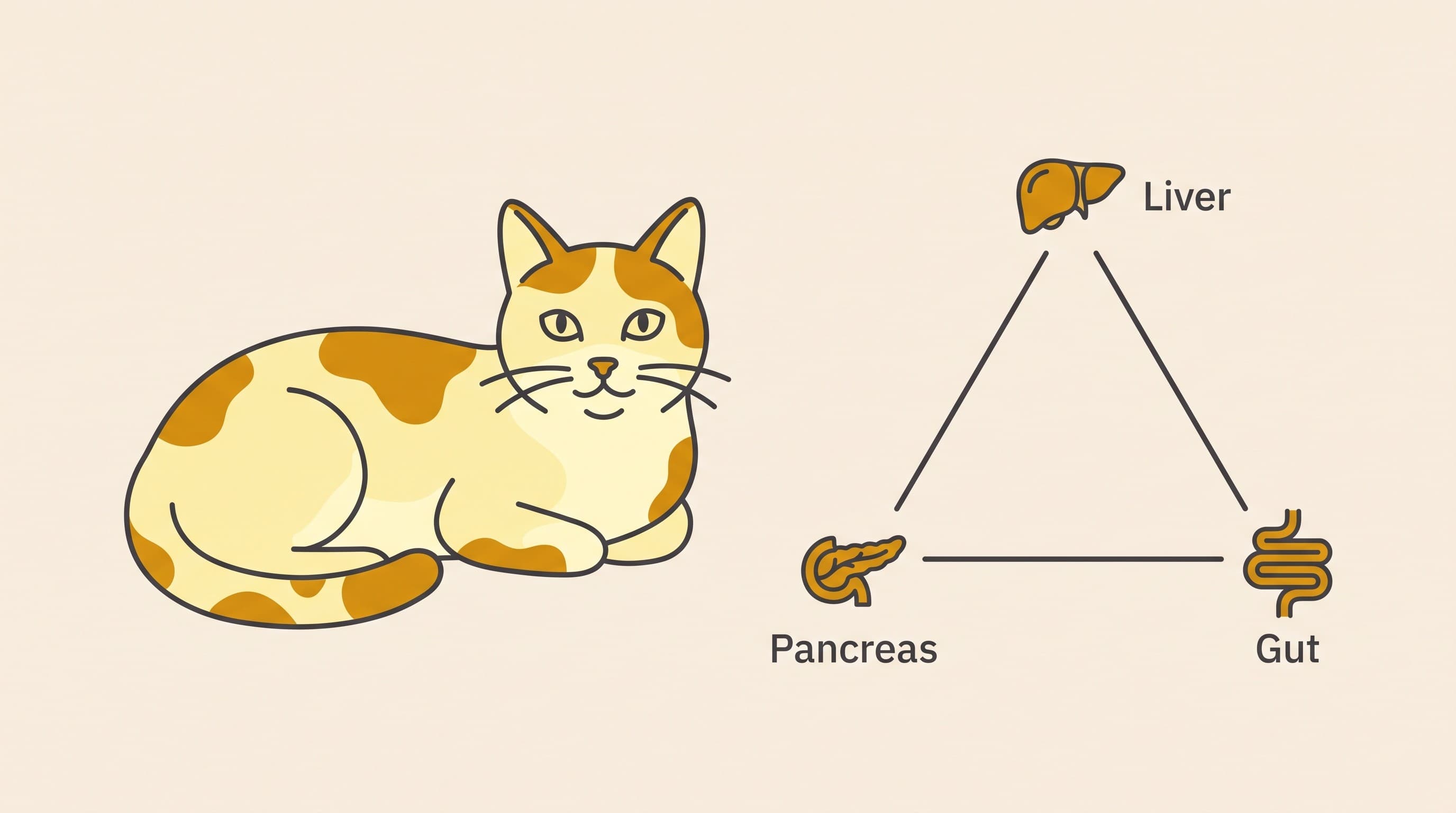
The result is a phenomenon we see far more in cats than in other species: the liver, the pancreas and the intestine inflaming together. When a cat has all three at once, cholangitis plus pancreatitis plus inflammatory bowel disease (IBD), we call it triaditis.
This explains something that puzzles a lot of owners. Your cat was referred, sensibly, for "liver disease", and then found themselves being investigated for their gut and pancreas as well, and you wondered whether the vet was casting around. They were not. In a cat with cholangitis, checking the pancreas and the intestine is not scope-creep, it is good medicine, because in cats these three so often travel together. Treating only the liver while missing an active pancreatitis or an underlying IBD is a recipe for a cat who never quite gets better.
How the type changes the treatment
This is where the classification earns its keep. The two main types of cholangitis are treated quite differently, which is why getting to the right diagnosis matters and why your vet may want to look closely before settling on a plan.
Neutrophilic cholangitis, being often bacterial, is typically treated with antibiotics. Ideally the choice of antibiotic is guided by a sample of bile, cultured to identify the bacteria involved and what they are sensitive to, so the treatment is targeted rather than a guess. Treatment is often needed for a good stretch of weeks.
Lymphocytic cholangitis, being immune-driven rather than infectious, is often treated by damping down the immune response, which usually means anti-inflammatory or immunomodulatory medication. This is a longer game, aimed at controlling a chronic process rather than clearing an infection.
You will notice that these two approaches are almost opposites: fight an infection in one, calm an over-reaction in the other. Give the wrong one to the wrong cat and you can make things worse. That is exactly why this is a veterinary decision, made after appropriate investigation, and not something to be guessed at from symptoms alone. Diagnosis usually leans on bloodwork, an ultrasound scan of the liver, pancreas and gut, and sometimes sampling of the liver, bile or intestine to tell the types apart and to pick up the pancreatitis and IBD components.
Alongside whichever specific treatment your cat needs, there is a common thread: supporting the appetite and treating any nausea, and addressing the pancreatitis and gut inflammation if they are part of the picture. Which brings us to the single most important thing you need to watch for at home.
The appetite red line
If you remember one practical thing from this entire article, make it this. A cat with cholangitis who stops eating is at real risk of tipping into hepatic lipidosis, and that is an emergency.
Here is why. Cholangitis makes cats feel unwell and nauseous, and unwell, nauseous cats stop eating. But in a cat, going off food does not just mean lost calories. It can trigger fatty liver (hepatic lipidosis), a second, serious liver problem stacked on top of the first, and it can develop within days. So a cholangitis flare that puts your cat off food is not just a bad patch to ride out. Appetite loss in these cats is treated as urgent, not incidental. This is the safety spine running through every feline liver condition, and it is covered in full in Your cat has stopped eating: a liver emergency.
In practice this means: know what your cat's normal eating looks like, watch it closely, and do not adopt a wait-and-see attitude if they go quiet on their food. A cat with a liver condition who has not eaten properly for a day or two needs a call to the vet, not a day of tempting them with treats. Managing the appetite well, with anti-nausea medication and, in a bad patch, assisted feeding, is often what keeps a cholangitis cat out of a full crisis.
Living with a relapsing condition
Cholangitis, particularly the lymphocytic type, is often a condition you manage rather than one you cure. Many cats have good long stretches punctuated by the occasional flare, and the aim is to keep the flares few, mild and quickly treated. That reframes what "success" looks like: not a single triumphant recovery, but a stable, comfortable cat over time.
Two things help you play the long game well. The first is learning to recognise your own cat's early flare signs (a dip in appetite, a return of intermittent vomiting, a bit less energy, or a faint yellow tinge) so you can act before a small wobble becomes a big one. The second is watching the trend rather than any single blood result. Cholangitis cats have repeat bloodwork over months, and it is the direction of travel, is the liver settling, is the cat maintaining weight, that tells you whether the plan is working. Our Liver Values Tracker is built precisely for this, letting you log each result and see the pattern over time so you and your vet are steering by the trend, not by one number.
Because triaditis so often involves the gut and pancreas, it is well worth reading alongside our Digestive Health space, where the IBD and pancreatitis pieces cover the other two corners of the triangle in their own right.
What to do next
If your cat has just been diagnosed, the useful questions to bring to your vet are: which type of cholangitis is this likely to be, and how will we confirm it? Are the pancreas and gut involved too? What is our plan for keeping the appetite up, and what should I watch for at home? And how often will we recheck the bloods so we can follow the trend?
Then keep a close, informed eye on the one thing that matters most day to day: is your cat eating? A cholangitis cat who is eating and holding their weight is usually a cat who is winning. A cholangitis cat who has gone off food is a cat who needs the vet, promptly. Everything else, the antibiotics or the immune medication, the diet, the rechecks, sits around that one central fact. Read Jaundice in cats so you know what a yellow tinge means, and keep the not-eating emergency piece close, because between the two of them you will know exactly when a quiet day is just a quiet day and when it is time to pick up the phone.
References
- van den Ingh TSGAM, Cullen JM, Twedt DC, Rothuizen J, et al. WSAVA Liver Standardization: morphological classification of feline inflammatory liver disease, including the three-way classification of cholangitis (neutrophilic/suppurative, lymphocytic, and fluke-associated). *Vet Clin North Am Small Anim Pract.* 2009.
- Feline cholangitis/cholangiohepatitis as one of the most common feline hepatobiliary diseases, distinct from canine chronic hepatitis.
- Shared common opening of the pancreatic and bile ducts into the duodenum in cats, underlying the high concurrence of triaditis.
- Triaditis defined as concurrent cholangitis, pancreatitis and inflammatory bowel disease in cats.
- Neutrophilic cholangitis: bacterial association, treatment with antibiotics ideally guided by bile culture.
- Lymphocytic cholangitis: chronic immune-mediated process treated with immunomodulatory/anti-inflammatory therapy.
- Anorexia in cats with cholangitis precipitating hepatic lipidosis; appetite loss treated as urgent.
Keep track of how your pet is doing
The owners who cope best are the ones who notice changes early. A simple health log shows you what is working, and what is not, before the next vet visit.
Start tracking, freeYou're not doing this alone
Compare treatment journeys and talk to owners managing liver & gallbladder. Free to join.
Join PetsLikeMine