

High Liver Enzymes But My Pet Seems Fine: Do I Panic?
Alastair Greenway
BVM&S MRCVS
This is one of the most unsettling situations in the whole of pet ownership, and it's oddly specific. Your dog or cat is bright, eating, playing, completely themselves, and yet a blood test has come back with a liver enzyme flagged as high. Nothing about your pet says "ill", but a number does, and that gap between what you can see and what the paper says is exactly what keeps people up at night. So let me answer the question in the title directly, and then earn the answer.
No, you almost certainly do not need to panic tonight. A mildly raised liver enzyme in a pet who genuinely seems well is a common, usually-not-urgent finding, and the sensible response is nearly always a planned recheck rather than a crisis. But "don't panic" is not the same as "ignore it", and there's a short, honest list of things that would change my answer. Knowing that list is what turns anxious guessing into a clear plan.
Why a well pet can have a high number
The reason this happens so often comes down to a single idea: liver enzymes measure leak, not function. ALT and ALP are enzymes that live in and around liver cells, and they spill into the blood when those cells are even mildly irritated or turning over a little faster than usual. The liver has huge reserve, so it can leak a bit of enzyme while doing its job perfectly. That's precisely why your pet can look and feel completely well while a number is raised.
Whether the liver is actually working is measured by different numbers on the same panel: albumin, glucose, urea, bilirubin and clotting. Here's the first genuinely reassuring thing you can do right now. Look at those on your pet's result. If the albumin, glucose and urea are sitting comfortably in range and the bilirubin is normal, that tells you the liver's function is holding, which is exactly what you'd expect in a pet who seems fine, and it's the strongest single piece of good news on the page.
There's a second reason well pets get flagged, and it's about which enzyme is up. If the raised value is ALP rather than ALT, remember that ALP has a long list of causes that aren't liver disease at all: steroid medication, Cushing's disease, normal bone growth in young dogs, and even lifelong breed-related highs in some Scottish Terriers, Siberian Huskies and Miniature Schnauzers. A lone high ALP in a well dog is one of the most over-worried numbers in veterinary medicine. Our piece [ALT, ALP, AST and GGT in plain English] breaks down which letter is which.
There's also a quieter, third reason, and it's worth understanding because it takes the sting out of a "just over the line" result. A laboratory's normal range is a statistical band, drawn so that it covers the large majority of healthy animals, not every single one. By design, a small proportion of perfectly healthy pets fall just outside it. So a value sitting a whisker above the top of normal, in a bright pet, is a genuinely different thing from a value several times over. It's part of why your vet cares far more about how far over the line a number sits, and whether it's moving, than about the mere fact that it's flagged at all. A flag is not a diagnosis; it's a prompt to look at the size and the direction.
The watch-versus-work-up model
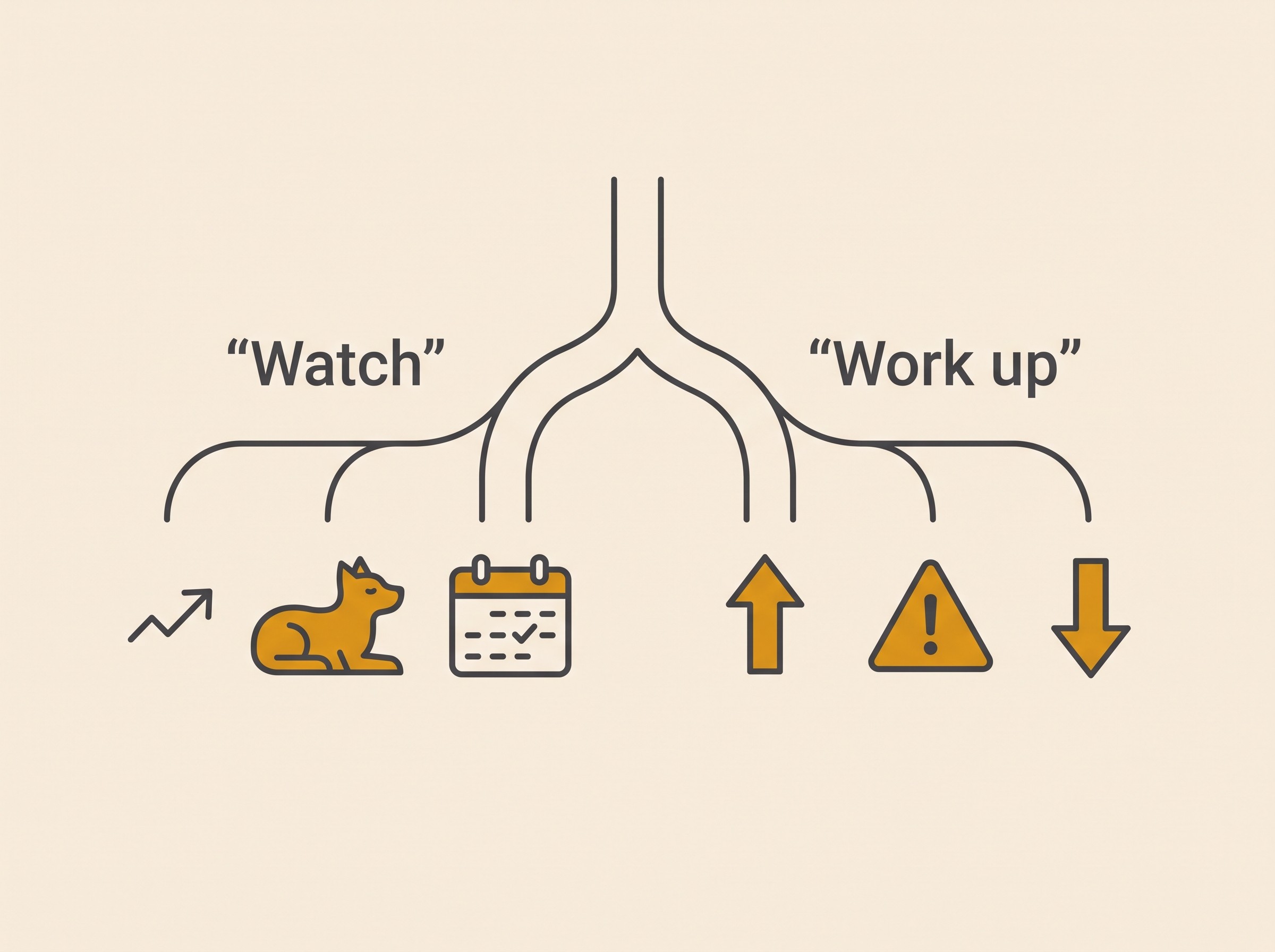
Here's the framework that decides what happens next, and it's honestly not complicated. Almost every "well pet, raised enzyme" case sorts into one of two piles.
The "watch" pile
A mildly raised enzyme (roughly one to two times the top of the normal range) in a pet who is genuinely well, eating normally, drinking a normal amount, bright, no vomiting, no yellow tinge, no swollen belly, is very often a recheck-in-a-few-weeks situation. Enzymes bump up for transient, often invisible reasons and frequently settle on their own. The right move is usually to repeat the bloods after a fast, which does two things: it removes food as a source of noise, and it tells you whether the number is a one-off blip or a real trend. Most well pets with a mild elevation are in this pile.
The "work up" pile
Four things move a case out of "watch" and into "let's investigate now":
- Magnitude. A markedly high enzyme, roughly more than five to ten times the top of normal, deserves proper investigation rather than a wait-and-see, even in a pet who seems well.
- A rising trend. A number climbing across repeat tests matters more than a single high value. This is the whole reason the recheck exists.
- Any clinical sign. The moment "seems fine" stops being true, off food, vomiting, drinking noticeably more, weight loss, a yellow tinge, a swollen abdomen, unusual sleepiness, or any odd behaviour, the calculus changes.
- Falling function markers. If albumin, glucose or urea start to drop, or bilirubin starts to climb, that's the liver's function being affected, and it's a different and more serious level of concern than a leak alone.
Notice what's doing the work here. It's not the mere existence of a raised number; it's how big it is, whether it's moving, and whether your pet is actually well. A single mild elevation in a bright pet with normal function markers sits, honestly and reassuringly, in the "watch" pile.
The line I won't let you cross
Everything above assumes a pet who is genuinely well apart from the number. So I have to be equally clear about the exception, because "my pet seems fine" is a judgement, and I never want to argue anyone out of a visit their pet needs.
A raised liver enzyme stops being a "watch and recheck" situation the instant any of these appear:
- Jaundice, a yellow tinge to the gums, the whites of the eyes, the ears or the skin
- A swollen or bloated abdomen
- Repeated vomiting, or turning away from food
- Marked lethargy, collapse, or a pet who simply isn't themselves
- Any neurological oddity, staring, head-pressing, circling, disorientation or a seizure, particularly after a meal
Any of those, with or without a known enzyme problem, is a same-day vet call. And there's one species-specific red line that overrides everything else on this page: a cat that stops eating for more than a couple of days is an emergency in its own right, because cats can slide into fatty liver (hepatic lipidosis) within days of not eating. If your patient is a cat who's gone quiet on food, don't wait for a recheck, read [Your cat has stopped eating: a liver emergency] and ring your vet today.
So what do I actually do this week?
If your pet is bright, eating and well, and the elevation is mild with normal function markers, here's a calm, concrete plan:
- Book the recheck your vet recommends, and ask for it to be a fasted sample so the result is cleaner.
- Ask which enzyme is raised. "Is it ALT or ALP, and is there anything, a medication, my dog's age or breed, that could explain it?" A lone high ALP with an innocent explanation is a very different conversation.
- Watch your pet, not the number. You already know your animal better than any test does. Keep a quiet eye on appetite, thirst, energy and toileting, and note anything that changes.
- Log it. Put the result into the Liver Values Tracker so that when the recheck comes back, you can see the two side by side. Is it stable? Falling? Climbing? That comparison is worth more than any single value, and it's the thing that will genuinely settle, or appropriately raise, your concern.
The honest bottom line is this. A well pet with a mildly raised liver enzyme is one of the most common and most over-feared findings we deal with. It usually earns a fasted recheck, a look at the function markers, and a bit of patience, not a panic. Keep watching your pet, keep the recheck, and let the trend tell the story. If any of the red flags above appear, that's your cue to stop watching and act. Everything in between is exactly what the recheck is for.
When you're ready for the next step, [The bile acids test, explained] covers the function test your vet might suggest, and [From a blood test to a biopsy: the liver workup, step by step] maps out the whole path if the number does turn out to need chasing.
References
- Hepatic enzyme leakage (ALT, ALP) versus hepatic function markers (albumin, glucose, urea, bilirubin, coagulation).
- Mild, isolated enzyme elevation in an asymptomatic patient as a monitor-and-recheck (fasted) scenario in first-opinion practice.
- Magnitude, trend, clinical signs, and function-marker changes as the drivers that escalate a raised enzyme to a workup.
- Corticosteroid-induced ALP isoenzyme (canine-specific) and breed-associated benign ALP elevations (Scottish Terrier, Siberian Husky, Miniature Schnauzer).
- Feline hepatic lipidosis risk following short-duration anorexia.
- Webster CRL, Center SA, Cullen JM, et al. ACVIM consensus statement on the diagnosis and treatment of chronic hepatitis in dogs. *J Vet Intern Med.* 2019;33(3):1173-1200.
Free downloads
Companion worksheets to put what you've read into practice. Free PDFs, print at home.
Keep track of how your pet is doing
The owners who cope best are the ones who notice changes early. A simple health log shows you what is working, and what is not, before the next vet visit.
Start tracking, freeYou're not doing this alone
Compare treatment journeys and talk to owners managing liver & gallbladder. Free to join.
Join PetsLikeMine