

Your Dog's Liver Enzymes Are High: What It Actually Means
Alastair Greenway
BVM&S MRCVS
It's late, your dog is asleep on the sofa looking completely normal, and you're staring at a blood result with a number highlighted in red or marked with an asterisk. Maybe the vet mentioned it in passing at the end of a routine appointment. Maybe it came back on a pre-anaesthetic panel before a dental, or a senior wellness screen. Somebody said the words "liver enzymes are a bit high", and now you're two hours deep into search results that all seem to disagree, and quietly terrified.
Take a breath. If you read nothing else tonight, read this: a raised liver enzyme is one of the most common findings on a dog's blood test, it is a sign and not a diagnosis, and in a dog who seems well it very often means "let's look a bit closer", not "something terrible is happening". The fact that your dog looks fine isn't a coincidence that makes it scarier. In a lot of these cases, your dog looks fine because your dog largely is fine, and the number is pointing at something we need to understand rather than something already hurting them. That doesn't mean you ignore it. It means you follow it up calmly, in the right order, with your vet. Let me walk you through what the number is, what it isn't, and what actually happens next.
Leak versus function: the idea that reframes everything
Here is the single most useful thing to understand, and almost nobody explains it at the appointment because there isn't time.
Liver enzymes measure leak, not work.
Enzymes like ALT and ALP live inside and around your liver cells. When liver cells are irritated, stressed, or turning over a bit faster than usual, some of that enzyme spills into the bloodstream, and the blood test picks it up. So a raised enzyme tells you that liver cells are leaking a little more than the lab's reference range expects. It does not tell you the liver has stopped doing its job.
The liver's actual job, its function, is measured by a different set of numbers on the same panel: albumin (a protein the liver makes), glucose (blood sugar the liver helps regulate), urea (a waste product the liver processes), bilirubin (the pigment the liver clears, which turns things yellow when it builds up), and clotting (the liver makes most of your dog's clotting factors). These are the numbers that tell you whether the liver is actually working.
Why does this matter so much? Because the two can move independently. A dog can have dramatically raised enzymes and a perfectly well-functioning liver, and a dog can have near-normal enzymes and a liver that's genuinely struggling. The liver has enormous reserve, so it can leak a bit of enzyme without missing a beat, and conversely a badly scarred liver can eventually run low on cells to leak from. This is exactly why "high enzymes" is not the same phrase as "liver failure", and why your vet will always read the function markers alongside the enzymes rather than reacting to one number in isolation. When you look at your dog's result, find the albumin, the glucose, the urea and the bilirubin. If those are sitting comfortably in range, that is genuinely reassuring, and it's the first thing I'd want you to notice.
ALT versus ALP: not all enzymes mean the same thing
The next thing to know is that "liver enzymes" isn't one number, it's a small family, and they don't all mean the same thing. There's a full plain-English breakdown in our companion piece on [ALT, ALP, AST and GGT], but here's what you need tonight.
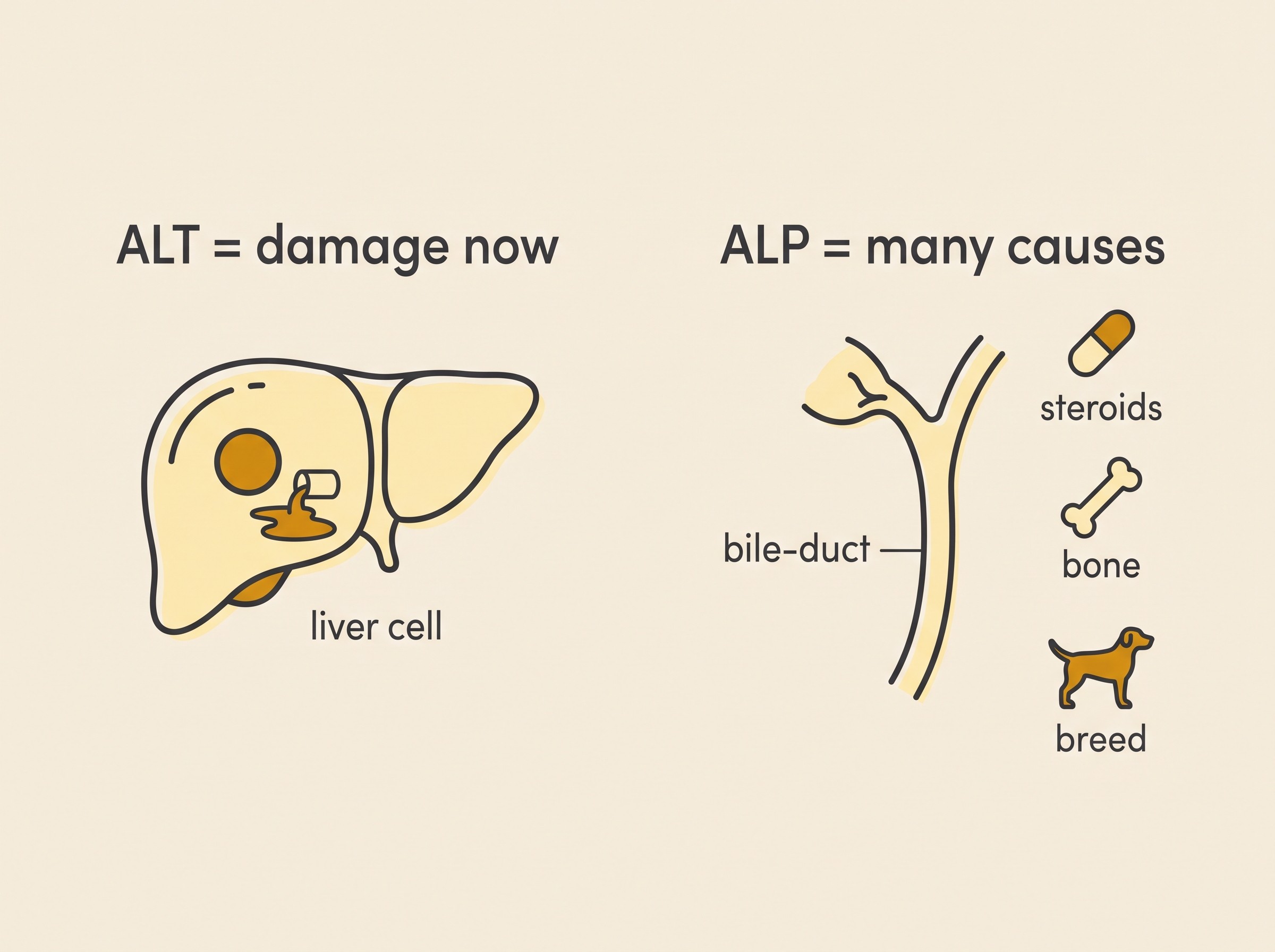
ALT is the "damage now" enzyme. ALT (alanine aminotransferase) lives inside liver cells specifically, so when it rises it's a fairly direct signal that liver cells themselves are being injured or irritated at this moment. A meaningfully raised ALT is the one that more reliably says "the liver itself".
ALP is the complicated one, and it's often not the liver at all. ALP (alkaline phosphatase) rises with problems in bile flow, but it also goes up for a whole list of reasons that have little or nothing to do with liver disease:
- Steroids. Dogs make a specific steroid-induced form of ALP, so any dog on steroid medication, or with high natural steroid levels, can run a high ALP.
- Cushing's disease (an overactive adrenal gland producing too much natural steroid) very commonly pushes ALP up.
- Growing bone in young dogs. ALP is also made by bone, so a healthy puppy or adolescent can have a raised ALP simply from growth.
- Some breeds just run high for life. There are dogs, classically some Scottish Terriers, Siberian Huskies and Miniature Schnauzers, who carry a high ALP their whole lives with no liver disease at all. In one of these breeds, an isolated high ALP is often not something to chase.
So a lone, mildly raised ALP in a well dog, especially one on steroids, an older dog, or a breed on that list, is usually a much calmer conversation than a rising ALT. If your dog's flagged value is ALP and everything else looks fine, that alone should take some of the fear out of tonight.
The mental model that actually helps: watch versus work up
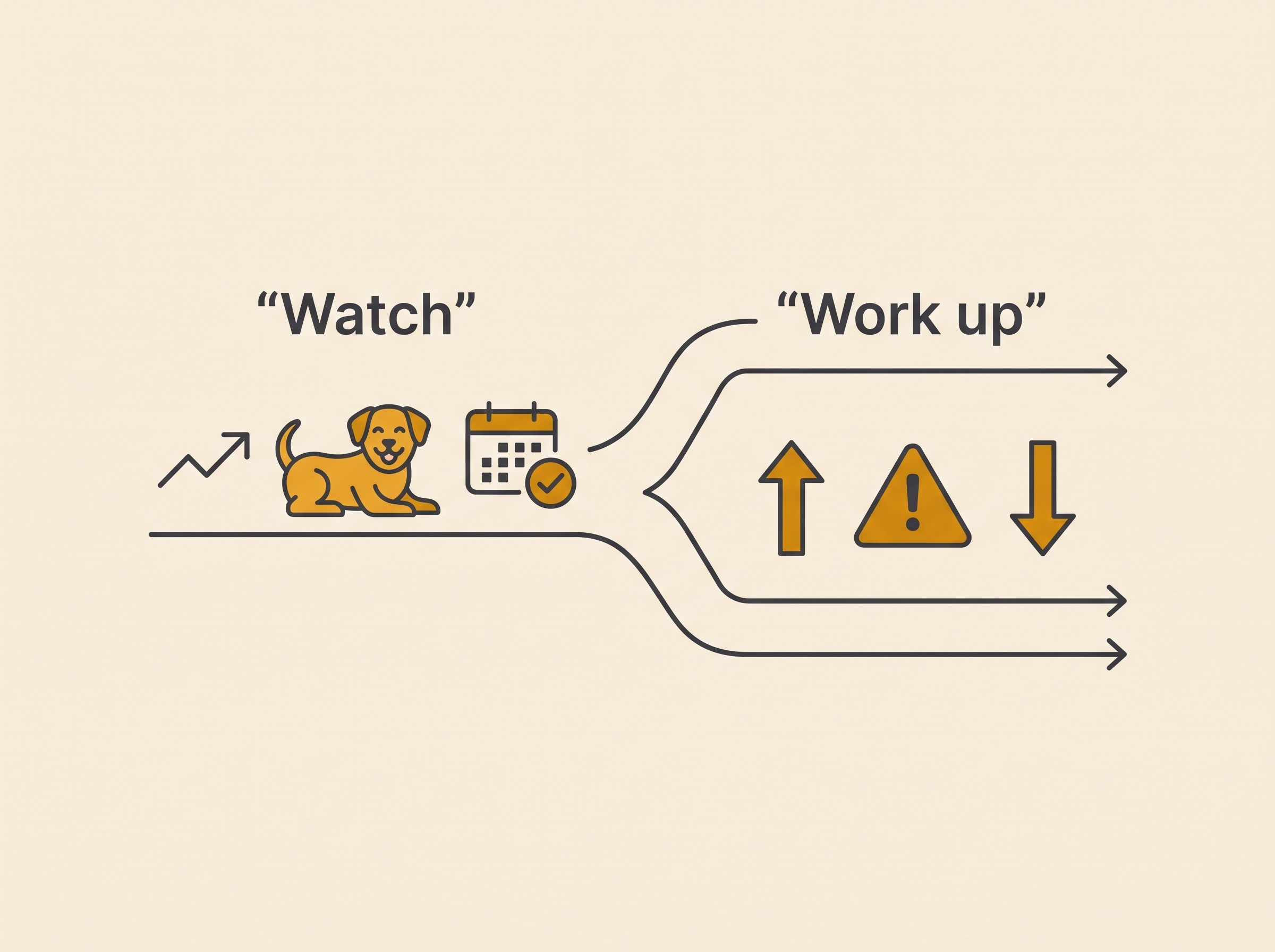
This is the framework I want you to leave with, because it's the one that turns a frightening number into a plan. Most raised-enzyme situations sort into one of two piles.
The "watch" pile. A mildly raised enzyme, roughly one to two times the top of the normal range, in a dog who is genuinely well (eating normally, bright, drinking a normal amount, no vomiting, no yellow tinge, no swollen belly), is very often a recheck-in-a-few-weeks situation rather than an emergency. Enzymes can bump up for transient reasons and settle on their own. Rechecking the bloods, often after a fast, tells you whether the number is a blip or a trend.
The "work up" pile. The things that raise the stakes and mean we shouldn't just wait are:
- Magnitude. A markedly high enzyme, roughly more than five to ten times the top of normal, deserves proper investigation rather than a wait-and-see.
- A rising trend. A number that's climbing on repeat tests matters more than a single high reading.
- Any clinical sign. Off food, vomiting, drinking noticeably more, weight loss, a yellow tinge to the gums or eyes, a swollen abdomen, unusual sleepiness or any odd neurological behaviour. Any of these changes the whole picture.
- Falling function markers. If the albumin, glucose or urea start to drop, or the bilirubin starts to climb, that's the liver's function being affected, and that's a different level of concern from a leak alone.
Notice that most of what pushes a case into the "work up" pile is either how big the number is, whether it's moving, or whether your dog is actually unwell. A single, mildly raised enzyme in a bright, well dog usually sits in the "watch" pile. That's not me minimising it. It's the honest, everyday reality of how these numbers behave.
The one exception: when it isn't a "recheck later" situation
Everything above assumes a dog who is genuinely well apart from the number. So let me be completely clear about the other side, because I never want to talk anyone out of a visit their dog needs.
A raised liver enzyme plus any of these is a same-day vet situation, not a watch-and-wait:
- Jaundice (yellow gums, yellow whites of the eyes, or a yellow tinge to the skin or ears)
- A swollen or bloated belly
- Repeated vomiting or refusing food
- Marked lethargy, collapse, or a dog who just isn't themselves
- Any neurological oddness: staring into space, head-pressing against walls, circling, disorientation, or a seizure, especially after a meal
A high enzyme is usually not an emergency in a well dog. In an unwell dog it's part of a picture that needs looking at now. Trust what your dog is showing you over what any article, including this one, says the number "usually" means.
What happens next: the workup ladder, previewed
If your vet does want to look further, there's a logical ladder, and you won't do all of it. Each rung answers a different question, and often you stop early because the answer is reassuring. Here it is in one glance, with our deeper pieces linked for when you're ready.
- Recheck the bloods, fasted. The cheapest, simplest step. Is the number real, is it still there, is it moving? A fasted sample removes a common source of noise.
- Bile acids test. A dedicated function test, filling exactly the gap the enzymes leave. It asks "is the liver working and is blood flowing through it properly?" rather than "are cells leaking?" Our piece [The bile acids test, explained] walks through the two-sample protocol and what a high result means.
- Abdominal ultrasound. A look at the liver's structure: its size, shape, texture, the gallbladder, and the blood vessels. It shows what the liver looks like, not what it is under a microscope.
- Liver sampling (a fine-needle sample or, for the real answer, a biopsy). The only step that gives a microscopic diagnosis, stages any scarring, and crucially measures copper in the tissue. Our piece [From a blood test to a biopsy] maps the whole ladder in detail.
Most dogs with a mild, isolated, well-dog elevation never go past rung one or two. Knowing the ladder exists is mostly so that "the next test" never feels like a lurch into the unknown.
Where this leaves you tonight
You came here panicking about one number, so let me hand you something better than a number: a way to watch the whole story. A single liver value is a snapshot, and snapshots lie in both directions. The trend, the same enzymes measured again in a few weeks and plotted over time, is what actually tells you whether anything is happening and whether it's getting better or worse. That's the entire logic behind our Liver Values Tracker, where you can log each result, see ALT, ALP, bilirubin and albumin side by side, and walk into your next appointment with the pattern instead of a scrap of paper.
For tonight, the honest summary is this. Your dog is asleep and looks well, which counts for a great deal. One raised enzyme, especially a lone high ALP, is common, is a sign rather than a diagnosis, and usually earns a fasted recheck rather than a crisis. Look at the function markers, and if they're holding, let that reassure you. Watch your dog for any of the red flags above, and if you see them, ring the vet the same day. Otherwise, book the recheck your vet suggests, bring your questions, and let the trend tell the story rather than one frightened glance at one number.
When you're ready, read [High liver enzymes but my pet seems fine: do I panic?] next, or [ALT, ALP, AST and GGT in plain English] if you want to decode every letter on the printout. If your patient is a cat, this whole conversation shifts, and [High liver values in cats] is written for you.
References
- Webster CRL, Center SA, Cullen JM, et al. ACVIM consensus statement on the diagnosis and treatment of chronic hepatitis in dogs. *J Vet Intern Med.* 2019;33(3):1173-1200.
- Enzyme leakage (ALT, ALP) versus hepatic function markers (albumin, glucose, urea, bilirubin, coagulation) as distinct concepts in canine hepatobiliary assessment.
- Steroid-induced (corticosteroid) isoenzyme of alkaline phosphatase as a canine-specific ALP fraction.
- Bone-origin ALP contribution in growing dogs.
- Breed-associated benign elevations of ALP (Scottish Terrier vacuolar hepatopathy / benign hyperphosphatasaemia; Siberian Husky; Miniature Schnauzer).
- Elevated liver enzymes, particularly ALP, as the most common abnormality on routine canine biochemistry panels.
Free downloads
Companion worksheets to put what you've read into practice. Free PDFs, print at home.
Liver Values: A Serial-Labs Tracking Sheet
PDF · 224 KBA write-on sheet to line up repeat liver bloods over time (ALT, ALP, AST, GGT, bilirubin, albumin, bile acids) so you and your vet watch the trend, not a single number. Pairs with the Liver Values Tracker.
High Liver Enzymes: What They Mean (and Don't)
PDF · 245 KBThe calm one-pager on a raised liver result: enzymes are a sign not a diagnosis, ALT (damage now) versus ALP (often not the liver), the watch-versus-work-up rule, and the recheck to bile acids to ultrasound to biopsy ladder.
Keep track of how your pet is doing
The owners who cope best are the ones who notice changes early. A simple health log shows you what is working, and what is not, before the next vet visit.
Start tracking, freeYou're not doing this alone
Compare treatment journeys and talk to owners managing liver & gallbladder. Free to join.
Join PetsLikeMine