

Liver Shunts (PSS): Surgery or Medical Management?
Alastair Greenway
BVM&S MRCVS
If you are reading this, you have probably just been told that your dog has a liver shunt, and you are trying to work out what on earth to do next. Perhaps your puppy has always been the small one, the slow grower, the one who seemed a bit vacant after dinner, and a blood test has finally put a name to it. Perhaps an older dog has started behaving strangely and the bile acids came back sky-high. Either way, you are almost certainly facing two things at once: a diagnosis you had never heard of a week ago, and a decision that feels far too big to make quickly. Surgery or medication? Thousands of pounds or a lifetime of tablets? A cure or a management plan?
Take a breath. This is a genuinely difficult decision, but it is a decision, not a foregone conclusion, and plenty of dogs do very well down either road. What follows is the honest version: what a shunt actually is, how the surgery-versus-medical-management choice is really weighed up, what it costs in the UK, and the questions worth taking to your referral appointment. None of this replaces your vet's assessment of your individual dog, but it should mean you walk into that conversation understanding the map.
What a liver shunt actually is
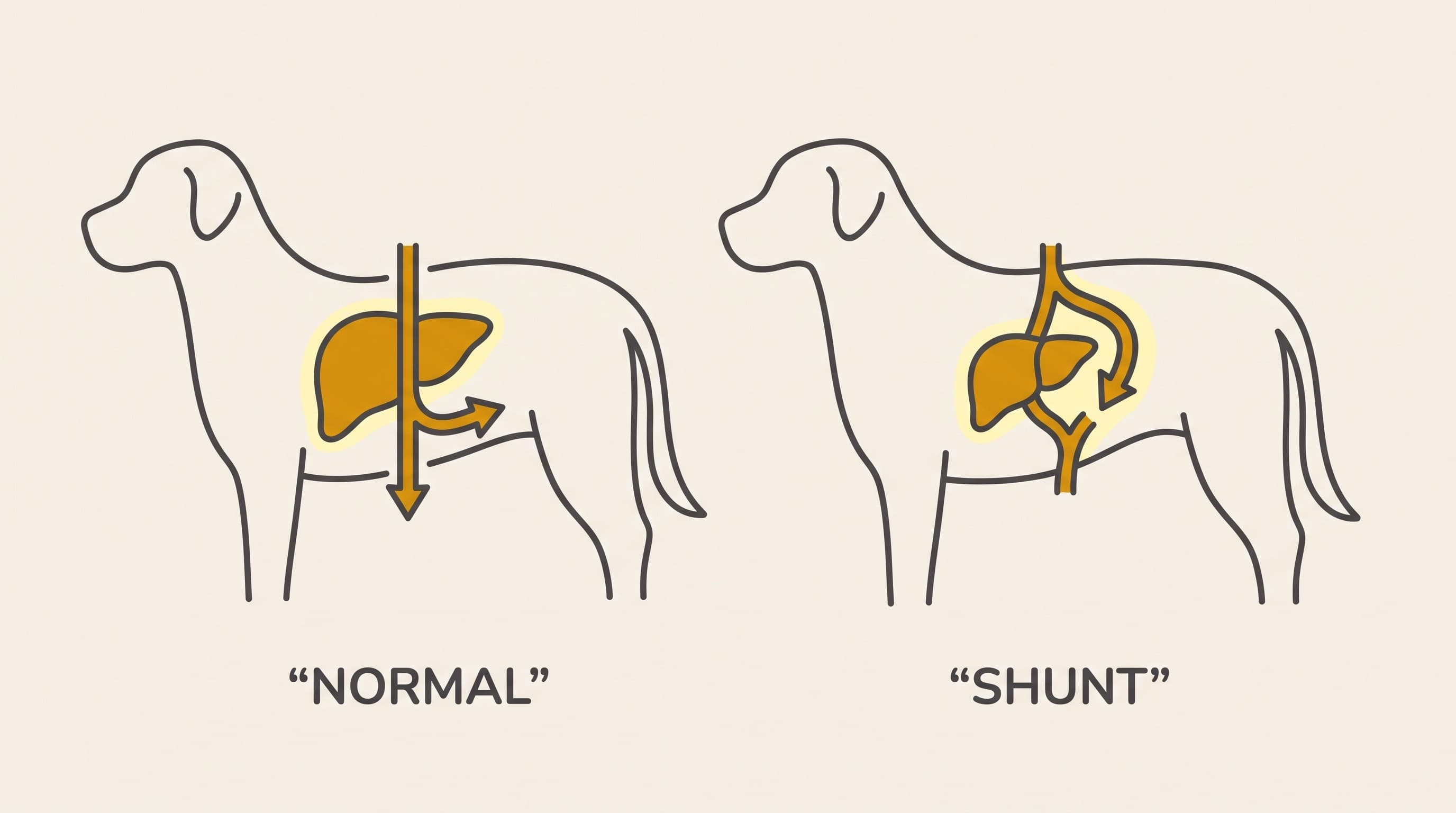
The medical name is a portosystemic shunt, or PSS. In a normal dog, blood coming from the gut is rich in nutrients but also carries waste products, including ammonia, and it is meant to travel through the liver first so the liver can filter and process it before it reaches the rest of the body. A shunt is an abnormal blood vessel that lets that blood take a shortcut, bypassing the liver almost entirely. The gut blood pours straight into the general circulation without being cleaned up.
Two things follow from that. First, the toxins that should have been filtered out, ammonia chief among them, build up and reach the brain, which is why so many of the signs are neurological and why they are often worse after a protein-rich meal (there is a whole piece on this, hepatic encephalopathy, and it is worth reading alongside this one). Second, the liver itself is partly starved of the blood flow it needs to grow and mature, so it often stays small and underdeveloped.
Shunts come in two broad flavours. Congenital shunts are the ones a dog is born with, and they are what most owners of young dogs are dealing with. They are usually a single abnormal vessel, and they are more common in certain breeds. Acquired shunts are different: they are multiple small vessels that the body opens up in response to high pressure in the portal system, usually because of advanced liver disease, and they tend to affect older dogs. The distinction matters enormously, because it largely dictates whether surgery is even on the table.
There is one more distinction your referral team will use, and it is worth knowing the words. A single congenital shunt can sit outside the liver (extrahepatic), which is more common in small breeds, or run inside the liver (intrahepatic), which is more common in large breeds and is harder to reach surgically. When you hear these terms at the appointment, they are not jargon for its own sake; they are the details that shape whether surgery is straightforward, difficult, or not advisable.
How a shunt is usually found
Most owners arrive at this diagnosis by one of a few routes, and understanding how your dog got here helps the rest make sense. Sometimes it is the neurological signs, the vacant episodes after meals, that prompt investigation. Sometimes it is a puppy who simply is not thriving, staying small and struggling to gain condition. And sometimes it is a chance blood result, a low urea or a low albumin, or a slow recovery from a routine anaesthetic, that makes a vet look harder.
The test that usually seals it is the bile acids stimulation test, which measures how well the liver is doing its filtering job by comparing a fasted blood sample with one taken after a small meal. In a shunt dog, that post-meal value is typically very high, because the meal's blood is bypassing the liver rather than being cleaned. There is a dedicated piece on this test and what the numbers mean, and it is worth reading if a bile acids test is where your journey started. From there, imaging (ultrasound, and often a CT scan at the referral centre) maps the exact vessel, which is what the surgeon needs before deciding whether and how to operate.
The decision, framed honestly
Here is the thing to hold on to. For the right dog, a shunt is one of the few liver problems where surgery offers the possibility of a functional cure rather than lifelong management. That is genuinely hopeful, and it is why so many vets will push you towards a referral opinion. But "the right dog" is doing a lot of work in that sentence, and surgery is not suitable, safe, or affordable for every dog.
So the real choice is between two honest routes:
- Surgical attenuation, which means gradually closing the abnormal vessel so blood is redirected back through the liver. Done in a suitable case, this offers the best long-term outcomes and, for some dogs, an essentially normal life afterwards.
- Medical management, which means controlling the effects of the shunt with medication and diet for the rest of the dog's life. This is control, not cure, but for some dogs it is the right and reasonable choice.
One point applies almost universally, whichever way you eventually go: most dogs are stabilised medically first, usually for around four to six weeks, before any surgery. This is not your vet stalling. A dog whose brain is being poisoned by ammonia is a much riskier anaesthetic and surgical candidate than one who has been settled down first, so the medication and diet are used to get your dog into the best possible shape before an operation, not merely as an alternative to it.
The case for surgery
For a young dog with a single congenital shunt outside the liver (an extrahepatic shunt), surgical attenuation at a referral centre generally offers the best long-term outcomes. The aim is to close the vessel so that the liver, freed to receive proper blood flow, can grow and take over its normal job. In the best cases, a dog who needed medication and a careful diet can end up needing neither.
It is major surgery, and it should be described to you as such. The vessel usually cannot simply be tied off all at once, because the small, underdeveloped liver cannot cope with the sudden return of full blood flow, so surgeons often use devices that close the shunt gradually over weeks. There are real risks around and after the operation, including a specific and important one, post-attenuation seizures, which we cover in the piece on life after shunt surgery. A good referral surgeon will talk you through the specific risks for your dog rather than quoting you generic numbers, and you should expect honesty about them.
Intrahepatic shunts, which sit deep inside the liver and are more common in larger breeds, are technically harder and carry higher risk. For these, and for dogs where surgery is not suitable for other reasons, the balance can tip the other way.
The case for medical management
Medical management is not the consolation prize, even though it can feel that way when you are told surgery offers a possible cure. It is the right answer in several situations: when surgery is not affordable, when a dog is not a good surgical or anaesthetic candidate, when the shunt anatomy makes surgery too risky, and for most dogs with acquired shunts, where the underlying liver disease means closing vessels is not the answer at all.
Medical management rests on a few pillars, all vet-directed:
- Lactulose, a syrup that changes conditions in the gut so that less ammonia is absorbed into the blood.
- Antibiotics, used to reduce the gut bacteria that produce ammonia.
- A protein-moderated diet, and this is a point worth underlining: protein is moderated, not eliminated. A protein-free diet is not safer. Dogs need protein to maintain muscle and health, and starving a shunt dog of protein does harm; the goal is the right amount of the right, highly digestible protein, chosen with your vet, not zero protein.
Some dogs are well controlled on this regime for a long time. Others are not, and the honest framing is that medical management asks you to stay vigilant for the rest of your dog's life, watch for the signs of encephalopathy creeping back, and keep up the recheck bloods and the diet. It is a real commitment, just a different one from surgery.
It is also worth being honest that medical management and surgery are not always a clean either/or. As mentioned, most dogs headed for surgery are managed medically first, so you will get a real feel for what daily management involves before you ever commit to an operation. Some owners find their dog settles so well on medication that they choose to continue it; others use those weeks to save, to arrange referral, and to prepare for surgery. There is no rule that says you must decide everything on day one, and using the stabilisation period to think is entirely reasonable.
The money and the insurance trap
This is the part that blindsides people, so let us be blunt about it early. In the UK, surgical correction of a shunt at a referral centre is a substantial cost, indicatively in the region of £3,800 to £4,500. Treat that as a ballpark, not a quote: the real figure depends on the centre, the imaging needed beforehand, the shunt type, and any complications. Ask for a written estimate.
And here is the trap. Congenital conditions are commonly excluded by UK pet insurance, and a shunt your dog was born with is congenital. Many owners assume their policy will cover this and discover otherwise at the worst possible moment. Before you make any decision, phone your insurer and ask, in writing, whether a congenital portosystemic shunt is covered under your specific policy. It is far better to know now, while you still have choices, than to find out after the fact. If cover is excluded, that does not close off surgery, but it does mean the cost falls to you, and that is a legitimate and important part of the decision, not something to feel guilty about weighing.
Before you decide: the questions to ask
You do not have to make this decision in the consult room, and you should not feel rushed into it. Once your dog is stable, you usually have a little time to think and to get a referral opinion. When you see the referral surgeon or internal medicine specialist, these are worth asking:
- Is my dog's shunt congenital or acquired, and single or multiple?
- Is it inside or outside the liver, and what does that mean for surgery?
- For my specific dog, what are the realistic surgical outcomes and the specific risks, including post-attenuation seizures?
- If we manage medically instead, what does day-to-day life look like, and how will we know if it stops working?
- What will each route cost, in writing, including the follow-up bloods and rechecks?
Where this leaves you
There is no single right answer here, and any vet who gives you one without knowing your dog's anatomy, age, and your circumstances is overselling. What there is, is a clear-eyed choice: a major operation that may give a young dog a normal life, or a lifelong management plan that keeps many dogs comfortable and well. Both are legitimate. Both keep your dog at the centre.
Two safety points to carry with you whichever you choose. First, hepatic encephalopathy is an emergency: a shunt dog who becomes stuporous, starts seizuring, presses their head against the wall, or collapses needs a vet immediately, not a medication tweak at home. Second, never withhold protein entirely in an attempt to help; protein is moderated on veterinary advice, and rescue medications and diet changes are always vet-directed.
The best next step is to understand the signs that tell you the shunt is affecting your dog's brain, so you can recognise trouble early and act. Read the piece on hepatic encephalopathy next, and if you are leaning towards or have committed to surgery, the piece on what recovery really looks like will tell you the honest version of the weeks afterwards.
References
- Webster CRL, et al. ACVIM consensus statement on the diagnosis and treatment of chronic hepatitis in dogs. *J Vet Intern Med* 2019;33(3):1173–1200.
Keep track of how your pet is doing
The owners who cope best are the ones who notice changes early. A simple health log shows you what is working, and what is not, before the next vet visit.
Start tracking, freeYou're not doing this alone
Compare treatment journeys and talk to owners managing liver & gallbladder. Free to join.
Join PetsLikeMine