

Has My Dog Done Its Cruciate? Signs and Symptoms
Alastair Greenway
BVM&S MRCVS
A cruciate problem usually arrives one of two ways. Sometimes it's sudden: the dog jumps off the sofa or skids on the kitchen floor chasing a ball and comes up holding a back leg in the air. Sometimes there's no single moment at all, just a limp that drifts in and out for weeks, worse first thing, gone by the afternoon, back by bedtime. Both patterns send owners looking for answers late in the evening, often with the dog asleep beside them, searching "dog limping back leg" when the vet is shut.
Two things are worth saying straight away. The first is that the thing you're most likely dealing with is common and very treatable, so you can let some of the worry go. The second is that reading the signs well turns a frightening guess into a clear, useful first vet visit. I'll be honest about what these signs do and don't tell us. A back leg limp can come from the hip, the hock, a torn nail, the lower back, a strained muscle or simple arthritis, and only your vet, with hands on the joint, can say for certain. What I can do is show you the particular pattern that makes us reach for the word cruciate.
Cranial cruciate ligament disease, to give it its full name, is one of the most common causes of hindlimb lameness in dogs (American College of Veterinary Surgeons, n.d.; Comerford et al., 2011). The cranial cruciate ligament, or CCL, is the band inside the knee, the stifle, that stops the shin bone sliding forward when your dog bears weight. It's the rough equivalent of the ACL people tear playing football. When it fails, the knee becomes unstable, and that instability is what you're seeing as a limp. The reassuring part is that this is well-trodden ground for vets: it's one of the conditions we see most, the outcomes are generally good, and there's a clear path forward.
The classic signs
The textbook presentation is sudden. The dog is fine one minute, then after a jump, a slip or a twist they're holding the leg up, toe-touching, or putting only the lightest weight through it (American College of Veterinary Surgeons, n.d.). That dramatic onset is exactly why owners blame the moment, convinced the sofa or the ball did the damage. I'll come back to why that's only half the story.
But the cruciate has a quieter face too, and this one trips a lot of people up. Instead of a sudden non-weight-bearing lameness, you get a limp of variable severity that comes and goes. Often it's worse after rest, so the dog is stiffest getting up from a long sleep and looser once they've warmed up, only for it to creep back later (American College of Veterinary Surgeons, n.d.). That rhythm of better with a bit of movement, worse again afterwards is very characteristic. Alongside it you might notice a reluctance to load the knee: hesitating at the bottom of the stairs, thinking twice before jumping into the car boot, or simply being less keen to play (American College of Veterinary Surgeons, n.d.).
A couple of slower changes tell us this has been brewing rather than just happened. One is muscle wasting: over a few weeks of favouring the leg, the thigh on the affected side gets visibly thinner than the good side (American College of Veterinary Surgeons, n.d.). The other, in longer-standing cases, is a firm swelling you can sometimes feel on the inside of the knee, called a medial buttress, which is the joint's response to chronic instability (American College of Veterinary Surgeons, n.d.). And one point that's easy to miss: a dog doesn't have to yelp to be in pain. A limp that simply persists is itself a sign that the leg hurts, even from a stoical dog who never makes a sound (American College of Veterinary Surgeons, n.d.).
None of these on its own proves a cruciate problem. But the more you can tick off, the more the picture leans that way.
Watch how your dog sits
There's one tell you can genuinely check at home, and it's a nice one because it's so simple. Watch how your dog sits.
A dog with a comfortable knee folds the leg neatly underneath, sitting square. A dog with a sore cruciate often can't do that, because bending the knee fully is uncomfortable, so they sit with the bad leg kicked out to the side instead of tucked under them (Howard and Kieves, 2018). Vets call this a positive sit test, and it's one of the small things we look for in an exam (American College of Veterinary Surgeons, n.d.; Howard and Kieves, 2018).
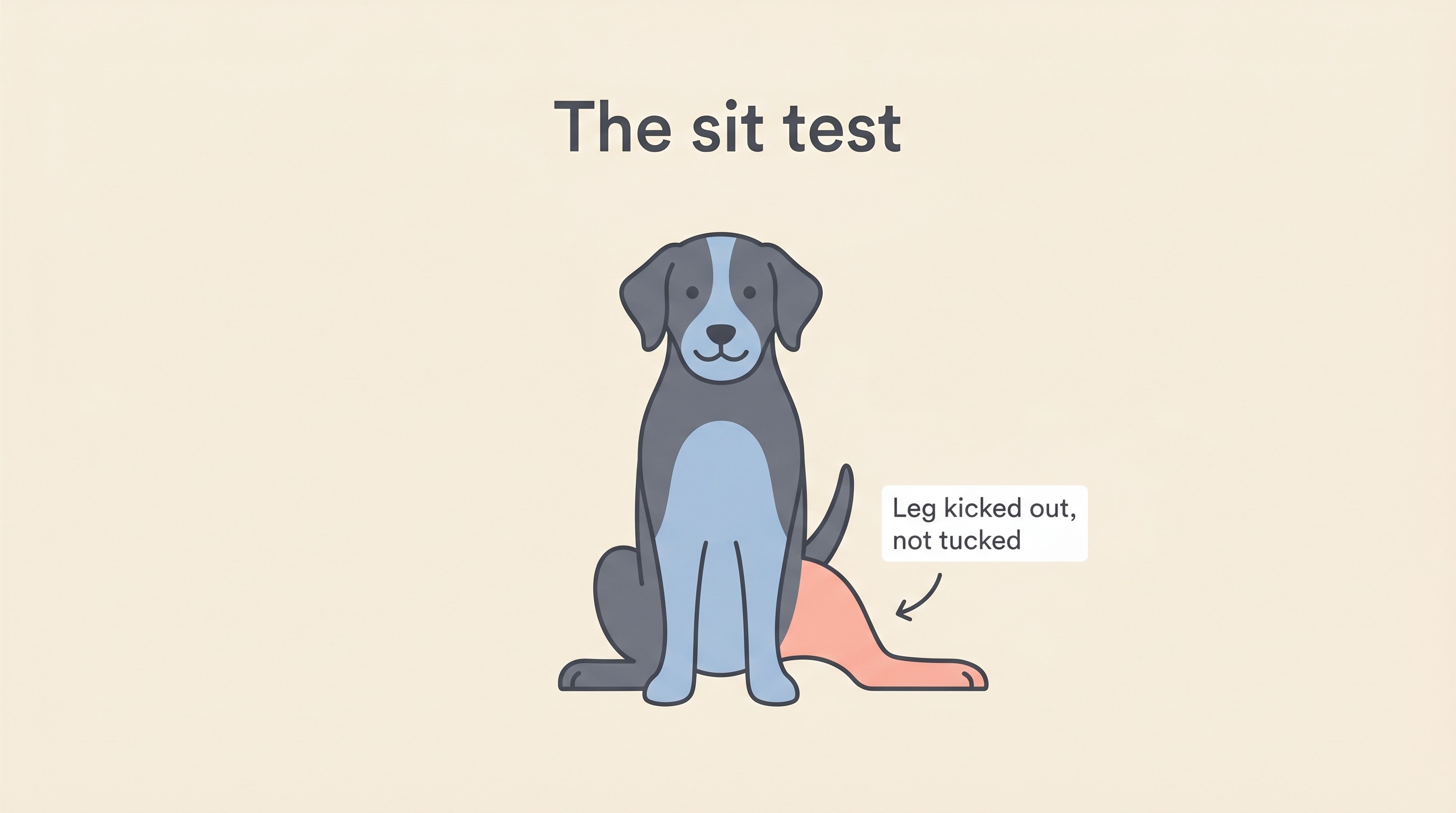
As with every sign here, this is a useful clue rather than a diagnosis. Plenty of perfectly sound dogs sit a bit sloppily, and the occasional cruciate case sits normally. So treat it as one more piece of the puzzle, something concrete to mention to your vet, rather than proof either way.
Sudden vs gradual
So which is it: the dramatic ball-chasing rupture, or the grumbling on-off limp? This is the part that catches most owners out, and it matters more than anything else on this page. They aren't two different problems. They're the same disease wearing two faces.
In dogs, the cruciate usually doesn't snap like a healthy rope pulled too hard. It frays. The ligament degenerates slowly, over months or even years, weakening from the inside until it's barely holding, often with almost no outward sign for much of that time (Comerford et al., 2011; Niebauer and Restucci, 2023). The grumbling, intermittent limp is often the noise of a ligament that's partly torn but not yet given way (Niebauer and Restucci, 2023). And the sudden, dramatic rupture is usually the last few fibres letting go on a ligament already most of the way gone. The jump off the sofa didn't cause it. It revealed it.
This way of seeing it does real work for you. It lifts a lot of the guilt, because the ball or the leap from the bed wasn't the villain. And it explains the on-off limp: a partly-torn ligament gives a partly-unstable knee that hurts on some movements and not others. The sobering news is that partial tears usually go on to complete rupture as the underlying degeneration continues, so a grumbling cruciate isn't likely to quietly heal itself (Niebauer and Restucci, 2023). The timing varies a lot from dog to dog, but it's why I'd never tell you to just wait and see.
I won't unpack the full degeneration story here, because it deserves its own space: the companion piece on why it's degeneration, not an injury explains the slow fraying and lifts the blame properly. And if you're chasing that frustrating intermittent limp specifically, the guide to partial cruciate tears is written for exactly that awkward early stage.
What to do now
If the picture I've described rings true, here's what genuinely helps between now and the vet.
The single most useful thing is to take the load off that knee. An unstable joint gets aggravated every time the shin bone slides forward under weight, so the less twisting and impact you allow, the better. In practice that means strict rest: lead-only to the garden for short toilet breaks, then back inside. No free running, no stairs if you can help it, no jumping on or off furniture or in and out of the car. Lift smaller dogs; block off the sofa for bigger ones. The instinct to walk it off is kind but wrong here, because exercising an unstable knee tends to make things worse.
This isn't a treatment plan, to be clear, just sensible first aid while you get a professional opinion. It mirrors the basics that sit underneath conservative management, where rest, weight control and pain relief are combined under veterinary guidance (Wucherer et al., 2013). But please don't reach for human painkillers from the cupboard: many are toxic to dogs, and masking the pain only encourages them to use a leg they should be resting. Pain relief is a conversation for your vet, who can choose something safe.
The other thing worth knowing, lightly, for planning rather than worry: in dogs that do their cruciate in one knee, a substantial proportion go on to have the same trouble in the other knee at some future point, because the same degenerative process is usually quietly under way on both sides (American College of Veterinary Surgeons, n.d.). I mention it only so you're not blindsided later. It's not a reason to panic, and there's plenty you can do to look after both knees. We cover the bilateral risk and spotting early signs in the other knee properly elsewhere, so you don't need to carry it today.
One quick aside, since people ask: this really is a dog condition. Cats do occasionally rupture a cruciate, but it's uncommon and usually follows a genuine accident rather than the slow degeneration we see in dogs. If you've got a limping cat, the same rest-and-see-your-vet advice applies, but the story behind it is usually different.
Where this goes next
If several of these signs fit your dog, the next step is straightforward: book a vet appointment, and keep your dog rested and lead-only until then. You don't need to diagnose this yourself. The valuable thing you've done by reading this is to be able to walk in and say "it came on suddenly after a jump," or "it's an on-off limp that's worse after rest, and she sits with that leg kicked out." That history makes your vet's job easier and your dog's path faster.
Once it's confirmed, there's a clear and well-worn road from here, with treatment options that work and a strong chance of getting your dog comfortably back on their feet. For what that first visit involves, the hands-on tests and what sedation and X-rays add, read how cruciate disease is diagnosed. And for the whole arc in one place, the complete guide maps out the journey. You're at the start of something manageable, not the edge of a cliff.
References
- American College of Veterinary Surgeons. (n.d.). Cranial Cruciate Ligament Disease. Retrieved from
- Comerford, E. J., Smith, K., and Hayashi, K. (2011). Update on the aetiopathogenesis of canine cranial cruciate ligament disease. Veterinary and Comparative Orthopaedics and Traumatology, 24(2), 91-98.
- Howard, J., and Kieves, N. R. (2018). Top 5 Signs to Watch for During an Orthopedic Examination. Clinician's Brief. Retrieved from
- Niebauer, G. W., and Restucci, B. (2023). Etiopathogenesis of Canine Cruciate Ligament Disease: A Scoping Review. Animals (Basel), 13(2), 187.
- Wucherer, K. L., Conzemius, M. G., Evans, R., and Wilke, V. L. (2013). Short-term and long-term outcomes for overweight dogs with cranial cruciate ligament rupture treated surgically or nonsurgically. Journal of the American Veterinary Medical Association, 242(10), 1364-1372.
Sister tool · Sightline
Track whether treatment is working
Sightline, a separate ConciergeVet tool, runs a short weekly check-in built on validated pain and mobility instruments, turns it into a single Sightline Score you can watch trend over weeks rather than judge on one bad day, and produces a report you can bring to your vet.
A written log, or our printable trackers, does much the same job.
See how Sightline tracks treatmentKeep track of how your pet is doing
The owners who cope best are the ones who notice changes early. A simple health log shows you what is working, and what is not, before the next vet visit.
Start tracking, freeYou're not doing this alone
Compare treatment journeys and talk to owners managing cruciate ligament disease. Free to join.
Join PetsLikeMine