


Questions to Ask Your Ophthalmologist About Cataract Surgery
Alastair Greenway
BVM&S MRCVS
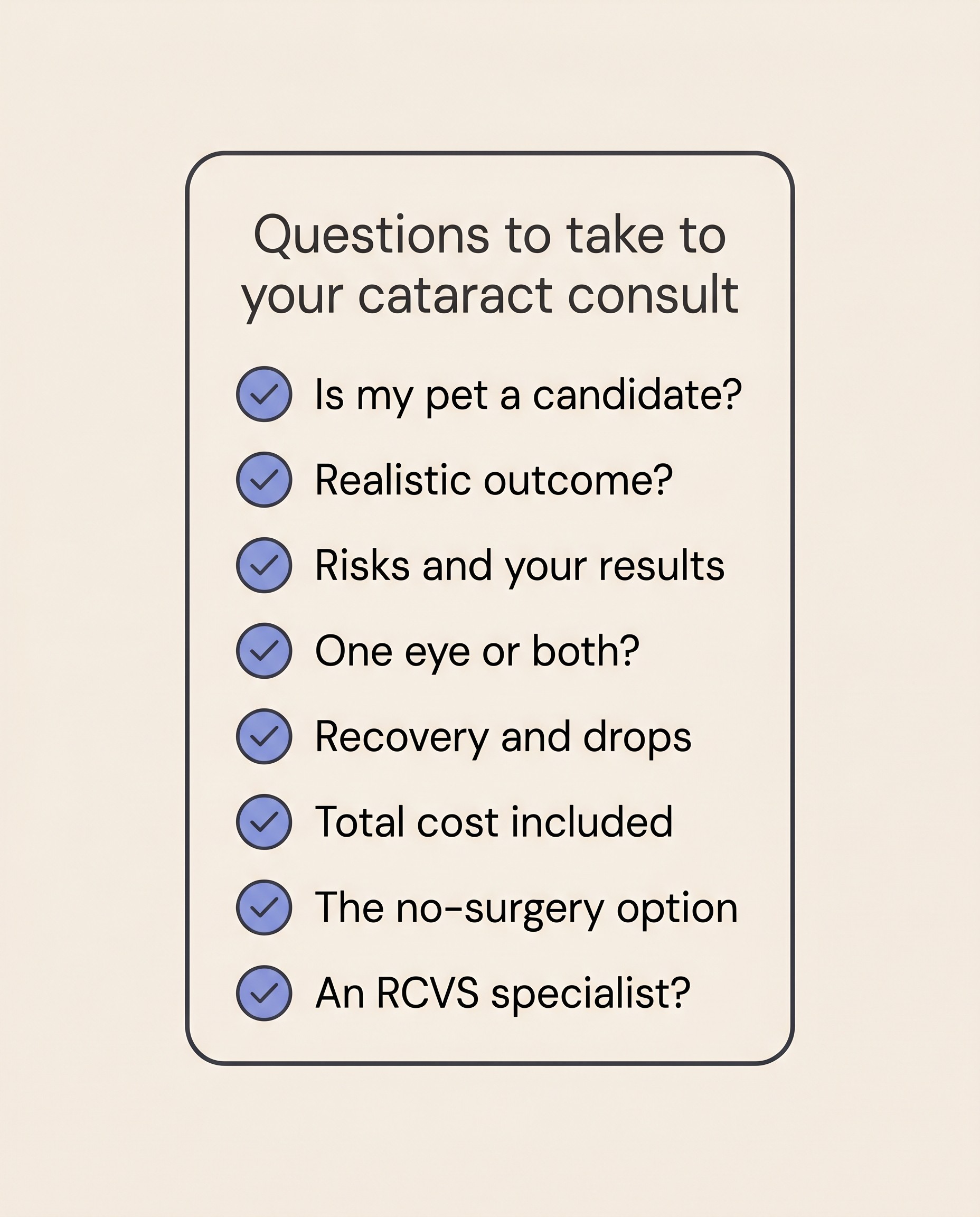
A cataract consult is a big appointment, and it costs real money. Over the years I've sent a lot of owners to these consults, and the ones who get the most out of them are the ones who arrive prepared: questions written down, someone alongside to take notes, and no willingness to be rushed. Nobody retains a consult's worth of detail while they're anxious about their pet, so the written list is doing real work, not just keeping you tidy. The most common regret I hear is the question that only surfaced in the car park afterwards.
This piece isn't about whether to operate. If you're still weighing that up, the two-sided version of that decision lives in should we operate? the cataract surgery decision, and I'd start there. This article assumes you've decided to at least explore surgery and you're heading to a specialist. Its job is to turn that into a calm, usable set of questions to ask in the room, grouped so you understand why each one matters.
"Is my pet a candidate, and is the retina healthy?"
If you ask only one thing, ask this one. A cataract is a cloudy lens, and that cloudiness blocks the surgeon's view of the back of the eye, so they can't simply look in and tell you the retina is sound. They have to test it. Two tests are worth asking about by name. An electroretinogram (ERG) confirms the retina still responds to light, and an ocular ultrasound confirms it isn't detached and the eye is structurally healthy (Cornell Riney, n.d.; MSPCA-Angell, n.d.). The reason this matters so much is blunt: if the retina isn't healthy, your pet will stay blind even after a technically perfect operation (Cornell Riney, n.d.).
The classic trap is progressive retinal atrophy, an inherited degeneration that can hide behind a cataract, and removing a cataract is not recommended when there's PRA, because vision won't improve and may get worse (ACVO, n.d.). You don't need to become an expert in it, since the disease is covered in progressive retinal atrophy, but you do want to hear how the specialist will check the retina before anyone operates. The full reasoning on who makes a good candidate sits in the decision piece.
Asking what success means for this one eye
It's easy to fixate on the headline figure, and it's a good one: around 90 to 95% of eyes regain useful vision in the immediate period after surgery, with the best results on cataracts treated sooner rather than later (MSPCA-Angell, n.d.). Cornell puts it a little more conservatively, at 80 to 90% for ideal candidates, and makes the same point that the sooner it's done the better (Cornell Riney, n.d.). Either way, a headline rate is an average across many eyes. The genuinely useful question is what it means for your pet's eye, given its maturity, any inflammation, and what the ERG and ultrasound showed, so ask the specialist to translate the number for the animal in front of them.
It's also fair to ask how that success holds up over time, because the early figure isn't the lifelong one. In the largest long-term follow-up, the chance of an eye going blind or being lost stayed under one in ten until after the three-year mark, then crept up beyond it (Sigle & Nasisse, 2006). That shouldn't put you off. It just means you're asking about the real arc rather than the brochure version, and it's why a good centre will want to see the eye for life. The full outcome discussion is owned by the decision piece.
"What are the risks, and what are _your_ complication rates?"
Every operation carries risk, and you want the recognised ones named. The most serious complications are post-operative glaucoma and retinal detachment (the latter uncommon, around 1 to 2%), while the commonest are clouding of the lens capsule behind the implant (posterior capsular opacification, much of it mild) and inflammation inside the eye (Sigle & Nasisse, 2006; MSPCA-Angell, n.d.). A reasonable owner-level anchor is that roughly one in ten eyes runs into a significant complication over time (Sigle & Nasisse, 2006; RVC, n.d.).
Here's the part the other pages can't give you. It is entirely reasonable to ask the specialist about their own, and their centre's, complication and success rates, not just the textbook figures, and to ask how a complication would be handled if one arose. This isn't interrogating anyone or trying to catch them out. A good surgeon expects the question and answers it happily. The week-by-week watch for these complications afterwards belongs to what cataract surgery and recovery involve.
One eye, or both?
This is a fair and common question, and genuinely one to ask rather than something I can answer for you from here. There's no single right default in the veterinary literature, and good centres weigh it case by case: which eye sees worse, the state of each retina, the anaesthetic load, and the cost of doing two. Just know that operating on both eyes scales the cost, which brings us neatly to the money.
What recovery and the drop schedule actually involve
Ask this one out loud, because the after-care is real work and a legitimate part of the decision. Recovery means several eye drops several times a day (Cornell quotes four to six times daily in the early going), tapering over weeks, a hard Elizabethan collar worn for a stretch, rest and no rough play, a recheck the day after surgery and then a run of follow-ups, and often at least one drop and routine checks for life (Cornell Riney, n.d.).
So the practical questions are: how many drops, for how long, and who can help if you work full time? A heavy schedule is far more manageable when it's organised, which is what the Eye-Drop & IOP regimen tracker is for. The detailed how-to is owned by the recovery piece, so here, just get the shape of the commitment.
"What's the total cost, and what's included?"
Ask for the all-in figure, not just the surgery line. In the UK, cataract surgery is a referral-centre procedure costing roughly £3,500 to £5,000 per eye, a practical estimate that varies by centre, with both eyes, the pre-operative ERG and ultrasound and the specialist consultation all adding to it (Paragon Referrals, n.d.). Many centres bundle the consult, imaging, anaesthetic, surgery, a night or two of hospitalisation and a post-op check into a package, so ask exactly what your number covers.
The questions that save nasty surprises: is this a fixed price or an estimate, what's included, what happens to the cost if there's a complication, and how does insurance work? Plenty of centres need full payment on admission for uninsured clients (Paragon Referrals, n.d.), so it's far better to learn that now than on the morning of surgery. The fuller cost breakdown sits in the decision piece.
What happens if we don't operate?
This is a sensible, important question, not a sign of giving up. Choosing not to operate is a reasonable, kind choice for many pets, and the evidence backs that: in one study, overall complication rates were not significantly different between owner-elected non-surgical eyes (20.8%) and operated eyes (18.3%) (Krishnan et al., 2020). The counterpoint to weigh is that the eye won't regain sight without surgery, and an untreated cataract still needs watching for the painful complications it can cause (Krishnan et al., 2020; Cornell Riney, n.d.).
And pets adapt remarkably well to fading sight, especially when it comes on gradually. The day-to-day of living with a cataract you don't operate on is its own guide, and the operate-or-not reasoning lives in the decision piece.
"Are you a recognised eye specialist, and how often do you do this?"
This is the question most owners never think to ask, and it's the one I'd most want you to. Cataract surgery is specialist work that needs dedicated equipment and training. In the UK it's done by an RCVS Recognised Specialist in Veterinary Ophthalmology, who is usually a Diplomate of the European College of Veterinary Ophthalmologists (DipECVO), and you can verify a specialist yourself on the RCVS "Find a Vet" register before you even go (RCVS Find a Vet, n.d.; Davies Veterinary Specialists, n.d.).
What does that recognition actually involve? In plain terms, a long apprenticeship and a hard exam: a veterinary degree, a year or so in general practice, then a residency of three or more years dedicated to ophthalmology, finishing with a tough multi-part specialist examination, after which they may lawfully call themselves a veterinary specialist (ACVO Certification, n.d.; that certifying body describes the US route, but the UK and European path through the ECVO Diploma is the same idea of a long residency capped by a hard exam). Given all that, it's entirely fair to ask how often a surgeon performs this operation and what their outcomes are. The good ones are proud to tell you, and if anything you ask is met with impatience rather than an answer, that in itself is useful information.
A second opinion is reasonable too, for a decision of this size and cost. No good specialist is offended by one, and the referral pathway makes it straightforward, so if the first consult leaves you uncertain, asking to see someone else is your right, not a discourtesy.
A note for diabetic dogs, and for cats
If your dog is diabetic, the case for moving quickly is strongest of all. Most diabetic dogs develop cataracts, around 80% within the first year or so of diagnosis, whatever the glucose control, and they form fast and can trigger painful inflammation inside the eye (Beam et al., 1999; Cornell quotes 75 to 80% within the first year; Cornell Riney, n.d.). So the question to ask is "if my dog is diabetic, how soon should we act, and how stable does the diabetes need to be for surgery?" The eye angle is covered in diabetic cataracts, and the glucose-control side belongs to the Diabetes space.
If you have a cat, your question-list looks different from a dog owner's. Cataracts are uncommon in cats and usually secondary to chronic inflammation inside the eye (uveitis), so your first questions are "what is causing this cataract, and does the cause need treating first?", and surgery is reserved for selected cases. The feline picture is its own guide: cataracts in cats.

Walking in prepared
To make this easy to carry into the room, we've put these questions onto a printable sheet: the cataract surgery questions checklist. Tick them off as you go, jot the specialist's answers next to each, and don't be shy about asking something twice. Even in human cataract clinics, a calmer, more structured consult tends to leave patients more satisfied with it, which fits what I see in the room: the prepared owner walks out steadier than the one who improvised.
And if, sitting in that room, you find you're not actually sure you want to go ahead at all, that's allowed too. Step back to the decision piece and take your time. This is your pet and a significant decision, a good specialist genuinely welcomes every one of these questions, and there are no silly ones to ask about your pet's sight.
References
- ACVO (American College of Veterinary Ophthalmologists). PRA (Progressive Retinal Atrophy), owner information (cataract as the most common secondary complication of PRA; cataract removal not typically recommended in PRA). ACVO Public.
- ACVO (American College of Veterinary Ophthalmologists). Certification. ACVO Public.
- Beam, S., Correa, M. T., & Davidson, M. G. (1999). A retrospective-cohort study on the development of cataracts in dogs with diabetes mellitus: 200 cases. Veterinary Ophthalmology, 2(3), 169–172.
- Cornell University College of Veterinary Medicine, Riney Canine Health Center. Canine cataracts.
- Davies Veterinary Specialists. Veterinary Ophthalmology.
- Krishnan, H., Hetzel, S., McLellan, G. J., & Bentley, E. (2020). Comparison of outcomes in cataractous eyes of dogs undergoing phacoemulsification versus eyes not undergoing surgery. Veterinary Ophthalmology, 23(2), 286–291.
- MSPCA-Angell (Angell Animal Medical Center). Lifting the Veil: Canine Cataracts & Cataract Surgery.
- Paragon Veterinary Referrals. Fixed Pricing: Ophthalmology.
- RCVS (Royal College of Veterinary Surgeons). Find a Vet: Specialists (Ophthalmology).
- RVC (The Royal Veterinary College). Canine cataract surgery (Small Animal Vet fact file).
- Sigle, K. J., & Nasisse, M. P. (2006). Long-term complications after phacoemulsification for cataract removal in dogs: 172 cases (1995–2002). Journal of the American Veterinary Medical Association, 228(1), 74–79.
Keep track of how your pet is doing
The owners who cope best are the ones who notice changes early. A simple health log shows you what is working, and what is not, before the next vet visit.
Start tracking, freeYou're not doing this alone
Compare treatment journeys and talk to owners managing vision & eye health. Free to join.
Join PetsLikeMine