

The extraction phone call: why teeth come out
Alastair Greenway
BVM&S MRCVS
Your phone rings, and it's the practice. Your heart lifts for a second, because you've been waiting all morning, and then the vet says the sentence you weren't ready for. "She's doing really well under the anaesthetic. But now I can see properly, she's going to need some teeth out. Six, possibly seven." There's a pause while you try to take that in, and in that pause a whole flood of things arrives at once. Six? She only went in for a clean. Is she going to be all right? How did it get this bad without me noticing? Should I have brushed more? Did I do this to her?
If that's the call you've just had, or the one you're bracing for, let me put the most important thing first, before any of the clinical detail. This is good news wearing a frightening costume. Your vet has found the source of a problem and is about to fix it. The teeth coming out are the teeth that were hurting her, or were about to. You have not failed her, and neither has your vet. Let me walk you through why this phone call happens, why it so often lands mid-procedure, and why taking teeth out is one of the kindest things we do.
Why you're only hearing this now, halfway through
The thing that makes this call so unsettling is the timing. You booked what you thought was a scale and polish, you handed her over, and now, an hour later, the plan has changed. It can feel like a bait and switch. It isn't, and understanding why explains almost everything about this phone call.
Before today, your vet could only ever see part of your pet's mouth. A conscious dog or cat will let you lift a lip for a few seconds, and no more. You cannot probe around each tooth, you cannot see the surfaces at the very back, and above all you cannot see below the gumline, which is exactly where the disease that matters actually lives. The crown of a tooth, the bit you and I can see, can look almost fine while the root and the bone around it are in trouble.
The only way to see the whole picture is with your pet asleep, with dental x-rays and a fine probe checking each tooth in turn. That assessment can only happen under the anaesthetic. So the moment your vet phones you is, quite literally, the first moment anyone has been able to see what's really going on. The grade she was given in the consult room was an educated estimate from the outside. Now your vet is looking at the truth of it, often on an x-ray screen, and the plan is catching up with the facts. (If your pet was given a number at her check-up and you want to understand it, we explain the 0 to 4 dental grades here, including why the grade can rise once the x-rays are in.)
None of that means anyone misled you. It means the mouth held its secrets right up until the point where we could finally look properly. That is normal, it is not a sign anything went wrong, and it is the whole reason the x-rays and the anaesthetic are worth it.
Why a tooth actually has to come out
Vets do not take teeth out lightly, and we don't do it to save time or hit a target. We take a tooth out when leaving it in would mean leaving pain, infection, or both, in your pet's mouth. Here are the reasons that sentence on the phone tends to come from.
Advanced periodontal (gum) disease. This is the big one, and the commonest reason in dogs. Periodontal disease isn't really about the tooth itself, it's about the attachment holding the tooth in, the gum, the ligament and the jawbone around the root. As it progresses, that attachment is destroyed and bone is lost. Once a tooth has lost enough of its support, or the pocket around it is too deep to heal, the tooth cannot be saved, and holding onto it just holds onto a painful, infected socket (WSAVA, 2020). Sometimes the disease has eaten right through into the nasal cavity, creating an opening called an oronasal fistula, and the only way to close that is to remove the tooth and stitch the gum over it (WSAVA, 2020).
A fractured or dead tooth. Dogs especially break teeth, usually on something too hard: an antler, a bone, a stone, a cage bar. When a fracture opens up the inside of the tooth, the sensitive pulp is exposed, and that tooth is painful and, in effect, an open door for infection down to the root. A fractured tooth with an exposed pulp is always considered painful and infected, whether or not your pet has shown it. The choices are specialist root canal treatment or extraction, and for most pets and most owners, extraction is the sensible, definitive answer.
Tooth resorption, especially in cats. This one deserves its own moment, and I'll come to cats properly below. In short, the tooth dissolves itself from the inside, it can't be filled or repaired, and it is genuinely painful. Extraction is the treatment (FelineVMA, 2025).
Severe inflammation (feline chronic gingivostomatitis). Some cats develop a fierce, painful, immune-driven inflammation of the whole mouth. Counter-intuitive as it sounds, the most effective treatment is removing most or all of the teeth, because the mouth is over-reacting to the teeth themselves (FelineVMA, 2025). There's much more in our piece on feline stomatitis.
A baby tooth that never left, or a badly crowded mouth. Retained deciduous (milk) teeth that sit alongside the adult tooth trap plaque and cause problems, and are best removed. Crowded little mouths, common in small and flat-faced breeds, can force the same decision.
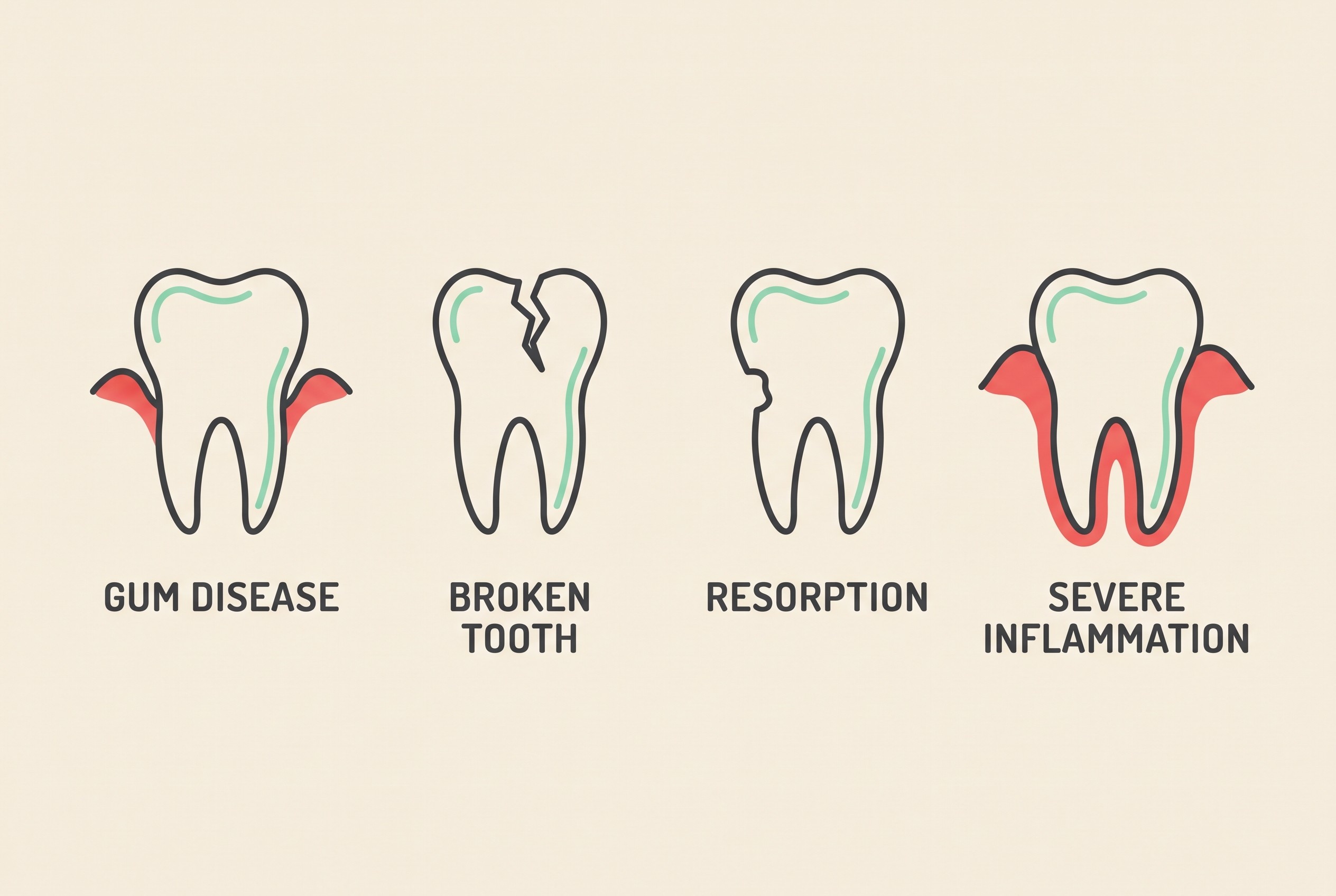
The thread running through all of these is the same. A tooth comes out because it has stopped being an asset and become a liability, a source of pain your pet has almost certainly been hiding. Which brings me to the guilt.
It is not your fault, and I mean that
Almost every owner on the other end of this call says some version of the same thing. I should have brushed her teeth. I should have brought her in sooner. I can't believe I let it get this bad.
So let me be straight with you. Pets are extraordinarily good at hiding oral pain, cats above all, because in the wild an animal that looks weak becomes a target. A pet with a genuinely sore mouth will very often keep eating, keep greeting you, keep seeming like themselves, because the drive to carry on is stronger than the urge to stop. "She's still eating" is the single most misleading reassurance in this whole area, and it fools devoted owners every day. It fools vets too, which is exactly why we look under anaesthetic rather than trusting the view from across the room. (If you want to understand the quiet signs, we've written about how pets hide mouth pain here.)
And some of this was never in your gift to prevent. Tooth resorption in cats, for instance, has no known cause and no known prevention. Cats whose owners brush every single night still develop it. A fractured tooth can happen in a heartbeat on the wrong chew. Periodontal disease has a strong genetic and breed component. You could have done everything by the book and still be standing in your kitchen holding this phone call.
What you actually did was bring her in and say yes to a proper look. That's the thing that's about to fix it. Please don't spend the afternoon punishing yourself for the very problem you're in the middle of solving.
Cats, resorption, and the tooth that looks fine
I want to slow down on cats, because the feline version of this call is often the most confusing, and it carries a specific reassurance you need.
In cats, one of the commonest reasons for extraction is tooth resorption, and it's baffling precisely because the tooth can look normal to the naked eye. What's happening is that the body's own cells are dissolving the tooth from within, usually starting at the root below the gum, which is why it so often only shows up on the x-ray taken while she's asleep. There is no filling for it. You cannot patch a tooth that is dismantling itself, and there is no way to reverse it or stop it once it has begun (FelineVMA, 2025). Leaving a resorbing tooth in place simply leaves the pain in place. Removing it, or in certain x-ray-confirmed cases removing just the crown, is what ends the ache.
The reason this matters on the phone is that "but she was eating fine, and the tooth looked normal to me" is completely true and completely beside the point. It was never something you could have seen or brushed away. If your vet has mentioned resorption, our full guide to feline tooth resorption walks through the types, why it happens, and why extraction is the kindness rather than a defeat.
Why taking a tooth out is a kindness, not a loss
Here's the reframe I most want you to carry, because it's the opposite of how it feels in the moment. It's natural to hear "six teeth out" and picture a diminished, struggling pet who can no longer eat. That is not what happens.
Dogs and cats do not use their teeth the way we do. They don't sit and chew thoughtfully; they tend to grab, crush and swallow, and much of what they eat, kibble included, barely gets chewed at all. A pet missing several teeth, or even most of them, manages food perfectly well once the gums have healed. What they lose is not the ability to eat. What they lose is the pain.
And that's the part owners consistently tell us they didn't expect. Again and again, people ring or come back a fortnight later and say some version of "she's like a puppy again", or "he's started playing with toys he's ignored for years", or "she's stopped hiding". They'd put the slowing down and the grumpiness and the withdrawal down to age, when really it was a mouthful of chronic pain they couldn't see. Take that away and the pet you remember often comes back. Removing a diseased, painful tooth doesn't take something from your pet. It gives them back the comfort the tooth had quietly stolen.
So the extraction isn't the sad ending to this story. It's the good bit. It's the moment the hurting stops.
Saying yes on the phone
Practically, this call is usually asking for your consent to go ahead now, while she's already safely under, rather than waking her up and booking a second anaesthetic to do it another day. There are good reasons to say yes then and there: one anaesthetic instead of two, no weeks of untreated pain in between, and it's very often the most cost-effective route as well.
You're allowed to ask questions, and you should. Fair ones to ask your vet on the phone are: which teeth, and why each one? Are there any you're going to try to save? Will she have stitches, and will she be on pain relief afterwards? Is there anything you're not sure about that we should discuss before you go ahead? A good vet will happily answer all of that, because informed consent given calmly is worth far more than a panicked yes.
Trust matters here too. The person on the phone is looking at your pet's x-rays and probing depths in real time, has your pet's welfare in front of them, and does not benefit from taking out a tooth that could safely stay. When a vet recommends extraction, it's because leaving the tooth would mean leaving pain.
Then, once you've said yes, the next thing on your mind will be the recovery: will she be sore, and will she be able to eat tonight. The honest and reassuring answer is that most pets are more comfortable within days, not worse, and we've set out exactly what to expect in eating after extractions. For now, she's asleep, she's monitored, and the thing that was hurting her is about to be gone. That's not the phone call you feared. That's the one that fixes it.
References
- World Small Animal Veterinary Association (WSAVA). Global Dental Guidelines. WSAVA, 2020.
- Feline Veterinary Medical Association (FelineVMA). 2025 FelineVMA feline oral health and dental care guidelines. Journal of Feline Medicine and Surgery, 2025.
- American Veterinary Dental College (AVDC). Tooth Resorption and dental nomenclature. AVDC Nomenclature.
Free downloads
Companion worksheets to put what you've read into practice. Free PDFs, print at home.
Keep track of how your pet is doing
The owners who cope best are the ones who notice changes early. A simple health log shows you what is working, and what is not, before the next vet visit.
Start tracking, freeYou're not doing this alone
Compare treatment journeys and talk to owners managing teeth & mouth. Free to join.
Join PetsLikeMine