


Feline chronic gingivostomatitis (stomatitis): when the whole mouth is inflamed
Alastair Greenway
BVM&S MRCVS
She's sitting by her bowl again, staring at the food she wants and can't face. Maybe she runs at it, takes one mouthful, then cries out and backs away. Maybe she's pawing at her cheek, or drooling ropes of saliva, or turning her head away when you reach for her. If you've managed to look inside her mouth, what you saw probably frightened you: the tissue at the back and along the gums an angry, raw red, so inflamed it looks almost proliferative, like the mouth itself has swollen up.
If your vet has just said the word "stomatitis", and then followed it with something that sounded impossible, that the kindest treatment is to take most or all of her teeth out, you are almost certainly reeling. Take a breath. This is one of the most painful conditions we see in cats, and watching it is genuinely distressing. It is also one we understand well, and there is a clear, well-trodden path back to a comfortable cat. You have not failed her, and you are not out of options. Let's go through what's actually happening, and why the treatment that sounds so drastic is the one that works.
What FCGS actually is
Feline chronic gingivostomatitis, usually shortened to FCGS, is not just a bad case of the gum disease every cat can get. It's a severe, persistent inflammation that spreads well beyond the gumline into the softer tissue of the mouth, often reaching right to the back where the upper and lower jaws meet (the area vets call the caudal mouth). You get erythema (redness), ulceration, and sometimes tissue that becomes so inflamed it looks raised and cauliflower-like (FelineVMA, 2025). It is, in plain terms, a mouth that is inflamed almost everywhere at once, and it hurts constantly.
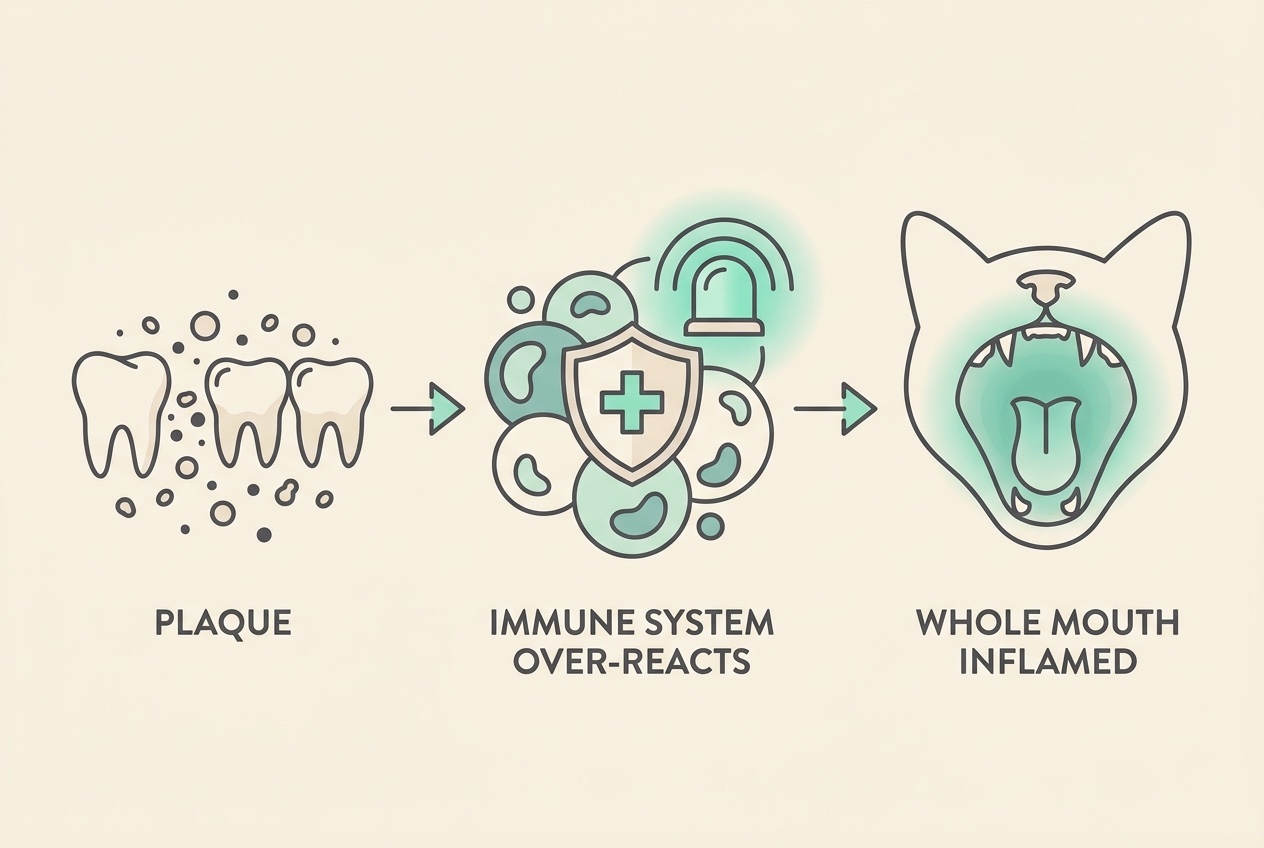
The important thing to understand is what's driving it. Ordinary gum disease is your cat's mouth reacting reasonably to plaque and infection. FCGS is the immune system reacting unreasonably, an over-the-top, self-perpetuating inflammatory response that keeps burning long after it should have settled (Soltero-Rivera et al., 2023). Affected cats show signs of an immune system stuck in the "on" position, with activated inflammatory cells that keep being re-triggered rather than calming down. That's why this is so often described as immune-mediated. Her body has, in effect, declared war on the surfaces inside her own mouth.
Why the whole mouth, and why her?
The honest answer is that FCGS is multifactorial, which is the polite scientific way of saying no single cause explains it, and it's almost never just one thing (FelineVMA, 2025). What we do know is that the immune system appears to be over-reacting to antigens, the flags that mark a surface as "foreign", coming from several sources at once: the plaque bacteria coating the teeth, and in many cats the tooth surfaces themselves, plus a contribution from viruses.
Feline calicivirus (FCV) is the microbe most consistently linked to FCGS. In one study it was found in 21 of 23 affected cats and in none of the healthy controls (Soltero-Rivera et al., 2023). That's a striking association, though it's worth being straight with you: carrying the virus doesn't seem to predict how bad the disease will be or how well treatment works, so FCV looks like part of the story rather than the whole of it. Other factors stack the odds too. Cats from multi-cat households are markedly more likely to develop FCGS than only-cats, which points to viral and immune pressure in busy homes (Soltero-Rivera et al., 2023). And cats carrying feline leukaemia virus (FeLV) respond less well to treatment, which is one reason your vet will want to test.
None of this is because of anything you did or didn't do. You didn't cause this by feeding the wrong food or missing a brushing session. FCGS is a dysfunctional immune response, not a hygiene failure, and it develops in cats from spotless homes with attentive owners all the time.
How the vet works out that it's FCGS
Much of the diagnosis is made by looking. The pattern of FCGS, inflammation that is bilateral (both sides), spreads beyond the gums, and often lights up the caudal mouth at the back, is fairly characteristic, and an experienced vet will recognise it quickly. But a careful work-up matters, because a few other things can masquerade as it, and because what's found changes the plan.
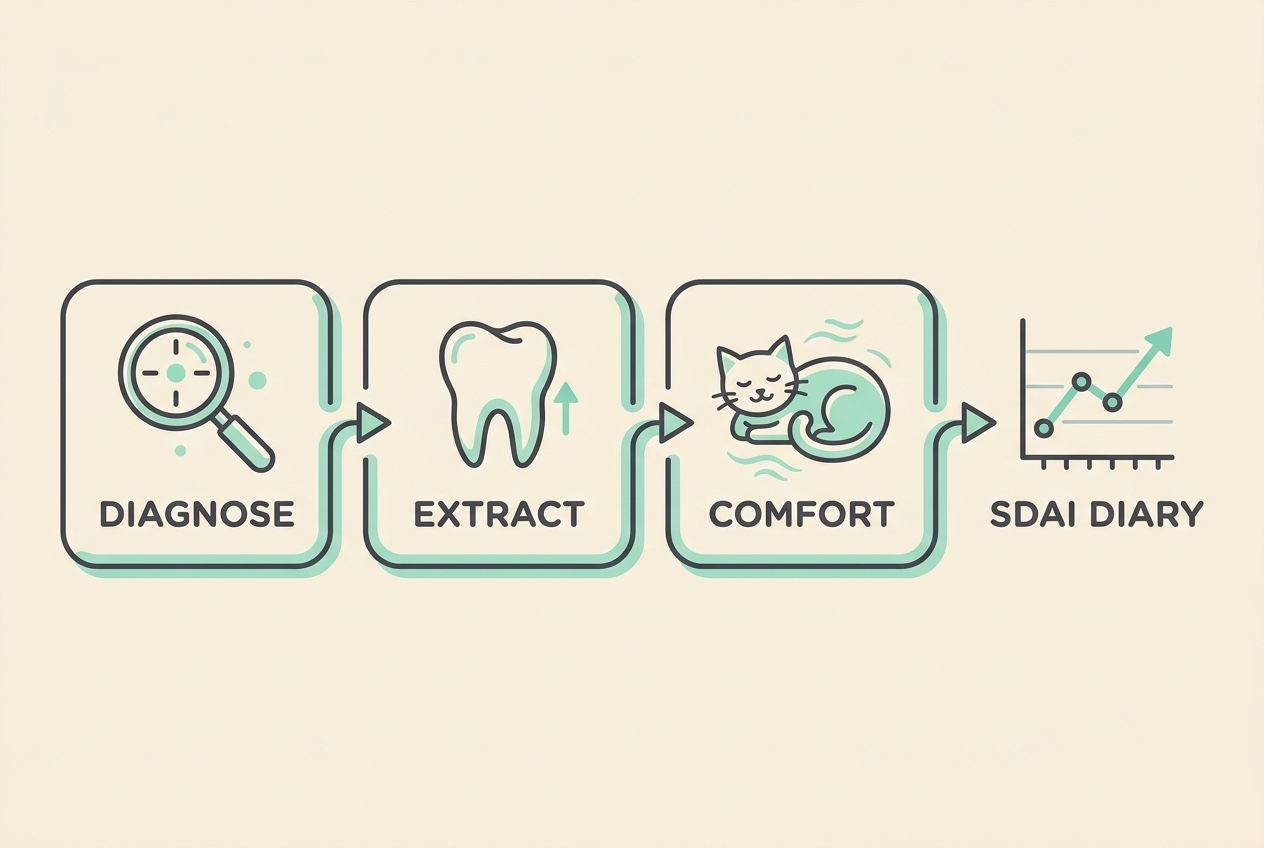
Expect your vet to want blood tests for FIV and FeLV, because those retroviruses carry real prognostic weight (FelineVMA, 2025). Where a lesion looks unusual, one-sided, or mass-like rather than the typical symmetrical inflammation, a biopsy may be recommended to rule out other conditions, including oral cancer, which can occasionally sit alongside or mimic FCGS. A full assessment of the mouth, with dental x-rays under anaesthetic, is part of the picture too, because it shows which teeth are diseased and helps plan the surgery. This isn't the vet being over-cautious or running up a bill. It's making sure the thing being treated is really what everyone thinks it is.
Why the treatment is to take the teeth out
Here is the part that stops owners in their tracks, so let's meet it directly. The first-line, evidence-based treatment for FCGS is extraction: either every tooth (full-mouth extraction), or every tooth behind the canines, meaning all the premolars and molars (partial-mouth extraction). Which one depends on how far forward the inflammation reaches around the canines and incisors (FelineVMA, 2025). The two approaches give broadly similar results, so your vet will tailor the choice to your cat's mouth (Soltero-Rivera et al., 2023).
I know how that sounds. It sounds like giving up, or like mutilation, and every instinct says a mouth with no teeth must be worse than a mouth with sore ones. But think back to what's actually driving the disease: an immune system over-reacting to the plaque-covered tooth surfaces. Take those surfaces away, and you remove the thing the immune system is reacting to. It isn't destroying her mouth. It's removing the fuel from the fire.
And the results are genuinely good. In a study of 95 cats, 28% had complete resolution of their stomatitis after extraction and a further 39% were substantially improved, so roughly two in three did well (Jennings et al., 2015). An earlier study reported even better numbers, with around 80% of cats cured or significantly improved (Hennet, 1997). Across the literature, full-mouth or near-full-mouth extraction has consistently given the best long-term outcomes of anything tried (Winer et al., 2016). There is no medication that comes close to matching it.
The reassurance owners most need, and rarely believe until they see it, is this: cats live extremely well without teeth. They still eat, and they eat happily, including dry food if they prefer it, because a cat's teeth are built for catching and tearing rather than chewing, and their tongue and gums manage the rest. What you'll usually notice within weeks of the surgery healing is a cat who is brighter, more relaxed, grooming again, and interested in food in a way she hasn't been for months. Extraction isn't the sad end of the story. For most cats it's the thing that gives them their comfort back.
The cats who need more than surgery
I won't pretend extraction is a guaranteed switch that flips every cat back to normal, because that wouldn't be fair to you. Two honest caveats belong here.
First, healing takes time, and many cats need medical support along the way. Most cats who go on to do well still need pain relief and sometimes anti-inflammatory or antibiotic medication for a while after the first couple of weeks, a finite stretch rather than forever, as the mouth settles (Soltero-Rivera et al., 2023). That's normal, not a sign it hasn't worked.
Second, there's a minority for whom extraction alone doesn't fully control the disease. Very roughly one in ten cats remain genuinely refractory, meaning the inflammation persists despite surgery, and these cats need ongoing, sometimes lifelong, medical management (Soltero-Rivera et al., 2023). That management is usually immune-modulating therapy under closer or specialist supervision. Ciclosporin, a drug that dampens the immune over-reaction, helped around three-quarters of refractory cats improve in one controlled trial, and is a mainstay for this group (Soltero-Rivera et al., 2023). Interferon and, at referral centres, stem-cell therapy are other options being used and studied.
One line I want to be firm about, because it comes up constantly. Steroids on their own are not a solution to FCGS. They can mask the pain for a while and feel like they're helping, but on their own they produce a real, lasting improvement in only about a quarter of cats, and long-term steroid use in cats carries its own serious costs, including a meaningful risk of triggering diabetes (Soltero-Rivera et al., 2023). Leaning on steroids year after year instead of treating the mouth properly tends to leave a cat still in pain and now managing a second illness as well. They have a place, in the right cat, alongside proper treatment and with a vet watching closely. They are not a way to avoid the real fix.
Seeing whether she's actually getting better: the SDAI
One of the hardest things about a mouth condition is that you can't easily see inside, and a cat in pain hides it by instinct. So how do you know if she's improving, or slipping? This is where the Stomatitis Disease Activity Index, or SDAI, comes in.
The SDAI, devised by the veterinary dentist Jamie Anderson, is a scoring system with two halves that fit together (Soltero-Rivera et al., 2023). One half is the vet's, a structured look at the redness, ulceration and proliferation in the mouth at each visit. The other half is yours, and it matters just as much: you score how your cat is doing at home, rating things like her appetite, her activity, her grooming, and her apparent oral comfort, each on a simple scale (Soltero-Rivera et al., 2023). Those are exactly the everyday signs that shift first when a cat feels better or worse, and you see them in a way no ten-minute consult ever can.
Tracking these numbers over time turns a vague, anxious "I think she seems a bit brighter?" into something you and your vet can actually read. It shows a flare before it becomes a crisis, and it shows real progress on the days when your cat still isn't quite herself and you're losing faith. Our SDAI diary tool is built around exactly this, so you can log the home scores between visits and bring a clear picture to each check-up.
About the "cures" you'll see online
If your cat has FCGS, you will end up in a Facebook group, and someone will tell you an unlicensed product bought online cured their cat. I understand completely why that's tempting when you're exhausted and your cat is in pain. Please be careful. The products that get passed around these communities are not licensed for this, haven't been through the trials that would show they work, and can carry real risks of their own. There is a separate piece here that walks through the specific ones and what the evidence actually says, and it's worth reading before you spend money or delay treatment that would genuinely help. Hope is not the problem. Being sold false hope while a treatable cat stays in pain is.
If your cat has stopped eating altogether, don't wait to work through any of this. A cat that isn't eating can become seriously unwell quickly, and that's a same-day call to your vet, not a watch-and-see. The path through FCGS is well-mapped, and it starts with getting her comfortable enough to eat again.
References
- Hennet, P. (1997). Chronic gingivo-stomatitis in cats: long-term follow-up of 30 cases treated by dental extractions. Journal of Veterinary Dentistry, 14(1), 15-21.
- Jennings, M. W., Lewis, J. R., Soltero-Rivera, M. M., Brown, D. C., & Reiter, A. M. (2015). Effect of tooth extraction on stomatitis in cats: 95 cases (2000-2013). Journal of the American Veterinary Medical Association, 246(6), 654-660.
- Winer, J. N., Arzi, B., & Verstraete, F. J. M. (2016). Therapeutic management of feline chronic gingivostomatitis: a systematic review of the literature. Frontiers in Veterinary Science, 3, 54.
- Soltero-Rivera, M., Goldschmidt, S., & Arzi, B. (2023). Feline chronic gingivostomatitis: current concepts in clinical management. Journal of Feline Medicine and Surgery, 25(9).
- FelineVMA (Lobprise, H., St Denis, K., Anderson, J. G., Hoyer, N., Fiani, N., & Yaroslav, J.) (2025). 2025 FelineVMA feline oral health and dental care guidelines. Journal of Feline Medicine and Surgery.
- Anderson, J. G. (Stomatitis Disease Activity Index, SDAI).
Keep track of how your pet is doing
The owners who cope best are the ones who notice changes early. A simple health log shows you what is working, and what is not, before the next vet visit.
Start tracking, freeYou're not doing this alone
Compare treatment journeys and talk to owners managing teeth & mouth. Free to join.
Join PetsLikeMine