

Dental disease grades explained: what grade 2, 3 and 4 mean
Alastair Greenway
BVM&S MRCVS
You were probably standing in the consult room when it happened. The vet had a look in your dog's or cat's mouth, said something like "she's a grade 3", handed you a leaflet about a dental, and moved on to the next thing. You nodded. It sounded serious, or maybe it didn't, and you got in the car not really sure whether a grade 3 was a mild telling-off or a five-alarm fire. Then you got home and typed it into a search bar, which is very possibly how you ended up here.
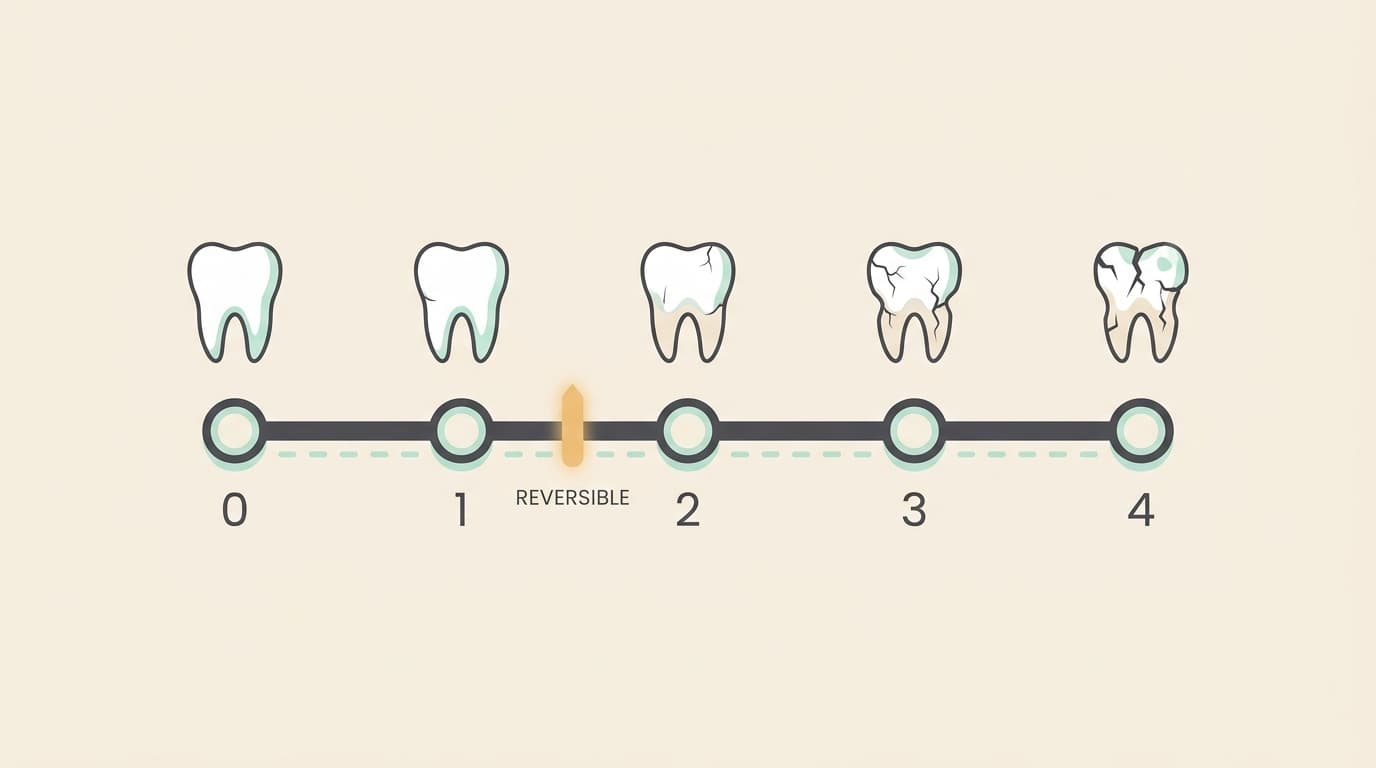
So let's fix that. The 0 to 4 dental grade is one of the most useful numbers your vet will ever give you, and one of the least explained. By the end of this you'll know exactly what your pet's grade means, what's still fixable and what isn't, and roughly what you'll be booking. No jargon, no scare tactics, just the map you should have been handed in the room.
Why you got a number at all
Vets grade periodontal disease on a scale of 0 to 4 to describe how far it has advanced and to plan what needs doing. It's shorthand. "Grade 3" tells another vet, a nurse, or your future self far more than "her teeth look a bit manky" ever could, and it's the same system used across the profession, set out in the WSAVA Global Dental Guidelines and the AAHA Dental Care Guidelines (WSAVA, 2020; AAHA, 2019).
Here's the first thing worth knowing: the grade is not really about how dirty the teeth look. Brown tartar (calculus) on the crown is what catches your eye, but it's the visible tip of the problem, not the problem itself. What the grade actually measures is periodontal disease, the disease of the gum, ligament and bone that anchor each tooth in place. A tooth can be caked in tartar and still be a low grade, or look deceptively clean and be a high one. The grade is trying to capture what's happening below the gumline, where it matters.
The one line that changes everything: reversible versus not
Before we walk the ladder, there's a single dividing line that does more work than any of the numbers, and it's the thing most owners are never told.
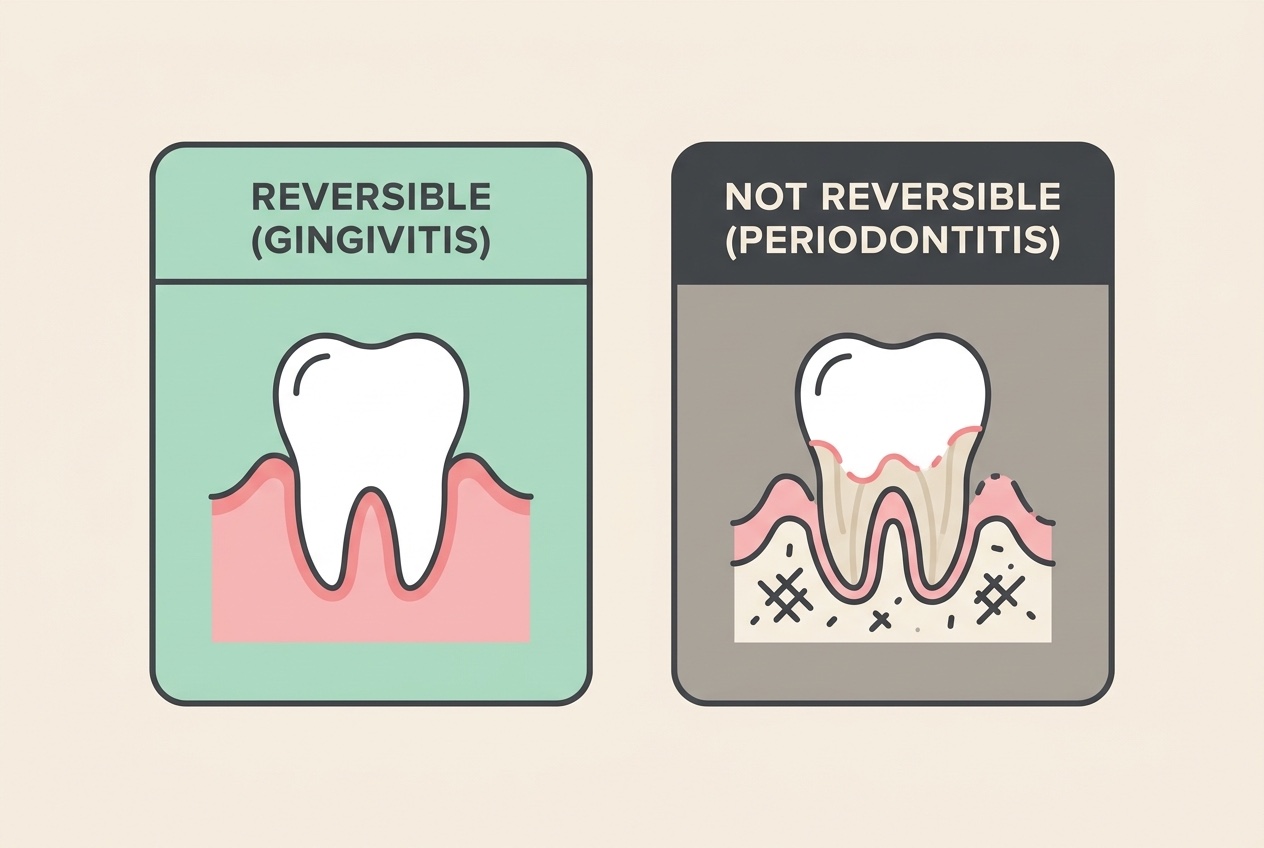
The early stage is gingivitis: inflammation of the gum only, with no lasting damage to the deeper structures. Gingivitis is genuinely reversible. Clean the plaque and bacteria off, keep on top of it at home, and the gum settles back down to healthy pink (WSAVA, 2020; AAHA, 2019).
Once the disease crosses into periodontitis, the picture changes. Now the body's inflammatory response, driven by the bacteria in the plaque, has begun to destroy the attachment holding the tooth in: first the ligament, then the bone. That lost attachment does not grow back on its own. It can be stopped, and the mouth can be made comfortable and healthy again, but the bone that's already gone is gone (WSAVA, 2020).
That's the line the whole scale hinges on. Grades 0 and 1 sit on the reversible side. Grade 2 and above sit on the other. It isn't a reason to panic if your pet is past it, most pets we treat are, but it is the reason "let's keep an eye on it" stops being good enough once you're into periodontitis. Waiting only means more attachment lost.
Grade 0 and grade 1: the hopeful end
Grade 0 is a clinically normal mouth: healthy gums, no inflammation, nothing that needs treating beyond keeping it that way (AAHA, 2019). Honestly, few adult pets are a true grade 0, which tells you how ordinary this disease is rather than how neglectful anyone has been.
Grade 1 is gingivitis only. You might see a thin red line where the gum meets the tooth, maybe a little plaque, perhaps the start of some smell. Crucially, there is no attachment loss yet: the gum is cross, but the foundations are intact (AAHA, 2019). This is the stage where home care earns its keep. A professional clean to reset things, then regular brushing, and a grade 1 mouth can go back to healthy. If your pet is here, you've caught it at the best possible moment.
Grade 2: the act-now grade
Grade 2 is early periodontitis, defined as up to 25% attachment loss around the affected teeth (AAHA, 2019). This is the tipping point. The gum has stopped being merely inflamed and the disease has started, quietly, to eat into the tooth's support.
It usually doesn't look dramatic. Your pet is very likely eating normally and giving you no obvious sign anything is wrong, which is exactly why grade 2 gets ignored. But this is the grade where acting promptly pays off the most. You can't reverse the small amount of attachment already lost, and you absolutely can stop it here, before it becomes the deeper, more painful, extraction-heavy disease of the higher grades. Think of grade 2 as the mouth putting its hand up early. Treating it now is the difference between a straightforward dental and a much bigger one later.
Grade 3: moderate periodontitis
Grade 3 is moderate periodontitis, with 25% to 50% of the attachment around affected teeth lost (AAHA, 2019). By now there are deeper pockets forming between gum and tooth where bacteria thrive, some gum recession, and often one or two teeth starting to loosen. Some teeth at this stage can be saved with proper cleaning below the gumline and good aftercare, and some will need to come out. Which is which depends on each individual tooth, and your vet can only really tell once your pet is asleep and they can probe and x-ray properly.
The goal has shifted a little by grade 3. At the low grades it's about prevention. Here it's about clearing infection and removing the sources of pain, so your pet has a clean, comfortable mouth to carry on with. That's an achievable and very worthwhile aim.
Grade 4: advanced, not "too far gone"
Grade 4 is advanced periodontitis, with more than 50% attachment loss (AAHA, 2019). This is the stage that sounds frightening, and it does need treating properly, so let's be straight about it. There is significant bone loss, teeth are often mobile, roots may be exposed, and several teeth are usually beyond saving and will need to come out.
Here's the part nobody tells the worried owner reading this at 11pm: grade 4 is not a death sentence for your pet, and it is not "too far gone". These are the mouths that do the most spectacularly well after treatment. Removing diseased, painful, wobbly teeth doesn't leave a pet worse off, it takes away a source of chronic pain and infection they'd been quietly living with. Owners are routinely startled by how much brighter, hungrier and more playful their pet is a couple of weeks after a big grade 4 dental. Pets manage very comfortably with fewer teeth, or even none. A comfortable mouth beats a mouthful of painful teeth every time.
Why the grade in the room is a starting estimate
Now for the honest catch, and it's an important one. The grade your vet gave you across the consulting table is their best estimate from a quick look at an awake, wriggling animal. It is not the final word, and it may change.
The reason is simple: most of the disease that determines the true grade is below the gumline, and you cannot see it from the outside. To grade a mouth properly, a vet needs to probe around each tooth and take full-mouth x-rays, and both of those require a general anaesthetic because no conscious dog or cat will hold still for it (WSAVA, 2020; AAHA, 2019).
This matters because the visible exam consistently underestimates what's really going on. In the classic studies of this, dental x-rays of teeth that looked normal on the surface still turned up clinically important disease in around 28% of dogs and around 42% of cats (Verstraete et al., 1998). Roughly speaking, the x-rays reveal a meaningful chunk more disease than the naked eye can. So it is entirely normal, and not a bait-and-switch, if your pet was called a grade 2 in the room and comes back a grade 3 once the team have seen below the gumline. The grade going up on the day means they found the disease that was always there, not that anything went wrong. It's worth knowing this can happen before you drop them off, so the update doesn't feel like a betrayal. (For more on this, see our piece on why dental x-rays matter.)
The other side of the same coin: a "scale and polish" that skips the x-rays cannot properly grade the mouth either, and can leave hidden disease behind. The grade and the x-rays go together.
Cats: the same scale, plus a problem it doesn't capture
Cats are graded on this same 0 to 4 periodontal scale, and it applies to them just as it does to dogs. But cats deserve their own paragraph here, because the grade alone can miss something important in a cat's mouth.
Alongside periodontal disease, cats are very prone to tooth resorption, a painful condition in which the tooth is destroyed from the inside out. It's a different disease from periodontitis, and the periodontal grade doesn't describe it. Worse, it frequently hides below the gumline where a conscious look won't find it, which is a large part of why so much feline disease only shows up on x-ray (Verstraete et al., 1998; FelineVMA, 2025). So if your cat has been given a dental grade, take it as the floor rather than the ceiling: the full picture, including any resorption, comes from the x-rays under anaesthetic. If your cat has been dropping food, chattering her jaw or flinching when she eats, that's worth flagging, and our article on feline tooth resorption goes into it properly.
What your grade actually means you'll be booking
To pull it together, here's the rough translation from number to plan. Every mouth is individual, so treat this as orientation, not a quote.
- Grade 0 to 1: prevention mode. A professional clean if there's gingivitis to reset, then home care, chiefly brushing, to hold the line. This is the reversible end.
- Grade 2: a dental now, to stop early periodontitis before it deepens. Acting here is the single best-value thing you can do for the mouth.
- Grade 3 to 4: a full dental under anaesthetic with x-rays, cleaning below the gumline, and very likely some extractions of teeth that are past saving. The aim is a clean, pain-free mouth, and it's very achievable.
Whatever number you were given, the reassuring truth runs through all of it: dental disease, even at grade 4, is one of the most treatable and rewarding things we fix. The worst outcome isn't a high grade. It's a high grade left alone.
If you've got the grade but not yet the plan, the natural next step is to read what actually happens during a dental, so the day itself holds no surprises. And if the number that worried you was a high one on an older pet, know that age by itself is not a reason to leave a painful mouth untreated. That's its own conversation, and one worth having with your vet rather than making the decision for them.
References
- American Animal Hospital Association (AAHA). 2019 AAHA Dental Care Guidelines for Dogs and Cats. Periodontal disease staging (PD0 to PD4) and reversibility of gingivitis.
- Bellows J, Berg ML, Dennis S, et al. 2019 AAHA Dental Care Guidelines for Dogs and Cats. Journal of the American Animal Hospital Association. 2019;55(2):49-69.
- Niemiec B, Gawor J, Nemec A, et al. World Small Animal Veterinary Association (WSAVA) Global Dental Guidelines. 2020. Staging, reversibility of gingivitis versus periodontitis, and the need for radiography and probing under general anaesthesia.
- Verstraete FJM, Kass PH, Terpak CH. Diagnostic value of full-mouth radiography in cats. American Journal of Veterinary Research. 1998;59(6):692-695. (Companion dog study: same issue, 686-691.) Clinically important radiographic findings in teeth without clinical lesions: approximately 42% of cats, approximately 28% of dogs.
- Feline Veterinary Medical Association (FelineVMA, formerly AAFP). Feline Oral Health and Dental Care Guidelines. 2025. Feline tooth resorption and the role of radiography in cats.
Free downloads
Companion worksheets to put what you've read into practice. Free PDFs, print at home.
Keep track of how your pet is doing
The owners who cope best are the ones who notice changes early. A simple health log shows you what is working, and what is not, before the next vet visit.
Start tracking, freeYou're not doing this alone
Compare treatment journeys and talk to owners managing teeth & mouth. Free to join.
Join PetsLikeMine