

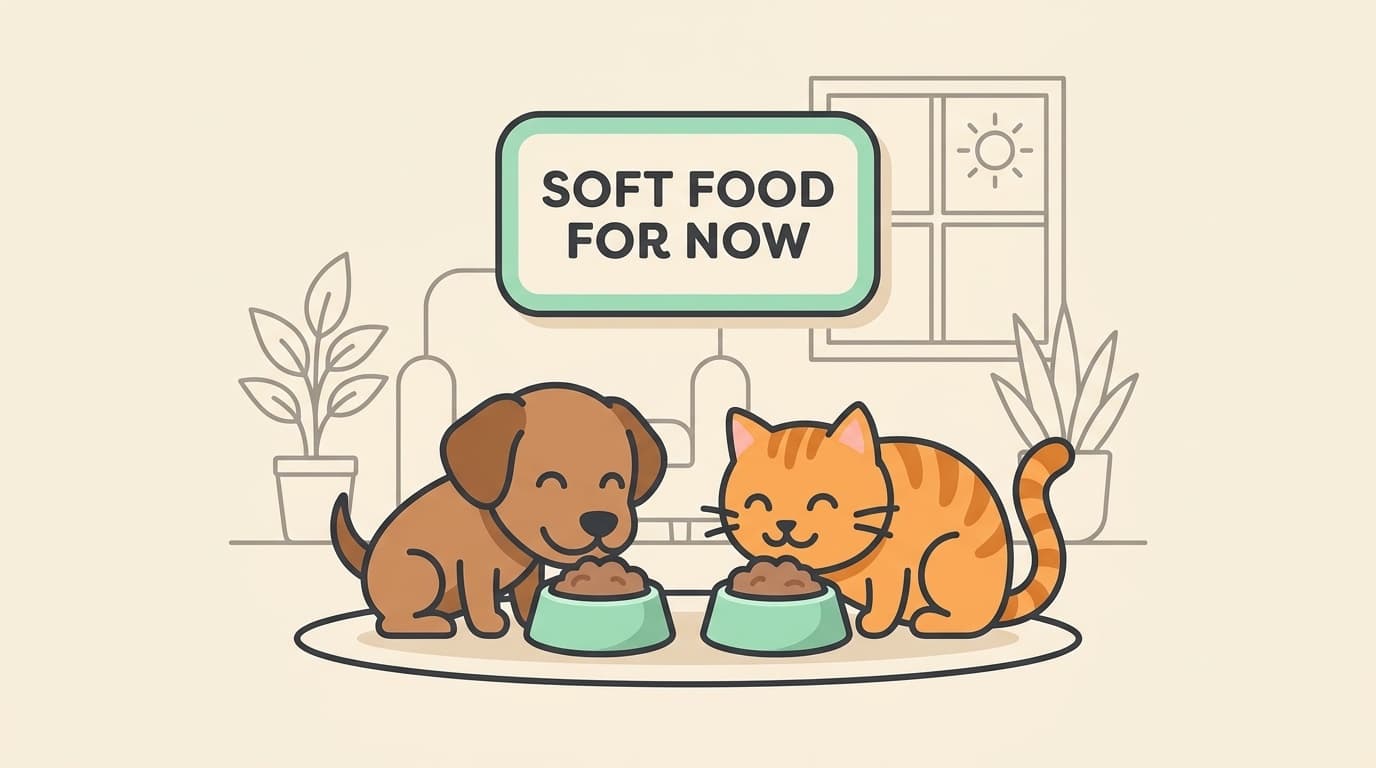
Eating after extractions: better, not worse
Alastair Greenway
BVM&S MRCVS
She's home. The anaesthetic hasn't fully lifted, so she's a bit wobbly and a bit vacant, and when she yawns you can see the dark line of dissolvable stitches where teeth used to be. The discharge notes say "soft food only" and not a great deal else, and now you're standing in the kitchen at teatime holding a bowl and a knot of worry. How is she supposed to eat with a mouth like that? What if she won't touch it? What if she's in pain and I can't tell? What if I've put my old friend through all this and now she starves?
I want to take that fear off you straight away, because it's the wrong fear. The single most common thing owners tell me at the post-dental check is a slightly baffled version of the same sentence: "she's eating better than she has in months." That is not a coincidence, and it isn't luck. We've just removed the thing that was hurting her every time she ate. So the honest headline of this whole piece is in its title. After extractions, eating gets better, not worse, and usually a lot faster than you're bracing for. Here's how the next couple of weeks actually go.

The first evening: small, soft, and sooner than you think
On the day itself, the main thing standing between your pet and her dinner isn't the mouth, it's the anaesthetic. A general anaesthetic leaves an animal groggy, a little nauseous and unsteady for the first few hours, and a groggy patient shouldn't be asked to eat a full meal in case she's still too woozy to swallow safely. So the rule for the first evening is simple: wait until she's properly awake and steady on her feet, usually a few hours after you get home, then offer a small amount of soft food rather than her normal portion.
Keep that first offering modest and easy. A little wet food, or her usual kibble soaked in warm water until it's mushy, or a scoop of something bland she likes. Warm food smells stronger, which helps tempt a sleepy patient, and body-temperature is gentler on a fresh mouth than fridge-cold. Don't be alarmed if she's not ravenous at teatime on surgery day; plenty of pets have a quiet first evening and then wake up hungry. What you're looking for is that she's interested in eating something within about 24 hours of coming home. Most are, and many will happily eat that very first evening once the fog clears.
If you have other pets, feed her separately and quietly for these first meals. It stops a bolshy housemate stealing her food and takes the competitive rush out of it, so she can eat gently and at her own pace.
The pain relief part, in plain terms
This is usually the bit that frightens owners most, so let me be clear about how it actually works. Your pet did not come home to face the pain unarmed. Modern dental surgery is built around keeping her comfortable from the start, using several approaches at once, which vets call multimodal pain relief (Epstein et al., 2015).
While she was asleep, the surgeon almost certainly used local anaesthetic nerve blocks, the same idea as the injection that numbs your jaw at the dentist, so the area was already frozen before any tooth came out and stayed numb into the early recovery. On top of that she'll have had pain relief through her drip, and your vet will have sent her home with medication to keep her ahead of any soreness over the days that follow (Steagall et al., 2022). For most dogs that's an anti-inflammatory painkiller (an NSAID) given with food; cats are often managed a little differently, sometimes with an additional painkiller, because cats and dogs process these drugs differently and are dosed on quite different rules.
Two things matter enormously here. First, give the medication your vet sent home exactly as the label says, with food, for the full course, even once she seems bright. Pain is far easier to stay on top of than to claw back once it's flared. Second, and this one is not negotiable: never reach into your own bathroom cabinet. Human painkillers are genuinely dangerous to pets. Ibuprofen and other human anti-inflammatories can cause stomach ulcers and kidney damage in dogs and cats, and paracetamol is lethal to cats even in tiny amounts (Pet Poison Helpline). If you ever feel your pet needs more pain relief than she's been given, the answer is a phone call to your vet, never a tablet from the cupboard.
The reassuring reality underneath all of this: a mouth after extractions is almost always more comfortable than the diseased, infected mouth was beforehand. We haven't added pain. We've taken a chronic, grinding source of it away, and covered the short healing window with proper medication on top.
The soft-food fortnight
For roughly the next one to two weeks, the job is to let the gum knit back together undisturbed, and soft food is how you do that. The gum was closed over each socket with dissolving stitches, and that repair needs a little time before it's asked to cope with anything hard or sharp. As a rough guide, plan on soft food for about ten to fourteen days after surgery, though a small single extraction may need less and a big surgical one a little more. Your own vet's timeline, on your discharge notes, always wins over any general figure here.
"Soft" can be as easy or as fancy as you like:
- Wet food straight from a tin or pouch. For a cat, choose a mince or paté texture rather than big chunks, which are harder to manage with a sore or toothless mouth.
- Her usual kibble, softened. Soak it in warm water or a little low-salt broth for ten or fifteen minutes until it's soft enough to squash easily against the roof of your mouth with your tongue. This is often the smoothest option because the flavour is familiar.
- Bland toppers she fancies, if she's being picky, to get her started.
Just as important is what to keep away from that healing mouth. No dry biscuits, no dental chews, no rawhide, antlers, bones or hard toys, and no tug games or fetch with hard objects, for the full recovery period. Anything hard risks disturbing the stitches or the clot in the socket, which is exactly the setback we're avoiding. It's a fortnight of soft living, not forever.
What normal recovery actually looks like
Knowing what's ordinary saves a lot of midnight panic, so here's the shape of a normal recovery.
For the first day or so, expect her to be a little quiet and sleepy as the anaesthetic clears. You may see some drooling, and a little blood-tinged saliva on the first day is normal, especially after several extractions; a faint pink tinge to the water bowl or a small smear on her bedding is nothing to fear. She may eat slightly gingerly at first, or favour one side, and then get bolder over a few days. The stitches are dissolvable and will melt away on their own over the following weeks, so there's no second trip to have them out, and you don't need to do anything to them. Do not brush anywhere near the surgical sites while they heal, and don't try to inspect them by prising the mouth open; leave the area be. Once your vet gives the all-clear at the recheck, you can gradually reintroduce normal food and, in time, start a gentle home-care routine on the teeth that remain.
Your vet will usually want to see her for a post-dental check, and may fit an elizabethan collar (the "cone") if she's pawing at her face. Most pets are visibly brighter within a few days, and it's genuinely common for owners to report their pet playing, grooming or greeting them with an energy they'd quietly written off as old age. That "she's slowing down" was often a sore mouth all along, and this is the point where it lifts.
The toothless cat eats just fine (really)
If your cat has had a lot of teeth out, or even all of them, I know exactly what's keeping you up: how on earth will she eat with no teeth? It feels like the cruellest possible outcome. It genuinely isn't, and this is the reassurance I most want you to believe.
Cats and dogs don't chew their food the way we do. They use their teeth mainly to grab and tear, and then they swallow food in fairly large pieces; the real grinding-and-crushing work we do with our molars simply isn't part of how they eat. That's why a cat with few or no teeth manages so well. Once the mouth has healed, most toothless cats eat wet food without a second thought, and a surprising number go back to eating dry kibble too, sometimes softened, sometimes not. Cats who have had full-mouth extractions for a horribly painful condition like chronic gingivostomatitis often eat far better afterwards, because for the first time in ages it doesn't hurt to do it. A toothless cat is not a starving cat. She's a comfortable one, and comfortable cats eat.
The same is true for dogs who lose a lot of teeth. They adapt remarkably quickly, and a wet or softened diet keeps a low-tooth dog perfectly well fed and perfectly happy.
When to pick up the phone
Almost every recovery is smooth, but you're her early-warning system, so here's what should prompt a call to your vet rather than a wait-and-see. None of this is common, and none of it is your fault if it happens; it just needs a professional eye.
- She won't eat anything at all. A quiet appetite on surgery night is fine, but if she's refusing all food and showing no interest by around 24 hours after coming home, ring your vet.
- Bleeding that doesn't settle. A pink tinge on day one is normal. Fresh, ongoing or heavy bleeding from the mouth is not, and warrants a call.
- Swelling of the face or jaw that appears or worsens after the first day or two. Some early puffiness can be expected, but swelling that comes up or grows after 48 hours should be checked (Woodward, 2018).
- Signs she's still sore despite her medication: heavy drooling, persistent pawing at the mouth, trouble picking food up, or hiding away. Pain that's breaking through the medication means the plan needs adjusting, by your vet, not by you.
- A bad smell, discharge, or a stitched area that looks like it's opening up. These can signal infection or that the gum repair has broken down, and both are very fixable when caught early (Taney & Smith, 2018).
- Off in herself: flat, feverish, not drinking, or simply "not right". Trust that instinct and call.
You will not be a nuisance for phoning. A quick call that turns out to be nothing is exactly what the practice would rather have than a problem left to grow overnight.
If your pet is a senior and you're reading this while you decide whether to go ahead at all, the recovery ahead is one of the reasons the answer is so often yes: it's usually gentler and quicker than the fear suggests. There's more on that in is my senior pet too old for a dental?. If you're still waiting on the day itself, dental day: dropping her off and picking her up walks through the practical hours, and the extraction phone call explains why teeth needed to come out in the first place, so you can stop second-guessing the decision and get on with the far nicer job of watching her feel better. For the fridge door, our printable post-extraction recovery sheet lays out the soft-food timeline, the do-not-give list and the red flags on a single page.
References
- Epstein ME, Rodan I, Griffenhagen G, et al. 2015 AAHA/AAFP Pain Management Guidelines for Dogs and Cats. Journal of the American Animal Hospital Association, 2015;51(2):67-84.
- Steagall PV, Robertson S, Simon B, et al. 2022 ISFM Consensus Guidelines on the Management of Acute Pain in Cats. Journal of Feline Medicine and Surgery, 2022;24(1):4-30.
- World Small Animal Veterinary Association (WSAVA). Global Dental Guidelines. WSAVA, 2020.
- Woodward TM. Complications of Tooth Extraction. In: Wiggs's Veterinary Dentistry: Principles and Practice, 2nd ed. Wiley, 2018.
- Taney KG, Smith MM. Surgical extraction of teeth and complications. Today's Veterinary Practice / Veterinary dentistry texts, 2018.
- Pet Poison Helpline. Ibuprofen and paracetamol (acetaminophen) toxicity in dogs and cats.
Free downloads
Companion worksheets to put what you've read into practice. Free PDFs, print at home.
Keep track of how your pet is doing
The owners who cope best are the ones who notice changes early. A simple health log shows you what is working, and what is not, before the next vet visit.
Start tracking, freeYou're not doing this alone
Compare treatment journeys and talk to owners managing teeth & mouth. Free to join.
Join PetsLikeMine