
Dental day: dropping her off and picking her up
Alastair Greenway
BVM&S MRCVS
It's the night before, the food bowl is going up, and she's looking at you as if you've lost your mind. Tomorrow morning you'll hand her over at reception, drive home to a quiet house, and spend the day glancing at your phone. If your stomach is in a knot about it, you're in good company. The dental itself is routine for us. Handing over someone you love and walking out without them never feels routine to you, and it shouldn't.
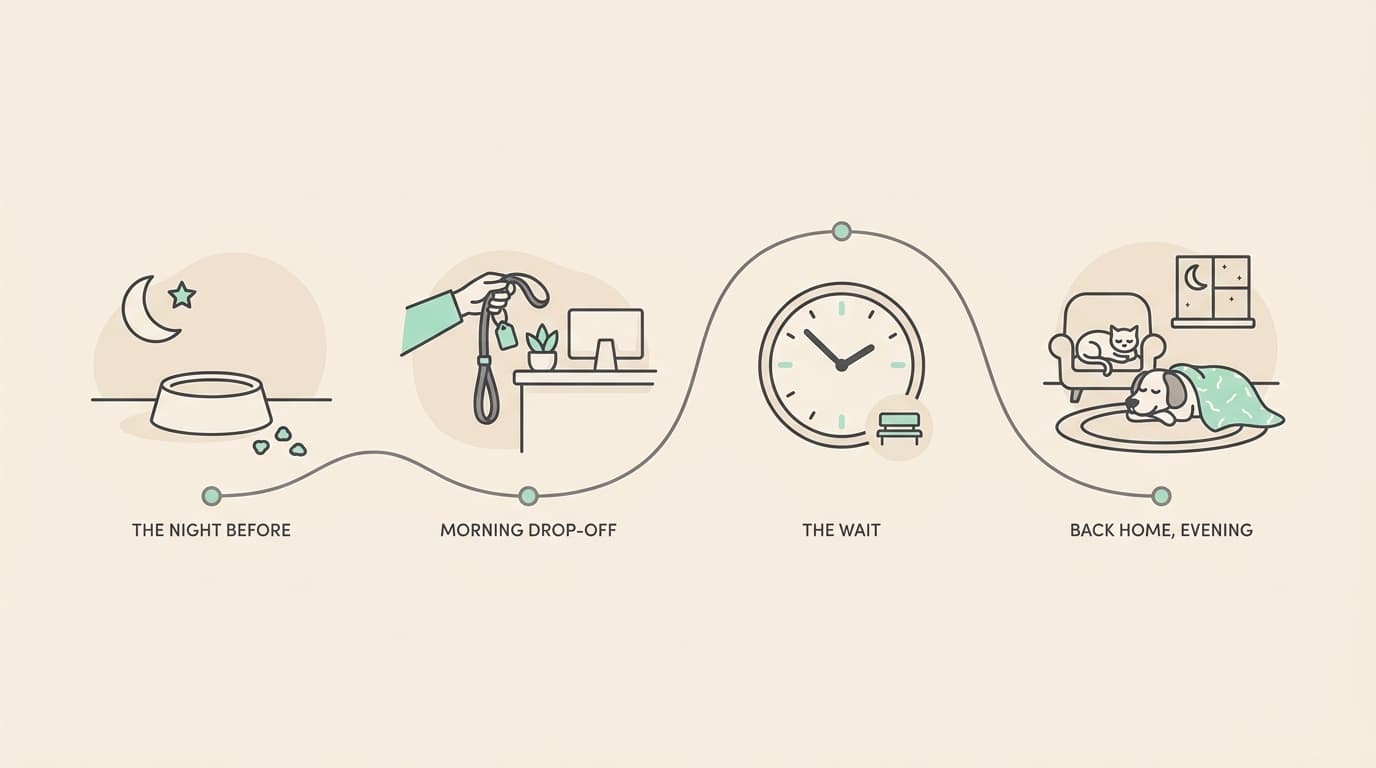
So let me take you through the whole day, hour by hour, exactly as it tends to run. Knowing what happens and when takes a surprising amount of the fear out of it. There are only really four moments that matter: the night before, the drop-off, the wait, and the collection. Let's walk through each one.
The night before: fasting done right (and it's changed)
This is the bit owners most often get slightly wrong, usually because they're working from old advice. For years the standard line was "nothing to eat after midnight", which for a morning admission meant your pet fasted for twelve hours or more. We now know that long overnight fast was never well supported by evidence, and in some cases it can actually make things worse rather than safer (AAHA, 2020).
Here's the reasoning, because it helps to understand it rather than just follow it. The point of fasting is to have a fairly empty stomach when your pet goes under, so there's less risk of stomach contents coming back up and being breathed into the lungs (that's called reflux, and the thing we're guarding against is aspiration). What the research showed is that a very long fast doesn't reliably empty the stomach any better, and a completely empty stomach can sit there producing more acid, so a marathon starve can be counterproductive.
Current guidance for a healthy adult is much gentler: withholding food for roughly four to six hours before the anaesthetic, rather than all night. For a morning admission that usually means a normal, modest breakfast is off the table, but a small meal the evening before is fine. In practice most practices will still give you a specific "no food after this time" instruction, because the sums depend on when your pet's slot actually is.
And this is the single most important line in this whole section: follow your own practice's written fasting instructions to the letter, even if they differ from what you read here. They know their list, their timings and your pet. If the note says food up at 8pm, put it up at 8pm.
A few pets need a different plan, and your practice will tell you if yours is one:
- Water usually stays down for longer than food. Modern advice is fairly relaxed about water, and many practices leave the bowl down until you leave the house, or ask you to lift it only an hour or two before admission. A dehydrated pet is not a safer pet. Again, do exactly what your practice says.
- Small, young and diabetic patients get a shorter fast, not a longer one. Tiny dogs, puppies and kittens, and diabetics can drop their blood sugar dangerously if starved too long, so their instructions will be different and specific.
- Flat-faced breeds may be asked to fast a little longer. Brachycephalic dogs like Bulldogs, French Bulldogs and Pugs are more prone to reflux, so some practices lengthen their fast to reduce that risk.
If you slip up and she steals a biscuit off the counter at breakfast, don't panic and don't hide it. Phone the practice and tell them. It's a genuinely common thing, and it's far better for us to know and reschedule or adjust than to be surprised. Nobody will be cross with you.

Cats: the fasting and the carrier both need thought
Cats are not just small dogs on dental day, and two things are genuinely different for them. First, a cat's stomach empties faster than a dog's, so cats often need a shorter fast, and an overnight starve is even less appropriate. Your practice will give you cat-specific timings; trust those over any generic advice.
Second, and this is the one owners underestimate, the stress of the journey often rattles a cat more than the fast does. A cat who has been chased round the kitchen and stuffed into a carrier arrives at the practice with her heart already racing, which is not how you want her to start the day. So the night before, leave the carrier out with a familiar blanket and a treat or two inside so it isn't an ambush in the morning. A synthetic feline pheromone spray on the bedding an hour before can help take the edge off. Load her calmly, cover the carrier with a towel in the car, and hand her over still in it. Most practices keep cats in a separate, quieter ward away from barking dogs, and it's worth asking whether yours does. A calmer cat is genuinely a smoother anaesthetic.
Drop-off: what you'll be asked and what you'll sign
Admission is usually a short appointment first thing, often with a nurse rather than the vet who'll do the procedure. It can feel like a rushed, emotional five minutes, so it helps to know what's coming.
You'll be asked to confirm a few things: that she's been fasted correctly, that you have a phone you'll keep on and answer all day, and whether anything has changed since the last visit (a cough, a limp, less appetite, a season). Small details matter, so mention them.
Then you'll sign a consent form. This is not a formality to skim. It's the document that says you understand and agree to the anaesthetic and the planned work, and it's where the day's most important conversation happens: what we do if we find more once she's asleep. A dental is one of the few procedures where we genuinely often don't know the full extent of the problem until your pet is anaesthetised and we've taken x-rays and probed each tooth. A tooth that looked borderline in the consult can turn out to be rotten to the root. So the form will ask you to agree an approach, and usually a cost ceiling, in advance. This is exactly what sits behind the extraction phone call that might come mid-morning, and it's worth thinking about your answer the night before rather than on the spot.
Make sure they have the best number to reach you, and a backup if you can. If you'd rather be phoned before any extraction over a certain number of teeth, say so and have them write it on the form. If there's a question you've been meaning to ask, ask it now. Then the hard bit: you hand her over, and you leave. She will not think you've abandoned her, and she'll be a great deal less anxious about the whole thing than you are.
The wait: what's actually happening while your phone stays quiet
The silence at home is the worst part, so here's what's filling it at the practice. There's a fuller walk-through in what actually happens during a dental, but in short:
At some point in the morning your pet is given a premed, an injection that combines a sedative and a painkiller. It settles her, takes the edge off any anxiety, and starts pain relief working before anything is done, all of which means a smoother, safer anaesthetic on a lower dose. Once she's sleepy, a nurse places an intravenous catheter in a front leg, which gives instant access for medication and lets a drip run to support her blood pressure throughout.
She's then anaesthetised, a breathing tube is placed to protect her airway, and she's kept asleep on anaesthetic gas and oxygen. For the whole procedure a nurse is dedicated to watching her, tracking her heart rate and rhythm, blood pressure, breathing, oxygen levels and temperature, and keeping her warm with heat support (AAHA, 2020). That constant human attention is the thing that most reduces anaesthetic risk, and it's happening the entire time, not just at the start. If the numbers behind that risk are what's keeping you up, the real anaesthetic risk numbers lays them out honestly.
The dental work itself, the scaling, the full-mouth x-rays, the probing, the charting and any extractions, all happens while she's under. Then the gas is turned off, she's kept on oxygen and gently woken, and a nurse sits with her through recovery, wrapped up warm, until she's lifting her head and swallowing. By the time you get the call to collect, she's usually already up, groggy but comfortable, on the other side of the whole thing.
Collection: what to ask before you drive home
You'll be given a collection time, usually late afternoon or early evening, though it can move if the list ran long or your pet needs a bit longer to wake up. Don't read anything sinister into a delay; we simply don't rush recovery.
Collection is often a discharge appointment with a nurse, and it's where you find out what actually happened. This is the moment to slow down and take it in, because you'll be told a lot at once while feeling relieved and a bit wobbly. It helps to jot the answers down. Useful things to ask:
- What was found and what was done? Ask to see the dental chart, the tooth-by-tooth map of what was healthy, what was treated and what came out. Ask how many teeth were removed, if any, and why.
- What medication is she going home on, and how do I give it? There's very often pain relief for a few days, and sometimes antibiotics. Get the timing and whether it's with food clear before you leave.
- What can she eat tonight and for the next few days? Especially if she's had extractions with stitches. If teeth came out, eating after extractions covers the "she'll actually eat better, not worse" reassurance in detail.
- What's normal tonight, and what would mean I should call? Pin down the line between expected grogginess and a genuine problem.
- When's the recheck? Extraction sites are usually looked at again a week or two later.
Then you take her home. She may look a bit sorry for herself, possibly with a shaved patch on her leg where the catheter was and a slightly dopey expression. That's all completely normal.
The first evening home: groggy is expected
Bring her into a warm, quiet room and let her settle. Most pets are noticeably drowsy or a little wobbly the evening after an anaesthetic, and it can take a full 24 to 48 hours to be completely back to themselves (AAHA, 2019). Keep it calm. No stairs if you can help it, no jumping onto the sofa or the bed, no boisterous other pets or excited children climbing on her. A cat is best kept in one quiet room overnight rather than given the run of the house while she's unsteady.
On food and water, less is more at first. Offer a small drink and, a little later, a small meal of around a quarter to half her usual amount, then more small amounts through the evening rather than one big bowl, which can bring on nausea after an anaesthetic. Something soft is kinder if she's had extractions. Don't be alarmed if she's not very interested tonight; appetite often lags behind for a day.
A few things are expected and not a cause for alarm: some drowsiness, a bit of blood-tinged saliva or a pinkish drool for a day or so after extractions, mild reluctance with hard food, and that faintly dazed look. What does warrant a phone call is different, and worth being clear on: she's still very groggy, disoriented or won't wake properly after 24 hours; she's completely refusing all food and water into the next day; there's active bleeding from the mouth rather than a little tinge; she's repeatedly vomiting, or seems to be in obvious, unrelieved pain. If any of that happens, ring the practice or the out-of-hours service. That's exactly what they're there for, and no one will think you're overreacting.
Most of the time, though, the story of dental day ends quietly: a sleepy pet on a blanket, a bit dopey from the drugs, with a clean and comfortable mouth she didn't have this morning. Tomorrow she'll be brighter, and within a few days a lot of owners notice their pet is more themselves than they've been in months, because the low-grade ache they'd been living with is gone. You got her through the day. Now you just let her sleep it off.
References
- American Animal Hospital Association (AAHA). 2020 AAHA Anesthesia and Monitoring Guidelines for Dogs and Cats. Journal of the American Animal Hospital Association, 2020.
- American Animal Hospital Association (AAHA). 2019 AAHA Dental Care Guidelines for Dogs and Cats. Journal of the American Animal Hospital Association, 2019.
- World Small Animal Veterinary Association (WSAVA). Global Dental Guidelines. WSAVA, 2020.
Free downloads
Companion worksheets to put what you've read into practice. Free PDFs, print at home.
After a Dental: Recovery Checklist
PDF · 241 KBThe days after extractions, made simple: soft food, no chews or tug toys while the gum heals, a write-on space for the pain relief your vet dispensed, the signs that mean ring the practice, and the recheck to book.
Questions to Ask Before Your Pet's Dental
PDF · 207 KBA one-page prompt for the pre-dental conversation, with room to write the answers: pre-anaesthetic bloods, whether full-mouth x-rays are included, the extraction-and-consent conversation, the pain-relief and anaesthetic-safety plan, and an itemised cost estimate. Includes the real anaesthesia-risk numbers and a plain warning that anaesthesia-free dentistry is not a substitute for a proper dental.
Keep track of how your pet is doing
The owners who cope best are the ones who notice changes early. A simple health log shows you what is working, and what is not, before the next vet visit.
Start tracking, freeYou're not doing this alone
Compare treatment journeys and talk to owners managing teeth & mouth. Free to join.
Join PetsLikeMine