

Is anaesthesia safe for my pet? The real numbers
Alastair Greenway
BVM&S MRCVS
If you're reading this the night before a dental, or lying awake after your vet first said the word "anaesthetic", I want to say the most important thing first. Being frightened of putting your dog or cat under is not you overreacting. It's love doing exactly what it is supposed to do. Almost every owner I sit across from at this point is far more scared of the anaesthetic than of the rotten tooth we're trying to fix, and I understand completely why. You've read the forum posts. You know someone whose dog "went in for a routine op and didn't come home". You are being asked to hand over the animal you love and trust that a team of strangers will give her back.
So let's do the honest thing and actually look at the numbers, because in my experience the fear shrinks to a manageable size once you can see it clearly. I'm not going to tell you anaesthesia is risk-free, because that would be a lie and you'd be right not to trust me. I'm going to tell you what the real risk is, what we do to make it as small as it can be, and why the thing that frightens you least, leaving a painful mouth alone, is often the bigger danger.
The actual numbers, said plainly
The biggest and most-quoted study of this question anywhere is a UK one. It's called the Confidential Enquiry into Perioperative Small Animal Fatalities, or CEPSAF, and it tracked the outcomes of just under 100,000 dogs and around 79,000 cats across more than a hundred practices (Brodbelt et al., 2008). That's an enormous dataset, and it's the reason a British vet can give you a real figure rather than a shrug.
Here is what it found for otherwise healthy pets, the ones graded as low anaesthetic risk before the procedure. The chance of a healthy dog dying from causes related to the anaesthetic was about 0.05%. The chance for a healthy cat was about 0.11% (Brodbelt et al., 2008).
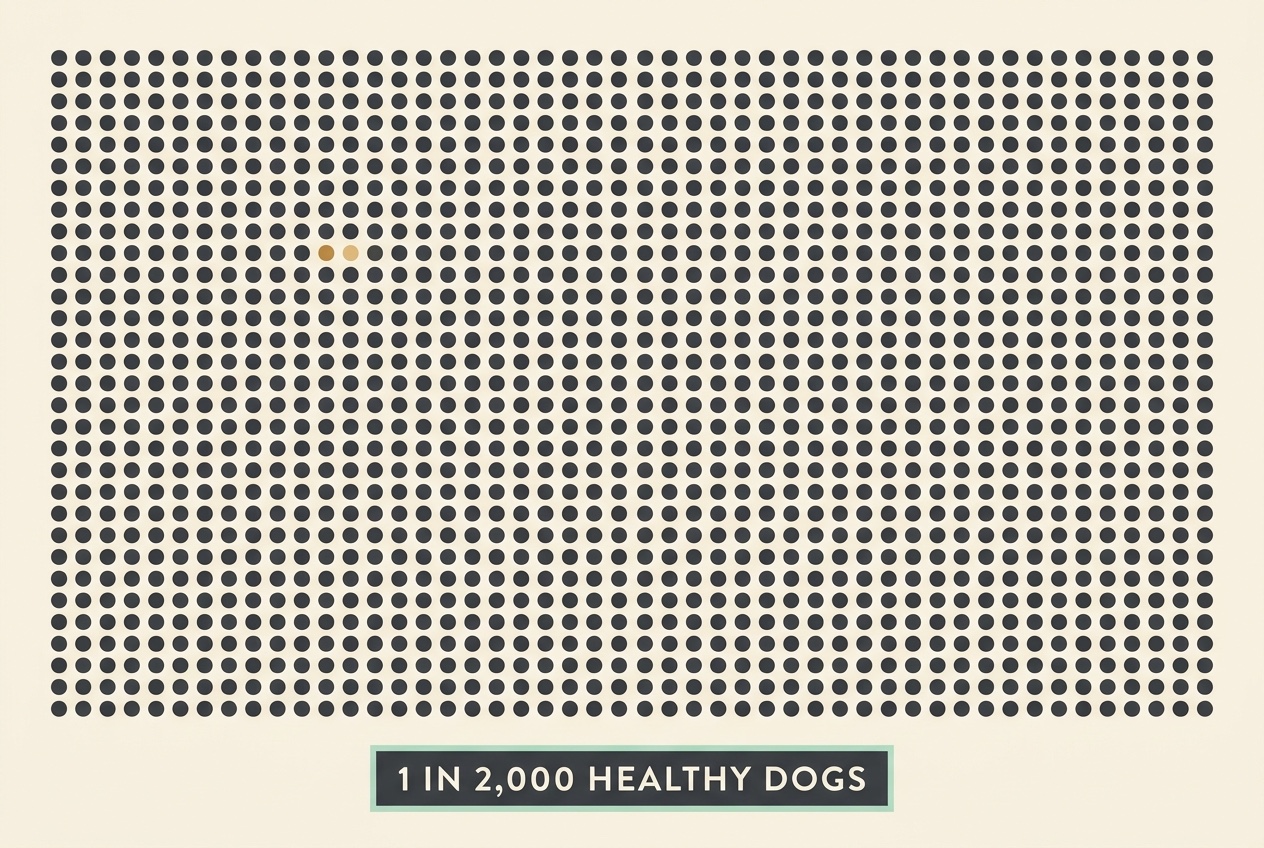
Percentages are slippery when you're frightened, so let me put those in plain words. For healthy dogs, that's roughly one in 2,000. For healthy cats, roughly one in 900. The study's precise figures were one death for every 1,849 healthy dogs and one for every 895 healthy cats. Turn the dog number around and it says that if you lined up 2,000 healthy dogs having an anaesthetic, on average 1,999 of them would wake up and go home. That is a real risk. It is also a small one, and it deserves to be held at its real size, not the size a bad night and a search engine give it.
I want to be straight about one thing, because being straight is the whole point of this page. Those numbers come from data gathered around twenty years ago. If anything, they now understate how safe a well-run modern anaesthetic is. Monitoring equipment, drugs and training have all moved on since, and the current professional standards for keeping a pet safe under anaesthesia are more thorough than they were then (Grubb et al., 2020). The one in 2,000 is the cautious version of the figure, not the flattering one.
Why cats sit a little higher, and why that isn't a reason to panic
You'll have noticed the cat figure is about twice the dog figure. If you have a cat, please don't let that number frighten you, because there are good, understandable reasons for it and every one of them is something a careful vet already knows and works around.
Cats are small. A ten-week-old puppy aside, most cats we anaesthetise are far lighter than most dogs, and small patients have less margin for error. The airway is smaller and more delicate to place a breathing tube into, and it's easier to give a cat slightly too much fluid for its size. The companion study that looked specifically at cats found exactly these threads: careful use of the breathing tube and careful fluid rates mattered, and the cats who were monitored with a pulse oximeter (a small clip that reads oxygen levels continuously) had a lower risk of dying (Brodbelt et al., 2007).
Read that again, because it's the reassuring part hiding inside the worrying number. The reason cats sit a little higher is not some mystery in the cat that can't be helped. It's a set of specific, known challenges, and the answer to every one of them is attentive technique and proper monitoring. A practice that anaesthetises cats thoughtfully, with the right-sized kit and a nurse watching the numbers, is directly closing that gap. Cats are not too fragile to anaesthetise. They just ask us to pay closer attention, which we should be doing anyway.
What a modern practice actually does to make it safer
When people picture an anaesthetic, they often imagine their pet asleep and a machine beeping in an empty room. That's not what good practice looks like, and understanding the difference is one of the quickest ways to feel calmer about it. Here is what the safety actually consists of.
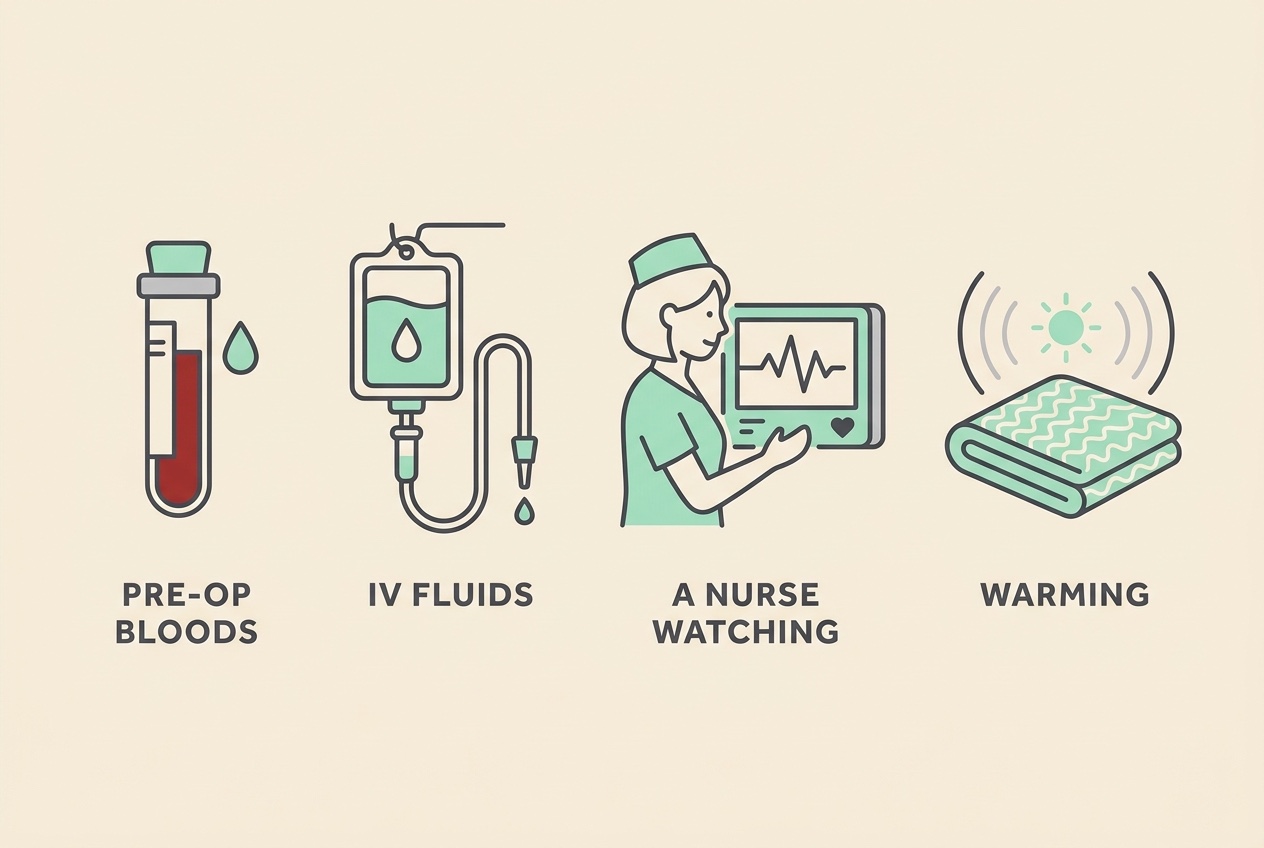
A proper assessment before anything happens. Your vet examines your pet, listens to the heart and chest, and in most cases runs pre-anaesthetic blood tests. These check the organs that process the anaesthetic drugs, mainly the liver and kidneys, and flag anything that would change the plan. This isn't box-ticking or an upsell. It's how we tailor the anaesthetic to your individual animal rather than treating her like an average. There's more on what those bloods look for in our guide to pre-anaesthetic blood tests.
An intravenous catheter and fluids. A small tube goes into a vein, usually in a front leg. It lets us give fluids to support blood pressure and, just as importantly, gives instant access to a vein if we ever needed to give a drug quickly. Having that line already in place is a safety net, not a luxury.
A dedicated person watching, not just a machine. Modern monitors track oxygen levels, heart rate and rhythm, blood pressure, breathing and temperature. But the thing that keeps your pet safest is a trained veterinary nurse whose whole job, for the length of the procedure, is to watch those numbers and your pet, and to notice a change a few minutes before it becomes a problem. Anaesthetic safety is far more about the person than the machine.
Warmth. Anaesthetised pets lose heat quickly, and getting cold slows recovery and matters more in small patients. Heat mats, warm-air blankets and warmed fluids keep the temperature up.
A recovery that's watched as closely as the procedure. This is the detail almost nobody tells owners, and it's an important one. In the CEPSAF data, a large share of the deaths happened not on the operating table but in the hours afterwards, during recovery (Brodbelt et al., 2008). Roughly half of the canine deaths and around six in ten of the feline deaths occurred in the post-operative period. That sounds alarming, but it's genuinely good news, because the recovery period is the part we can most easily watch and support. A practice that keeps monitoring your pet as she wakes, rather than assuming the danger passed when the surgery ended, is directly acting on the single biggest lesson of that study.
The other side of the scales
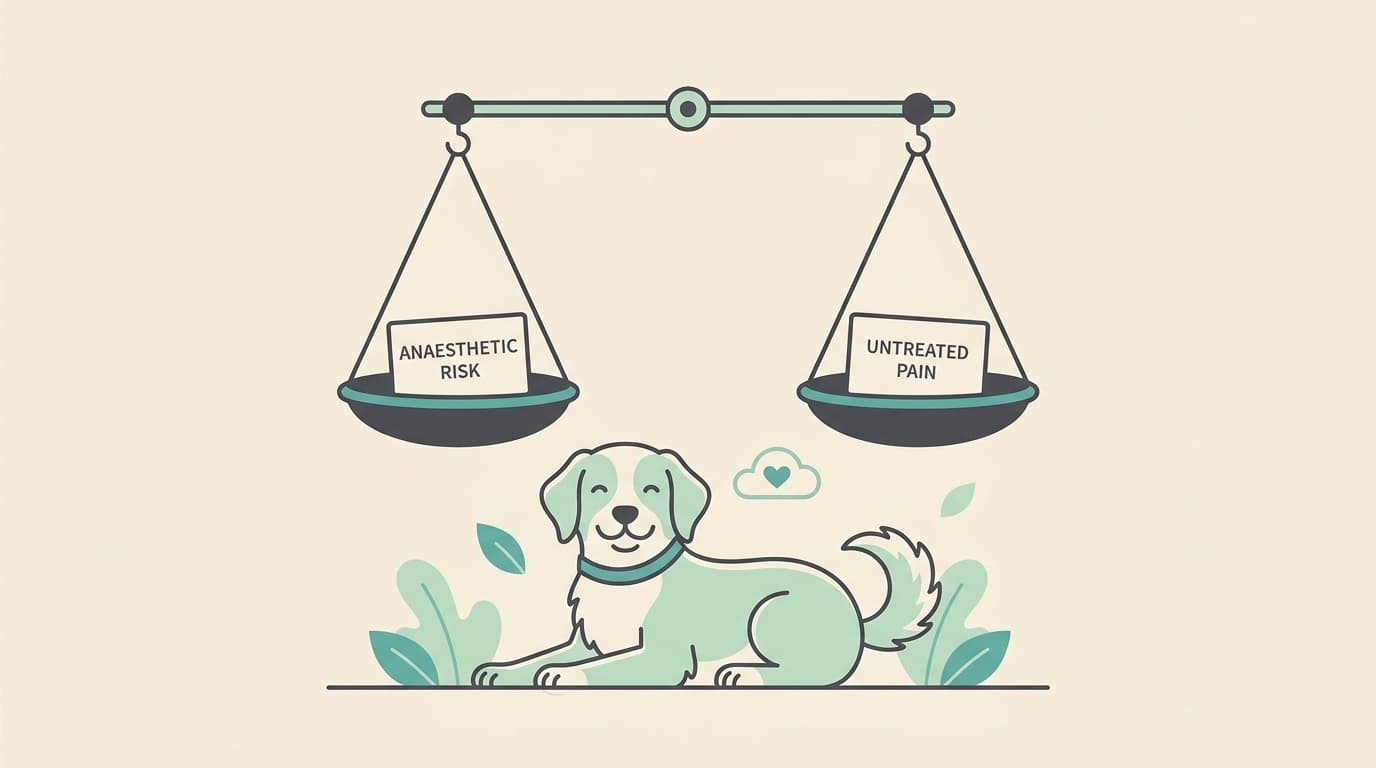
Here is the part the fear tends to hide from you completely. The choice in front of you is never "risk" against "no risk". It's a small, managed anaesthetic risk on one side, and the certain, ongoing harm of an untreated mouth on the other.
A grade 3 or grade 4 dental mouth, the kind that gets a dental booked in the first place, is not just cosmetically unpleasant. It's a source of genuine, chronic pain and a reservoir of infection sitting a few centimetres from the eyes, the sinuses and the bloodstream (WSAVA, 2020). Pets are extraordinarily good at hiding oral pain, so "she's still eating and seems fine" is not the reassurance it feels like. Over and over, owners tell me after a dental that their pet is brighter, more playful and more themselves than they've been in a year, and that they hadn't realised how much the mouth had been dragging her down until it stopped.
So when you weigh it up, weigh the whole thing. "Doing nothing" is not the safe, neutral option it disguises itself as. It's a different choice with its own real cost, paid slowly in daily discomfort rather than in one frightening morning. The anaesthetic risk is a number you can see and manage. The cost of leaving an infected, painful mouth alone is a certainty.
When the risk genuinely is higher
I'd be doing the opposite of my job if I pretended the risk is the same for every pet. It isn't. The same study found that pets who were already unwell, graded as higher anaesthetic risk because of existing illness, had a substantially higher chance of an anaesthetic-related death, in the region of 1.3 to 1.4% rather than the 0.05 to 0.11% seen in healthy animals (Brodbelt et al., 2008). That's roughly one in 75, and it's an honest figure you deserve to have.
But read what that actually means, because it's easy to take it the wrong way. It doesn't mean a sick or older pet shouldn't have an anaesthetic. It means the assessment beforehand matters even more, and it's exactly why we do it. When we find something on the pre-op exam or the bloods, the answer is almost never "cancel". It's "let's stabilise this first", or "let's adjust the drugs", or "let's keep it short and efficient". Illness raises the stakes, and the work-up is how we lower them again.
Age gets tangled up in this, and it shouldn't. Age is a number, not a disease. A healthy twelve-year-old is not automatically a worse candidate than an unhealthy four-year-old. What raises anaesthetic risk is unmanaged illness, not the date on the birth certificate, which is why we assess the individual pet in front of us rather than her age alone. If you have a senior pet and the "she's too old" worry is the thing keeping you up, our guide on whether a senior pet is too old for a dental is written for exactly that fear.
The questions worth asking your vet
You are allowed to ask every one of these, and a good vet will be glad you did. Asking them is not doubting your practice. It's you doing your job as her advocate, and it usually helps you feel far steadier about the day.
- Who will be monitoring my pet during the anaesthetic, and will they be doing only that?
- What monitoring equipment do you use, and will she be on intravenous fluids?
- Do you recommend pre-anaesthetic blood tests for her, and what will they tell us?
- Given her age and health, is there anything you'd want to check or stabilise first?
- How will she be kept warm, and how closely is she watched as she wakes up?
Write them down and take them in. The answers will almost always reassure you, and where they don't, you've learnt something worth knowing before the day rather than after it.
If you've read this far, you already care enough to have done the hard part. The next step is small and concrete: book the pre-anaesthetic chat with your vet, take your list of questions, and let them size the risk to your actual pet rather than to the worst story you've read. You get to choose to go ahead informed and steady, instead of frightened. That's a very different feeling, and it's the one your pet needs from you on the day.
References
- Brodbelt, D.C., Blissitt, K.J., Hammond, R.A., Neath, P.J., Young, L.E., Pfeiffer, D.U., & Wood, J.L.N. (2008). The risk of death: the confidential enquiry into perioperative small animal fatalities (CEPSAF). Veterinary Anaesthesia and Analgesia, 35(5), 365-373.
- Brodbelt, D.C., Pfeiffer, D.U., Young, L.E., & Wood, J.L.N. (2007). Risk factors for anaesthetic-related death in cats: results from the confidential enquiry into perioperative small animal fatalities (CEPSAF). British Journal of Anaesthesia, 99(5), 617-623.
- Grubb, T., Sager, J., Gaynor, J.S., Montgomery, E., Parker, J.A., Shafford, H., & Tearney, C. (2020). 2020 AAHA Anesthesia and Monitoring Guidelines for Dogs and Cats. Journal of the American Animal Hospital Association, 56(2), 59-82.
- Niemiec, B., Gawor, J., Nemec, A., Clarke, D., McLeod, K., Tutt, C., Gioso, M., Steagall, P.V., Chandler, M., Morgenegg, G., & Jouppi, R. (2020). World Small Animal Veterinary Association (WSAVA) Global Dental Guidelines. Journal of Small Animal Practice, 61(7), E36-E161.
Free downloads
Companion worksheets to put what you've read into practice. Free PDFs, print at home.
Keep track of how your pet is doing
The owners who cope best are the ones who notice changes early. A simple health log shows you what is working, and what is not, before the next vet visit.
Start tracking, freeYou're not doing this alone
Compare treatment journeys and talk to owners managing teeth & mouth. Free to join.
Join PetsLikeMine