

What actually happens during a dental (it's a lot more than a clean)
Alastair Greenway
BVM&S MRCVS
It's just a clean, right? That's how most people picture it when they book their dog or cat in for "a dental". A quick scrub, the teeth come out shinier, she's home by teatime. The word "clean" does a lot of quiet damage here, because it makes the whole thing sound like a car wash, and then the estimate arrives with anaesthetic and x-rays and monitoring on it, and none of that seems to fit a wash.
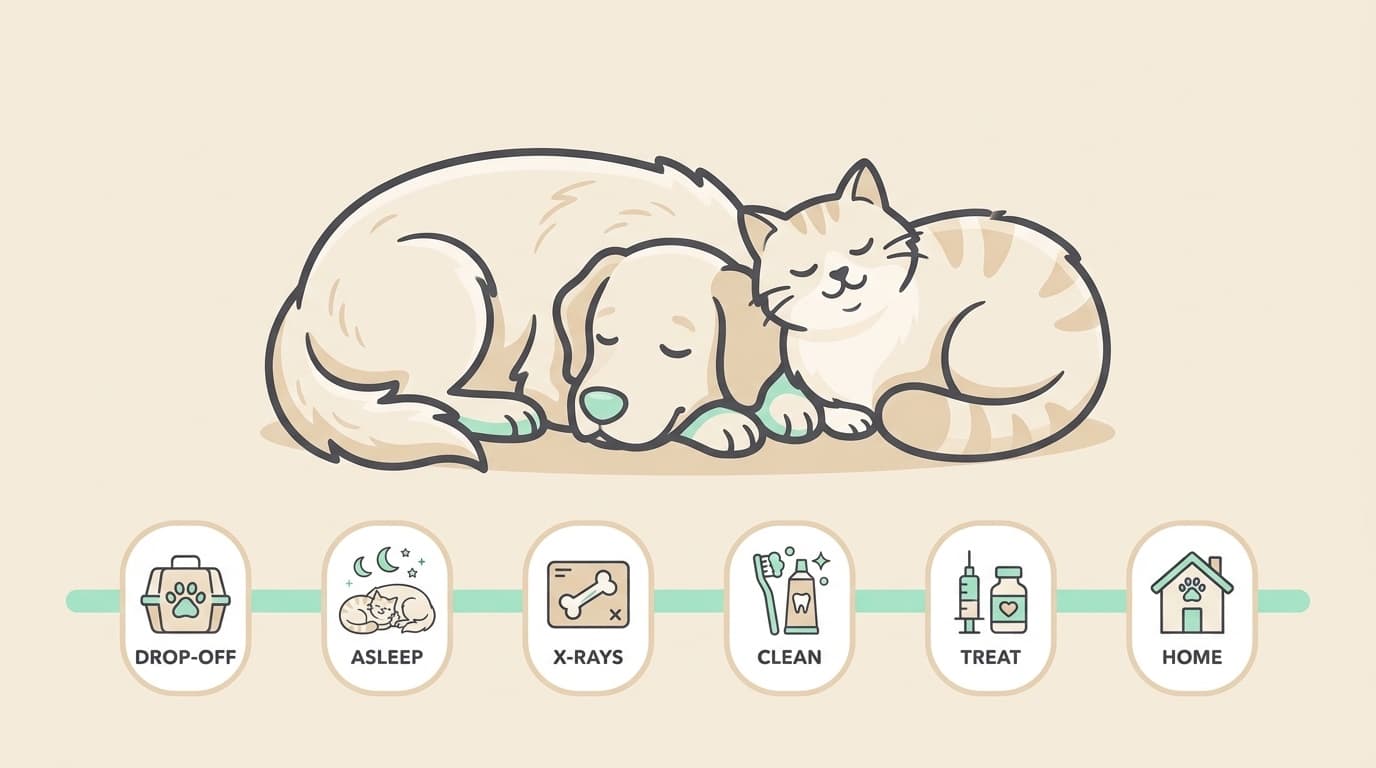
So let me walk you through what actually happens on the day, start to finish, in the order it happens. Not the marketing version, the real one. My hope is that by the end you'll understand two things: why a proper dental is a full surgical procedure rather than a tidy-up, and why the parts that make it look expensive, the anaesthetic and the x-rays especially, are exactly the parts that make it worth doing. The unknown is most of the fear. Once you can picture the day, it gets a lot smaller.
The night before, and the morning drop-off
It starts the evening before, with taking the food up. Most practices ask you to withhold food from late the night before, usually leaving water available until the morning, so the stomach is empty for the anaesthetic. An empty stomach lowers the chance of anything coming back up while she's asleep, which is the main reason for the fast. Your practice will give you their exact timings, and they matter, so follow theirs over any general rule.
In the morning you drop her off, and this is often the hardest hour of the whole thing for the owner. You hand over a bright, apparently fine animal, and you spend the day imagining the worst. I understand that completely. What's actually happening in that admission appointment is a set of careful checks, and it's worth knowing what they are. There's more on the practical side of the day, the drop-off and the wait and the collection, in our guide to [dental day].
Before anything else: the pre-anaesthetic check
Nobody goes under without a look-over first. A vet listens to the heart and chest, checks the gums and hydration, feels the tummy, takes a weight so the drug doses can be calculated precisely, and asks you about how she's been. This is also when most practices recommend pre-anaesthetic blood tests, which check that the liver and kidneys, the organs that process the anaesthetic drugs, are up to the job, and flag anything hiding under the surface.
People sometimes wonder whether the bloods are an upsell. They aren't. They're one of the ways we catch a problem before it becomes a problem, and in an older pet especially they can change the anaesthetic plan or, occasionally, tell us to pause and sort something else out first. We cover exactly what they look at, and why, in [pre-op bloods]. If anything on the check gives us pause, this is the point where we talk to you, before we've committed to anything.
Going under: premed, catheter, and the breathing tube
Once she's cleared for the day, the anaesthetic happens in stages, not all at once. First comes a premedication, an injection that takes the edge off, provides early pain relief, and means less of the main anaesthetic drug is needed. A sedated, comfortable patient is a safer patient.
Next, a small patch of fur is clipped from a front leg and an intravenous catheter goes in. That catheter is a lifeline in the literal sense: it's how we give the drugs, how we run fluids, and how we'd deliver emergency medication in the rare event it's needed, without having to find a vein in a hurry. Through it she's given the drug that takes her from sedated to fully asleep, usually over a few seconds.
The moment she's asleep, a breathing tube (an endotracheal tube) is passed into the windpipe and its soft cuff is gently inflated. This does two jobs. It carries the anaesthetic gas and oxygen that keep her asleep and well-oxygenated for the whole procedure. And, just as importantly for a dental, it seals the airway so that none of the water, bacteria and debris we're about to flush out of a dirty mouth can trickle down into the lungs (AAHA, 2019). That protected airway is one of the flat reasons a real dental can't be done on a conscious animal: there's no way to keep the mouth full of water and the lungs safe at the same time without it.
While she's asleep: what the monitoring is for
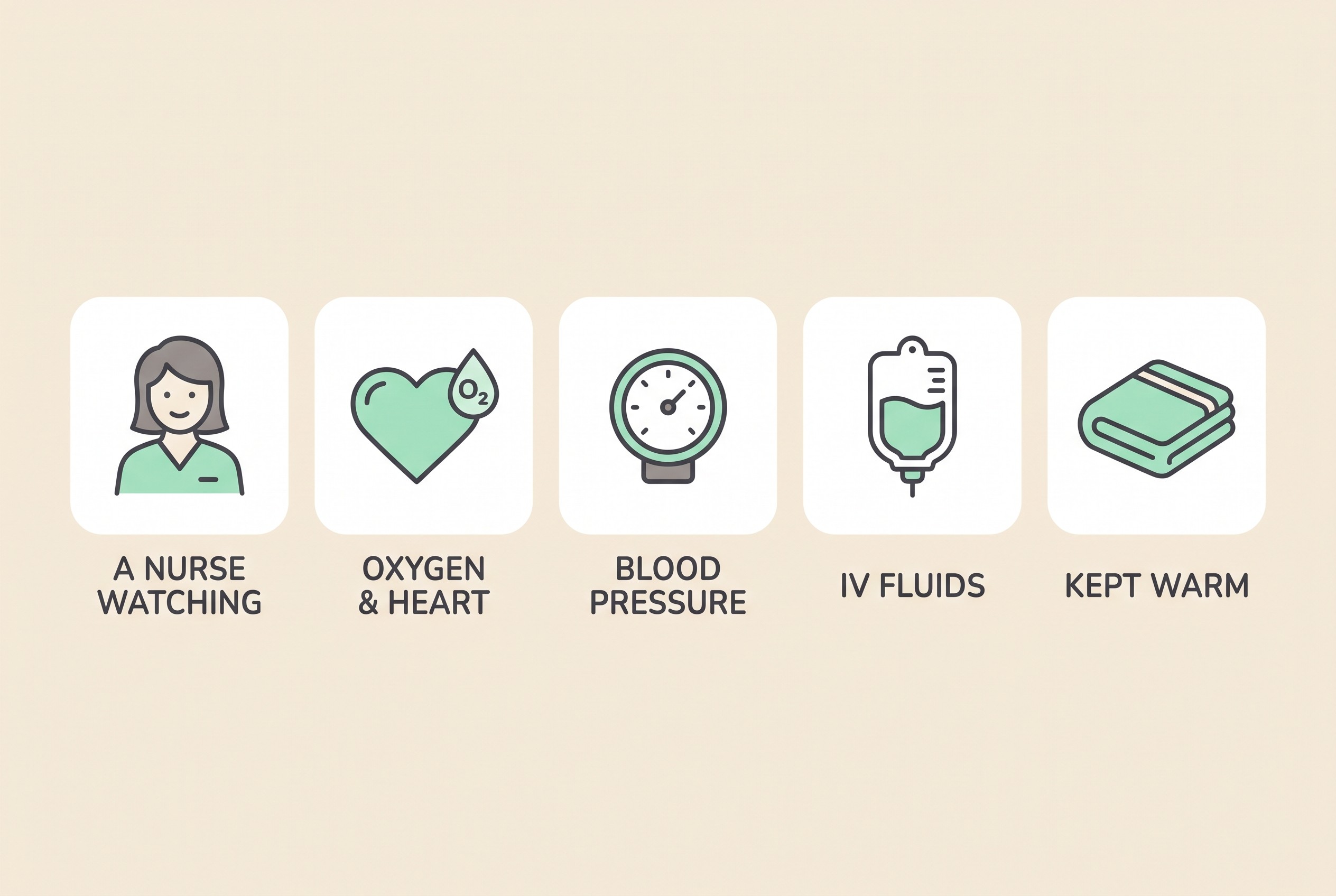
Here's the part that reassures owners most once they know about it, so I'll spend a moment on it. From the second she's under to the moment she's awake, she is not left alone with a machine bleeping in an empty room. A trained person, usually a veterinary nurse, is watching her the entire time, and their whole job is her.
Alongside that person, monitoring equipment tracks the things that matter: the oxygen level in the blood (pulse oximetry), the heart rhythm and rate (ECG), blood pressure, the carbon dioxide she's breathing out (capnography), and her body temperature (AAHA, 2020). She's also on intravenous fluids through that catheter to support her blood pressure and circulation, and on some form of active warming, a heat mat or a warm-air blanket, because a sleeping patient loses heat and a warm patient recovers better. None of this is theatre. It's the machinery that lets us spot the smallest change early and adjust before it becomes anything at all. If the anaesthetic itself is the part that frightens you most, and for a lot of people it is, our piece on [the real anaesthetic risk numbers] sets out honestly how small the risk is in a healthy pet and how much all of this monitoring pulls it down.
The examination you can only do asleep
Now the actual dentistry begins, and the first stage isn't cleaning at all. It's a proper look. Awake, in the consulting room, we can see the front of the mouth and the obvious problems, the heavy tartar, a wobbly tooth, an angry gum. We can't see the back teeth properly, we can't measure anything, and we certainly can't get a probe under the gumline of an animal who understandably won't sit for it.
Asleep, we can. Every tooth is examined in turn, and a fine blunt instrument called a periodontal probe is walked around each one, checking the depth of the little groove where the gum meets the tooth. A healthy groove is shallow. A deep pocket means the attachment holding that tooth in has been lost, which is what periodontal disease actually is. All of this gets written down tooth by tooth on a dental chart, so there's a map of the whole mouth: which teeth are healthy, which have pockets, which are mobile, which are fractured or missing. If you've ever been told your pet is a "grade 2" or "grade 3" and weren't sure what that meant, this charting is where that number comes from, and our guide to [what the dental grades mean] unpacks it.
The x-rays: seeing the two-thirds you can't
Then come the x-rays, and I'd ask you not to think of these as an optional extra, because they're the opposite. The crown, the bit of tooth you can see, is only about the top third. The other two-thirds is root, sitting in the jawbone, completely out of sight. And a large share of the disease that causes pain lives down there, invisible from above.
Full-mouth x-rays, an image of every tooth, are how we see it. They reveal root abscesses, bone loss around the roots, fractured or dead roots, and, in cats especially, teeth being destroyed from the inside. In one classic study, more than one dog in four and better than four cats in ten had a genuinely important problem hiding in a tooth that looked completely normal to the eye (Verstraete et al., 1998). That's why we x-ray every tooth, not just the bad-looking ones: the innocent-looking ones are the ones that hide things. A "scale and polish" without x-rays cleans the visible crowns and leaves that hidden disease sitting there, which is why it isn't a complete dental at all. We make that whole case in [why dental x-rays matter]. For now, the short version: the x-rays are the part of the day that tells us whether the mouth is truly healthy or just looks it.
The clean itself, above and below the gumline
Only now do we get to the "clean" that most people thought was the whole appointment. And even this is two jobs, not one.
Above the gumline, an ultrasonic scaler uses high-frequency vibration and a fine water spray to break the tartar off the visible surfaces of the teeth. That's the part that makes the mouth look transformed, and it's satisfying, but on its own it's cosmetic. The part that actually treats disease is the scaling below the gumline, where the scaler and fine hand instruments clean the tooth surface inside the gum pocket, removing the plaque and calculus that are driving the inflammation and the bone loss. Sub-gingival cleaning is where periodontal disease is genuinely dealt with, and it's precisely the part that can only be done on an anaesthetised patient with a protected airway. It is also, done by a non-vet on a conscious animal, unlawful in the UK, but that's a piece of its own.
After scaling, every tooth is polished with a soft cup and a fine paste run at low speed (AAHA, 2019). This isn't for shine. Scaling leaves microscopic scratches on the enamel, and polishing smooths them back down so that plaque has less to cling to afterwards. It's the small final step that helps the clean last.
Extractions, if they're needed, and why they help
Sometimes the chart and the x-rays show teeth that can't be saved: badly diseased, mobile, abscessed, fractured, or, in cats, resorbing from the inside. If so, this is when they come out, and it's usually the part owners dread most, often finding out about it by phone mid-procedure.
I want to reframe extractions, because they sound like failure and they aren't. A tooth that's a source of chronic pain and infection helps nothing by staying in. Taking it out removes the pain at its source, and animals are genuinely brighter afterwards, not worse. Before any tooth comes out, the area is numbed with a local anaesthetic nerve block, the same idea as the injection you'd have at your own dentist, so that even under general anaesthetic the pain signals are blocked at the source and she wakes up more comfortable. She'll also go home with pain relief. Owners are routinely amazed at how much livelier their pet is within days of losing teeth they'd been quietly suffering with, and cats in particular eat perfectly well afterwards, which surprises people every time. There's honest, practical detail on the recovery in [eating after extractions].
Waking up, and going home
When the work is finished, the anaesthetic gas is turned off, she breathes pure oxygen for a few minutes, and she starts to wake. The breathing tube stays in until she's swallowing and can protect her own airway again, then it comes out. She's kept somewhere warm and quiet, still watched, while she comes round, and the same nurse who monitored her stays with her through the wobbly, groggy phase.
Most pets go home the same afternoon or evening. She may be sleepy, a little subdued, maybe not quite herself until the next morning, and that's normal after an anaesthetic. If she's had extractions there'll be pain relief to give and usually a few days of soft food, and the practice will tell you exactly what to watch for. The morning after is when most owners exhale, because the groggy pet from pick-up is bright again and, if there was pain in that mouth, often noticeably happier than before.
Cats: the same day, with two differences worth knowing
Everything above applies to cats just as much as dogs, and I don't want the feline version tacked on as an afterthought, because a cat's dental has two features that make all of this matter more, not less.
The first is that cats are experts at hiding oral pain. A cat with a genuinely painful mouth will very often keep eating right up until the tooth is treated, because in a cat, showing weakness is dangerous. So "but she's still eating" is not the reassurance it feels like, and the day asleep is frequently the first time anyone gets to properly assess what's going on in there.
The second is tooth resorption, a common and painful feline condition where a tooth dissolves itself from the inside out. Early on there can be nothing at all to see on the crown while the damage is happening at the root, which is exactly why the x-rays are non-negotiable in cats. A cat quoted for a "clean" with the x-rays left off to save money is having the single most common painful cat dental problem skipped over. If your cat has been diagnosed with it, or you've just heard the word, [tooth resorption] explains why extraction is the kindness rather than a failure.
So, is it "just a clean"?
Laid out in order, you can see it isn't. A dental is a full-mouth examination under anaesthetic, tooth-by-tooth charting, probing, full-mouth x-rays, cleaning above and below the gumline, and treatment or extractions where the evidence shows they're needed, all with a trained person watching over a monitored, warmed, supported patient (AAHA, 2019; Niemiec et al., 2020). The clean is one step of many, and on its own the least important one.
That's also why the two things that make the estimate look big, the general anaesthetic and the x-rays, are the two things you should least want to skip. They aren't the padding on a dental. They're the parts that turn it from a cosmetic tidy-up into a procedure that actually finds and fixes what's hurting your pet. If you're weighing up quotes, the one question that cuts through it all is simple: does this include a general anaesthetic and full-mouth x-rays? If the answer is no, it isn't a complete dental, whatever the leaflet calls it.
References
- American Animal Hospital Association (AAHA). 2019 AAHA Dental Care Guidelines for Dogs and Cats. Journal of the American Animal Hospital Association, 2019;55(2):49-69.
- American Animal Hospital Association (AAHA). 2020 AAHA Anesthesia and Monitoring Guidelines for Dogs and Cats. Journal of the American Animal Hospital Association, 2020;56(2):59-82.
- Niemiec B, Gawor J, Nemec A, et al. World Small Animal Veterinary Association (WSAVA) Global Dental Guidelines. Journal of Small Animal Practice, 2020;61(7):E36-E161.
- Verstraete FJM, Kass PH, Terpak CH. Diagnostic value of full-mouth radiography in cats. American Journal of Veterinary Research, 1998;59(6):692-695.
- Verstraete FJM, Kass PH, Terpak CH. Diagnostic value of full-mouth radiography in dogs. American Journal of Veterinary Research, 1998;59(6):686-691.
- FelineVMA. 2025 FelineVMA Feline Oral Health and Dental Care Guidelines.
Free downloads
Companion worksheets to put what you've read into practice. Free PDFs, print at home.
Keep track of how your pet is doing
The owners who cope best are the ones who notice changes early. A simple health log shows you what is working, and what is not, before the next vet visit.
Start tracking, freeYou're not doing this alone
Compare treatment journeys and talk to owners managing teeth & mouth. Free to join.
Join PetsLikeMine