

Is my senior dog or cat too old for a dental?
Alastair Greenway
BVM&S MRCVS
"She's fourteen. Surely she's too old to go under anaesthetic?"
I hear this almost every week, usually from someone who loves their old dog or cat very much and is quietly terrified. The mouth is clearly a mess. The breath could strip paint, there's a wobbly tooth or two, and yet the thought of handing her over for a general anaesthetic feels like the bigger danger. So the appointment gets put off, and put off again, and the painful mouth stays exactly as it is.
If that's you, I want to start by saying this is a completely reasonable fear, and you are not being neglectful for feeling it. The worry comes from love. But I also want to gently move the question, because "how old is too old?" is not actually the question your vet is asking. Age is a number. It is not a diagnosis, and on its own it is not a reason to leave a painful mouth untreated.
Let me walk you through how we really decide, honestly, including the bits that are genuinely riskier in an older pet and what we do about them.
"Age is not a disease" is a real principle, not a slogan
This phrase gets said a lot in veterinary medicine, and it can sound like reassuring wallpaper. It isn't. It's a genuine clinical position, and the professional guidelines say it plainly: advanced age by itself is not a contraindication to anaesthesia, and a medically justified procedure should not be refused on the basis of the calendar alone (AAHA, 2023).
Here's the important distinction. When an older pet is at higher anaesthetic risk, it is almost never the years doing it. It's disease. A fourteen-year-old with well-managed health can be a safer candidate than a middle-aged pet with a heart murmur nobody has looked into. What raises risk is a struggling heart, poorly controlled kidney disease, uncontrolled diabetes, an underlying problem we haven't found yet. Those things become more common with age, which is exactly why we look for them so carefully. But the birthday is not the risk. The health status is.
So the real question is not "is she too old?" It's "is this particular pet, on this particular day, in good enough shape to have an anaesthetic safely?" That is a question we can actually answer, with an examination and some tests, rather than a guess based on her age.
The honest version of the risk
I'm not going to tell you anaesthesia is completely safe, because that isn't true and you'd be right not to believe me. What I can do is give you the real numbers, because the fear is almost always much larger than the fact.
The best UK data we have comes from a large study of nearly 100,000 dogs and around 79,000 cats (Brodbelt et al., 2008). In healthy dogs and cats, the risk of an anaesthetic-related death was around 0.05% in dogs and 0.11% in cats. In plainer terms, that's roughly 1 in 2,000 healthy dogs and about 1 in 900 healthy cats. Small, real, and worth respecting, but small.
Now, the honest part I won't skip past. In that same study, pets who were already unwell had a considerably higher risk, around 1.33% in sick dogs and 1.40% in sick cats. That is a real jump, and it's the number sitting behind your fear. But notice what separates the two groups. It isn't age. It's illness, graded by how much underlying disease a pet has going into the anaesthetic. A healthy older pet sits far closer to the reassuring end of that range than the frightening one. The whole point of the work-up is to find out honestly where your pet actually sits, and where we can, to nudge her towards the safer end before she's ever anaesthetised.
That's also why the safeguards matter so much. Careful monitoring, a drip, a warm patient and a trained pair of eyes on her the whole time are precisely the things the evidence points to for lowering risk (AAHA, 2020). A modern dental is not the anaesthetic your grandmother's spaniel had in 1985.
What it actually costs to leave a bad mouth alone
Here is the side of the scales that gets forgotten when fear takes over. Doing nothing is not the safe option. It's a different risk, and often a worse one.
A severely diseased mouth, the kind with loose teeth, receding gums, exposed roots or an abscess, is genuinely painful. Not "a bit uncomfortable". Painful. Orofacial pain from dental disease is one of the commonest sources of chronic pain we see in dogs and cats, and chronic pain quietly erodes quality of life (Monteiro et al., 2023). It's also a persistent source of infection sitting inches from the eyes, the nasal passages and the bloodstream.
The cruel thing is how well pets hide it. Most keep eating, because the instinct to eat is stronger than the instinct to protect a sore tooth, so owners understandably conclude she must be fine. She isn't fine. She's coping. What I see again and again is an owner who was sure their old dog was "just slowing down with age", and then, a couple of weeks after a dental, tells me she's playing with toys she'd ignored for a year, or that their elderly cat has started jumping onto the bed again. The slowing down wasn't age. It was pain, and pain is treatable.
So when we weigh things up, it is never "risky anaesthetic" against "safe nothing". It's a small, managed anaesthetic risk against the near-certainty of ongoing pain and infection if we walk away. For a lot of senior pets, the mouth is the single most worthwhile thing we can fix to give them comfortable, bright months or years.
The senior cat deserves her own paragraph
Cats are not small dogs here, and old cats least of all. They are the absolute champions at hiding oral pain, so the "but she's still eating" trap is even stronger. A cat with a mouth I'd wince to look at will often still clear her bowl, just more slowly, dropping the odd bit, maybe grooming a little less and sitting a little more hunched. Owners read all of that as "she's just a quiet old lady now". Frequently, she's sore.
Two dental problems in particular pile up in older cats. Tooth resorption, where the tooth painfully destroys itself from the inside, and the advanced periodontal disease that years of plaque leave behind. Both hurt, and both are common enough that a bad mouth in a senior cat should be assumed painful until proven otherwise.
The other reason the senior cat can feel frightening is that chronic kidney disease and heart changes are common in this age group, and both matter for anaesthesia. That is not a reason to give up. It's a reason to test properly first, which for cats is exactly what a good work-up does. And here's the reassurance owners rarely believe until they see it: cats cope wonderfully after dental treatment, even after multiple extractions. They eat, often better than before, because we've taken the pain away. A toothless cat is a comfortable cat, not a starving one.
What the work-up actually looks at
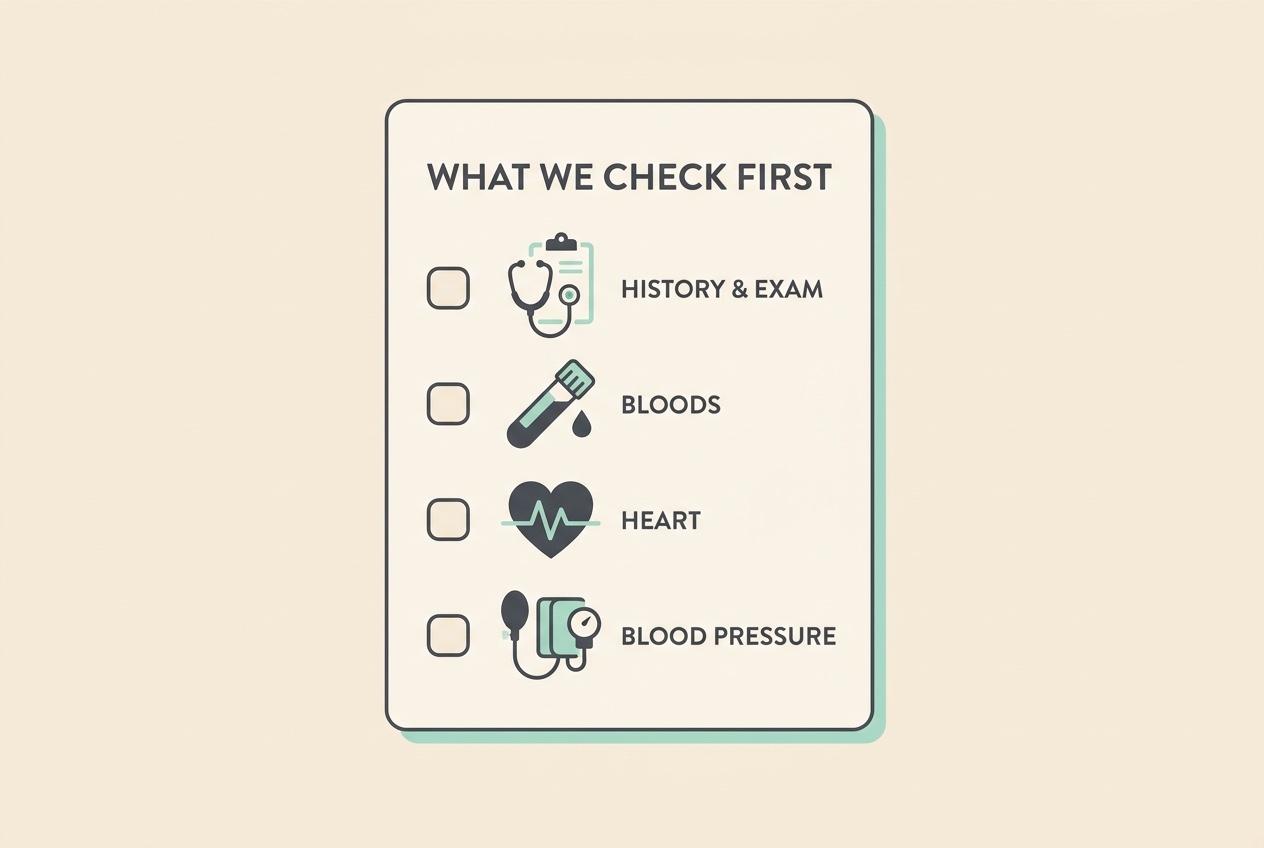
This is the part that turns a scary "should we risk it?" into a considered, individual decision. Before we commit an older pet to an anaesthetic, we build a picture of her health.
- A proper history and physical exam. How is she in herself, is she drinking more, coughing, losing weight? Then a hands-on check of the heart, chest, abdomen and, of course, the mouth.
- Pre-anaesthetic blood tests. These look at kidney and liver function, red and white cells, protein and often more. They're not an upsell. They're how we catch the hidden problem that would change our plan, and they're especially informative in seniors. (There's a fuller explanation in our piece on pre-anaesthetic bloods.)
- Blood pressure, and a good listen to the heart. If we hear a murmur or find high blood pressure, we want to understand it before, not during, an anaesthetic.
- Sometimes more. Depending on what we find, that might mean a urine test, an ECG, a heart scan or chest x-rays. Not routinely for everyone, but targeted at whatever the exam or bloods flagged.
The single most important thing to understand about all this: an abnormal result usually changes the plan, it doesn't automatically cancel it. Mild kidney values might mean extra intravenous fluids and a tweaked drug choice. A heart murmur might mean a scan and a chat with a cardiologist first. We are not looking for a reason to say no. We are gathering what we need to say yes safely, or occasionally to say "let's fix this other thing first".
How we actually keep an older pet safe on the day
Knowing what happens once she's asleep takes a lot of the terror out of it, so here is what a careful team does for a senior patient.
She'll have an intravenous catheter and a drip running, which supports her blood pressure and gives us instant access if we ever need it. Her drug protocol is chosen for her, lighter and more tailored than a young, robust patient would get, because older organs clear drugs more slowly. She's kept warm, because seniors lose heat faster and cold patients recover worse. And crucially, someone is watching her the entire time. Not just a beeping machine, but a trained nurse whose only job is her, tracking her heart, her breathing, her oxygen, her blood pressure and her temperature, and adjusting things minute by minute (AAHA, 2020).
We also aim to be efficient. A well-planned dental gets the necessary work done without keeping her under a moment longer than needed. All of this is ordinary, everyday practice, and all of it is aimed squarely at that gap between the healthy-pet risk and the sick-pet risk. The full picture of the numbers, and the questions worth asking your own vet, is in the real anaesthetic risk numbers.
When caution genuinely does win
I promised honesty, so here it is. Sometimes the answer is "not yet", or occasionally "the kindest thing is not to". This isn't about age either. It's about specific, serious problems that tip the balance:
- Unstable or poorly controlled heart disease. Heart failure that isn't yet under control changes the calculation, and we'd usually want it stabilised on medication first.
- Advanced or uncontrolled kidney disease, particularly in older cats. Anaesthesia asks a lot of the kidneys, so we want them as supported as they can be before we proceed, and sometimes that means treating and rechecking first.
- Other unstable illness, such as poorly controlled diabetes or a pet who is systemically very unwell.
In these situations, the right move is rarely a flat "never". More often it's "let's treat that first and reassess", or "let's do the minimum that stops her pain rather than a marathon procedure", or a frank conversation about whether the overall quality-of-life picture makes the anaesthetic worthwhile. A good vet will lay this out with you honestly rather than either pushing you into it or dismissing the mouth entirely. And you are always entitled to ask for a second opinion, or a referral to a practice with more advanced anaesthesia and monitoring for higher-risk patients. Asking is not doubting your vet. It's being her advocate.
Having the conversation
If you take one thing from this, let it be that you're allowed to ask questions, all of them, and a vet worth their salt will welcome it. Useful ones to bring to the appointment:
- What did her exam and any tests actually show, and what's her anaesthetic risk in plain terms?
- What will you do to reduce that risk for her specifically?
- Who is monitoring her while she's asleep, and how?
- If you find more once she's under, how will you decide what to do, and how will you reach me?
- What happens if we don't treat this mouth?
That last question matters as much as the first. The decision is never "anaesthetic risk" in isolation. It's that small, carefully managed risk weighed against a painful mouth we could put right.
So the next step isn't to book the dental this second. It's to book the conversation. Ask your vet for a proper senior work-up and an honest discussion of the findings. Once you can see where your own pet actually sits, the decision usually gets a great deal clearer, and far less frightening, than it feels tonight.
If she does have teeth out, don't dread the recovery either. Most pets, including the very old ones, eat sooner and more comfortably than owners expect, which is the whole point. There's a separate guide on eating after extractions, and plenty more on caring for an ageing dog or cat in our Senior Pets space.
References
- American Animal Hospital Association (AAHA). 2023 AAHA Senior Care Guidelines for Dogs and Cats: Anesthetic and Surgical Considerations. AAHA, 2023.
- American Animal Hospital Association (AAHA). 2020 AAHA Anesthesia and Monitoring Guidelines for Dogs and Cats. Journal of the American Animal Hospital Association, 2020.
- American Animal Hospital Association (AAHA). 2019 AAHA Dental Care Guidelines for Dogs and Cats. Journal of the American Animal Hospital Association, 2019.
- Brodbelt DC, Blissitt KJ, Hammond RA, et al. The risk of death: the Confidential Enquiry into Perioperative Small Animal Fatalities (CEPSAF). Veterinary Anaesthesia and Analgesia, 2008;35(5):365-373.
- Monteiro BP, Lascelles BDX, Murrell J, et al. 2022 WSAVA guidelines for the recognition, assessment and treatment of pain. Journal of Small Animal Practice, 2023;64(4):177-254.
- World Small Animal Veterinary Association (WSAVA). Global Dental Guidelines. WSAVA, 2020.
Keep track of how your pet is doing
The owners who cope best are the ones who notice changes early. A simple health log shows you what is working, and what is not, before the next vet visit.
Start tracking, freeYou're not doing this alone
Compare treatment journeys and talk to owners managing teeth & mouth. Free to join.
Join PetsLikeMine