

Pre-anaesthetic bloods: what they check and why
Alastair Greenway
BVM&S MRCVS
You've booked the dental, steadied yourself for the anaesthetic, and then the receptionist adds a line to the estimate: pre-anaesthetic blood tests, another chunk of money on top of a bill that already made you wince. And a small, reasonable voice in your head says it. Is this actually for my pet, or is it an upsell?
I want to answer that plainly, because it's a fair question and you deserve a straight reply rather than a defensive one. So here is the short version, and then I'll show you my working. Pre-anaesthetic bloods are a genuine safety tool, not a scam. But they are not equally valuable for every single pet, and any vet who tells you they are is overselling. For some animals they're the thing that catches a hidden problem and changes the whole plan. For a young, healthy pet having a quick procedure, they're much more of a judgement call, and you're entitled to have that conversation rather than just have it added to the bill. Let me take you through what they check, what they're really for, and how to tell which situation your pet is in.
What the blood is actually checking
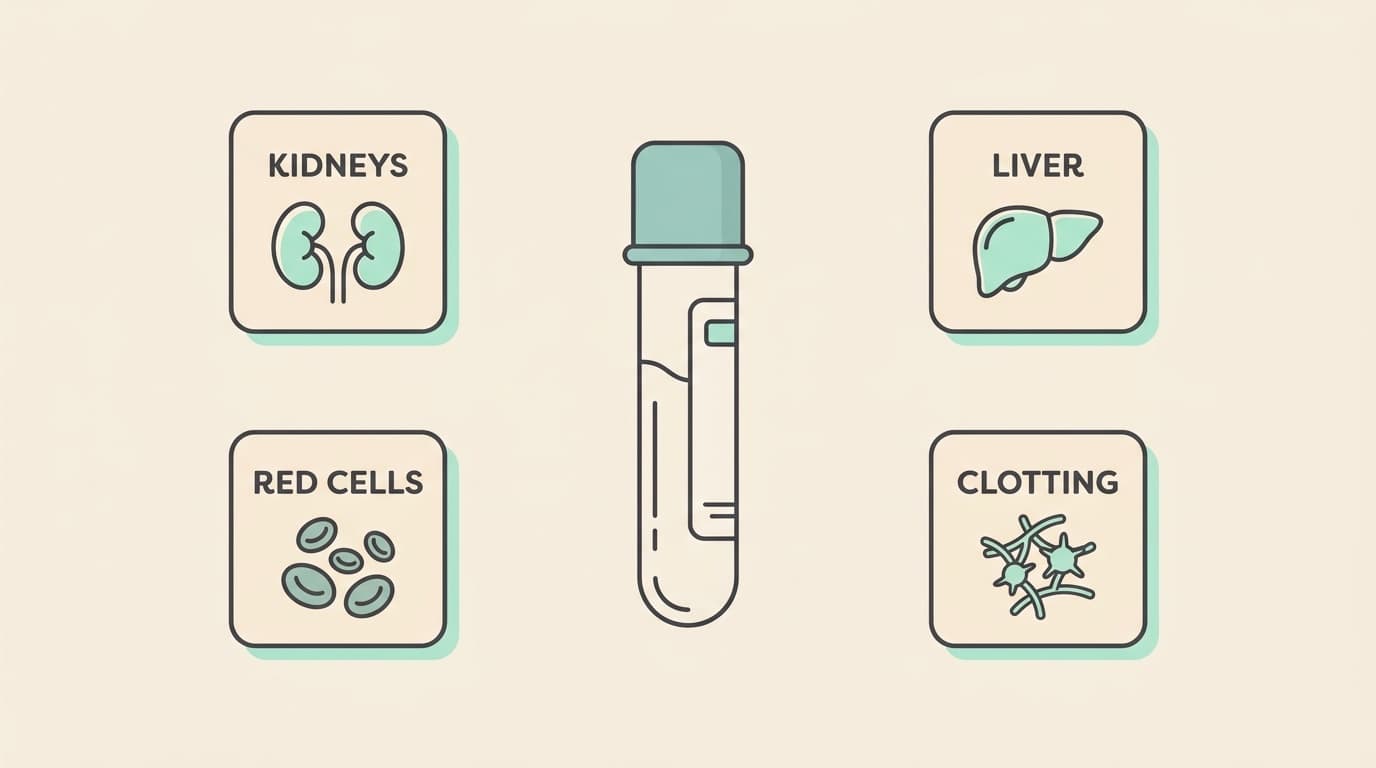
An anaesthetic isn't just "being asleep". It's a set of powerful drugs that your pet's body has to process and then recover from, and a period where blood pressure, oxygen and temperature all need to hold steady. Pre-anaesthetic bloods are a snapshot of the systems that carry the most of that load. Here's what a standard panel looks at and, more usefully, why each part matters for the anaesthetic specifically.
The kidneys and liver. These two organs do most of the work of clearing anaesthetic drugs out of the body afterwards. If either is struggling, the drugs can hang around longer and hit harder than expected, which affects both the dose we choose and how smoothly your pet wakes up. The blood values here (urea, creatinine and sometimes SDMA for the kidneys; enzymes like ALT and ALP for the liver) tell us whether those organs are up to the job before we ask them to do it.
The red blood cells. These carry oxygen, which is the single thing an anaesthetised patient needs most. If a pet is anaemic (low on red cells) going into an anaesthetic, there's less margin, and we'd want to know why before proceeding rather than discover it halfway through.
Platelets and clotting. A dental with extractions involves bleeding, sometimes more than owners expect. Platelets and the clotting picture tell us whether your pet can seal those small wounds properly. This matters more for a mouth full of extractions than for, say, a lump removal.
Total protein and blood glucose. Protein levels affect how drugs travel in the bloodstream, and glucose flags problems like diabetes that change how we manage the day. In older cats especially, an unexpected result here can be the first hint of something going on under the surface.
Depending on your pet and your practice, the panel might be a smaller in-house screen run while you wait, or a fuller profile sent to an external laboratory. Neither is automatically "better"; they answer slightly different questions, and a good vet picks the depth to match the patient.
What they're really for: three real jobs
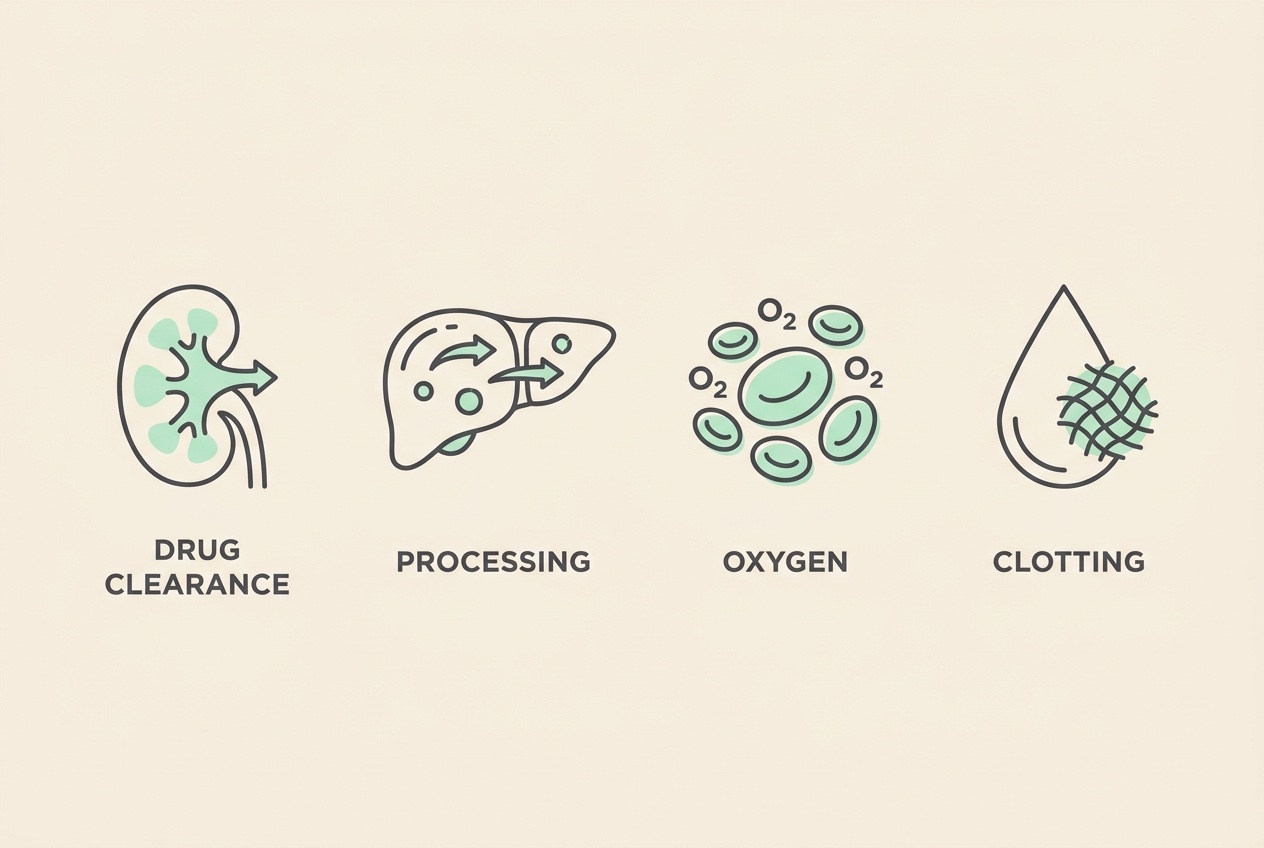
Strip away the marketing and pre-anaesthetic bloods do three genuine things.
The first is finding hidden disease. Pets, and cats above all, are brilliant at looking well while something quietly brews underneath. Early kidney disease, a liver problem, an endocrine condition: these can be well established before a pet shows a single outward sign. A blood test can catch that before the anaesthetic, when we can still act on it, rather than after.
The second, and honestly the more common payoff, is tailoring the anaesthetic to your individual pet. Even when the bloods don't reveal a hidden disease, they let us fine-tune. Slightly high kidney values might mean a higher fluid rate and a tweaked drug choice. A borderline liver might steer us away from one drug towards another. This is the bit owners rarely hear about: most of the time the test doesn't change whether we anaesthetise, it changes how, and that quiet tailoring is where a lot of the safety actually lives (Grubb et al., 2020).
The third is a baseline. A normal result today is a reference point for the future. If your pet is ever unwell in a year's time, having "this is what her normal looked like" on file is genuinely useful.
None of those three is invented. They're the reasons the profession's anaesthesia and dental guidelines recommend a proper pre-anaesthetic assessment, with testing chosen to fit the patient rather than applied identically to everyone (Grubb et al., 2020; Bellows et al., 2019).
The bit most pages skip: where bloods add most, and where it's a judgement call
Here's the part that separates an honest answer from a sales pitch. The value of pre-anaesthetic bloods is not the same for every pet, and the evidence says so plainly.
When researchers looked at routine screening in young, healthy dogs having elective procedures, the results are humbling. Yes, the bloods "changed management" in a lot of cases on paper, but when five specialist anaesthetists reviewed the same results, they barely agreed with each other on what to change, and most changes were made by only one of the five. The authors' own conclusion was that the effect on the actual outcome for the patient was unknown (Mitchell et al., 2018). In plain terms: for a genuinely healthy young pet, routine bloods rarely turn up something that meaningfully changes the day.
You'd expect older pets to be the clear-cut case for testing, and this is where it gets genuinely interesting. A study of cats and dogs over eight years old found that non-targeted "test everything" bloods still only changed the anaesthetic plan in about 2% of animals, and bumped up the risk grading in barely 1% (Díaz et al., 2021). Not because the tests were useless, but because the anaesthetists were already good at predicting who'd have a problem, from the history and the physical exam. When they expected an abnormality, they usually found one. When they didn't expect one, it was mostly normal.
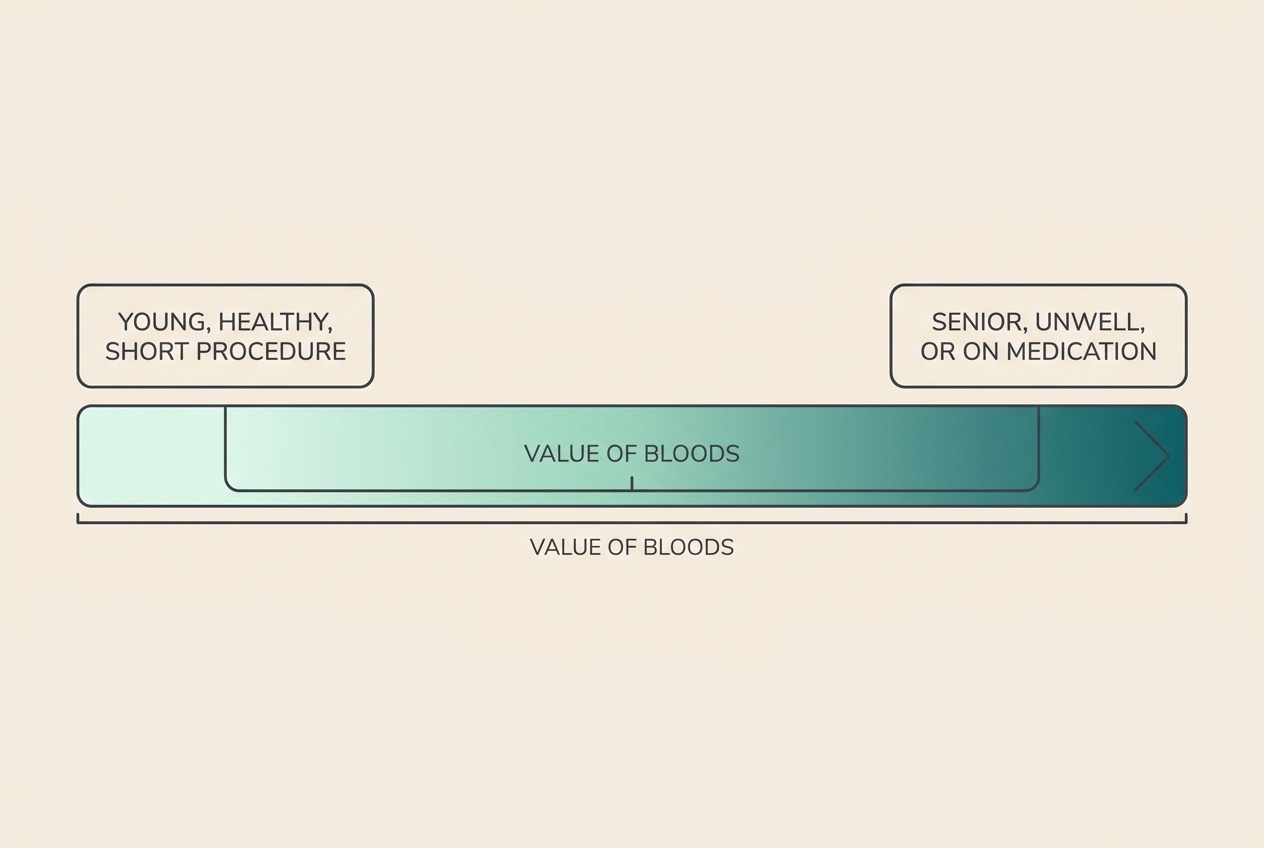
So what does that actually tell you? Not "don't bother". It tells you the value of bloods rises steeply when there's a reason to look:
- Age. Not because age is a disease, but because the diseases that bloods catch (kidney, liver, endocrine) simply become more common with the years. The seven-to-ten-year window onward is where subtle, invisible changes start appearing (Bellows et al., 2019).
- A known or suspected health problem, or anything the vet picks up on the physical exam: a heart murmur, weight loss, drinking more than usual.
- A pet already on medication, where we need to know the organs clearing both the drug and the anaesthetic are coping.
- The procedure itself. A long dental with multiple extractions asks more of a patient than a five-minute procedure, so the threshold to test sensibly drops.
For a young, fit, thoroughly examined pet having a short procedure, reasonable vets genuinely differ on whether routine bloods are worth it, and you're allowed to be part of that decision. For an older pet, or one with any question mark hanging over it, the case gets a lot stronger. That's not a fudge. It's just where the evidence actually sits.
The older cat gets her own section
If you have a senior cat facing a dental, this part is written for you, because cats are exactly where pre-anaesthetic bloods earn their keep most reliably, and it's no coincidence.
Cats are the champions of hiding illness, and two of the conditions they hide best are precisely the ones that matter for an anaesthetic. Chronic kidney disease is common in older cats and can be well advanced before a cat shows anything more than "she's a bit slower and drinks a touch more". An overactive thyroid, common in the same age group, quietly stresses the heart. Both change how we'd anaesthetise, and both can be flagged on a blood sample when a physical exam alone might not catch them.
There's a neat, slightly sad overlap here too. The cats who most need dentals, the older ones with years of accumulated dental disease or painful tooth resorption, are the very cats most likely to have one of these hidden conditions brewing. So in the senior cat, the blood test isn't defensive box-ticking. It's often the most informative thing we do before she's anaesthetised, and it can genuinely change her plan for the better. This is a big part of why age alone never rules out a dental. We assess the individual, and bloods are one of the main ways we do that. There's more on that specific worry in our piece on whether a senior pet is too old for a dental.
So, is it an upsell?
Let's meet the original suspicion head-on, because you deserve a real answer, not a reassuring pat.
An upsell is selling you something you don't need to inflate a bill. Pre-anaesthetic bloods are not that, and the profession's own guidelines back their use. But "not an upsell" is not the same as "compulsory for every pet", and the honest position lives between the two. The test has real value that climbs with your pet's age, health and the size of the procedure, and for many pets, especially older ones and cats, it's genuinely worth doing. For a young, healthy, carefully examined pet having something quick, it's a reasonable thing to do and also a reasonable thing to discuss, decline, or think about. What shouldn't happen is it being added silently to an estimate as though there's no decision to be had.
So here's how to tell the difference in your own case, by asking rather than guessing:
- "What specifically will you check, and why for my pet?" A good answer is tailored to your animal's age and health, not a generic "we always do it".
- "Given her age and what you found on the exam, how much do you think this will add?" This invites the candid version, which might be "quite a lot in a twelve-year-old cat" or "probably not much in a fit two-year-old".
- "If something shows up, what happens?" The reassuring truth is that an abnormal result almost never means "cancel". Far more often it means adjust the drugs, add fluids, or occasionally treat one thing first. The bloods are there to make the anaesthetic safer, not to hunt for a reason to say no.
- "Is this recommended or required?" A straight practice will tell you which, and respect your decision either way.
Ask those, and the answer stops being a matter of trust and becomes something you can actually see. In my experience, most owners who were braced for a sales pitch come out of that conversation reassured, because a vet who's genuinely thinking about your pet will happily explain their reasoning. If a practice can't or won't, that tells you something too.
If you want the wider picture of how the whole anaesthetic is kept safe, of which the bloods are just one layer, our guide to the real anaesthetic risk numbers lays it out, and what actually happens during a dental walks through the day itself. The next concrete step is simple: before the dental, ask your vet the four questions above and decide together. That's not doubting them. It's exactly the conversation a good one wants to have with you.
References
- Bellows, J., Berg, M.L., Dennis, S., Harvey, R., Lobprise, H.B., Snyder, C.J., Stone, A.E.S., & Van de Wetering, A.G. (2019). 2019 AAHA Dental Care Guidelines for Dogs and Cats. Journal of the American Animal Hospital Association, 55(2), 49-69.
- Díaz, M.D.M., Kaartinen, J., & Allison, A. (2021). Preanaesthetic blood tests in cats and dogs older than 8 years: anaesthetists' prediction and peri-anaesthetic changes. Veterinary Anaesthesia and Analgesia, 48(6), 854-860.
- Grubb, T., Sager, J., Gaynor, J.S., Montgomery, E., Parker, J.A., Shafford, H., & Tearney, C. (2020). 2020 AAHA Anesthesia and Monitoring Guidelines for Dogs and Cats. Journal of the American Animal Hospital Association, 56(2), 59-82.
- Mitchell, K., Barletta, M., Quandt, J., Shepard, M., Kleine, S., & Hofmeister, E. (2018). Effect of routine pre-anesthetic laboratory screening on pre-operative anesthesia-related decision-making in healthy dogs. The Canadian Veterinary Journal, 59(7), 773-778.
Free downloads
Companion worksheets to put what you've read into practice. Free PDFs, print at home.
Keep track of how your pet is doing
The owners who cope best are the ones who notice changes early. A simple health log shows you what is working, and what is not, before the next vet visit.
Start tracking, freeYou're not doing this alone
Compare treatment journeys and talk to owners managing teeth & mouth. Free to join.
Join PetsLikeMine