

Flea and Worm Subscription Boxes: Convenient, or Over-Treating?
Alastair Greenway
BVM&S MRCVS
A treatment turns up through your letterbox every month, already the right size for your pet, and you never have to remember, queue, or think about it again. For a lot of busy owners, a flea and worm subscription box is one of the genuinely good ideas of the last few years, and I'm not going to pretend otherwise. The convenience is real, and a pet that actually gets treated on time beats a pet whose treatment lives forgotten in a drawer.
So this isn't a piece telling you to cancel your subscription. It's a piece about a single, more useful question: does the box fit your pet? Because the one thing a subscription can't do on its own is know your individual animal, and the default setting for almost every box is the same "monthly-everything" regime the profession has actually been moving away from. Convenient and right-sized aren't the same thing, and the whole game is working out whether yours is both.
What these boxes actually are
Flea and worm subscription services (there are several well-known UK ones, and more launching all the time) post you a regular supply of parasite treatment for a monthly fee. You answer a few questions when you sign up, typically your pet's species, weight and age, and sometimes a little about their lifestyle, and a matched product then arrives on a schedule. Some are run or overseen by vets or SQPs (the qualified people allowed to supply many parasite products), some bundle in advice or a helpline, and some are essentially a slick delivery wrapper around off-the-shelf products. The quality and the amount of professional oversight vary a lot between them, which matters more than it first appears.
The genuine upside, said plainly
Let's give the boxes their due, because the benefits are real and worth naming:
- You never forget. Missed and late treatments are one of the commonest reasons parasite control fails in practice. A box that arrives on time solves a real behavioural problem.
- The dose matches the weight (at least at sign-up), which removes a common source of error with off-the-shelf products.
- The cost is spread into a predictable monthly figure rather than a lump sum, which suits a lot of household budgets.
- The products are usually decent licensed treatments, and where there's genuine SQP or vet oversight, you're getting advice as well as delivery.
If a subscription is the thing that gets an at-risk pet reliably covered when nothing else did, that's a straightforwardly good outcome. Don't let anyone shame you out of convenience that works.
It's also worth being fair about cost. For a genuinely higher-risk pet that does need year-round, broad-spectrum cover, a subscription can work out cheaper than buying the same products piecemeal, and cheaper again than the same products bought individually at full price from a practice. The value question isn't "boxes versus vets" in the abstract; it's whether this box, treating this pet, is charging you for the right amount of the right thing. That's a question you can actually answer, and the rest of this piece is about how.
Where the model can quietly go wrong
Here's the honest other half. The subscription model has a built-in bias, and it's worth seeing clearly.
It defaults to monthly-everything. Most boxes are designed around continuous, year-round, monthly treatment for fleas and worms, because that's the simplest thing to sell and ship. But that regime isn't what the profession's current guidance recommends for every pet. The BVA, BSAVA and BVZS position on responsible parasiticide use is to risk-assess the individual animal and avoid blanket treatment, and ESCCAP frames worming as risk-based rather than automatically monthly. A box's default is a commercial default, not a clinical one. For a lower-risk pet, it can mean paying for, and dosing your pet with, more product than they actually need. We work through what "how much does my pet really need" looks like in does my pet actually need monthly flea treatment?.
Over-treating isn't only a cost question. Dosing a pet that doesn't need it also feeds into the environmental picture, because flea and worm chemicals are turning up in rivers and wildlife. Right-sized treatment is the responsible answer, and there's more on that in flea and worm treatments and the environment.
A generic box can also under-cover. This is the flip side people forget. A one-size regime might not include the specific cover your pet genuinely needs. If your dog has real lungworm risk, for example, a standard box product may not be lungworm-active, leaving a gap that matters, while still charging you every month. Matching to the individual cuts both ways: too much for some pets, not quite the right thing for others.
The oversight can be thin. Because two of the medicine categories require a qualified person to be involved (there's a full explainer in POM-V, NFA-VPS, AVM-GSL: pet medicine categories decoded), it's worth knowing whether your box has a real SQP or vet behind it, or whether the "assessment" is just a sign-up form. A form doesn't examine your pet, and it doesn't revisit the plan as your pet ages or their life changes. A kitten becomes an indoor adult, a dog moves out of a lungworm area, a household gains or loses young children: all of these should change the plan, and a set-and-forget subscription won't notice unless you tell it to.
The default is "forever". A box is designed to keep arriving, which is its whole appeal, but it also means the treatment quietly continues long after anyone last thought about whether it's still the right call. Preventive care should be reviewed at least once a year, ideally around your pet's annual health check, and a subscription that just rolls on can crowd out that review rather than prompt it.
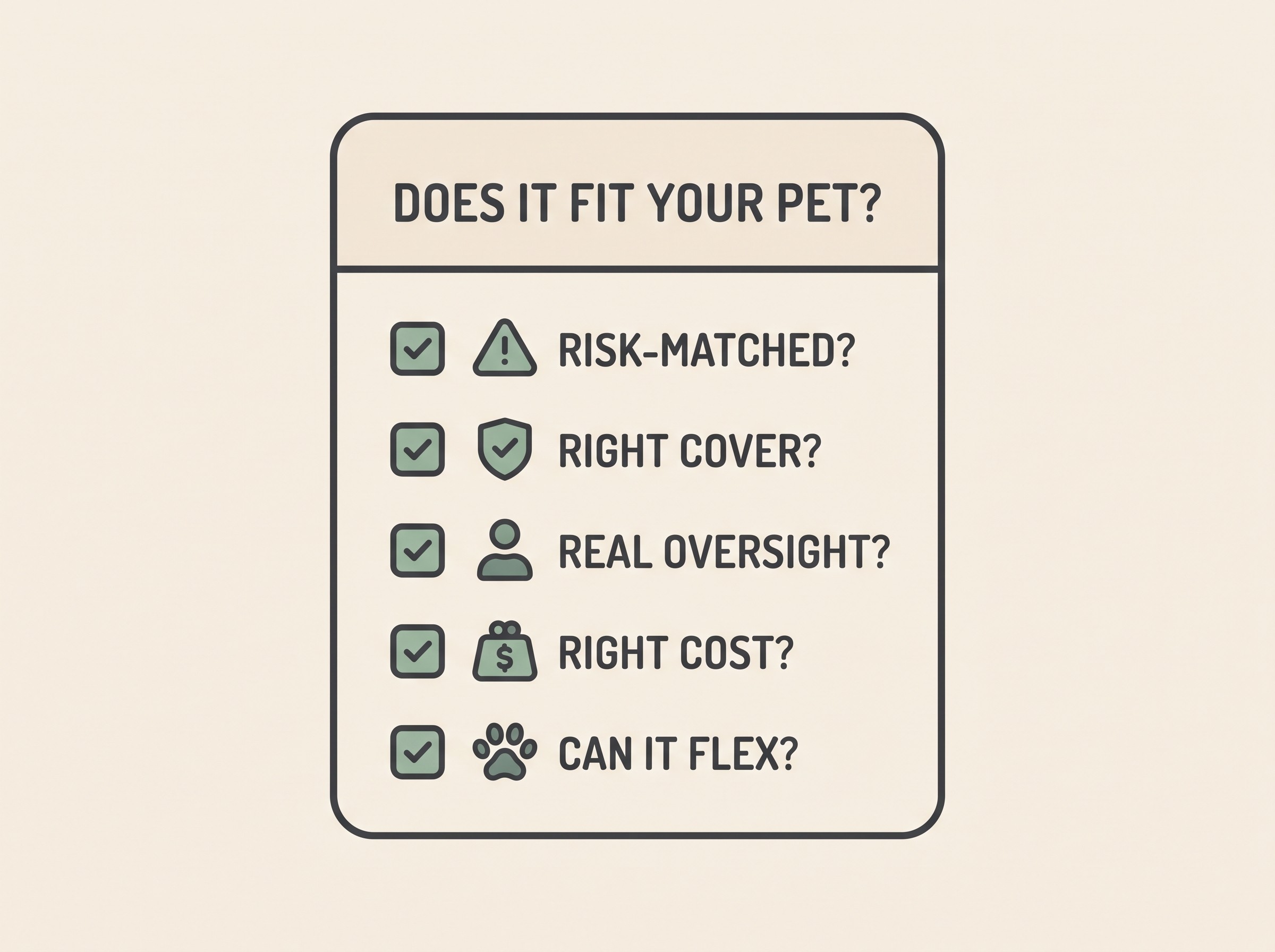
The checklist: does this box fit your pet?
Rather than "boxes good" or "boxes bad", run yours through these questions. This is the honest-broker version of the decision.
- Is the plan matched to my pet's actual risk, or is it one-size-fits-all? Did they ask anything meaningful about lifestyle, hunting, swimming, other pets, indoor-only status, or your region, or just weight and age?
- Does it cover what my pet genuinely needs? Fleas, ticks, roundworm, tapeworm and lungworm are not all covered by every product. Does the box include the ones that apply to your pet, and skip a monthly cadence for the ones that don't need it?
- Is there real professional oversight? Is there a vet or SQP I can actually reach with a question, and will the plan be reviewed if my pet's circumstances change?
- Am I paying monthly for something that could be seasonal or risk-based? For a lower-risk or indoor pet, a lighter plan may be both cheaper and more appropriate.
- Can I flex it? An indoor cat, a seasonal tick risk, a change of address: can the box adapt, or does it just keep sending the same thing forever?
If your box comes out well on those, brilliant, keep it and enjoy the convenience. If it doesn't, the answer usually isn't "cancel and treat nothing", it's "adjust the plan so it actually fits".
Two pets, same box, different verdicts
To make this concrete, picture two pets on the same generic monthly-everything subscription.
The first is a young, bouncy Labrador who lives in a lungworm area, swims in ponds, eats anything he finds, and shares a home with a toddler. For him, reliable year-round cover is genuinely warranted, and a box that arrives every month and stops anyone forgetting is doing him a real favour. The only thing worth checking is that the specific products actually cover his risks, lungworm in particular, because a standard flea-and-worm box doesn't always. For this dog, the subscription is close to ideal; the fix, if there is one, is a phone call to make sure the cover matches.
The second is a settled, middle-aged indoor cat in an adults-only flat, no other pets, no hunting, no garden. She's on the same monthly box, receiving the same year-round flea and worm treatment. For her, that regime is very likely more than she needs, and she's a good example of a pet whose plan should probably be lighter and more risk-based (there's a dedicated piece on exactly this at indoor-only cats: do they need flea and worm treatment?). Her owner isn't doing anything wrong by having a subscription; they've just never been prompted to ask whether the default fits. The fix here is a conversation with the vet and a smaller, right-sized plan.
Same product, same convenience, two completely different verdicts, and the only thing that separates them is whether anyone asked "does it fit this pet?". That question is the whole point, and it's one no automated sign-up form asks on your behalf.
Boxes, wellness plans, and doing it yourself
A subscription box isn't the only way to get organised, and it's worth knowing the alternatives so you're choosing rather than defaulting. Your vet's wellness or healthy-pet plan may bundle parasite treatment with vaccinations and health checks, which is a different value calculation we unpick in are vet wellness plans worth it?. And you can, of course, simply build your own schedule: agree a right-sized plan with your vet, then set it up as monthly or seasonal reminders in the Preventive Care Scheduler so you get the "never forget" benefit of a box without being locked into its default regime. If you'd like a personalised starting point for that conversation, the parasite risk quiz maps your pet's actual exposure in a few minutes.
The point to hold onto is that a subscription box is a delivery method, not a diagnosis. It can be a genuinely excellent one, and for many pets it is. The single question that keeps it honest is the one to bring to your vet: "is this plan matched to what my pet actually needs, or just to what's easiest to post?" Get that right, and the convenience is all upside.
References
- BVA/BSAVA/BVZS (2021, updated 31 October 2025). *Responsible use of parasiticides in cats and dogs* (position statement; risk-assess the individual, avoid blanket treatment).
- ESCCAP UK & Ireland. *GL1 Worm Control in Dogs and Cats*, 7th ed (June 2025) (risk-based deworming).
- VMD prescription/distribution categories and the role of SQPs/RAMAs in supplying parasiticides.
- NOAH Compendium. *Datasheets of UK licensed veterinary medicines* (product spectrum, including which products are lungworm-active).
Keep track of how your pet is doing
The owners who cope best are the ones who notice changes early. A simple health log shows you what is working, and what is not, before the next vet visit.
Start tracking, freeYou're not doing this alone
Compare treatment journeys and talk to owners managing staying well. Free to join.
Join PetsLikeMine